
Results
-
 £99.99
March of the Robot Army - Philip Sparke
March of the Robot Army was commissioned by Linda Anzolin & Giordano-Bruno Tedeschi for Campobanda 2019, with funds made available by JUST ITALIA. Campobanda is an Italian summer music camp for 8- to 18-year-olds (held in Camposilvano in 2019) which has a different theme every year. The theme for 2019 was 'science fiction', so composer Philip Sparke chose to write a robot march. After a quirky introduction featuring trumpet calls and chromatic figures, the main theme appears in a minor mode on clarinet and tenor sax and is then taken up by the full band. A change of key heralds a new theme, led by the trumpet and again repeated by the full ensemble. A further change of key introduces a legato 'trio' melody over a rather robotic accompaniment: instruments are added bit by bit until a climax is reached. Small motifs from the introduction then lead back to a full recapitulation, revisiting the first two themes in new guises before finishing the march with a flourish.
Estimated dispatch 7-14 working days
-
 £209.99
Dunamis - André Waignein
Major Yvon Ducene wanted a new lush and colourful composition for his Guides military band, with Andr Waignein as its composer. Early in 1979 the composer began his assignement and in October of the same year, the finished full score was on the music stands of this prestigious military band of the Belgian Army.The introduction (Grave) mirrors an atmosphere full of serenity in which the theme, played by the oboes and the English horn is predominant and immediately holds the listener spell-bound. It is taken up again as central element of the slow movement.The Allegro breaks away from the quiet passion of the introduction. Here, the band can really show its capabilities to thefull. Based on a very precise rythm, an idiom of sudden desperation and adversity develops which, fused with a crushing agression, culminates in a kind of eruption, soom calmed down by a Lento : peace and quiet has returned thanks to a melody by the horns and soon taken over by the clarinets. In the meantime, the saxophone - an instrument full of human emotion - express the main spatial dimension in contemporary psyche. Following a harmonic transition the brass-players take up the theme again in forte whilst the basses and the woodwinds interwine in technical arabesques.The movings of the mind and the heart get an audible and almost touchable shape in the ensuing Allegro, a movement characterized by a rhythmic dialogue in which the whole orchestra participates and where the exposition contains a wealth of sound and technical contrasts. The Lento finally uses the central theme of the slow movement again, with some occasional references to the two allegros. The last page is of unprecedented grandeur. All the instruments display their most beautiful sound which were named by Jacques Ferschotte, when speaking about Honneger, "harmonies d'intensits" harmonies of the unmeasurable.
Estimated dispatch 7-14 working days
-
 £332.99
Cantica de Sancto Benedicto - Jacob de Haan
Cantica de Sancto Benedicto is a three-movement work for mixed choir, soprano solo, concert band and organ ad libitum - on Latin lyrics that relate to the life of Saint Benedict. It was commissioned by the city of Norcia in Italy, whereBenedict was born. The holy Benedict (480-547) is considered the founder of monastic life within the Roman Catholic Church. His enormous influence is especially owing to his monastic rule, the Regula Benedicti.Jacob de Haan has named the movements ofCantica de Sancto Benedicto after the Holy Trinity: the Father (Gloria Patri), the Son (Gloria Filio) and the Holy Spirit (Gloria Spiritui Sancto). The lyrics of thehymn Gemma Caelestis, (which, like the othertexts, were originally used in Gregorian chant) are voiced by the choir. To this purpose, Jacob de Haan composed new, choral-like, homophone music. The sequence Laeta Quies is rendered by the soprano; the verses (divided over the threemovements) are alternated with those of Gemma Caelestis. The work closes with an impressive grand finale, in which texts are used from the proprium of the mass in honor of the saint's day of the holy Benedict (11 July). Notes to the conductor:For this cantata, there are various possibilities for the performance. The first involves a performance in which the choir and soprano parts are only accompanied by organ. Such a performance has several advantages: since the band never soundstogether with the choir and the soprano, no balance problems occur, and even a performance with a large concert band and a small cantata choir is conceivable. A special layout is also possible - with which you can set up a three-dimensionalperformance in a church. For example, the choir can sing in the chancel, accompanied by the choir organ; the soprano can stand on the gallery, accompanied by the main organ; and the band can be seated in another part of the church. The choir couldalso sing from a gallery. With layouts like this, working with two conductors is advisable. Choral parts available separately.
Estimated dispatch 7-14 working days
-
 £140.80
Belvedere Suite - Wilhelm Koenen
Part One: 'Danse mditerranenne'This part is composed of stylized folkmusic elements from several regions of Mediterra-nean countries. If this music recalls memories of your holidays on the sunny beaches, the composer will have reached his goal.Part Two: 'Impression'This part is meant as a contrast with the first and the third parts. The conductor should not stick to the metronome tempo, but he can express his own interpretation by means of 'rubato playing'. This 'impression' was inspired by the Provence landscape.Part Three: 'Marche grotesque'We deliberately used non-typical characteristics of the traditional march. The underlying idea is: A band starts playing a march at the ordinary marching tempo. There is already a mistake at measure 4 when some musicians play the wrong bar which causes the fifers to start too early with the drum and fife signals. A grumpy 'Stop' brings and end to the false start by means of a pathetic quaver (eighth note). The drummers however continue to play their drum beats, so the fifers start again and play very quickly in order to catch up with the drummers. They even manage to do so, thanks to that late quaver (eighth note). The band now also starts to play again and reacts to this chaos by laughter. The march that comes next does not match the metric characteristics of the usual march. The woodwinds, dreaming of holidays, get caught in a Tarantella. A compelling signal by the trumpets and the horns, soon joined by all band registers, leads the band back to reality. We deliberately chose well-known 'secondary parts' in order to make the audience accept the 'out-of-tune playing'. Original themes would not have had the same effect. The whole composition is just one great musical joke. If the audiance chuckles the composer will have achieved his aim. The third part is extremely well suited to end a concert or to be used as encore.
Estimated dispatch 7-14 working days
-
 £169.99
Olympica - Jan Van der Roost
This "Grand Overture" was commissioned by the "Nagano Community Band" - Japan- on occasion of its jubilee in 1992 and is dedicated to the band's conductor, Ikuo Inagaki.The work is based upon three main themes, each symbolising a certain theme. The first part is characterized by its bright themes played mainly by the brass, accompanied by the woodwinds and festive percussion. This part symbolizes the jubilee which is the origin of the composition. This is followed by a bouncing allegro, in which each register of the band displays brilliant techniques. Especially the woodwinds come to the fore! This movement depicts the industriousness and enthousiasm shown by the members of the"Nagano Community Band" in the carrying out of their hobby. A third, main theme, is choral-like in character and is displayed both in the (soft) brass as well as in the warm medium register of the reeds. Here, nature's beaty in and around the city of Nagano is musically celebrated. Following a "chamber-music episode" (featuring the flute, oboe, clarinet, alto-saxophone and horn) the initial allegro re-occurs, weaving its way towards a grandiose finale, in which the two previous themes are once again apparent. Due to its very colourful scoring and the enormous diversity of musical thoughts and ideas, this composition is a fascinating and memorable piece, worthy a jubilee overture!
Estimated dispatch 7-14 working days
-
 £91.99
Guardians of the Waves - Philip Sparke
Guardians of the Waves was commissioned by the Japan Coast Guard Band to celebrate their 30th anniversary in 2018. They gave the premiere as part of a 30th anniversary concert on November 8th that year. Set in traditional march form, Guardians of the Waves opens with a short introduction, which leads to the main theme, played initially by the brass and then repeated with a florid woodwind descant. The theme is extended and morphs into a second theme, first played tutti and then quietly repeated by bassoon, tenor sax and euphonium. This leads to a conventional 'bass strain', played twice with varying accompaniments. A quieter trio section follows, delicately scored and featuring the tenor instruments of the band. Taken up by the full band, this leads back to a recall of the introduction and a return to the main two themes, which lead to a triumphal close.Recorded by the Kobe College Wind Orchestra and its conductor Osama Matsuura
Estimated dispatch 7-14 working days
-
 £407.00
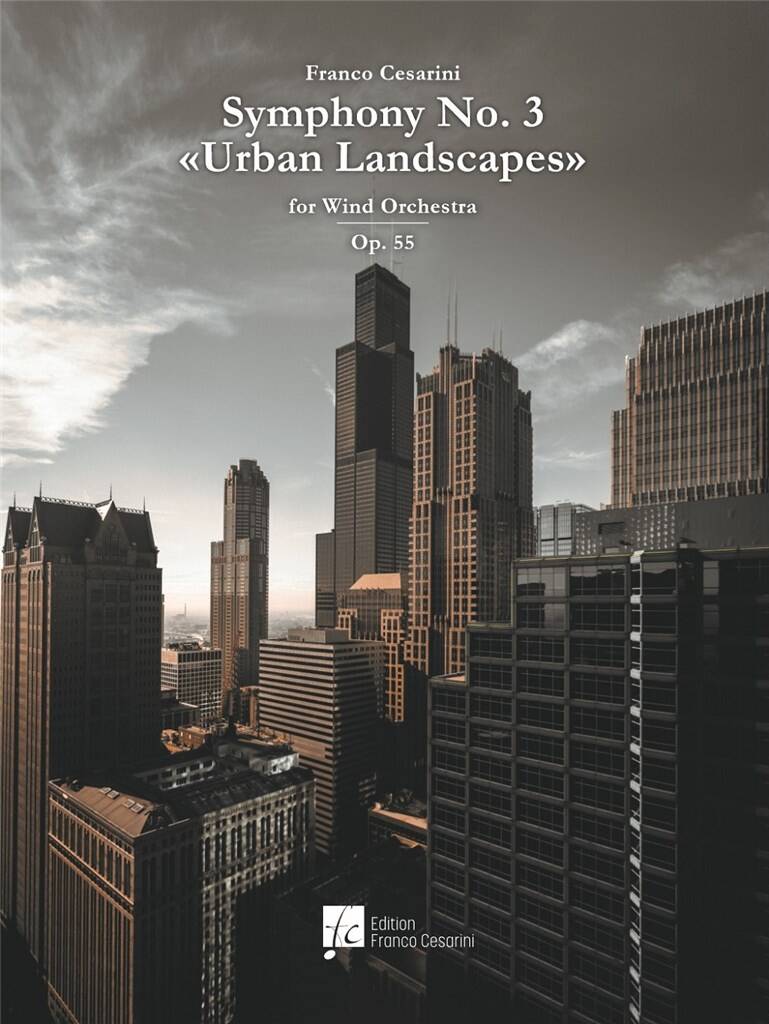
Symphony Nr. 3 Urban Landscapes Op. 55 - Franco Cesarini
Fascinated by the beauty of Chicago, Franco Cesarini has translated his emotions into music: this is how Symphony No. 3 "Urban Landscapes" Op. 55, was born, a musical portrait of this metropolis overlooking Lake Michigan. The composition is divided into three movements: The Wrigley Building from Dawn to Noon, Blue Silhouette and Cloud Gates, which by sharing the same thematic material arranged in cyclical form, strengthen the overall cohesion of the piece. The first movement, preceded by a short slow introduction in which the main theme is presented in an almost dreamlike form, metaphorically represents the city at dawn. The sudden change of time symbolizes the start of activities with all its noises and sounds: you can hear the bell that announces the closing of the subway doors, the sound of cars speeding by, the siren of a patrol car. If the first movement represents the day, the second introduces a nocturnal environment: a melancholic melody played by the English horn anticipates a more animated tempo depicting melodies coming from jazz clubs. Powerful fanfares that take up the second theme of the first movement introduce the third movement. In this finale, the role of the two themes is reversed compared to the first movement and one takes the place of the other in a kind of games of mirrors. Symphony No. 3 "Urban Landscapes" Op. 55: a sumptuous musical portrait of the "Windy City".
Estimated dispatch 7-14 working days
-
 £435.40
Goldberg 2012 - Svein H. Giske
The first time I heard Bach's Goldberg Variations was in the movie Silence of the lambs, in the early 1990s. I noticed the beautiful background music in one of the scenes, but at that time I didn't know what it was. A few years later, when I was studiying at the Grieg Academy, I got to know the entire piece. For me, this is a piece of music which I can listen to countless times. I think it sounds as fresh today as it did more than 15 years ago and it never ceases to inspire me. Both Bach's composition and Glenn Gould's famous 1955 recording (which was the first one I heard) still makes a great impression on me. Before Gould recorded it at age 22, it wasn't a highly ranked piece amongst pianists and Bach was by many viewed as a bit old-fashioned. The young Canadian turned all this around. He managed to portray Bach in a reformed way, producing fine nuances in phrasing and making the many layers in Bach's music more transparent than anyone before him. Thus he plunged both himself and Bach (back) onto the international music scene. When The Norwegian Band Federation (NMF) asked me to write the test piece for NM in 2012, it was only natural for me to use the Goldberg Variations as a starting point and inspiration for my work. Since I was a teenager at NMF's summer courses in the mid eighties I've always listened to many different styles of music. Growing up in Sunnmre with the Brazz Brothers as teachers and mentors, jazz-, pop/rock- and folk music were early on a natural part of my musical background. I also have my classical education from the Grieg Academy on trumpet. As the title of my piece implies, I've wanted to bring Bach to the present and put his music into various modern musical landscapes. I think you can bring about a special kind of energy when music from different genres are mixed and I've tried to do this by mixing Bach with artists and musical styles from the present. In Goldberg 2012, the music is often constructed by several layers, which in a way are living parallel musical lives. They are seemingly moving or floating freely, almost unaware of each other, but bound together by the same basic pulse. The rythms, however, are often notated on a different rythmic subdivision level than the usual 8th- or 16th note levels. By doing this, I hope to achieve transparent sounds that rythmically are perceived as more free and detached from each other. In large sections of the piece, pop/jazz is fusioned with elements from Bach. I guess you could have this little scene as a synopsis for the piece: picture a group of musicians meeting: some are classical performers, some are jazz. They start to improvise together, each in their own voice or musical dialect and I'm sort of in the middle, trying to write down what they are playing. This is what I feel much of Goldberg 2012 is about. The foundation of the piece, in addition to Bach and references from pop/jazz music, lies also in my own material. This material, basically two chords, is heard in it's purest form in the 1st movement. I use these chords to create scales, new chords and different motifs which contribute to blend together the different moods of the piece. It has not been my intention to copy Bach's form (theme and 30 variations), but rather to use the bits and pieces that I like the most as an inspiration for my own variations. The 1st movement, Aria 2, is for my 3rd son, Olav, who was born on the 21st of April 2011, and the 5th movement, From long ago, is dedicated to the memory of my father, Svein J. Giske, who passed away on the 6th of June 2011. -Svein H. Giske, January 2012-
Estimated dispatch 7-14 working days
-
 £92.99
Final Covenant - Fisher Tull
As the title implies, the work expresses the deep religious emotions of the promises made by God to mankind. Two thematic elements are employed: the first, a dramatic proclamation, is introduced by horns and subsequently taken bytrumpets and woodwinds - the second plaintive theme, in the manner of a supplication, is presented by oboes followed by flutes and clarinets. The first theme returns leading to a climactic section by the full ensemble. Adevelopment section focuses on fragments from the principal theme culminating in a brief brass fanfare based on the earlier accompanying motives. The recapitulation of the principal theme brings the work to a quiet and peacefulclose. (8:00)
Estimated dispatch 7-14 working days
-
 £194.80
The Producers - Mel Brooks
The Producers is a musical adapted by Mel Brooks and Thomas Meehan from Brooks' 1968 film of the same name, with lyrics written by Brooks and music composed by Brooks and arranged by Glen Kelly and Doug Besterman. As in the film, the story concerns two theatrical producers who scheme to get rich by overselling interests in a Broadway flop. The humor of the show is accessible to a wide range of audiences.
Estimated dispatch 7-14 working days
 View Music