
Results
-
 £39.95
Music for Junior Wind Band - Vol. 5 - More Carols - Adrian Taylor
The arrangements and compositions in these books were written by Adrian Taylor for various beginner or school bands that he has conducted over the years. Children joined these bands on the 2nd parts, usually having only been playing for a year and they then progressed to the 1st parts the following year.The 2nd parts are written without key signatures in treble clef, in B flat major for bass clef trombone and euphonium and in E flat major for bass clef tuba. 1st parts are written with the appropriate key signatures for each piece, reflecting the greater understanding and skills of the players on these parts. Most of the pieces can be played with only a few parts being covered, the addition of the other parts usually enhancing the arrangement rather than simply doubling existing musical lines. The essential parts are the two Trumpet (and Clarinet or Cornet) parts, the two Trombone/Euphonium parts and preferably also the 1st Horn part. A piano part helps to fill out the harmonies where other parts are missing. The brass parts in the wind band versions are identical to those in the brass versions.
Estimated dispatch 7-14 working days
-
 £39.95
Music for Junior Wind Band - Vol. 7 - Adrian Taylor
The arrangements and compositions in these books were written by Adrian Taylor for various beginner or school bands that he has conducted over the years. Children joined these bands on the 2nd parts, usually having only been playing for a year and they then progressed to the 1st parts the following year.The 2nd parts are written without key signatures in treble clef, in B flat major for bass clef trombone and euphonium and in E flat major for bass clef tuba. 1st parts are written with the appropriate key signatures for each piece, reflecting the greater understanding and skills of the players on these parts. Most of the pieces can be played with only a few parts being covered, the addition of the other parts usually enhancing the arrangement rather than simply doubling existing musical lines. The essential parts are the two Trumpet (and Clarinet or Cornet) parts, the two Trombone/Euphonium parts and preferably also the 1st Horn part. A piano part helps to fill out the harmonies where other parts are missing. The brass parts in the wind band versions are identical to those in the brass versions.
Estimated dispatch 7-14 working days
-
 £99.99
March of the Robot Army - Philip Sparke
March of the Robot Army was commissioned by Linda Anzolin & Giordano-Bruno Tedeschi for Campobanda 2019, with funds made available by JUST ITALIA. Campobanda is an Italian summer music camp for 8- to 18-year-olds (held in Camposilvano in 2019) which has a different theme every year. The theme for 2019 was 'science fiction', so composer Philip Sparke chose to write a robot march. After a quirky introduction featuring trumpet calls and chromatic figures, the main theme appears in a minor mode on clarinet and tenor sax and is then taken up by the full band. A change of key heralds a new theme, led by the trumpet and again repeated by the full ensemble. A further change of key introduces a legato 'trio' melody over a rather robotic accompaniment: instruments are added bit by bit until a climax is reached. Small motifs from the introduction then lead back to a full recapitulation, revisiting the first two themes in new guises before finishing the march with a flourish.
Estimated dispatch 7-14 working days
-
 £209.99
Dunamis - André Waignein
Major Yvon Ducene wanted a new lush and colourful composition for his Guides military band, with Andr Waignein as its composer. Early in 1979 the composer began his assignement and in October of the same year, the finished full score was on the music stands of this prestigious military band of the Belgian Army.The introduction (Grave) mirrors an atmosphere full of serenity in which the theme, played by the oboes and the English horn is predominant and immediately holds the listener spell-bound. It is taken up again as central element of the slow movement.The Allegro breaks away from the quiet passion of the introduction. Here, the band can really show its capabilities to thefull. Based on a very precise rythm, an idiom of sudden desperation and adversity develops which, fused with a crushing agression, culminates in a kind of eruption, soom calmed down by a Lento : peace and quiet has returned thanks to a melody by the horns and soon taken over by the clarinets. In the meantime, the saxophone - an instrument full of human emotion - express the main spatial dimension in contemporary psyche. Following a harmonic transition the brass-players take up the theme again in forte whilst the basses and the woodwinds interwine in technical arabesques.The movings of the mind and the heart get an audible and almost touchable shape in the ensuing Allegro, a movement characterized by a rhythmic dialogue in which the whole orchestra participates and where the exposition contains a wealth of sound and technical contrasts. The Lento finally uses the central theme of the slow movement again, with some occasional references to the two allegros. The last page is of unprecedented grandeur. All the instruments display their most beautiful sound which were named by Jacques Ferschotte, when speaking about Honneger, "harmonies d'intensits" harmonies of the unmeasurable.
Estimated dispatch 7-14 working days
-
 £89.99
Preludio all' atto I - Giuseppe Verdi
Ernani (1844), Giuseppe Verdi's fifth opera, is based on the homonymous tragedy by Victor Hugo. Verdi's success with Ernani, as well as Nabucco and I lombardi alla prima crociata, can be ascribed to two distinct ideas: the melodic idea and the patriotic idea. The melodic idea is very important to move and touch the audience, while the patriotic idea is the source of enthusiasm and emotions. Approximately ten years elapse between two similar stories: the one of the outlaw Ernani and the one of Manrico, the troubadour. In the prelude to Act I, in only three minutes, Verdi has succeeded in skillfully concentrating the main elements of the entiredrama. One can clearly observe the themes of love, oath, and death.
Estimated dispatch 7-14 working days
-
 £332.99
Cantica de Sancto Benedicto - Jacob de Haan
Cantica de Sancto Benedicto is a three-movement work for mixed choir, soprano solo, concert band and organ ad libitum - on Latin lyrics that relate to the life of Saint Benedict. It was commissioned by the city of Norcia in Italy, whereBenedict was born. The holy Benedict (480-547) is considered the founder of monastic life within the Roman Catholic Church. His enormous influence is especially owing to his monastic rule, the Regula Benedicti.Jacob de Haan has named the movements ofCantica de Sancto Benedicto after the Holy Trinity: the Father (Gloria Patri), the Son (Gloria Filio) and the Holy Spirit (Gloria Spiritui Sancto). The lyrics of thehymn Gemma Caelestis, (which, like the othertexts, were originally used in Gregorian chant) are voiced by the choir. To this purpose, Jacob de Haan composed new, choral-like, homophone music. The sequence Laeta Quies is rendered by the soprano; the verses (divided over the threemovements) are alternated with those of Gemma Caelestis. The work closes with an impressive grand finale, in which texts are used from the proprium of the mass in honor of the saint's day of the holy Benedict (11 July). Notes to the conductor:For this cantata, there are various possibilities for the performance. The first involves a performance in which the choir and soprano parts are only accompanied by organ. Such a performance has several advantages: since the band never soundstogether with the choir and the soprano, no balance problems occur, and even a performance with a large concert band and a small cantata choir is conceivable. A special layout is also possible - with which you can set up a three-dimensionalperformance in a church. For example, the choir can sing in the chancel, accompanied by the choir organ; the soprano can stand on the gallery, accompanied by the main organ; and the band can be seated in another part of the church. The choir couldalso sing from a gallery. With layouts like this, working with two conductors is advisable. Choral parts available separately.
Estimated dispatch 7-14 working days
-
 £157.50
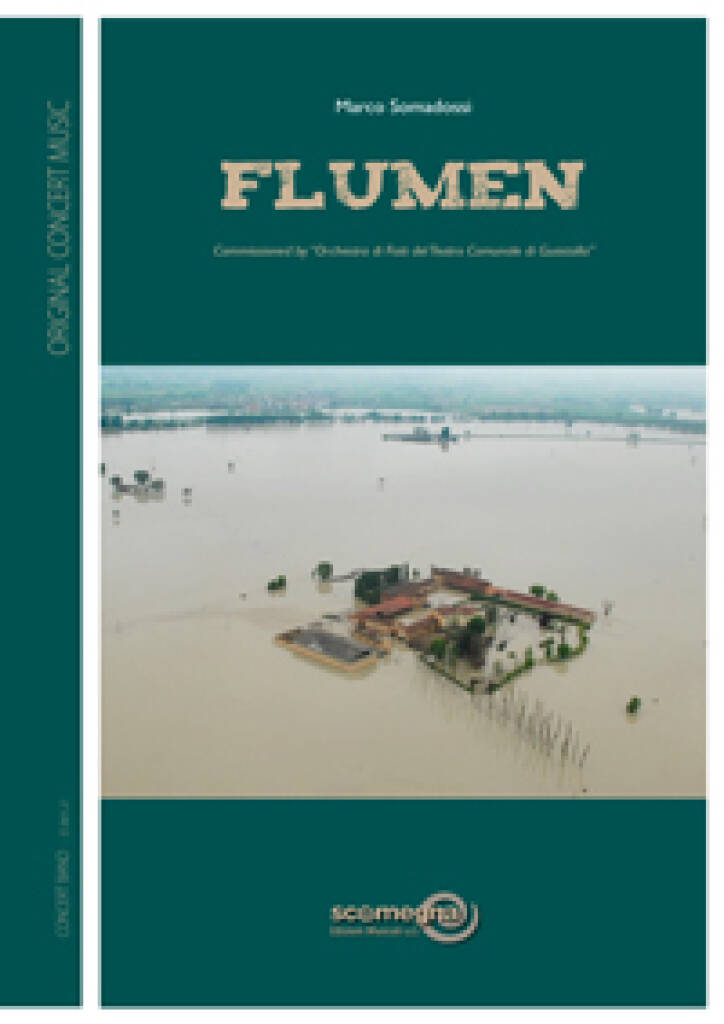
Flumen - Marco Somadossi
In October 2000, the River Po produced its highest flood waters in the last hundred years, provoking a natural disaster of dramatic dimensions. To the thousands of valiant men and women committed to defending their villages against the threat of the flood is dedicated the symphonic poem entitled "Flumen" (river, in Latin), inspired by the thematic material in the Gregorian sequence, "Victimae paschali laudes". The main melody is elaborated and its essence is transfigured in an alchemy of modern sounds from which, at times, archaic echoes emerge. The composition is structured in two parts: the first ("The River") is sullen and menacing, with sounds that portray the turbulent water and the inexorable and frightening rise of the flood;this contrasts with a second section ("The People"), with its primitive rhythms and vaguely multiethnic character (expressed through modal harmonies). Here the work evokes man's ancestral struggle against the forces of nature: the strenuous defence of the Po riverside communities to against the threat of flooding. In the finale, the two themes interweave and overlap, re-establishing a symbolic and primordial equilibrium where man and nature are again in harmony with each other.
Estimated dispatch 7-14 working days
-
 £110.00
Mount Everest - Kees Vlak
This composition basically consists of three fragments and an epilogue (conclusion):1) Plateaux, 2) Sherpas, 3) Climb. The piece starts with a musical depiction of the deserted plateauxs and mountain peaks of the Himalayas. The mysteriousness of theTibetan country was caused by its inaccessibility to other nations. One even believed that there was a paradise behind the huge mountains; the land of Shangra La. 1) After the sound of a gong, the Asian-like theme arises extremely softly from thedecay of the percussion. In bars 4 and 5 the syllables of Hi-ma-la-ya echo. Then a second theme appears; it symbolises the enchantment of the mountaineers by seeing the Mount Everest. 2) Eastern percussion, very evenly without emotion, sound from thedeserted village of the sherpas. The phrasing is prescribed by the number 'three'. From measure 56 Tibetian monks sing a chant, also with the religious background of the number 'three'. 3) The third part starts of with the sight of the giant MountEverest with an entirely new theme, that is played impressively by the strong low brass instruments of the band, immediately followed by the excited big climbing. The many surprises are depicted by the changing time signatures. Two themes are inconstant battle; the binary Himalaya theme and the ternary Mount Everest theme. Only once there is a steely composure. The registers in which the piece is played increase. The tension rises...Then the peak is reached. A long pause follows before onerealises that one is on top of the world. Slowly the emotions of joy grow and lead to an enormous climax. The first enchanted theme sounds again in total glory.
Estimated dispatch 7-14 working days
-
 £214.80
Missa Solemnis - Serge Lancen
This Mass has been dedicated to His Holyness Pope John Paul II, to witness Lancens deep and respectful admiration for the Holy Father. The work was composed in 1986 and written for two solo voices: a soprano and a baryton-Martin (high baritone), mixed choir, harp (ad libitum) and symphonic band or organ. It has ten parts: INTROIT - KYRIE - GLORIA - OFFERTORIUM - SANCTUS - PATER NOSTER - AGNUS DEI - COMMUNIO - DEO GRATIAS - and as final part an ALLELUIA. Lancen expressed his views about this Mass as follows: 'The most important aspect of the Mass is the praising of God and the sacrificing to God; that is why I thought it suitable to use both the themes of the Sanctus and the Offertorium in writing the Introtus. It seemed to me also quite logical that the initial themes of the Kyrie and the Agnus Dei would be rather similar as these are two moments where the priest and the worshippers invoke God. The composition ends with a brilliant Alleluia in which I also briefly quote the theme of the Sanctus.' This Mass was premiered on 27 may 1989 at 'Our Lady's Church' in Maastricht, The Netherlands, as part of the celebrations of the fiftieth anniversary of the Roman Catholic Band Federation of the Limburg County. The Bishop Castermans celebrated the Mass, whereas Jan Cober conducted this first performance. The Missa Solemnis is an alternation of meditating, though often impressive, orchestral passages with angelical choral sounds and the pious singing of both soloists. This may not be the type of music we usually expect from Serge Lancen, but nevertheless the composer remains faithful to his own typical style of composition. You can call this work romantic, though it surely is 'contemporary' or, why not, 'from all times'. The instrumentation is varied and extremely rich, mostly due to Lancen's typical use of 'wind band colours'. This Latin Mass suits perfectly well in the tradition of Roman-Catholic Masses that have been written by several great composers.
Estimated dispatch 7-14 working days
-
 £61.00
Pas Redoubl 2 - Gioachino Rossini
Gioacchino Rossini (1792-1868) was one of the great composers of the Italian operatic School, even though most of these productive years were spent in Paris. He has written these two marches for the crown prince of Sweden and Norway in 1836, just before Rossini returned to Italy.These two marches have now been discovered in the Bernadotte Library at the Royal Castle in Stockholm and are instrumentated for wind band by Birger Jarl.
Estimated dispatch 7-14 working days
 View Music