
Results
-
£66.30
Fanfares in Remembrance - Peadar Townsend
Fanfares in Remembrance was commissioned by Nick Jarvis, Principal conductor of the Band of the Royal British Legion, Christchurch, Dorset, UK to be premiered during the Last Post Ceremony at the Menin Gate, Ypres, Belgium on May 27th, 2017. The work is a short reflection two World War One bugle calls, 'The General Salute' and 'Retreat' or 'Sunset' as it is also known. The significance and symbolism of bugle calls from this era are well known and they are still used in Barracks across the world. I have used sections of these famous British bugle calls on two trumpets either side of the band playing in two different musical keys. The band then plays an intermittent low drone like chord, again in a different musical key to the two trumpets. In my mind this opening depicts two buglers at dawn at either end of a misty field directly after a brutal slaughter. The two buglers are almost calling out for their missing comrades only to realise they are gone...... The work moves into a haunting oboe melody signifying loss. The oboe is joined by the full band in a tune of strength, solidarity, yet profound sadness. The work concludes with a recap of the opening idea; however, the two buglers are now united in musical key sounding 'The General Salute'. The music ends as the wind blows gently. The memories live on forever......
Estimated dispatch 7-14 working days
-
£134.99
Recalls - Ben Haemhouts
Recalls obviously refers to memories. This piece of music is in fact a series of flashbacks, however, it does not highlight the actual memories of specific thoughts, people or events.The composition evolves around the late Frans Steurs, who for manyyears was the inspirational artist behind the brass band that is currently commissioning this work. The main theme of the work is based on the name STEURS". E = mi, U = do, R = re and S = "si" which is Dutch for the note "ti". This idea forms themusical theme for the entire composition and different variations are used throughout. The structure of the work is based on the concept of a story which father Steurs is telling his two daughters, who play the flute and the clarinet. Each part ofthe work has a story-like character:1. Introduction: following a short ominous intro, the main theme is presented for the first time.2. The Story: father Steurs has both his daughters on his knee and he tells them stories from the old days. Trumpetsand trombones play variations of the theme. The story gets very exciting (accelerande, poco a poco agitato) until the tale takes a dramatic turn when the father tells an exciting story at the time of the Second World War. He tells of being hunteddown by the occupying army and these adventurous episodes are related to us musically in part3. Danger, with its skilful references to "vor dem Sturm" from "Eine Alpensinfonie" by Richard Strauss.4. called Fugitives, is about how he fled in the nightfrom the enemy and this is reflected in the bass tones of a new theme. The aggression of the war is illustrated from bar 117 onwards, by a harsh brass section. The main theme is repeated once again and this time up-tempo. The second theme is broughtonce again from bar 149 onwards.5. Dialogues, depicts the conversations between the two daughters and their father. Father speaks (bar 155); the daughters answer (bar 164 - flute, bar 166 - clarinet); bar 178: father answers with the tune of the maintheme to the two daughters. The discussions gradually intensify but ultimately end in peace in the last part called Conclusion.The piece of music "Recalls" is a free interpretation by the composer who consulted the letters between the two daughtersof Steurs and their father and in this respect it is not really music for a programme."
Estimated dispatch 7-14 working days
-
£184.99
Rubicon - Bert Appermont
The Rubicon is a river in Northern Italy which Julius Caesar crossed with his army in 49 BC in defiance of the leaders of Rome, who feared his power. A civil war against rival Pompey ensued, which culminated in Caesar seizing power as the absoluteruler of Rome. The phrase "crossing the Rubicon" therefore refers to any person committing himself irrevocably to a risky, decisive and irrevocable of course of action.The work consists of three parts that deal with this important moment in history.Part 1 (Meditation) symbolises Caesars request to the Gods to assist him in his difficult choice. In a slow introduction we hear the melancholy and beseeching sounds of the duduk (alternatively, this part can be played by a soprano saxophone)and of the soprano solo singer over the bourdon accompaniment. The soprano solo singer then sings "dona tibi pacem" (give him rest) in a melodious and probing theme.In Part 2 (Battle of Pharsalus) trumpets and trombones resound alternately ina stately Roman fanfare, producing a stereophonic effect. This develops into a martial theme in which Caesars impressive army goes to battle against the army of rival Pompey. While the theme of Caesars army fades away, Pompeys theme emerges as anaive dance in six-eight time. His army is definitely in the majority and it believes it can easily defeat the enemy. Suddenly trumpets and trombones clash on two sides of the orchestra: Caesars army advances and attacks. A fierce battle ensues inwhich the two themes are played alternately as well as simultaneously. Thanks to his shrewd battle tactics, Caesar manages to win this legendary battle after all: his theme resounds ever louder in trumpets and horns until everything dies out andchanges into a kind of reconciliation between the soldiers of the two armies. The melancholy "dona tibi pacem" from part 1 now serves as a reconciliation theme.Caesar is now the sole ruler of the New Roman Empire, which would be destined to leave itsmark on our Western civilisation to this day. The third part is a sparkling succession of dance music (Dance) with many Greek and Roman elements in which Caesars victory is praised and celebrated. It is common knowledge that the culture(arts, gods, etc.) of the Romans drew heavily on Greek culture. I have therefore used an authentic Greek theme (the Seikolos song) several times in this part (bar 17 in the euphonium, bar 60 in the base section, bar 68 in the sopranosaxophone) to suggest the music of that era and to evoke the right atmosphere. After a gradual increase in tempo in the entire orchestra, the opening melody gloriously resounds once more, surrounded by virtuoso dance music. The work ends withbombastic brass fanfares in which Caesars theme triumphs once more.NOTE FOR THE CONDUCTOR:The Armenian duduk and the monochord that are used in the introduction give a special tone to the music, but could be substituted (soprano saxophone instead ofthe duduk) or left out (monochord). The soprano solo is also doubled within the orchestra and could therefore also be left out if necessary, although it does provide the work with an extra dimension. The male voices in the introduction and the finalecould possibly be replaced with a synthesizer with choral setting.As a visual and acoustic element in part 2, the trumpets, the e-flat cornet, the small drum and trombones can be stood up and placed at two sides of the orchestra (bar 80).Seen fromthe point of view of the conductor, put the trumpets, the e-flat cornet and the small drum in the left section and the trombones in the right section of the orchestra. This also helps to create a visual contrast between the two themes of the secondpart. The players can be seated again at bar 97 or bar 121. The soprano soloist can be placed in or in front of the orchestra, depending on what gives the best result. For the conclusion of the work the soprano solo can be sung from afar (from thewings) to create additional atmosphere.This work was composed especially for the "St Joseph" brass band from Pey/Echt (Belgium) with conductor Mark Prils.
Estimated dispatch 7-14 working days
-
 £248.99
Missa Brevis - Jacob de Haan
Missa Brevis, written for choir and wind band, was commissioned by the Conseil Dpartemental pour la Musique et la Culture de Haute-Alsace (Dir.: Philippe Pfisterer) in Guebwiller (France), in celebration of the millennium of Pope Leon IX'sbirth in guisheim (France). The composer conducted the first performance on June 23, 2002. It was performed live for the French television channel France 2. The mass movements Kyrie, Gloria, Credo, Sanctus, Benedictus, and Agnus Deiare very suitable for the Catholic as well as the Protestant liturgy. For this mass, various ways for performing in diverse variable strengths are possible. An instrumental performance is possible if the brass represents the choir parts. In thisoption, it is desirable for the brass to be positioned separately from the rest of the band (on a gallery, for example), so that the idea of two choirs is approached. In a performance with a large choir, the brass can work very well as a support. Inthat case, the dynamics of the brass should be adapted somewhat, since these are actually intended for an instrumental performance. You can also leave out the brass entirely for the benefit of the choir. For the accompaniment of smaller choirs, youcan opt for a small ensemble from the band. This can also be a quartet, put together as desired. For the performance of this mass, the obvious choice is one of the above options. However, as an alternative, a performance with a combination of theseoptions (vocally/instrumentally) is also possible not just from an artistic point of view (variation), but also from a practical starting point for example in the case that the choir has rehearsed only two movements. With a full strength, theconductor can vary the instrumentation to his or her liking. Then the brass can also play a role in the accompaniment (instead of supporting the choir). The following combinations are possible:1. clarinet choir (from Eb Clarinet to BassClarinet)2. clarinet choir + saxophones3. brass (flugelhorns, horns, euphoniums, bass section)4. brass (2 trumpets / 2 trombones)5. double reeds (optional + flute, optional + string bass)6. tutti7. all winds8. allbrassIn a performance by brass band and choir, it is usually advisable to leave out option 1 (choir + brass + band). The choir sings self-reliantly, accompanied by a full brass band. In an instrumental performance, you can consider a combinedquartet (two cornets and two trombones) + brass band.Choral parts available separately.
Estimated dispatch 7-14 working days
-
 £94.99
Conzensus - Jan Van der Roost
This stately concert opener was originally written by Jan Van der Roost for a special event in which six respected wind orchestras (two Belgian and four Dutch) of different composition (two symphonic bands, two fanfare bands and two brass bands) were featured during six concerts. Each evening brought forth a performance by a symphonic band, a fanfare, and brass band, so that the audience could experience all three types of ensembles. This was indeed an original concept.The name, ConZEnSus, comes from a combination of the words, 'Concert Cyclus' (concert series) and 'zes' (Dutch for 'six'). This leads to a new word, which refers to 'consensus'. The general tenor of the cycle isthus immediately indicated. The richness of color of the various ensembles is revealed through an open and friendly atmosphere. During all six concerts (over a span of three years), ConZEnSus functioned as a permanent opening number for each orchestra. Thus the same musical story was portrayed in three different packages.
Estimated dispatch 7-14 working days
-
£149.99
Jello, The Colours Of My Soul - Ben Haemhouts
Jello...The Colours of my Soul is an assignment that was written to be a lasting memory of the untimely, dramatic death of a young child. The work came about due to various conversations between the father and the composer whereby the final resultmust be seen as an attempt by the composer to musically translate the feelings of the parents.The first part of the title, "Jello", is a combination of the names of the two children of the commissioner, namely Jelle and Lobcke, and "the Colours of mySoul" are the colours of the soul of the parents who despite the loss of one of their children, continue to cherish their two children. The introduction provides the atmosphere of grieving for the loss, whereby use is made of pure fifths in order toportray the solidarity with nature, as we are familiar with in symphonies by Bruckner. A little later a bit of the first theme is suggested, which develops into a real funeral march.The Dies Irae, as this occurs in Berlioz's Fantastic Symphony (F, E,F, D, E, C, D), forms a leitmotiv through the entire work in order to symbolise the constant battle between life and death.Shortly before the storm-passage, (where a wind machine is used) which announces disaster, fragments from children's songs areplayed to the accompaniment of a rising choir piece from behind the stage, which strengthens the imminent confrontation with death.After the introduction of the two themes in the long introduction, a quick passage follows in which all kinds ofbeautiful memories are recalled. There is story telling, laughing, and dancing. One of the previous children's songs is also cited. The Dies Irea is heard once again, this time short and fast.Bit by bit happy elements are steadily distorted untilseriousness breaks through again, like an unavoidable and unstoppable evil. The entire piece becomes evermore stirring, as if a big climax will follow. At this moment a very long fermata makes a sudden end to the hysterical allegro. The crucialmoment in the work follows...How does one deal with something as tragic as the death of one's own child? Does one mourn for what no longer is and what never will be? Or does one try to cherish the beautiful moments and continue to live with thesecolourful memories?A subdued, dignified choir piece captures the beautiful memories and ends in a positive, hopeful tone.
Estimated dispatch 7-14 working days
-
 £97.00
Syrille - Marc Jeanbourquin
In 2009 Marc Jeanbourquin was a trombonist in the harmony orchestra 'La Gerinia' from Marly (Switzerland). To commemorate the 20th anniversary of the summer music camp of its music school, he was commissioned to write a musical fairy tale for the band. Marc Jeanbourquin was inspired by stories written by his wife Lise Jeanbourquin, and so 'Syrielle the story of a fairy who wanted to catch a star', came into being. The theme of Syrielle is presented in the opening bars as a sequence of two chords, which convey the fairy like feeling of calm and mystery. She lives in a forest and is looking for friends. Then she comes across an ogre who also lives alone. When she sees him, she panics and hurts herself. The ogre takes her and cares for her, and the two end up becoming friends. One by one the themes for the two main characters are stated, and eventually evolve into a festive samba. At the end the theme from Syrielle returns, but this time in a major key, so to make a happy end to this musical fairy tale.
Estimated dispatch 7-14 working days
-
 £230.00
A Poem Against War - Harrie Janssen
A Poem against War A Poem against War was commissioned by Psalm 150, Dinxperlo for the project Leven in Vrijheid!.Starting point of the composition of this piece was the poem A Poem against War from the American poet Karen Kapowich. The poem tells of young lives that are broken in their start because of war.A monument - founded in memory of the soldiers who gave their lives - is hardly noticed and even ignored. Children find the tree-sheltered memorial place rather scary and even the narrator speeds up his stride when passing. Underlying theme is the otiosity of war.The musical piece is composed of two parts that are being played without interruption. The first part explains the drama of the battle. The second part is based on the poem of Karen Karpowich in which we look back on the sacrifices that have been made. The text is sung by a Mezzo Soprano and emphasizes the bloodshed that comes along with every war. The opening theme returns at the end of the piece but in a complete metamorphosis, wherein optimism and vigor take place for resignation knowing that history repeats itself time and time again. A Poem against War had its premiere on 25th November 2012 in de DRU Cultuurfabriek in Ulft by Fanfare-orchestra Psalm 150, Dinxperlo led by Tijmen Botma. The Mezzo Soprano was Elske ter Lindert.commissioned by Psalm 150, Dinxperlo for the project Leven in Vrijheid!.Starting point of the composition of this piece was the poem A Poem against War from the American poet Karen Kapowich. The poem tells of young lives that are broken in their start because of war.A monument - founded in memory of the soldiers who gave their lives - is hardly noticed and even ignored. Children find the tree-sheltered memorial place rather scary and even the narrator speeds up his stride when passing. Underlying theme is the otiosity of war.The musical piece is composed of two parts that are being played without interruption. The first part explains the drama of the battle. The second part is based on the poem of Karen Karpowich in which we look back on the sacrifices that have been made. The text is sung by a Mezzo Soprano and emphasizes the bloodshed that comes along with every war. The opening theme returns at the end of the piece but in a complete metamorphosis, wherein optimism and vigor take place for resignation knowing that history repeats itself time and time again. A Poem against War had its premiere on 25th November 2012 in de DRU Cultuurfabriek in Ulft by Fanfare-orchestra Psalm 150, Dinxperlo led by Tijmen Botma. The Mezzo Soprano was Elske ter Lindert.
Estimated dispatch 7-14 working days
-
 £159.60
Suite Acadienne - Bernhard Bogisch
1. La belle Franoise.This song tells the story of the beautiful Franoise, who is visited by her lover on the eve of his departure. She helps him prepare for his voyage and they talk for the last time at the foot of a rock, which has been their trysting place. The next day, when he has left the harbour, he hears the sound of a bell. It is the bell that tolls for Franoise, who is being carried to her grave.2. Le Prince Eugne.At least two versions of this song are in existence, both of which are represented here. It tells of the prince Eugne, who, on his way to Paris, encounters twenty of his worst enemies. He manages to kill fourteen of them before his sword breaks. He then asks his page to get him another sword, but the lad is too afraid for his own life. This being the case the prince tells him to tell his wife to take care of his son, who 'will have his revenge by lighting a candle in Paris'.3. Pinson et Cendrouille.This song deals with the marriage of two not further specified animals, who have nothing with which to prepare a wedding feast, and need help from the other animals. But when the rat comes in carrying a fiddle, he is chased away.4. Le Dpart de l'Amant.At least two versions of this song are known, both of which are represented here. It is one of many songs dealing with departure, and is of Canadian origin. The lover is warned of the charms of the pretty 'canadiennes' which among Acadiens refers to French Canadians from Qubec. 'Be true to me save your heart. When I return from my voyage I will make you happy'.5. Le Remde son Talon.This, like many children's/folk songs is a bit of a nonsense song. Marguerite has trouble with the heel of her shoe, and asks her mother for help. Mom suggests various things, such as an onion (too round), a tomato (too flat) etc. In the end it turns out that a bachelor is her best bet.
Estimated dispatch 7-14 working days
-
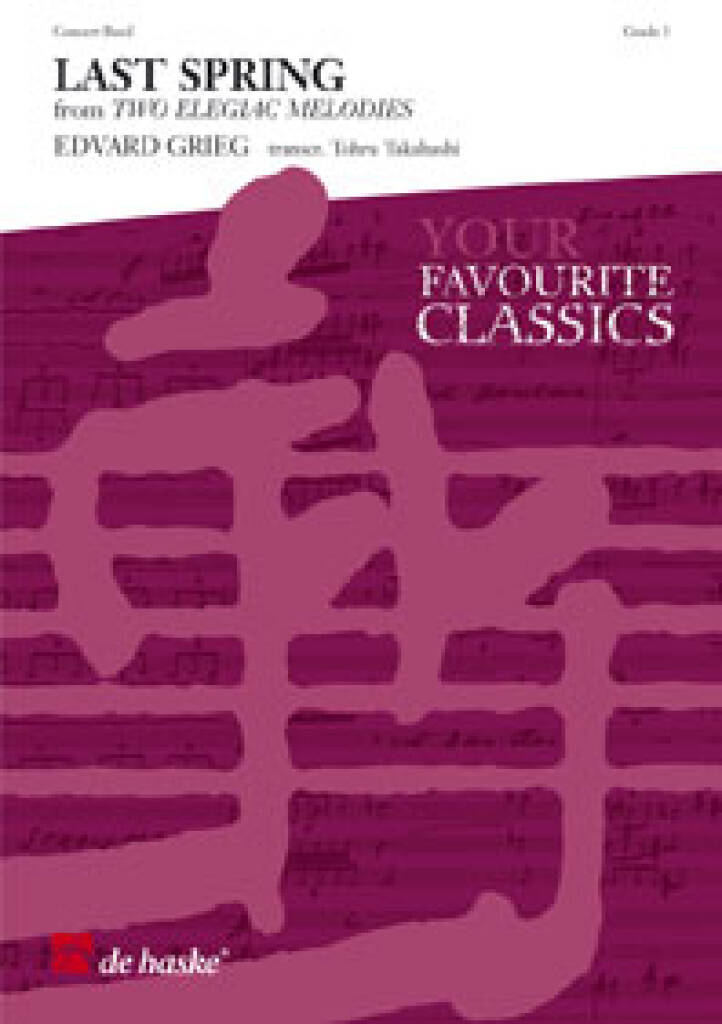 £94.99
Last Spring
In 1880, Edvard Grieg composed twelve song poems by Aasmund Olavsson Vinje. He arranged two of these songs for String Orchestra published under the title of Two Elegiac Melodies, Op. 34. These two deeply meloncholy pieces were titled The Wounded Heart and Last Spring. The latter of these two titles inspired Tohru Takahashi to produce this expressive and sensitive transcription for Concert Band, which will make a fantastic encore piece for any concert.
Estimated dispatch 7-14 working days
 View Music