
Results
-
 £174.99
The Curse of the Mermaid (Concert Band - Score and Parts) - Doss, Thomas
The Curse of the Mermaid tells the story of a greedy and wealthy fisherman wanting to make money in any way possible. When his business starts to fail, he puts the blame on the mermaids. One day, the fisherman kills a mermaid, who casts a spell on him shortly before she disappears into the water. The composition is in the form of a symphonic poem, starting slow and then mysteriously opening up revealing a fantastic colourful world of sounds and motion. There are various moments during the piece where the composer includes broad and beautiful melodic material, as well as surprising effects and great rhythmical interest. This is a challenging but great piece for concerts or contests! Duration: 11.45
Estimated dispatch 7-14 working days
-
 £76.99
Allein Gott in der Hoh' sei Ehr (Concert Band - Score and Parts) - Bach, Johann Sebastian - De Haan, Jacob
Jacob de Haan begins his arrangement of the well-known hymn Allein Gott in der Hoh' sei Ehr (All Glory Be to God on High) with a quotation from his own Missa Katharina, a mass for choir, soprano, and band. To this melody he sets the Latin text from the last part of the Gloria. The chorale is then heard after an interlude and can, at the director's discretion, be accompanied by the choir singing in either German or English. A perfect work for church concerts.Duration: 3.15
Estimated dispatch 7-14 working days
-
 £69.99
Centre Wind Band Set (Score & Parts)
Your band will be the focal point of everyone's attention in this (parade) march. A simple but rewarding march, suitable for many occasions. Johan de Corff is fully conversant as far as writing marches is concerned and with 'Centre' he has added another prime specimen to this eternally popular musical style. 'Centre' is published in marching-card size. 03:00
Estimated dispatch 7-14 working days
-
 £104.99
Stand Alone (Concert Band - Score and Parts) - Hisaishi, Joe - Nagao, Jun
Joe Hisaishi is a highly sought-after film score composer in his home country of Japan. Among his numerous movie scores are several for anime fi lms. Anyone who watched the 1998 Nagano Winter Olympics heard his work, whether they knew it or not, as he composed the music for the opening ceremony. Stand Alone is an emotional song written for a Japanese TV-series, recorded by none other than Sarah Brightman. (She even sung in Japanese!) Joe Hisaishi's music can now be enjoyed by an even wider audience thanks to this arrangement by fellow countryman Jun Nagao.Duration: 4:45
Estimated dispatch 7-14 working days
-
 £125.00
Diaghilev Dances (Concert Band - Score and Parts) - Hesketh, Kenneth
As a young musician, Hesketh was spellbound by the sounds and colours of the ballet music commissioned for the Ballets Russes company by Serge Diaghilev, the great ballets by Stravinsky, Debussy, Ravel and Prokofiev.Diaghilev Dances is Hesketh's homage to this great legacy, which he describes as a miniature ballet consisting of an introduction, three dances and three entr'actes.
Estimated dispatch 7-14 working days
-
 £75.50
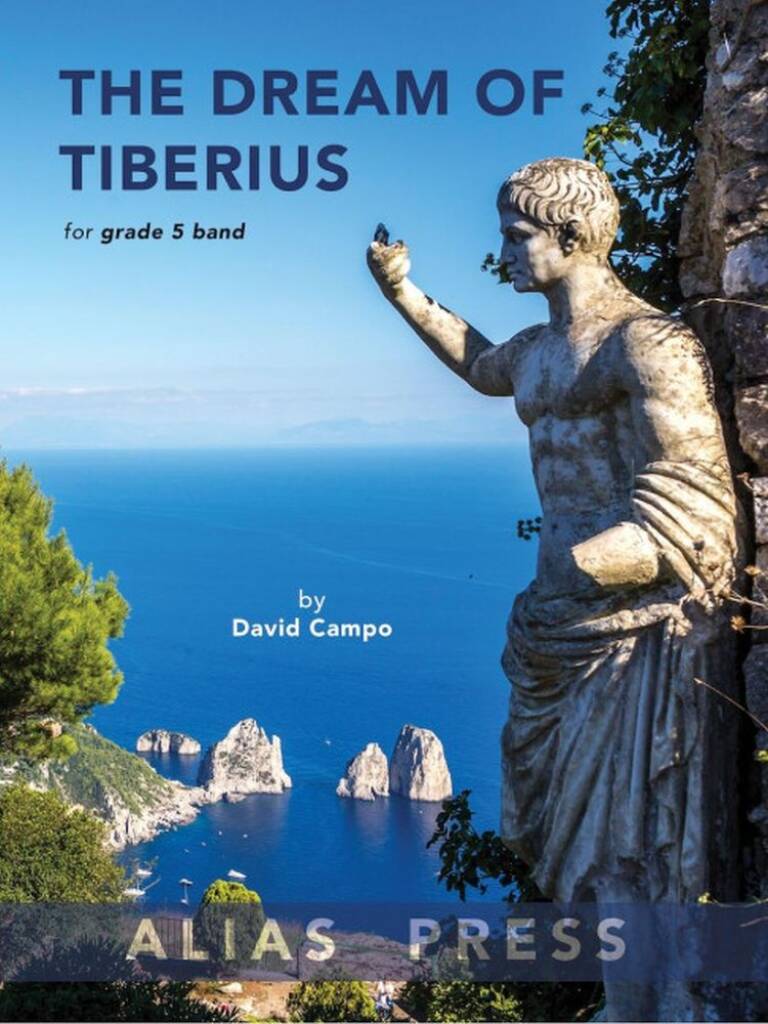
The Dream of Tiberius - David Campo
The Roman Emperor Tiberius was born in 42 BCE to Tiberius Claudius Nero and Livia Drusilla, both descendants of prestigious political families, at a time when Rome was undergoing significant political upheaval. Julius Caesar had begun a brutal civil war in 49 BCE to end Rome's rule as a Republic and consolidate his power as supreme ruler. Following Caeser's assassination in 44 BCE, Tiberius' father backed the forces wishing to return Rome to a Republic, but they were defeated by Caesarian loyalists led by Caeser's heir Octavian. As a result, Tiberius' early life was spent on the run and in political exile with his parents. In 27 BCE, Octavian would become the first Emporer of Rome and assume the name Augustus. Augustus forced Tiberius' parents to divorce and took Tiberius' mother as his new bride, separating the family and forcing Tiberius to live with his father. Upon his father's death, Tiberius went to live with his mother and Emporer Augustus, a situation Tiberius found extremely uncomfortable but one over which he had no control. Having been adopted by the Emperor, Tiberius assumed the military and political life thrust upon him. He proved to be an outstanding military and political leader, and with his marriage to Vipsania Agrippina his life took on a heretofore unknown stability. However, Augustus would intervene in Tiberius' life once more, forcing him to abandon his happy marriage and take Augustus' daughter Julia (Tiberius' step sister) as his new wife. This arrangement, while securing Tiberius' place as Augustus' heir and ensuring he would one day be Emperor of Rome, was disastrous. Julia's drunken licentiousness was a constant source of scandal and embarrassment for Tiberius (and her father, the Emperor) and she was eventually exiled by her father Augustus. Tiberius was named Emperor of Rome upon the death of Augustus in AD 14, assuming his position as the most powerful man on Earth. However, no matter how powerful he had become, Tiberius never felt as if he had ever had any control over his life, having been manipulated from childhood through adulthood by the whims of Augustus. As Emperor, he soon became disgusted with the political intrigue of the Roman Senate and by AD 26 left Rome and took up residence on the island of Capri, where he lived out the rest of his life. History does not regard Tiberius fondly and by all accounts towards the end of his reclusive life on Capri, he had become a miserable, sick and mentally unstable old man reveling in debauchery and cruelty. It is also informative to note that he was Emperor of Rome when Jesus of Nazareth was crucified, and while there is no indication that Tiberius was even aware of the existence of Jesus, as Emperor he was responsible for the appointment of Pontius Pilate as Governor of Judea. Even considering this, it is difficult to look on the life of the Emperor Tiberius and not feel some sympathy and pity. It's in this spirit that I composed "The Dream of Tiberius." I imagine the man sitting in thoughtful seclusion on the beautiful island of Capri imagining what his life might have happily been had not power been thrust upon him: husband, father and humble servant of the people.
Estimated dispatch 7-14 working days
-
 £123.20
3 Letzte Motetten - Anton Bruckner
Anton Bruckner (b. 4.9.1824, Ansfelden, d. 11.10.1896, Vienna) didn't have it easy. Throughout his life, the Austrian composer was plagued by self-doubt. Anton Bruckner came from a simple, rural background. After the death of his father, he was accepted as a choirboy at the monastery of Sankt Florian in 1837. After several years as a school assistant and his own organ and piano studies, he first worked as organist in St. Florian, then from 1855 as cathedral organist in Linz. Introduced to music theory and instrumentation by Simon Sechter and Otto Kitzler, he discovered Richard Wagner as an artistic role model, whom he admired throughout his life and also visited several times in Bayreuth.In 1868 Anton Bruckner became professor of basso continuo, counterpoint and organ at the Vienna Conservatory; ten years later court organist; and in 1891 finally honorary doctor of the University of Vienna. He was considered an important organ virtuoso of his era, but had to wait a long time for recognition as a composer. It was not until Symphony No.7 in E major, composed between 1881 and 1883, with the famous Adagio written under the effects of Wagner's death, that he achieved the recognition he had hoped for, even if he was reluctant to accept it given his inclination towards scepticism and self-criticism.Anton Bruckner was a loner who did not want to follow a particular school or doctrine. He composed numerous sacred vocal works, such as his three masses, the Missa Solemnis in B flat minor (1854), the Te Deum (1881-84) and numerous motets. As a symphonic composer, he wrote a total of nine symphonies and many symphonic studies from 1863 onwards, tending to revise completed versions several times over. Bruckner's orchestral works were long considered unplayable, but in fact were merely exceptionally bold for the tonal language of their time, uniting traditions from Beethoven through Wagner to folk music, on the threshold between late Romanticism and Modernism.Anton Bruckner composed about 40 motets during his lifetime, the earliest a setting of Pange lingua around 1835, and the last, Vexilla regis, in 1892.Thomas Doss has compiled some of these motets in this volume for symphonic wind orchestra.These motets show many characteristics of personal expression, especially Bruckner's colourful harmony in the earlier works, which is in places aligned with Franz Schubert (changes between major and minor; and movements in thirds). Later works are characterised by many components which, in addition to the expanded stature of the movements, include above all a sense of the instrumentation as an outward phenomenon and the harmony as a compositional feature that works more internally. Some aspects of Bruckner's work are the result of his long period of study, which familiarised him not only with the tradition of his craft, but also gave him insights into the "modernity" of his time in such composers as Wagner, Liszt and Berlioz.From this developed his personal standpoint, which always pursues the connection between the old and the new.
Estimated dispatch 7-14 working days
-
 £256.00
14 Motetten - Anton Bruckner
Anton Bruckner (b. 4.9.1824, Ansfelden, d. 11.10.1896, Vienna) didn't have it easy. Throughout his life, the Austrian composer was plagued by self-doubt. Anton Bruckner came from a simple, rural background. After the death of his father, he was accepted as a choirboy at the monastery of Sankt Florian in 1837. After several years as a school assistant and his own organ and piano studies, he first worked as organist in St. Florian, then from 1855 as cathedral organist in Linz. Introduced to music theory and instrumentation by Simon Sechter and Otto Kitzler, he discovered Richard Wagner as an artistic role model, whom he admired throughout his life and also visited several times in Bayreuth.In 1868 Anton Bruckner became professor of basso continuo, counterpoint and organ at the Vienna Conservatory; ten years later court organist; and in 1891 finally honorary doctor of the University of Vienna. He was considered an important organ virtuoso of his era, but had to wait a long time for recognition as a composer. It was not until Symphony No.7 in E major, composed between 1881 and 1883, with the famous Adagio written under the effects of Wagner's death, that he achieved the recognition he had hoped for, even if he was reluctant to accept it given his inclination towards scepticism and self-criticism.Anton Bruckner was a loner who did not want to follow a particular school or doctrine. He composed numerous sacred vocal works, such as his three masses, the Missa Solemnis in B flat minor (1854), the Te Deum (1881-84) and numerous motets. As a symphonic composer, he wrote a total of nine symphonies and many symphonic studies from 1863 onwards, tending to revise completed versions several times over. Bruckner's orchestral works were long considered unplayable, but in fact were merely exceptionally bold for the tonal language of their time, uniting traditions from Beethoven through Wagner to folk music, on the threshold between late Romanticism and Modernism.Anton Bruckner composed about 40 motets during his lifetime, the earliest a setting of Pange lingua around 1835, and the last, Vexilla regis, in 1892.Thomas Doss has compiled some of these motets in this volume for symphonic wind orchestra.These motets show many characteristics of personal expression, especially Bruckner's colourful harmony in the earlier works, which is in places aligned with Franz Schubert (changes between major and minor; and movements in thirds). Later works are characterised by many components which, in addition to the expanded stature of the movements, include above all a sense of the instrumentation as an outward phenomenon and the harmony as a compositional feature that works more internally. Some aspects of Bruckner's work are the result of his long period of study, which familiarised him not only with the tradition of his craft, but also gave him insights into the "modernity" of his time in such composers as Wagner, Liszt and Berlioz.From this developed his personal standpoint, which always pursues the connection between the old and the new.
Estimated dispatch 7-14 working days
-
 £159.60
Suite Acadienne - Bernhard Bogisch
1. La belle Franoise.This song tells the story of the beautiful Franoise, who is visited by her lover on the eve of his departure. She helps him prepare for his voyage and they talk for the last time at the foot of a rock, which has been their trysting place. The next day, when he has left the harbour, he hears the sound of a bell. It is the bell that tolls for Franoise, who is being carried to her grave.2. Le Prince Eugne.At least two versions of this song are in existence, both of which are represented here. It tells of the prince Eugne, who, on his way to Paris, encounters twenty of his worst enemies. He manages to kill fourteen of them before his sword breaks. He then asks his page to get him another sword, but the lad is too afraid for his own life. This being the case the prince tells him to tell his wife to take care of his son, who 'will have his revenge by lighting a candle in Paris'.3. Pinson et Cendrouille.This song deals with the marriage of two not further specified animals, who have nothing with which to prepare a wedding feast, and need help from the other animals. But when the rat comes in carrying a fiddle, he is chased away.4. Le Dpart de l'Amant.At least two versions of this song are known, both of which are represented here. It is one of many songs dealing with departure, and is of Canadian origin. The lover is warned of the charms of the pretty 'canadiennes' which among Acadiens refers to French Canadians from Qubec. 'Be true to me save your heart. When I return from my voyage I will make you happy'.5. Le Remde son Talon.This, like many children's/folk songs is a bit of a nonsense song. Marguerite has trouble with the heel of her shoe, and asks her mother for help. Mom suggests various things, such as an onion (too round), a tomato (too flat) etc. In the end it turns out that a bachelor is her best bet.
Estimated dispatch 7-14 working days
-
 £137.99
Odyssee - Jan Bosveld
The Odyssee tells the story of Odysseus, the undaunted hero. In times long ago the blind poet Homer wrote this famous epic. The "Odyssey" follows the "Iliad", the story of the bloody war between the Greek and the Trojans. This battle endsafter ten years thanks to the Odysseys famous trick. the Trojan Horse. The Odyssey is not a war epic, but a story about perseverance, loyalty, adventure, and the survival instinct of its ingenious hero. In The Odyssey, Homer describes howOdysseus, the king of Ithaca, had to endure another ten years of affliction after the ten years of war in Troy before he could finally return to his home land. During those years, his wife, Penelope, had to try and keep her many admirers away.These men not only wanted het hand but also the kingship. To prove her husbands worth, she played a trick: "As soon as I have finished weaving this shroud for my father-in-law, Laertes, I will choose one of you to become my husband", she promisedthem. But during the night, she secretly loosened what she had woven during the day, prolonging the time until Odysseus would finally return. After twenty long years, when he finally stood at the door, she wondered: Is this really my husband? Ishe an imposter? Cunningly, she asked him to move the bed, because only she and her husband know that the bed was immovable and was build around an old three trunk! Odysseus was deeply moved: this really was his wife, his Penelope! Nearly threethousands years later, the loyalty and strength of this character, and all the dangerous adventures that Odysseus survived thanks to courage and intelligence, still moves us today. Odyssee by Jan Bosveld is not just an adventure story, butrather a characteristic piece in which memories of Homers story can be heard. The composition opens with a firm, stirring theme describing our hero, Odysseus, in detail: This man is not to be taken lightly. The further development of thisshort introduction completes this character sketch: trustworthy, perseverant, and a genius. After that we can picture Odysseus on the lonely beach of Ogygia. Do the trumpets depict his memories of the war of Troy? Does he think of his wife, as werecognise the weaving loom of Penelope in the murmuring eighth? In the solemn, plaintive part that follows, we can imagine Penelope feeling lonely, sitting in the womens room with her servants.One of the girls plays the harp, but that does notclear the sombre atmosphere. Then we can imagine seeing the sorceress Circe, who changed Odysseus men into swine. After she gives a simple magic sign something follows that reminds us of the sound of pigs grunting. Then the Odysseus theme resounds:the hero comes to savi his comrades. Assisted by Hermes, he forces Circe to lift the spell. The piece ends the same way as it began, with an animated theme: Odysseus is still the same, undefeated and not to be taken lighty!
Estimated dispatch 7-14 working days
 View Music