
Results
-
£104.99
Basel Impressions - Sven Van Calster
The city of Basel (Switzerland) is situated at a turn of the river Rhine where three countries touch noses: France, Germany and Switzerland. The river divides the city in two and six bridges connect the two parts which differ greatly. One part is geared towards tourism and culture, while the other part is more industrial, with criminality and drug abuse a part of everyday life.
Estimated dispatch 7-14 working days
-
£184.99
Rubicon - Bert Appermont
The Rubicon is a river in Northern Italy which Julius Caesar crossed with his army in 49 BC in defiance of the leaders of Rome, who feared his power. A civil war against rival Pompey ensued, which culminated in Caesar seizing power as the absoluteruler of Rome. The phrase "crossing the Rubicon" therefore refers to any person committing himself irrevocably to a risky, decisive and irrevocable of course of action.The work consists of three parts that deal with this important moment in history.Part 1 (Meditation) symbolises Caesars request to the Gods to assist him in his difficult choice. In a slow introduction we hear the melancholy and beseeching sounds of the duduk (alternatively, this part can be played by a soprano saxophone)and of the soprano solo singer over the bourdon accompaniment. The soprano solo singer then sings "dona tibi pacem" (give him rest) in a melodious and probing theme.In Part 2 (Battle of Pharsalus) trumpets and trombones resound alternately ina stately Roman fanfare, producing a stereophonic effect. This develops into a martial theme in which Caesars impressive army goes to battle against the army of rival Pompey. While the theme of Caesars army fades away, Pompeys theme emerges as anaive dance in six-eight time. His army is definitely in the majority and it believes it can easily defeat the enemy. Suddenly trumpets and trombones clash on two sides of the orchestra: Caesars army advances and attacks. A fierce battle ensues inwhich the two themes are played alternately as well as simultaneously. Thanks to his shrewd battle tactics, Caesar manages to win this legendary battle after all: his theme resounds ever louder in trumpets and horns until everything dies out andchanges into a kind of reconciliation between the soldiers of the two armies. The melancholy "dona tibi pacem" from part 1 now serves as a reconciliation theme.Caesar is now the sole ruler of the New Roman Empire, which would be destined to leave itsmark on our Western civilisation to this day. The third part is a sparkling succession of dance music (Dance) with many Greek and Roman elements in which Caesars victory is praised and celebrated. It is common knowledge that the culture(arts, gods, etc.) of the Romans drew heavily on Greek culture. I have therefore used an authentic Greek theme (the Seikolos song) several times in this part (bar 17 in the euphonium, bar 60 in the base section, bar 68 in the sopranosaxophone) to suggest the music of that era and to evoke the right atmosphere. After a gradual increase in tempo in the entire orchestra, the opening melody gloriously resounds once more, surrounded by virtuoso dance music. The work ends withbombastic brass fanfares in which Caesars theme triumphs once more.NOTE FOR THE CONDUCTOR:The Armenian duduk and the monochord that are used in the introduction give a special tone to the music, but could be substituted (soprano saxophone instead ofthe duduk) or left out (monochord). The soprano solo is also doubled within the orchestra and could therefore also be left out if necessary, although it does provide the work with an extra dimension. The male voices in the introduction and the finalecould possibly be replaced with a synthesizer with choral setting.As a visual and acoustic element in part 2, the trumpets, the e-flat cornet, the small drum and trombones can be stood up and placed at two sides of the orchestra (bar 80).Seen fromthe point of view of the conductor, put the trumpets, the e-flat cornet and the small drum in the left section and the trombones in the right section of the orchestra. This also helps to create a visual contrast between the two themes of the secondpart. The players can be seated again at bar 97 or bar 121. The soprano soloist can be placed in or in front of the orchestra, depending on what gives the best result. For the conclusion of the work the soprano solo can be sung from afar (from thewings) to create additional atmosphere.This work was composed especially for the "St Joseph" brass band from Pey/Echt (Belgium) with conductor Mark Prils.
Estimated dispatch 7-14 working days
-
£109.99
Dublimania - Menno Bosgra
This new work is based on Irish folk music.In the first part, the main theme is presented as a ballad, starting with the piccolo (as replacement for the flute which is widely used in Ireland), moving on the wood section to end with the entire orchestra.It then changes to a kind of rock style theme: powerful, rhythmic accompaniment with effects in dampers, a pedal point and the use of the spoons which is typical of Irish music (Irish pub), high-range bongo drum (replacement for the Bodhran), etc.In this second part I introduced a second theme as a counterbalance, played by several groups, which has clearly a more legato character and therefore sounds more melodious.The climaxof the work starts in the low-range brass section with its marcato theme that is developed with a great deal of rhythmicity in the accompaniment, clusters, etc. into a percussion solo interspersed by the orchestra in five-eight time with frequent parallel movement in chords (folk music style).Towards the end, theme 2 recurs twice: first as heard earlier with an extra counter melody and accompaniment pattern, then in a canonical form, in which the theme is played by three groups. The conclusion is a repeat of the middle section in five-eight time.I have tried to use many of the colours of a wind orchestra by having the wood sections and brass section play alone and making extensive use of dampers. Percussion also has a prominent role throughout the work.
Estimated dispatch 7-14 working days
-
 £89.99
Yellowstone Choral - Filip Ceunen
Yellowstone Choral was inspired by the marvellous landscapes of the Yellowstone National Park in the United States. The choral comprises three choral phrases that alternate throughout the work. The beginning is lightly orchestrated, with an oboe solo, but more instruments gradually join in before the second phrase of the choral is introduced. The third phrase does not appear so quickly and when it does it is introduced by horns and trombones before building up to the climax of the choral, where the trumpet takes the upper hand. After this the choral gradually fades away, with the first and second phrases appearing just a few more times. The choral ends as it began,with a slowly ebbing orchestration.
Estimated dispatch 7-14 working days
-
£76.99
We are Golden
Self-taught singer/songwriter and pianist Mika (born 1983) lives in his own little world, that obviously also appeals to other people! Two years after his international success with his first album, Life in Cartoon Motion, which sold more than five million copies, he's back with his second album, The Boy Who Knew Too Much. From this three times Platinum release comes the song We Are Golden. Absolutely intoxicating!
Estimated dispatch 7-14 working days
-
£129.99
A Jupiter Fantasy (from the Planets) - Yasuhide Ito
Utilizing the melody from the central section of Holst's "The Planets: IV. Jupiter", I have exclusively written a chorus piece for an event in 1999. Based on that particular piece, a duo for piano and flute was written the same year. Later, more than a total of 30 renditions were written based on the original piece.This version of "Jupiter", arranged for the large wind band, is one of three parts of a three-part composition, which includes "Mars" and "Earth", composed in 2003 and 2005 respectively.The trumpet ad lib kicks off the central section, in which various other instruments could repeatedly perform the section, and ad lib is most welcome too.(Yasuhide Ito)
Estimated dispatch 7-14 working days
-
 £139.99
Suite on Celtic Folk Songs - Tomohiro Tatebe
This suite for wind band consists of three Old Irish melodies: "March" is a traditional Irish march of slower 6/8 beat. Led by a characteristically accented drum, the drone effect of a Uilleann bagpipe rings through for an air of courage. Next is a beautiful and nostalgic theme titled "Yellow Village Gate" in Gaelic, the first language of Ireland. Here, a solo piccolo presents the image of a simple fife. "Reel" is a typical Irish dance of very quick tempo. Maintaining the pace from beginning to end, intensified motion combining duple and 6/8 meter drives through to the coda's bold conclusion. (Tomohiro Tatebe)
Estimated dispatch 7-14 working days
-
 £209.99
Machu Picchu - Satoshi Yagisawa
Commissioned for the Ensemble Liberte Wind Orchestra, Kawaguchi City, 30th Anniversary ConcertExplaining the significance of Machu Picchu begins with remembering the Incan empire at its zenith, and its tragic encounter with the Spanish conquistadors. The great 16th century empire that unified most of Andean South America had as its capital the golden city of Cuzco. Irresistible to Francisco Pizarro, while stripping the city of massive quantities of gold, in 1533 he also destroyed Cuzco's Sun Temple, shrine of the founding deity of the Incan civilization.While that act symbolized the end of the great empire, 378 years later an archeologist from Yale University, Hiram Bingham, rediscovered "Machu Picchu", a glorious mountaintop Incan city that had escaped the attention of the invaders. At the central high point of the city stands its most important shrine, the Intihuatana, or "hitching post of the sun", a column of stone rising from a block of granite the size of a grand piano, where a priest would "tie the sun to the stone" at winter solstice to insure its seasonal return. Finding the last remaining Sun Temple of a great city inspired the belief that perhaps the royal lineage stole away to this holy place during Pizarro's conquest.After considering these remarkable ideas I wished to musically describe that magnificent citadel and trace some of the mysteries sealed in Machu Picchu's past. Three principal ideas dominate the piece: 1) the shimmering golden city of Cuzco set in the dramatic scenery of the Andes, 2) the destructiveness of violent invasion, and 3) the re-emergence of Incan glory as the City in the Sky again reached for the sun.(Satoshi Yagisawa)
Estimated dispatch 7-14 working days
-
 £174.99
Toccata Festiva - Jan Van der Roost
'Toccata Festiva' was commissioned in 1994 by the Dutch Brass Band Championships. The wind band version was made a year later by the composer himself. Historically speaking, the toccata is considered to be one of the first independent instrumental forms for keyboard instruments. Originally the toccata was typically more or less improvised, later this musical form was given a more regulated structure. Both elements are used in the 'Toccata Festiva': on the one hand the different themes are developed freely, on the other, the piece has an orderly structure. It is in a three part form (quick-slow-quick) and includes both strong rhythmical figures and broad melodic lines. Partof the composition is written in a more or less archaic tone idiom, referring to the period from which the toccata form originates (16th century).
Estimated dispatch 7-14 working days
-
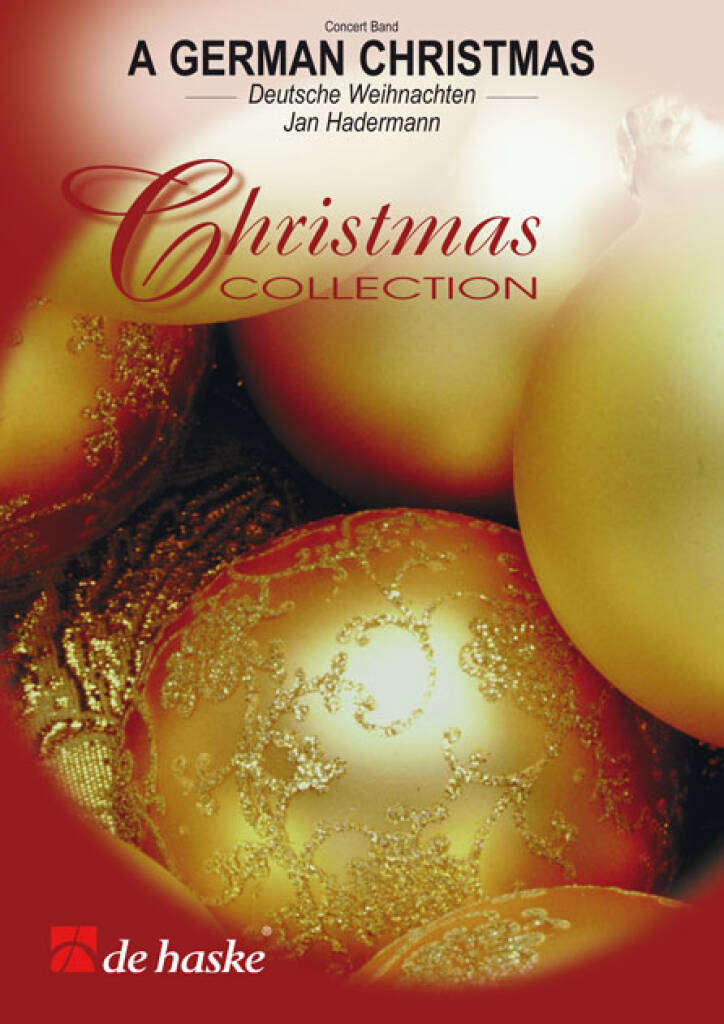 £109.99
A German Christmas - Deutsche Weihnachten - Jan Hadermann
Following a Christmas concert in German speaking Belgium, Jan Hadermann put together A Geman Christmas. Three well-known German Christmas carols O Tannenbaum, Alle Jahre Wieder and Ser die Glocken nie klingen have beentranscribed in this Christmas medley. The romantic simplicity of the music makes it ideal for all bands.
Estimated dispatch 7-14 working days
 View Music