
Results
-
 £159.99
1834 - Jan Van der Roost
The twofold title of this concert work is directly connected with the band who commissioned it. The 'Harmonie Municipale Grevenmacher' from the town of the same name, by the river Moselle in the Grand Duchy of Luxembourg was founded in the year1834. The name Machera is derived from the word machara, which in turn originated from maceries (old wall). Later, Machera evolved into Machern, Grafenmachern, and finally Grevenmacher.In 2009, this music society the third oldest still in existence in the country celebrated its 175th anniversary. And after all these years the society still flourishes! The dynamic committee, led by Georges May, fully supports and inspires themusical leader of the band, Claude Weiland, as well as his 60-strong ensemble. This well-functioning team took the initiative to ask Jan Van der Roost to write an anniversary composition, inspired, on the one hand, by the rural character ofGrevenmacher and its surroundings (where the famous Moselle wine growing dominates the countryside), and on the other hand, by the dynamics, creativity and joie de vivre the band exudes. All of this resulted in a twofold work with alternating peaceand excitement, virtuous and melodic features, orchestral splendour and soberly orchestrated passages. The premire, on 10 January 2010, was conducted by the composer himself at a successful gala concert which brought a fine year full of musicalfestivities to a close. The 'Harmonie Municipale Grevenmacher' faces the future with confidence, and will now prepare for its next milestone: the 200th anniversary!
Estimated dispatch 7-14 working days
-
 £154.60
Rendezvous - Torstein Aagaard-Nilsen
Rendezvous was commissioned by Krohnengen Brass Band for their 50th Anniversary in 2019. This version for Concert Band was scored autumn 2020.Rendezvous is devided into three sections. Each section are referring to Edvard Grieg's own titles. but twisted, to make sure that everybody understand that this music is a mash-up of themes Edvard Grieg used in opus 54 (for piano) and opus 61 (songs for children).1. Trolltog med avsporing (March of the Trolls derailment)March of the Trolls is a famous part of Edvard Grieg lyric pieces, opus 54.2. Klokkeklang i feil sang (Bell ringing in wrong tune).Bell ringing show that Grieg was one of the first composers to write the way impressionists did. What happens if this beatiful piece is combined with several other themes from the same book? It somehow works in its own way.3. Pep talk til Blakken (Pep talk to Blakken)The riff used in the first part becomes an important part of the third part: a funky treat of the childrens song "Kveldssang for Blakken" (Evening song for Blakken).I felt that a rather tired old horse needed a pep talk more than a slow tune. So that is why you get this music(!) - and this is how my rendezvous with Grieg ends.Not sure what maestro Grieg would have thougt... But, I have read that the fiddlers that played the tunes Grieg used was not happy with the way Grieg used them.So there you go...Torstein Aagaard-Nilsen
Estimated dispatch 7-14 working days
-
£69.99
An Irish Lullaby - Stephen Bulla
What can be more charming than a comely Irish folk melody? This is music that allows the band to play in the rubato style, with much room for expression. Found in an old British publication and simply called "Irish Air," this endearing arrangement is a rhapsodic treatment that takes fragments of the melody and develops them into a large symphonic work. The freedom of tempi allows you to work with your band in a sensitively conducted way that only a beautiful piece like this will allow.There is always room on a concert program for at least one lush, melodic contrast piece. Perhaps this one is for you. It's so difficult to describe a thing of real beauty. Please listen tothe demo recording and hear it for yourself.
Estimated dispatch 7-14 working days
-
 £159.60
Sculptures Of An Exhibition - Kees Vlak
This composition was commissioned by the village of Midden-Beemster to commemorate the 375th anniversary of the polder of the same name. It was premiered in august 1987 by the Beemster Fanfare Band. On this occasion some twenty sculptors were invited to create a work of art. Those sculptures were set up at the most picturesque areas of the polder. On a 40 km long bicycle route one can admire the curious statues wile enjoying the beautiful scenery as well. The compostition is based on two themes: a main theme and the promenade theme.1.Introduction: After the grandiose presentation of the main theme, on the dominant, we leave the village to the sound of some pretty music.2.Promenade and Watchman: After some time, we discover a dark statue hidden in the bushes; it is shaped like a square standing on one of its corners. It is called "Watchman". We hear the promenade theme as a solo and all next themes will be variations.3.A Building of Willow-trees: Far away on a dike, we discover the huge skeleton of a kind of house. It is a construction of skilfully interwoven willow-branches. The musical themes are also interwoven. The sculpture is called "Construction of wood used by the farmers".4."Die Flsse, ah die Flsse"and Promenade: We continue our trip and see now a horn of plenty, made of brown ceramics and set up on the green slope of an old fortress. The sun shines on the sheep being at pasture under the willow-trees. No doubt, this scene will have something to do with abundance.5.Cardplayers in front of the Nightingale: A statue in cast iron, representing two carplayers, has been erected in front of the windmill called "The Nightingale". This sculpture suggests a rather animate atmosphere. The opponents with the trumpets and the trombones suggest the cardgame. The trumpets are constantly changing from players. At a certain moment the trumpet gets hold of the decisive trick and starts a victorious blow. The trombone, however, repeats this shout of joy with quite some perverse delight and in a completely wrong pitch. The game continues and after a climax all cards are finally thrown on the table.6.Autumn and Promenade: The trip now brings us a white sculpture in ceramics, decorated with some autumn leaves. Is this a seated man or a chair? Anyway, it looks very nostalgic. This is the time for a moment of reflection with the oboe or the saxophone. It is called "Autumn".7. The Powerlifter: Somewhat hidden in a ditch, we discover a small statue in cast iron, representing a powerlifter who is going to give way under the weight. The music uses the main theme with powerlifting euphoniums, saxophones and clarinets.8.The Bull: Here we have another cast iron sculpture, but this time it is a really powerful figure. This "Bull" statue uses the same theme as that of the powerlifter, but it gets a stronger foundation from the bass insturments.9.Mirror and Promenade: While strolling alongside the channel we suddenly see four mirrors. They not only reflect themselves, but also mirror in the water of the channel. These reflections are suggested by the use of tuned percussion. The promenade theme is also used in mirror image.10.Reflictions or...?: On top of the dike we have a nice view on a farmyard with its orchard. A very big net, coverd with sparkling tin plates, has been stretched between the trees. This sculpture is called "Reflections of ...?. Of what? Yes, of course, reflections of the times when the polder was a lake and the sun was reflecting in the wild waves.11.Willpower: Finally we discover a big statue in cast iron. It is not clear whether it is a man or a woman. Anyway the enormous bundles of muscles in the legs and the thighs are striking. This sculpture is called "Willpower". The idea of determination is musically suggested by a very long preamble to the promenade theme in one great stringendo, leading to the conclusion of the trip.12.The beautiful country: Here we have the most beautiful picture. The magnificent Beemster Polder in bloom. We see a nice windmill with decorated wings. We hear the main theme, now on the tonic.
Estimated dispatch 7-14 working days
-
 £199.99
Fanfare No. 1 - Wataru Hokoyama
Fanfare No. 1 (1995) In the summer of 1995 before his departure to the United States, a request from his high school band friends for a good concert opener sparked 19 year old Hokoyama to write his very first wind band composition.To capture the excitement of the rising curtain, the piece begins with magnificent brass ascending in 4th and 5th intervals. This is followed by the energetic entrance of the full ensemble like celebratory cannon fire. The following melody has many notes, yet is still simple. Do not overestimate it, just perform with driving momentum.In the slower middle section, utilize an instinctive vision of a scorching midsummer sun shimmering on the horizon. (Likely this shimmering sunset image was scored unconsciously, being composed in midsummer. A more applicable mood might be "Indian sunset". Perhaps this Indian style came from a capricious feeling of youthfulness.)The bright tempo and melody return for the last section. The climactic volley of musical display is like explosive fireworks as the last sounds echo throughout the concert hall.The composer wishes for performers to play from their hearts and not be limited by an analytic approach to the score-absolute accuracy is not required. Above all, the deepest pleasure for the composer is to know that teachers and students share the joy of music making with the intention of sharing it with others all over the world.With deepest gratitude, thank you for performing this work.
Estimated dispatch 7-14 working days
-
 £149.40
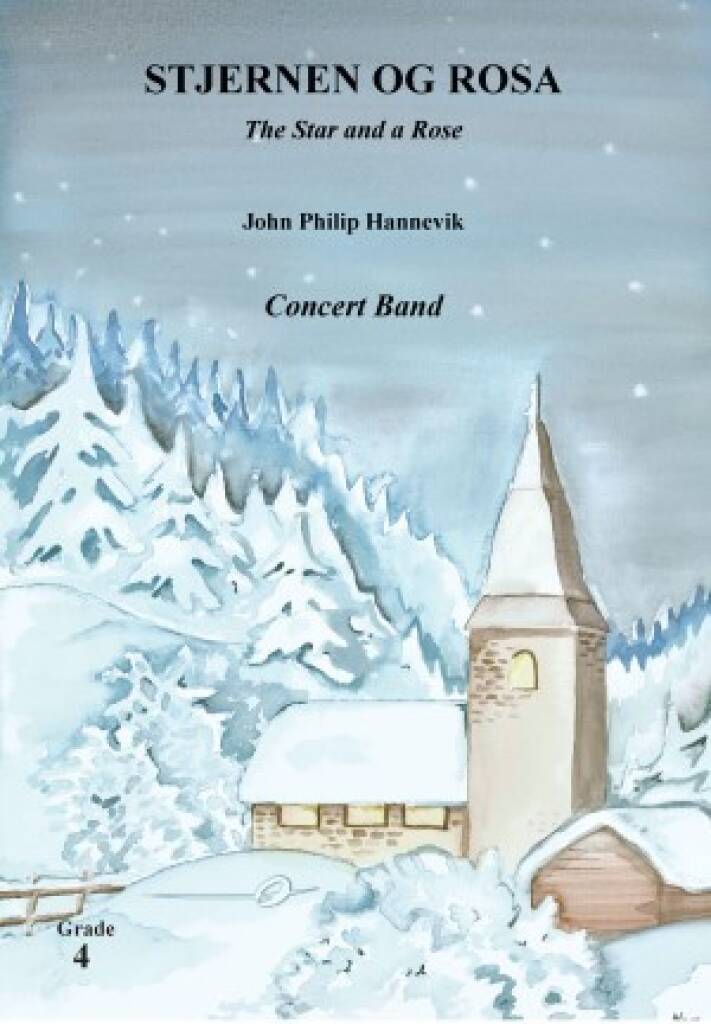
Stjernen og Rosa - John Philip Hannevik
The Star and a Rose is a big-scale Christmas piece for band, featuring four seasonal chorales.The first is a Gregorian-like chant Hodie Christus natus est.In this section of the piece, a soloist can be placed away from the band, maybe on a gallery. The soloist can be a tenor instrument, maybe trombone, or you can feature a vocal soloist.After this, the music leads us on to the old German Christmas chorale Lo, how a rose e'er blooming. This song is given a fairly rhythmical treatment, but make sure that the melody is presented in a cantabile style.An interlude follows, before the piece presents one of the most used and loved Scandinavian Christmas chorales, Mitt hjerte alltid vanker (My Heart will always wander), composed by the Danish bishop Hans Adolph Brorson around 1732. This song is building towards a climax, before the solo horn brings it all down to the Stable view described in the lyrics.Then comes a transition that brings us in to the final section of the piece, which presents the international Christmas Carol Adeste Fideles. As many will notice, I have borrowed a section from David Wilcocks majestic harmonization towards the end.The title of the piece has its background form the lyrics in My heart will always wander, where the text speaks about the stars in the sky. But also in the latin text for Adeste Fideles:Stella duce, Magi, Christum adorantesThe Rose is of course from the lyrics in the chorale Lo, how a Rose.
Estimated dispatch 7-14 working days
-
 £193.20
CASTRVM - Lionel Beltrán-Cecilia
CASTRVM is a symphonic episode inspired by four of the main civilizations that have coexisted over time in Ulldecona's Castle. With its melodies and sound effects, the composer tries to transport the listener through a trip to four uninterrupted movements, from the beginnings of this small settlement, creating a natural atmosphere recreated by the voice and the singing of birds to take us into the history with the first inhabitants, the Iberians, giving strength to the introduction of the composition, to move on to the time of the Andalusians, which with a melody in the form of a dance marked by percussion will transport us to take a walk in the surroundings of its circular tower. Next, and with strength, we arrive at the medieval and Christian period, marked in the score by the brass instruments, in this fragment we find moments that take us into the church of "Santa Mara de los ngeles", with melodies that evoke resonance and pomposity, continuing until we find the immense square tower, symbol of the fortress and homage, finally used as a prison and arsenal of those times. Then, there is a small slow march that will move us to some measures of strong stridency to finish with the whole section of low brass having its great moment of prominence, down to we reach the last part, Qna, a name that is recited during the musical piece and one of the names given in the past to the area that could be seen from the castle, where the change of location of the new town is recreated leaving the castle site, but always looking at it with respect and admiration as at the beginning of what is now the current Ulldecona, in this part, the composer plays a bit with a very well-known and significant melody for the inhabitants of Ulldecona, the "Jota Vieja", first making a reflex effect of all its melody and then only with the first six notes of this one, which builds a bridge until reaching the march and, later, the grand finale of this symphonic episode. The work was commissioned by Ulldecona Town Council and the Ulldecona Music Band, led by its conductor Joan Nadal i Girona, to commemorate the 800th anniversary of the donation of the Town Charter of Ulldecona "the old" (1222-2022), as part of the PATRIMONIUM 20.22 programme, "La Banda (Sonora) del Castell" (The soundtrack of the Castle).CASTRVM consists of: I.Iberians: stone and ironII.AndalusiansIII.The square tower: fortress and homageIV.Qna
Estimated dispatch 7-14 working days
-
£134.99
Recalls - Ben Haemhouts
Recalls obviously refers to memories. This piece of music is in fact a series of flashbacks, however, it does not highlight the actual memories of specific thoughts, people or events.The composition evolves around the late Frans Steurs, who for manyyears was the inspirational artist behind the brass band that is currently commissioning this work. The main theme of the work is based on the name STEURS". E = mi, U = do, R = re and S = "si" which is Dutch for the note "ti". This idea forms themusical theme for the entire composition and different variations are used throughout. The structure of the work is based on the concept of a story which father Steurs is telling his two daughters, who play the flute and the clarinet. Each part ofthe work has a story-like character:1. Introduction: following a short ominous intro, the main theme is presented for the first time.2. The Story: father Steurs has both his daughters on his knee and he tells them stories from the old days. Trumpetsand trombones play variations of the theme. The story gets very exciting (accelerande, poco a poco agitato) until the tale takes a dramatic turn when the father tells an exciting story at the time of the Second World War. He tells of being hunteddown by the occupying army and these adventurous episodes are related to us musically in part3. Danger, with its skilful references to "vor dem Sturm" from "Eine Alpensinfonie" by Richard Strauss.4. called Fugitives, is about how he fled in the nightfrom the enemy and this is reflected in the bass tones of a new theme. The aggression of the war is illustrated from bar 117 onwards, by a harsh brass section. The main theme is repeated once again and this time up-tempo. The second theme is broughtonce again from bar 149 onwards.5. Dialogues, depicts the conversations between the two daughters and their father. Father speaks (bar 155); the daughters answer (bar 164 - flute, bar 166 - clarinet); bar 178: father answers with the tune of the maintheme to the two daughters. The discussions gradually intensify but ultimately end in peace in the last part called Conclusion.The piece of music "Recalls" is a free interpretation by the composer who consulted the letters between the two daughtersof Steurs and their father and in this respect it is not really music for a programme."
Estimated dispatch 7-14 working days
-
 £104.50
Bonnie Annie Laurie March - John Philip Sousa
According to Sousa scholar Paul Bierley, Sousa often remarked that the old Scottish ballad Annie Laurie was the most beautiful of all folk songs. In 1883 he wrote the march Bonnie Annie Laurie based on this favorite folk song. In 1880 Sousa became the fourteenth leader of the United States Marine Band, and this was undoubtedly one of the marches that he composed during this period. Highlighted and enhanced in this march-style setting, this wonderful melody never sounded better.
Estimated dispatch 7-14 working days
-
 £90.30
Giubilare Flautissimo - Harald Suilen
It was for the 80 anniversary as musician of Mr. Denessen that the wind band Harmonie St. Cecilia' at Tegelen, The Netherlands asked me to write this march. As his slogan is 'Playing music keeps me fit' the 94 year old Wiel Denessen still plays the flute in the band and is an example for many a musician. This march is a homage to a special music amateur, an exemplary band member, but above all a man of great qualities.The march 'Giubilare Flautissimo' was premiered at the anniversary concert on 17 November 1996.Harald Suilen
Estimated dispatch 7-14 working days
 View Music