
Results
-
 £89.99
Yellowstone Choral - Filip Ceunen
Yellowstone Choral was inspired by the marvellous landscapes of the Yellowstone National Park in the United States. The choral comprises three choral phrases that alternate throughout the work. The beginning is lightly orchestrated, with an oboe solo, but more instruments gradually join in before the second phrase of the choral is introduced. The third phrase does not appear so quickly and when it does it is introduced by horns and trombones before building up to the climax of the choral, where the trumpet takes the upper hand. After this the choral gradually fades away, with the first and second phrases appearing just a few more times. The choral ends as it began,with a slowly ebbing orchestration.
Estimated dispatch 7-14 working days
-
 £72.99
Dream of the Rarebit Fiend - Thomas Thurban
A rose by any other name is still a rose. This work enjoyed at least three different titles after its creation at the beginning of the 20th century. But whatever it was called, it is a delightful example of the cakewalk (don't take it too fast!) and should be played often.
Estimated dispatch 7-14 working days
-
 £90.00
Bright Dawn Overture, Op. 59 - Franco Cesarini
Bright Dawn Overture was commissioned to Franco Cesarini by the Swiss Band Association as part of a project for the renewal and expansion of the artistic repertoire. "There was never a night or a problem that could defeat sunrise or hope.". This sentence by the English philosopher Bernard Williams inspired Franco Cesarini in composing this overture. In fact, even the darkest night is always followed by the sunrise and metaphorically, in every moment of difficulty, man clings to the hope of a better future. Bright Dawn Overture is written in the classic form of an Italian overture (fast-slow-fast). It is intended as a hymn of hope of recovery after a period of great difficulty. A single theme characterizes the composition, passing through the various registers and presents itself in new forms, while constantly being transformed. In the central part the theme takes on an almost mystical character, while in the finale it presents itself in a heroic guise and the composition concludes with a gesture of decisive optimism.A piece accessible to most concert bands, perfect as an opening work!
Estimated dispatch 7-14 working days
-
 £92.00
I Tak - Stephane Kregar
I Tak: And yes! It is in Tczew in Poland that this very festive piece draws its inspiration. Spirit of dance, celebration and friendship, these are the impressions described in this very lively music. The introduction is darker and nostalgic, like after a trip but the joy and the party are stronger! Odd measures inevitably bring to mind the spirit of the Slavic festivals where it is good to laugh, sing and dance ...
Estimated dispatch 7-14 working days
-
 £84.99
Send In The Clowns - Stephen Sondheim
Send in the Clowns is one of the most well known songs written by composer Stephen Sondheim. The ironic lyrics have a present-day meaning. It was recorded by the likes of Judy Collins, Frank Sinatra and Barbra Streisand. Between them all, they brought this song eternal fame. The Norwegian arranger, Richard Johnsen, who is very familiar with this musical repertoire, made this beautiful arrangement and kept it very close to the sound of the original version.
Estimated dispatch 7-14 working days
-
£78.95
Breaking News - John M. Pasternak
Has a monster started terrorizing your city? Has the mayor been re-elected? We've got Breaking News! Find out what the news is about at the end of this fun piece for young band. The title says it all in composer John Pasternak's new piece reminiscent of a news program theme. It is exciting, unique, and students will love to play it again and again.
Estimated dispatch 7-14 working days
-
 £154.60
Har du fyr? - Ola Bremnes
This arrangement was made for The Suoni Wind Orchestra of Skien, Norway, and performed for the first time at their Promenade Concert "At Sea" at the Ibsen Culture Center, March 8th 2014, being the final number of the concert. Participating this concert was also the Choir Canto Libre and the two vocal soloists were Eli Kristin Hansveen and Andreas Hoff. Since that time this arrangement has been used also at other concerts involving choir and soloists. It is important that tempo is not too slow and one has to be thorough with details in the percussion parts. I have tried to paint a musical picture of the sea, as an eternal power, shifting from the quiet and lazy to thepowerful and majestic with crushing waves and stormy winds, as Ola Bremnes describes it in his fantastic lyrics. - yvind Strand - Solo Options: Vocal Soprano Sax Alto Sax Tenor Sax Trumpet Flugelhorn Euphonium (TC/BC)
Estimated dispatch 7-14 working days
-
 £122.50
Suite - Istvan Bogar
Istvn Bogr's series of movements intended for youngsters is colourfully instrumented, evocative music, rich in melodic invention; in character it is most closely akin to Tchaikovsky's Nutcracker ballet music. In the opening movement (Little march), little boys wearing paper shakos on their heads and carrying wooden swords play at soldiers. The following movement, Humming, is the only movement in the suite that is calm and in odd-numbered rhythm; in it the children gather flowers in their little baskets, and meanwhile hum pleasant tunes. The third movement is a funny game, with its tempo sometimes speeding up, sometimes slowing down, but by the end really going wild.The title of the finale is Game of tag. The tiny formal sections and interludes in this lively, cheerful music are linked together by a recurring rondo theme, and the chase ends with a brief coda.
Estimated dispatch 7-14 working days
-
 £71.50
Fanfare and Jubilee - James Swearingen
Another great composition for young bands by James Swearingen. Exciting yet playable rhythms combined with memorable melodies makes this piece sound more difficult than it is. Skillfully scored so that it is playable with a limited instrumentation, it's a perfect concert or contest selection for young bands. HIGHLY RECOMMENDED!
Estimated dispatch 7-14 working days
-
 £93.50
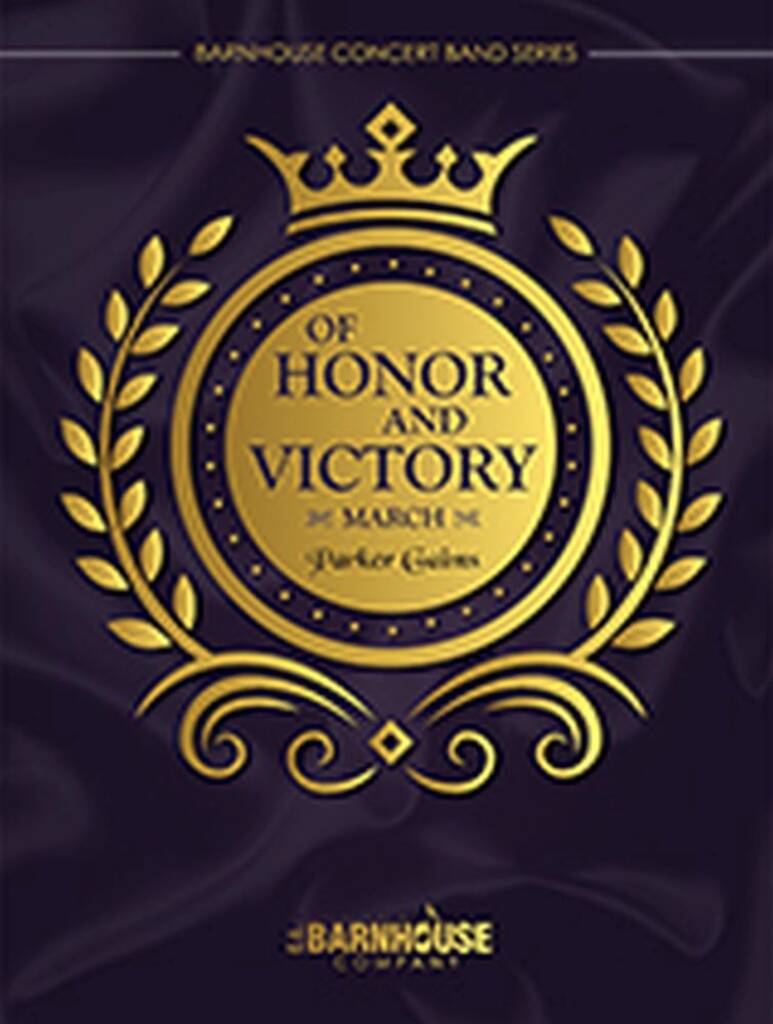
Of Honor And Victory - Parker Gaims
"Of Honor and Victory" is an outstanding march for band, composed in traditional form and style. Brimming with suspense, it features lyrical melodies, regal tuttis, bold percussion crashes, and daring harmonies. Full of grandeur and excitement, "Of Honor and Victory" is sure to captivate both listeners and performers, making it the perfect choice as a concert opener or grand finale. First-class!This work is not yet in print. Please check back later to view the conductor score and for purchasing information. In the meantime, please enjoy this recording performed by The Washington Winds, conducted by Edward S. Petersen.
Estimated dispatch 7-14 working days
 View Music