
Results
-
£101.50
Normal - Harold Bennett
This march is one of Harold Bennett's (pseudonym of Henry Fillmore) finest. It is in Henry Fillmore's typical fast and fun vein and in standard march form. What is unique about this classic from the original Bennett Band Book is that it is one of the few Bennett marches that includes a break strain, which will make it a great introduction to younger students to prepare them to play the more challenging marches of Fillmore, Sousa and others.
Estimated dispatch 7-14 working days
-
 £93.50
Bamboo Warrior - Christina Huss
This piece is truly epic! It is lush, it is tuneful, and it is aggressive. Composer Christina Huss was clearly inspired by the music of the far east harmonically and with authentic instruments like the Taiko drum. It is a musical and dramatic work.
Estimated dispatch 7-14 working days
-
 £186.20
Concerto for Alto Saxophone and Band - Ronald Binge
Ronald Binge was born on 15 July 1910 at Derby, England. He studied harmony and counterpoint on his own and tried his hand at arranging and composing during the many years he worked as a pianist and musician in movie theatres. In 1934 he met the conductor of Italian descent Annunzio Paolo Mantovani (1905-1980) and started writing numerous arrangements for the symphony orchestra of this very popular conductor. In fact, Binge is the inventor of the famous 'Mantovani Sound' (with echo effects by the strings) which charmed and pleased millions of music lovers and television spectators all over Europe in the fifties and sixties. In 1952 he scored a hit with ' Elisabethan Serenade'. Binge also wrote classical music and even a series of wind band compositions such as the most popular 'Cornet Carillon'. Ronald Binge died on 6 September 1979 at Ringwood. He dedicated his Concerto for Alto Saxophone (1956) to the famous American saxophone virtuoso Sigurd Rascher (1907-2001), the pioneer of the classical saxophone. At the request of the Dutch wind band publisher Pieter Jan Molenaar, Binge wrote a version for symphonic band. Unfortunately both the editor and the composer died some time later in 1979 and could not attend the premiere of this version by the Dutch Royal Marine Band conducted by Jaap Koops and with Johan Perik as soloist. The concerto consists of three parts. In the dynamic and quick 'Allegro Spirituoso' one can hear the melody alternately with the soloist and the accompanying band. The second part is more lyrical, though passionate as well and it is better known as it is often performed on itself under its title 'Romance'. The final part 'Rondo Allegro Giocoso' is written in rondo form as its title indicates and it allows the soloist to demonstrate his virtuosity in a very lively dialogue with he band.
Estimated dispatch 7-14 working days
-
 £205.30
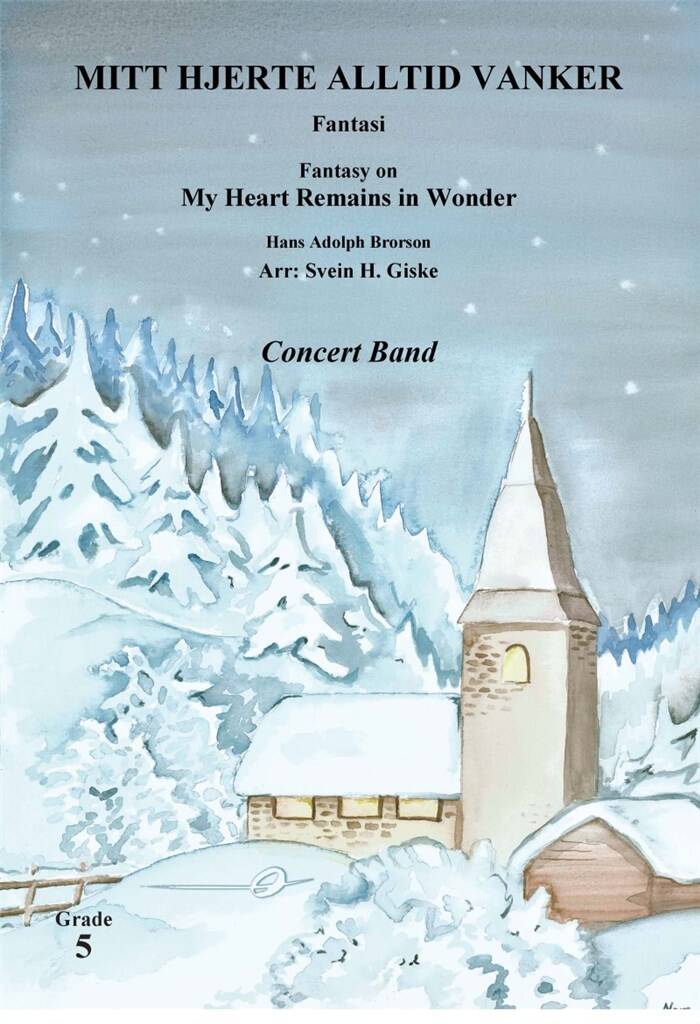
Mitt hjerte alltid vanker - Fantasi - Hans Adolph Brorson
This arrangement was commissioned by B3 (The Bergen Woodwind Ensemble). B3 is a large woodwind ensemble located in Bergen with a mix of professional and amateur players. My Heart Remains in Wonder is a well-known Christmas hymn in Scandinavia. I wanted my version to be different to the traditional hymn tune style in which it is normally performed. One day I was outside walking and this idea came to me: an ostinato-like, mechanical skeleton of arpeggio semiquavers on which I could 'hang' the melody. However, I also wanted to do the melody line a bit different. The inspiration for this comes from folk music and the way fiddlers hardly ever lift their bow off the strings when they play. Because of this, it is important that the melody is played in a very sostenuto style in this arrangement. The harmonies lie somewhere between jazz and folk music with a little nod towards Grieg (himself heavily influenced by folk music) in the slow middle section.
Estimated dispatch 7-14 working days
-
 £115.60
Optimist - John Teigen
"Optimist" is one of the most well-known songs by Norwegian singer and composer Jahn Teigen. It was written for the Norwegian Eurovision in 1989. It did not win this competition, but is still one of the greatest Norwegian songs from the late 1980's. This arrangement is very close to the original in form, rhythmic- and melodic lines. The repeat at bar 65 may be played as many times as one wish, or it can be omitted.
Estimated dispatch 7-14 working days
-
 £73.60
The Show must go On - Queen
The Show Must Go On is a song of the English rock band Queen, final track on the album Innuendo in 1991. It is one of the few hits of Queen that reached at the time a higher position in the US (# 2) than in the UK (# 16). Initially it was thought that this song was a testament of Freddie Mercury, speaking of his state of mind before he died, but this sad and poignant poetry was born from the pen of Brian May. At the end it is still the result of the collaboration of all group members.
Estimated dispatch 7-14 working days
-
 £149.40
The Battle of the Hats - Øystein Sjøvaag Heimdal
The word svimesltt, which is the title of this piece in Norwegian, has two meanings. One meaning is "knocked out", whilst the other, "sltt", means a folk melody/dance.Svimesltt is one of several folk dances, all of them with humorous titles, originally written by ystein Olsen Vadsten. Norwegian culture is the basis for these dances, both rhythmically and melodically. The accompaniment has brought this funpiece into the 21st Century.When it comes to Svimesltt, it is the traditional dance "halling" that is the inspiration. Halling is a rather wild dance, where the man tries to win the heart of a lady by attempting to kick a hat off a stick,held up in the air. This iswhere "The Battle of the Hats" gets its distinctive name A truly Norwegian tradition.The composer wanted to write a "crazy" melody, which highlights how "knocked out" a man can be by love, as he tries to win the chosen ones heart.
Estimated dispatch 7-14 working days
-
 £76.99
From Heartland to Heaven - Chisham
Commissioned to honor a beloved teacher who had passed away, this eloquent piece both begins and ends with warm and moving chorale sections. The contrasting allegro con brio theme is full of energy and vitality. While this piece is not very difficult, it features close contemporary harmonies and it provides ample opportunities for expressive playing especially in the woodwinds. Includes lots of tasteful percussion parts to keep your drummers involved. A wonderful composition that will pay big musical dividends and it is a wonderful choice for contest or concert performances. VERY VERY NICE!
Estimated dispatch 7-14 working days
-
£72.95
Jingle Bell Rag - James Pierpont
This piece has a very high cute factor with the infusion of Ragtime music into the ever-popular Christmas carol Jingle Bells. It is a clever combination that works as if it was always meant to be this way. A perfect change of pace piece for your next holiday concert in a solid arrangement that is effective and educational. Use it to teach the history of this important American style of music.
Estimated dispatch 7-14 working days
-
 £137.70
Run Away - Hans Offerdal
This piece is about running away. First there is restlessness, then the escape begins. But what are we running away from? That is for you to find out!Playing time: appx. 4:30 To the conductor:There are challenges in the use of dynamics and rhythm. It is important that energy and pace is upheld all the way up until the next to last page. Dissonances are present several places, but the voice leading is diatonic within the given scale.The whole piece is based on one single scale: F melodic minor with lowered second degree. It is notated as a concert F major scale with two accidentals. Feel free to use it during warm-ups!
Estimated dispatch 7-14 working days
 View Music