
Results
-
 £76.99
A Mariah Carey Christmas
Mariah Carey made a huge addition to our holiday listening experience with her Merry Christmas album. This arrangement includes three of those tunes woven into a medley by Joe Murphy: All I Want for Christmas Is You Miss You Most (At Christmas Time) Christmas (Baby Please Come Home).
Estimated dispatch 7-14 working days
-
 £76.99
A Christmas Remembrance
This entertaining medley combines treasured holiday titles in a framework of musical surprises and effects! Creative, yet simple, Gary's percussion writing provides a beautiful background of dazzling Christmas sonorities. Titles include: Deck the Halls The First Noel The Holly and the Ivy and I Saw Three Ships.
Estimated dispatch 7-14 working days
-
 £76.99
The Blues Brothers Revue
You simply can't top the Blues Brothers for high-energy musical entertainment. In this medley of their best-known tunes, Jay Bocook provides an exciting arrangement perfect for any pops or lighter program. Includes: I Can't Turn You Loose, Soul Man, Soul Finger, and Everybody Needs Somebody to Love.
Estimated dispatch 7-14 working days
-
 £76.99
The Symphonic Beatles
The legendary Beatles have produced some of the biggest hits of all time. From veteran Hollywood and TV writer John Cacavas comes this outstanding showcase that brings several of those hits to the concert stage. Includes: A Hard Day's Night, Yesterday, I Want To Hold Your Hand, Michelle, and Hey Jude.
Estimated dispatch 7-14 working days
-
 £98.99
Smiling After the Rain - Yukiko Nishimura
Composer Yukiko Nishimura writes "I wanted to create something that brings happiness and smiling, which we find in small, daily events." This expressive work for concert band will stretch the musicianship of your players. The heartfelt inspiration behind the piece makes it a perfect piece to teach higher concepts.
Estimated dispatch 7-14 working days
-
 £76.99
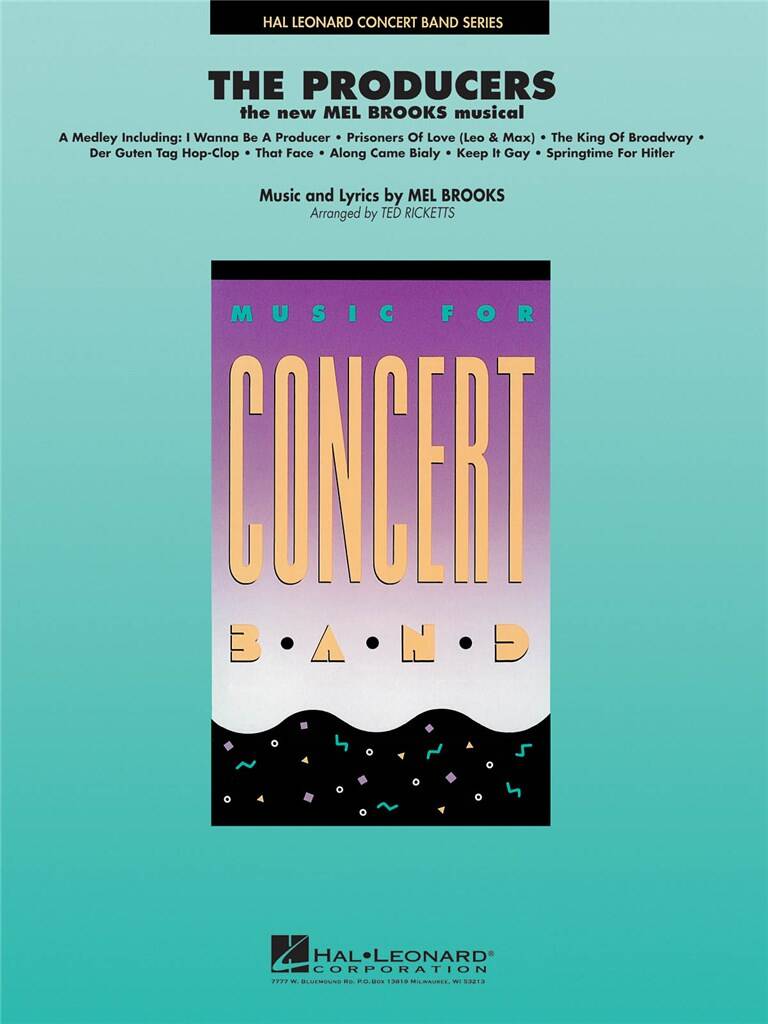
The Producers
Currently the hottest ticket on Broadway, this Mel Brook's masterpiece features a wealth of dazzling show tunes. Includes: Along Came Bialy, Der Guten Tag Hop-Clop, I Wanna Be A Producer, Keep It Gay, The King Of Broadway, Prisoners Of Love, That Face, and of course, Springtime For Hitler.
Estimated dispatch 7-14 working days
-
£77.50
English Christmas - Clare Grundman
Based on the tunes of three old English carols: I Saw Three Ships, The Wassail Song, and What Child is This? Duration: ca. 3 minutes.
Estimated dispatch 7-14 working days
-
 £60.99
Song for Hope - Michael Sweeney
Written as a memorial for a middle school band student, this sensitive and moving work opens with a chorale played by off-stage brass. A flowing melody stated in the low register is then developed before leading to a brieffanfare-like affirmation. The Korean folk song You and I is briefly quoted before returning to the off-stage brass and calm closing passage. A beautifully scored lyric piece for band. (Extra players are not required for theoff-stage parts.) Dur: 4:30
Estimated dispatch 7-14 working days
-
ISS Flyover - Peter Meechan
I.S.S Flyover was written in August 2012, when the International Space Station (I.S.S.) was visible in the sky over my home town of Manchester, UK. This is not an uncommon occurrence (www.heavens-above.com is a useful tool to help you find when the orbit of the I.S.S. passes over), but what was unique about this particular pass was that there would be astronauts carrying out repair work on the outside of the station.The idea that something that seemed to pass so quick in the skies above us juxtaposed with what must have seemed a slow, dangerous journey for the astronaut is what lead me to write this piece.The opening passage is a fast, ostinato driven section; the speed and energy that the I.S.S is perceived from earth. The middle section is desolate and sparse; the astronauts looking down on earth as they slowly orbit around the globe, the loneliness of space. The final section is a return to the original material - this time with even more momentum and drive, provided by the percussion.I.S.S. Flyover was commissioned by a Canadian consortium of: the University of Saskatchewan, Brandon University, the University of Calgary, Harmonie Laval, Memorial University of Newfoundland, the University of Prince Edward Island, the University of Toronto and Anthony Reimer, Calgary, Alberta. The work is dedicated to Darrin Oehlerking who organised the commission consortium.
Estimated dispatch 5-14 working days
-
£13.95
Joy to the World
1Joy to the WorldHandel arr. StirlingThe Central Band of the Royal Air Force2.162A Carol Symphony - I. PreludeHely-Hutchinson/WilliamsThe Central Band of the Royal Air Force4.003Shepherd's HeyPercy GraingerThe Central Band of the Royal Air Force2.104A Fireside Christmasarr. Sammy NesticoThe Central Band of the Royal Air Force8.075Dance of the TumblersRimsky-Korsakov/O'DonnellThe Central Band of the Royal Air Force3.486-9A Joyful ChristmasNeil RichardsonThe Central Band of the Royal Air Force I. Ding Dong Merrily on High 1.57 II. Unto Us a Child is Born 3.09 III. O Little Town of Bethlehem 3.24 IV. Masters in This Hall 1.5010Hallelujah ChorusHandel trs. RichardsThe Central Band of the Royal Air Force3.5811Carols from Olde Englandarr. Duncan StubbsThe Central Band of the Royal Air Force9.1112Jesu, Joy of Man's DesiringBach trs. MorrellThe Central Band of the Royal Air Force3.2913Dance of the Sugar Plum FairyTchaikovsky trs. RichardsThe Central Band of the Royal Air Force1.5014-16A Christmas SuiteDavid BarkerThe Central Band of the Royal Air Force I. Chaconne 1.52 II. Scherzo Variations on We Three Kings of Orient Are 2.53 III. Fanfare and Fugue 4.1017Chrismas-TimeStuart L. StirlingThe Central Band of the Royal Air Force5.23
Estimated dispatch 7-14 working days
 View Music