
Results
-
 £49.95
A Life Well Lived (Concert Band - Score and Parts) - Wiffin, Rob
A Life well lived was commissioned by the Morrish family in 2023 on the death of Ian Morrish. It is dedicated to them with the inscription in loving memory of Ian.I knew Ian from early days at Southall Citadel Salvation Army Corps and then our paths crossed again briefly when I joined the Central Band of the Royal Air Force. Ian had been a euphonium player in the band for many years and was about to leave to take up a teaching post in Surrey. He was always very involved in choral music, conducting choirs throughout his life. I therefore wanted to keep this piece song-like and actually started with the song which appears from letter D to the end, which can always be performed on its own. From there I used the rising octaves that introduce the song to form the beginning of the work, with the feeling in the back of my head of a river starting to flow. There is nothing referential in the more dramatic sections towards the beginning, but every life has its dramas and I wanted something to give some balance to the tranquil nature of much of the piece. In the middle of the work I use a little motif taken from a song I remember Ian singing in his floating tenor voice. I develop the motif a little as an accompaniment to a new line which has, for me, a sense of purpose and directness and has an oblique reference to the RAF March Past. This builds to the aforementioned song and from there the music flows with its highs and lows to its peaceful conclusion.- Rob WiffinDuration: 3.30
Estimated dispatch 7-14 working days
-
 £94.95
Fire in the Blood (Concert Band - Score and Parts) - Lovatt-Cooper, Paul
Fire in the Blood was commissioned by Dr Stephen Cobb for the 120th anniversary of the International Staff Band of the Salvation Army. The piece was composed for the celebration concert where the ISB were joined by several other staff bands from around the world to perform independently to a sell-out capacity crowd at Britain's most famous concert hall The Royal Albert Hall. Fire in the Blood received its world premier at the 'ISB 120' concert at the Royal Albert Hall on June 4th 2011.With this piece I wanted to acknowledge music that had an impact on me through my Salvation Army upbringing. When thinking of a title for this piece I had no hesitation than to reflect and re-word the Salvation Army's motto under their famous crest 'Blood and Fire'.When composing Fire in the Blood I wanted to use three songs of worship that have been prevalent in the Salvation Army's services over a number of years. Opening with Richard Phillips' setting of Psalm 95, 'Sing for Joy', the music is vibrant and full of energy, I wanted to capture the spirit of the well known words of Scripture. The music then moves into a more reflective section that includes Howard Davies' emotive song melody 'Lord, you know that we love you' and Laurie Klein's worship song 'I love you Lord'.A re-statement of the opening Psalm setting follows and this, in turn, leads into a dramatic and powerful finale that combines two pivotal statements drawn from the slower, reflective section: I love you lord, and I lift my voice to worship you, O my soul rejoice and Lord, you know that we love you with a final flourish from Psalm 95: Come let us sing joy to the Lord!- Paul Lovatt-CooperDuration: 10:00
Estimated dispatch 7-14 working days
-
 £154.99
Swaying in the West Wind (Concert Band - Score and Parts) - Yagisawa, Satoshi
This piece was commissioned by Japan Ground Self Defense Force Western Army Band. In the programme note for the premiere the composer wrote: "I am always impressed by the expansive earth and sparkling ocean scenery when I come to Kyushu. I have met many local people here and they are all expressive and energetic. I wrote this dramatic piece to convey to the whole of Japan the memory of my experience here, swaying in the west wind. I wrote this, hoping that the Self Defense Force will forge closer ties with the community through this piece." Eastern drama felt in the west wind!Duration: 8:00
Estimated dispatch 7-14 working days
-
 £93.10
Impressions from a Journey (Concert Band - Score and Parts) - Stahli, Urs
I'm in the mountains... in Switzerland - in the Valais - on the Riederalp. I'm enjoying the view of the surrounding mountain peaks on this late summer afternoon.A alphorn plays a melody. The echo comes back once, twice, no, three times from the mountain slopes! It's getting dark. The melody of the evening blessing from Humperdinck's Hansel and Gretel comes to mind. It is night.A new day begins! I make my way to Riederfurka, to Villa Cassel. There I am greeted by the sound of the orchestra. I enjoyed the music and my lunch. In the afternoon, the musicians invited me to a dance. As waltzing is not really my thing, I walk on to the Riederhorn. There I enjoy the wonderful view! I am happy!- Urs SthliDuration: 8.00
Estimated dispatch 7-14 working days
-
 £54.95
Spider Legs (Concert Band - Score and Parts) - Wiffin, Rob
Spider Legs is a vibrant Latin dance number. Although I have used Latin rhythms in pieces in recent years this is the first time I have returned wholeheartedly to one of my favourite types of music since I wrote Tiptoe Tune in 2001. Typically I wrote it when I should have been writing something else but I really enjoyed going back to these rhythms. Stylistically Spider Legs can best be described I suppose as 'Merengue House' but perhaps it is better without any description! It was composed in 2014, shortly after the birth of my granddaughter Emma Louisa who was nicknamed 'Spider Legs' at the time and the name seemed to fit the music so well that I could not resist it.
Estimated dispatch 7-14 working days
-
£10.95
Spider Legs (Concert Band - Score Only) - Wiffin, Rob
Spider Legs is a vibrant Latin dance number. Although I have used Latin rhythms in pieces in recent years this is the first time I have returned wholeheartedly to one of my favourite types of music since I wrote Tiptoe Tune in 2001. Typically I wrote it when I should have been writing something else but I really enjoyed going back to these rhythms. Stylistically Spider Legs can best be described I suppose as 'Merengue House' but perhaps it is better without any description! It was composed in 2014, shortly after the birth of my granddaughter Emma Louisa who was nicknamed 'Spider Legs' at the time and the name seemed to fit the music so well that I could not resist it.
Estimated dispatch 7-14 working days
-
 £32.95
Trombone Concerto (Trombone Solo with Concert Band - Score only) - Wiffin, Rob
The composer writes:My Trombone Concerto was commissioned by Brett Baker following an earlier piece I had written for him called Shout. The concerto was composed in Spain the summer of 2010. Once I started writing I realised this concerto was, inevitably, going to draw on my own experiences as a trombone player.The first movement was really a matter of getting the right thematic ideas and balancing the tutti and solo passages so, for formal structure, I studied the Gordon Jacob Trombone Concerto. There is a lyrical section preceding the first Allegro that owes much in spirit (but not the actual music) to The Eternal Quest, Ray Steadman-Allen's Salvation Army solo.The slow movement seemed determined to come out in the vein of a Richard Strauss song. I wanted to write ineluctably cantabile as we trombone players rarely get a chance to play the melody! There is a brief allusion to that wonderful moment when the trombone gets to sing above the orchestra in Sibelius' seventh symphony. Arthur Wilson (my teacher at college) died in the summer of 2010 so it seemed appropriate to dedicate this movement to him.The last movement is the lightest of the three in style and is slightly jazz-inflected, hopefully providing some fun for the soloist.While wanting to test the instrument, I did not set out with the intention of making the concerto difficult but there are undoubtedly challenges of technique, range and style to be met by the soloist.Recorded on Polyphonic CD QPRM161D Roman TrilogyDuration: 19:30
Estimated dispatch 7-14 working days
-
£164.95
Trombone Concerto (Trombone Solo with Concert Band - Score and Parts) - Wiffin, Rob
The composer writes:My Trombone Concerto was commissioned by Brett Baker following an earlier piece I had written for him called Shout. The concerto was composed in Spain the summer of 2010. Once I started writing I realised this concerto was, inevitably, going to draw on my own experiences as a trombone player.The first movement was really a matter of getting the right thematic ideas and balancing the tutti and solo passages so, for formal structure, I studied the Gordon Jacob Trombone Concerto. There is a lyrical section preceding the first Allegro that owes much in spirit (but not the actual music) to The Eternal Quest, Ray Steadman-Allen's Salvation Army solo.The slow movement seemed determined to come out in the vein of a Richard Strauss song. I wanted to write ineluctably cantabile as we trombone players rarely get a chance to play the melody! There is a brief allusion to that wonderful moment when the trombone gets to sing above the orchestra in Sibelius' seventh symphony. Arthur Wilson (my teacher at college) died in the summer of 2010 so it seemed appropriate to dedicate this movement to him.The last movement is the lightest of the three in style and is slightly jazz-inflected, hopefully providing some fun for the soloist.While wanting to test the instrument, I did not set out with the intention of making the concerto difficult but there are undoubtedly challenges of technique, range and style to be met by the soloist.Recorded on Polyphonic CD QPRM161D Roman TrilogyDuration: 19:30
Estimated dispatch 7-14 working days
-
 £160.00
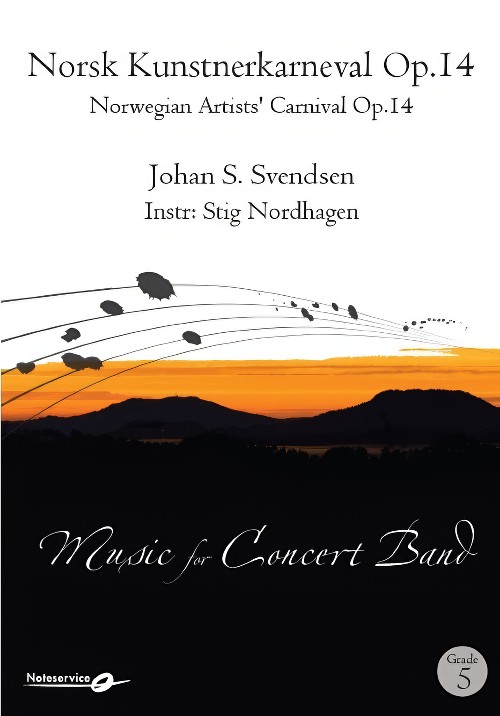
Norsk Kunstnerkarneval Op.14 (Norwegian Artists' Carnival Op.14) (Concert Band - Score and Parts) - Svendsen, Johan S. - Nordhagen, Stig
This well-known work was composed in Christiania in 1874 for a burlesque Carnival in Kunstnerforeningen.An early title for the work was Bryllup paa Dovre. The manuscript score and parts at The National Library in Oslo of the early version with this title have much more music than the version printed by C.F. Peters, Leipzig in 1881. The form in this first version was ABA with an additional trio part that later were discarded. In the trio Svendsen used the melody Saeterreisen (Os har gjort kva gjeras skulle) from Lindeman's collection of Norwegian Folk Tunes. (Vol. I/115). In the A-part a wedding tune (Bruraslaatten) from Sogn is used (Lindeman Vol. I/476). The Carnival's literary theme was the connection between the cold north and the warm south. Musically the south is represented in Svendsen's music by Raffaele Sacoo's melody from 1835, Te voglio bene assai.I believe that if Norwegian quality music from this period is going to be performed, it must at least be available. There must be editions for modern instrumentations with full scores. I do this as my contribution to expand and enrich the repertoire for Concert Bands.- Stig Nordhagen
Estimated dispatch 7-14 working days
-
 £9.99
£9.99Christmas Collection - Alto Saxophone 1 Eb Part II - Large Print A4
Christmas Collection is a newly revised carol book with original, additional and rearranged carols from New Christmas Praise as well as 10 extended pieces. Parts are now also available in large print A4 size!Titles:A child this day is bornA Christmas lullabyA great and mighty wonderAll I want for Christmas is youAll my heart this night rejoicesAngels, from the realms of Glory (Come and worship)Angels, from the realms of Glory (Iris)Angels we have heard on highA starry nightAs with gladness men of oldAuld lang syneA virgin most pureAway in a manger (The manger scene)Away in a manger (Traditional)A winter's taleBethlehemBrightest and best (Spean)Brightest and best (Traditional)Calypso CarolCarol for the NativityCarol of the bellsCarol of the drumChild of MaryChristians Awake!Christ is born (Il est n)Christ was born on Christmas DayCome and join the celebrationCome, children, come quicklyCoventry CarolDeck the hallDing dong! merrily on highDo you hear what I hear?Frosty the snowmanGabriel's MessageGaudeteGlory in the highestGlory in the highest HeavenGod of God, the uncreatedGod rest you merry, gentlemenGood Christian men, rejoiceGood King WenceslasGo, tell it on the mountain!Happy Christmas (War is over)Hark the glad sound!Hark! the herald angels singHave yourself a merry little ChristmasHere we come a-wassailingHow far is it to Bethlehem?Huron CarolInfant HolyIn the bleak midwinter (Cranham)In the bleak midwinter (Darke)I saw mommy kissing Santa ClausI saw three ships come sailing inIt came upon a midnight clear (Traditional)It came upon a midnight clear (Willis)It's beginning to look a lot like ChristmasIt's the most wonderful time of the yearI wish it could be Christmas everydayI wonder as I wanderJesus, good above all otherJingle BellsJingle bell rockJoy to the world!Last ChristmasLet it snow!Little baby JesusLittle children, wake and listenLittle DonkeyLittle Jesus, sweetly sleepLo! he comes with clouds descendingLong, long agoLove came down at ChristmasMary's boy childMary's ChildMasters in this hallMerry Christmas everyoneMistletoe and wineNoelO Christmas treeO come, all ye faithfulO come, ImmanuelO Heaven-sent KingO holy night!O little town of Bethlehem (Christmas Carol)O little town of Bethlehem (Forest Green)O little town of Bethlehem (St Louis)Once in royal David's cityPast three o'clockPatapanPersonent HodiePraise ye the LordRing the bellsRise up, shepherd!Rockin' around the Christmas treeRudolph, the red-nosed reindeerSans day carolSanta Claus is comin' to townSaviour's DaySee, amid the winter's snowSilent Night!Sleigh RideSoftly the night is sleepingSo here it is, merry ChristmasStars are shiningStill, still, stillStop the cavalrySussex CarolSweet chiming bellsSweet chiming Christmas bellsThe candle songThe cherry tree carolThe Christmas songThe first NowellThe holly and the ivyThe infant KingThe light has comeThe shepherds' farewellThe stable doorThe star in the eastThe twelve days of ChristmasThe virgin Mary had a baby boyThey all were looking for a kingThou didst leave thy throneThree kings' marchUnto us a boy is bornWalking in the airWe gather round the manger-bedWe three kings of Orient areWe wish you a merry ChristmasWhat child is this?When a child is bornWhen Santa got stuck up the chimneyWhence is that goodly fragrance flowing?When wise men came seekingWhile shepherds watched (Cranbrook)While shepherds watched (Handel)While shepherds watched (Winchester Old)White ChristmasWho is he?Winter WonderlandWorldwide Christmas messageZither CarolA starry nightChristmas JoyChristmas PraiseCoventry CarolInfant HolyMid-winterRudolph, the red-nosed reindeerThe everlasting lightTo celebrate his birthYuletide Rag
Estimated dispatch 7-14 working days
 View Music