
Results
-
 £57.50
Carrying You from "Laputa: Castle in the Sky" - Joe Hisaishi
New Sounds in Concert Band Series(NSB) for small band with 2-part choir Duration: approx.4'10" Arranged by Eiji Suzuki"Carrying You" was composed as a theme song to Castle in the Sky, an animated film produced by Studio Ghibli and directed by Hayao Miyazaki, released in 1986. The composer for Castle in the Sky was originally not Joe Hisaishi, but the director Miyazaki strongly requested him. The director told Hisaishi his vision for the film, and based on the world he imagined, Hisaishi made a collection of music called the Image Album. The melody that later becomes the basis for "Carrying You" was born from this album. However, the director Miyazaki was not planning on including a theme song in this film. Isao Takahata, the producer, proposed including a song, for the audience to think over the film at the end. He wanted the audience to think, "While the protagonists sought for the treasure, they didn't obtain any treasure. What did they obtain instead?" They thought, if they are going to create a theme song, it should be something organically connected with the entire film. Takahata requested the director Miyazaki to write the lyrics for the theme song. And to Hisaishi, he gave instructions to create a melody for the theme song using an instrumental piece called "Pazu and Sheeta" from the image album mentioned above. Director Miyazaki handed a piece of memo with lyrics to Takahata. "Carrying You" we hear now is this lyrics with some changes, set to Hisaishi's music. The melody is used at the opening of the film as well as the scene where Laputa is destroyed, and the song is used for the ending. Performance Advice from Arranger Suzuki: This is an extremely simple arrangement that can be performed by lower grade bands and singers. Of course, it can be played without singers and chorus, but the contents of the lyrics are very tasty so if possible, we recommend that you perform using the voices. Depending on your resources, the voice parts can be done as all solo, all female chorus, and so on.
Estimated dispatch 7-14 working days
-
 £76.99
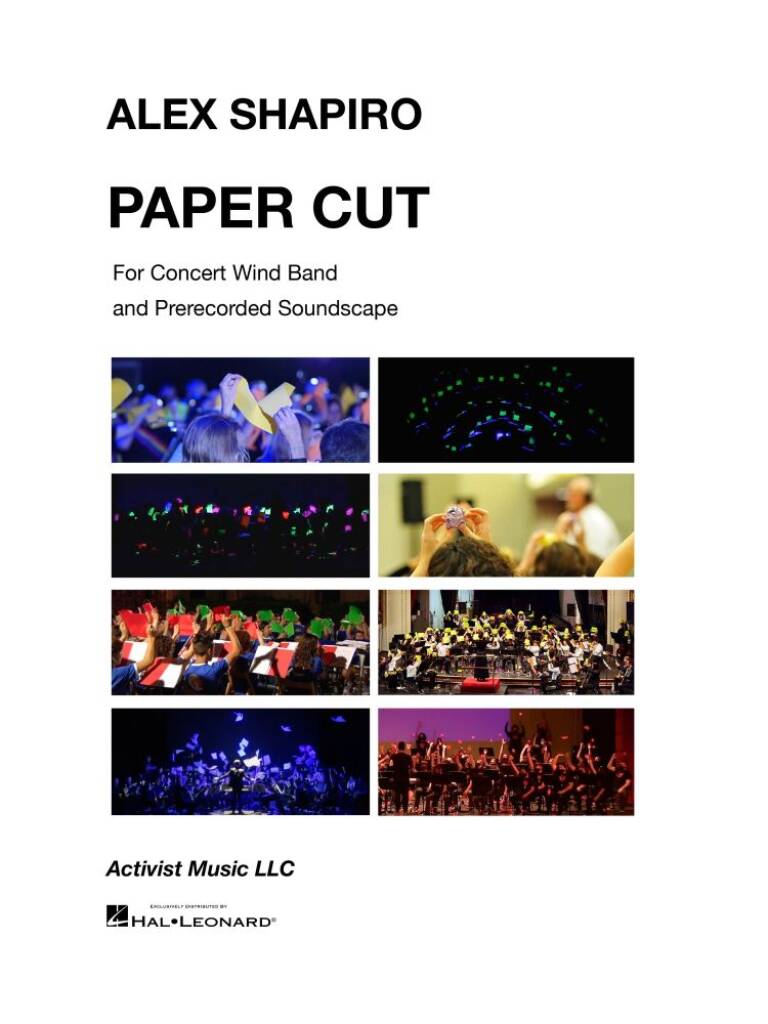
Paper Cut - Alex Shapiro
Composer Alex Shapiro's piece Paper Cut is reminiscent of a movie soundtrack to which the musicians can imagine their own dramatic scene. Paper Cut is written to make the players themselves part of the action with choreographed maneuvers that look as compelling as they sound. In fact, the band members don't even play their instruments until halfway into the piece - instead they play paper along with a prerecorded track! The unusual element of paper and the myriad sounds that can emerge from something so simple offers a fresh view of what music-making can be and opens everyone's ears to the sonic possibilities found among everyday objects. Although Paper Cut was composed with middle schoolers in mind, it's also suited to more advanced musicians, since the paper techniques and the skill of playing against a prerecorded track are interesting for all ages. To perform the piece, you'll need an audio system capable of playing the prerecorded audio tracks from a laptop computer via a small digital audio interface connected to an audio mixer. Download information is provided in the printed piece. A free downloadable interdisciplinary curriculum for teaching Paper Cut is also available for download at www.BandQuest.org. Learn more on YouTube!. Bandquest, an exciting series of new music and accompanying curricula for band, is a program published by the American Composers Forum. The series was started as a response to feedback from music educators that there is a pressing need for new, fresh band music. The heart of this program is new works written by a diverse group of leading American composers who have created challenging pieces that are a true departure from standard middle school repertoire. Every BandQuest project includes a residency component in which the composer works collaboratively with a middle school as they create their new piece.Many BandQuest pieces are accompanied by an interdisciplinary curriculum designed to assist students as they learn the music and to integrate each piece with non-music studies. Visit www.bandquest.org to learn more about this innovative series, and email [email protected] to request a free downloadable audio catalog.
Estimated dispatch 7-14 working days
-
 £159.99
The Miner's Saga - Otto M. Schwarz
This programmatic piece is about a simple miner by the name of Gottlieb Bumler and his pact with the devil. In the program note one can follow each step of the story so you can almost hear the events as if they were happening in front of you! This cinematic piece is full of sound effects, great brass sequences, solid percussion and virtuosic winds. An ideal piece for a thematic concert, or a challenging choice for a contest. This programmatic piece is about a simple miner by the name of Gottlieb Bumler and his pact with the devil. In the program note one can follow each step of the story so you can almost hear the events as if they were happening in front of you! Thiscinematic piece is full of sound effects, great brass sequences, solid percussion and virtuosic winds. An ideal piece for a thematic concert, or a challenging choice for a contest.
Estimated dispatch 7-14 working days
-
 £435.40
Goldberg 2012 - Svein H. Giske
The first time I heard Bach's Goldberg Variations was in the movie Silence of the lambs, in the early 1990s. I noticed the beautiful background music in one of the scenes, but at that time I didn't know what it was. A few years later, when I was studiying at the Grieg Academy, I got to know the entire piece. For me, this is a piece of music which I can listen to countless times. I think it sounds as fresh today as it did more than 15 years ago and it never ceases to inspire me. Both Bach's composition and Glenn Gould's famous 1955 recording (which was the first one I heard) still makes a great impression on me. Before Gould recorded it at age 22, it wasn't a highly ranked piece amongst pianists and Bach was by many viewed as a bit old-fashioned. The young Canadian turned all this around. He managed to portray Bach in a reformed way, producing fine nuances in phrasing and making the many layers in Bach's music more transparent than anyone before him. Thus he plunged both himself and Bach (back) onto the international music scene. When The Norwegian Band Federation (NMF) asked me to write the test piece for NM in 2012, it was only natural for me to use the Goldberg Variations as a starting point and inspiration for my work. Since I was a teenager at NMF's summer courses in the mid eighties I've always listened to many different styles of music. Growing up in Sunnmre with the Brazz Brothers as teachers and mentors, jazz-, pop/rock- and folk music were early on a natural part of my musical background. I also have my classical education from the Grieg Academy on trumpet. As the title of my piece implies, I've wanted to bring Bach to the present and put his music into various modern musical landscapes. I think you can bring about a special kind of energy when music from different genres are mixed and I've tried to do this by mixing Bach with artists and musical styles from the present. In Goldberg 2012, the music is often constructed by several layers, which in a way are living parallel musical lives. They are seemingly moving or floating freely, almost unaware of each other, but bound together by the same basic pulse. The rythms, however, are often notated on a different rythmic subdivision level than the usual 8th- or 16th note levels. By doing this, I hope to achieve transparent sounds that rythmically are perceived as more free and detached from each other. In large sections of the piece, pop/jazz is fusioned with elements from Bach. I guess you could have this little scene as a synopsis for the piece: picture a group of musicians meeting: some are classical performers, some are jazz. They start to improvise together, each in their own voice or musical dialect and I'm sort of in the middle, trying to write down what they are playing. This is what I feel much of Goldberg 2012 is about. The foundation of the piece, in addition to Bach and references from pop/jazz music, lies also in my own material. This material, basically two chords, is heard in it's purest form in the 1st movement. I use these chords to create scales, new chords and different motifs which contribute to blend together the different moods of the piece. It has not been my intention to copy Bach's form (theme and 30 variations), but rather to use the bits and pieces that I like the most as an inspiration for my own variations. The 1st movement, Aria 2, is for my 3rd son, Olav, who was born on the 21st of April 2011, and the 5th movement, From long ago, is dedicated to the memory of my father, Svein J. Giske, who passed away on the 6th of June 2011. -Svein H. Giske, January 2012-
Estimated dispatch 7-14 working days
-
 £168.50
60 Warm-up Chorales for Concert Band
During his experience as a band conductor and teacher of wind orchestra conducting at university, Franco Cesarini has dealt with the topic of warm-ups very frequently. Throughout these long years of conducting he has had the opportunity to try many existing methods, evaluating their advantages and disadvantages.After a long time, he has decided to compile a collection of chorales for warm-ups, which are organized according to the criteria that he considers most effective.While working on his60 Warm-up Chorales for Concert Band, Franco Cesarini has always borne in mind that amateur musicians play for pleasure.He feels that it is extremely important that they have satisfaction at every moment of the rehearsal and not to start the rehearsal with needless "punishing" exercises. Nobody is really motivated to start playing with scales, long notes, or tricky rhythmical exercises. There is often a distinguished absentee in band rehearsals, namely music itself!Although this publication does not foresee a specific tempo for the chorales, they should often be performed rather slowly but without dragging.Dynamics are not indicated, so that the conductor has the opportunity to draw the attention of the musicians to his gestures and to make them react according to his indications.Timpani and bell parts have been added with the aim of not leaving the percussionists completely inactive during the warm-up phase, but can also be omitted.The chorales are written in four parts (SATB) and are also playable in smaller groups. The four voices can be played in different combinations of woodwinds or brass quartets or in mixed combinations.The collection includes ten chorales for the following keys: D flat major, A flat major, E flat major, B flat major, F major and C major.With his 60 Warm-up Chorales Franco Cesarini would like to convey the message to play the chorales in a musical way, thus raising the musicians' awareness of phrasing, the right interpretation of cadences, rubato and agogic.Above all, never do anything without putting the musical aspect in the foreground. 60 Warm-up Chorales for Concert Band: A perfect collection to warm-up and improve tuning of a concert band!
Estimated dispatch 7-14 working days
-
 £79.99
Scalin' and Wailin' - Thomas C. Duffy
Scalin' and Wailin' is a flexible, fun piece written with a differentiated instruction model. Three different difficulty levels meet students where they're at in their development and allows space for each to grow. This piece is also ideal for educators and conductors looking for side by side programming - younger ensembles can all play within the easiest group and more advanced ensembles can play within the more difficult groups, all fitting together in one energetic piece. Celebrate BandQuest's 20th anniversary with this special release, and find what works for your ensemble! BandQuest, an exciting series of new music and accompanying curricula for band, is a program published by the American Composers Forum. The series was started as a response to feedback from music educators that there is a pressing need for new, fresh band music. The heart of this program is new works written by a diverse group of leading American composers who have created challenging pieces that are a true departure from standard middle school repertoire. Every BandQuest project includes a residency component in which the composer works collaboratively with a middle school as they create their new piece. Many BandQuest pieces are accompanied by an interdisciplinary curriculum designed to assist students as they learn the music and to integrate each piece with non-music studies. Visit www.bandquest.org to learn more about this innovative series, and email [email protected] to request a free downloadable audio catalog.
Estimated dispatch 7-14 working days
-
 £149.40
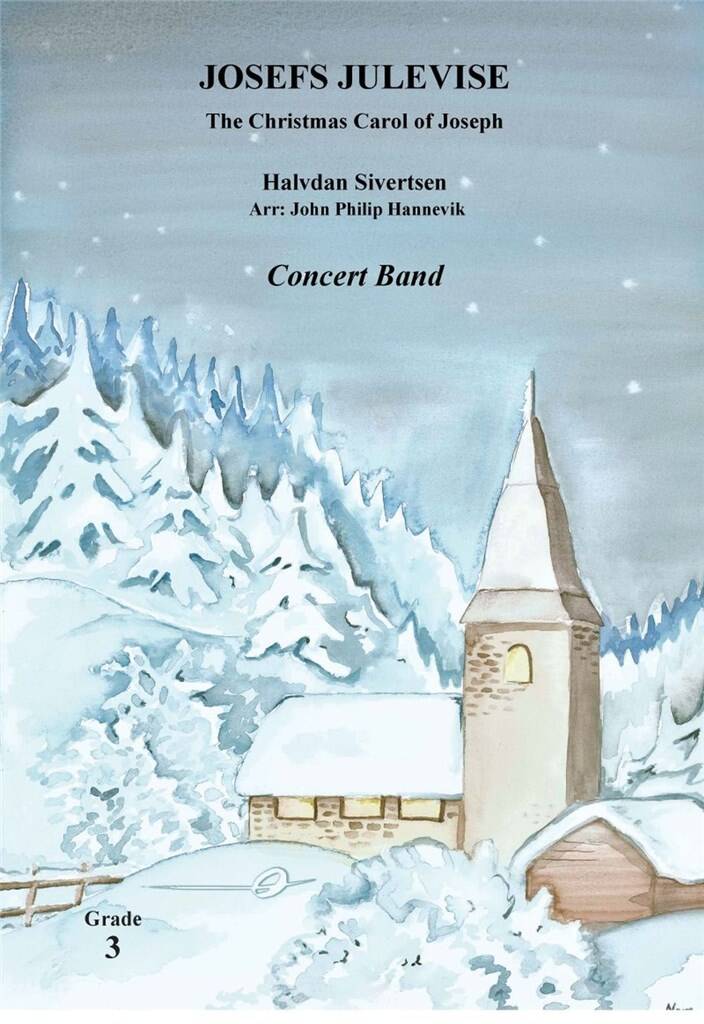
Josefs Julevise - Halvdan Sivertsen
Halvdan Sivertsen (born 1950) is one of the most popular singer/ songwriters in Norway. He is well know as a first-class storyteller, and he has a strong melodic line in all his music. This Christmas song was first recorded in 1991 and it has become a Norwegian classic. The lyrics tell the story of a couple travelling through time to find a city with bright lights, where they hear people sing about the couple who are about to have their first baby. But still this couple can not find anybody willing to help them, and they are forced to go back 2000 years, to find the stable where they find some shelter. Maybe they should have travelled further ahead in time in the firstplace, to find people willing to open their door to the poor and needing?
Estimated dispatch 7-14 working days
-
 £84.99
Best Friends - Johan Nijs
Friends are of the utmost importance in any person's life. True friends can always count on one another, even if they don't meet up as often as they might wish. With Best Friends, the Belgian composer Johan Nijs portrays this themein a wonderful ballad that can be played on the trumpet, euphonium or trombone. A great chance to put one of your players in the spotlight.
Estimated dispatch 7-14 working days
-
 £53.50
Christmas Elves in Santa's Workshop - Mike Hannickel
Take advantage of some of the silly voices your young band students can create with this whimsical visit to Santa's workshop. Lots of workshop tool sound effects combine with some Christmas favorites to show the audience theworkshop from the Elves' point of view. They need paint, they need googly eyes, they need nails, they need A BREAK! (Grade 1/2)
Estimated dispatch 7-14 working days
-
 £274.99
Symphony No. 2: States Of Mind, Opus 87 - Teo Aparicio-Barberán
I- Logos (reason)II- Pathos (emotion)III- Ethos (credibility)The ancient Greeks believed that music shaped the character of man. In Egyptian temples, music was an essential part of the magical rites to alter the course of nature or to treat illness.And today we know that sound can actually alter matter. The secret of music lies in harmony and mathematics, as many great musicians and experts have always known.One of the most important qualities of music is that it enables the listener to focushis attention inwards instead of on what is around him. It is indisputable that music can inspire emotion. Music leads us into a universe of emotions that are difficult to put into words. In short, music reaches into corners of our soul and thoughtsthat words cannot reach and makes it possible to more clearly describe these different States of mind.The composer of this symphony also believes that each "musical argument" must be constructed so that it will induce the desired reaction in thelistener.Music: more than wordsIn recent times, most orchestral symphonies have been based on a story, a text or something similar so that their composition must be structured accordingly.The intention of this work by Teo Aparicio-Barbern is quitedifferent. The composer describes the three elements of the argument as the only formal structure of the work. Since certain philosophers in world history were able to subdivide grammatical argument, why shouldnt that also be possible for the musicalargument?Since ancient times the power of the spoken word has captivated mankind. How can an argument move people and mobilise the masses? Where does the power of words come from today? The answer lays not so much in what people say but in how theysay it.Rhetoric is one of the oldest humanist disciplines in Western civilisation. Aristotle, in the 4th century BC, called it the art of persuasion. Indeed, the terms rhetoric and persuasion are mutually interchangeable.More than 2000 years agoAristotle structured his rhetoric according to the following three elements: the logos, the pathos and the ethos.Logos (words, reason) is the reasoning that gives freedom to the structure of the text by expressing what one wishes to say usingspecialist terms. With logos we create arguments to receive public approval and to defend our ideas.Pathos, the second element, refers to the effective use of public psychology. Pathos can be considered as the capacity to induce the desired emotionalresponse in the public, by creating an emotional connection with the public so that they accept our message.The third element, ethos (credibility), refers to the character of the speaker and is perhaps the most important of the three elements.Aristotle based his concept of ethos upon his belief that truth and justice will always have the upper hand over anger. He believed that what was true and good was easier to prove and was more persuasive.This second orchestral symphony from thecomposer from Enguera follows these three parameters of the argument according to Aristotle. Each movement tries to summon a different state of mind in the listener so that the message itself can be better understood and appreciated. Apart from thesethree general concepts the music is only structured, as Claude Debussy would say, in a "formative way".The first movement, logos, is based on a scherzo melody that undergoes various changes in rhythm and harmony. The arguments are presented by meansof conventional techniques of composition. The second movement, pathos, is characterised by suggestions of sound. It is subdivided into two large parts. The first part is based on a five seven sequence with five sounds that are repeated in differentenvironments, structures and dynamics. The second part, which is largely tonal, brings out more directly the emotional overtones that each argument must have. The third movement, ethos, is a faithful rendition of the composers personality. In thislast part, clear rhythmic sequences stand out, there are large dynamic contrasts and lots of tone variation. In addition, and this is quite in keeping with the composers earlier work, the harmony in States of Mind is handled in a manner that is bothoriginal and efficient, as a result of which Aparicio-Barberns message is well understood by the listener.This second symphony by Teo Aparicio-Barbern is devoted to "my dear Henrie Adams, a guiding light in this eternally dark musical world. Thankyou for everything."
Estimated dispatch 7-14 working days
 View Music