Results
-
 £140.80
Belvedere Suite - Wilhelm Koenen
Part One: 'Danse mditerranenne'This part is composed of stylized folkmusic elements from several regions of Mediterra-nean countries. If this music recalls memories of your holidays on the sunny beaches, the composer will have reached his goal.Part Two: 'Impression'This part is meant as a contrast with the first and the third parts. The conductor should not stick to the metronome tempo, but he can express his own interpretation by means of 'rubato playing'. This 'impression' was inspired by the Provence landscape.Part Three: 'Marche grotesque'We deliberately used non-typical characteristics of the traditional march. The underlying idea is: A band starts playing a march at the ordinary marching tempo. There is already a mistake at measure 4 when some musicians play the wrong bar which causes the fifers to start too early with the drum and fife signals. A grumpy 'Stop' brings and end to the false start by means of a pathetic quaver (eighth note). The drummers however continue to play their drum beats, so the fifers start again and play very quickly in order to catch up with the drummers. They even manage to do so, thanks to that late quaver (eighth note). The band now also starts to play again and reacts to this chaos by laughter. The march that comes next does not match the metric characteristics of the usual march. The woodwinds, dreaming of holidays, get caught in a Tarantella. A compelling signal by the trumpets and the horns, soon joined by all band registers, leads the band back to reality. We deliberately chose well-known 'secondary parts' in order to make the audience accept the 'out-of-tune playing'. Original themes would not have had the same effect. The whole composition is just one great musical joke. If the audiance chuckles the composer will have achieved his aim. The third part is extremely well suited to end a concert or to be used as encore.
Estimated dispatch 7-14 working days
-
 £90.30
Omaggio a S.E.M. - L. Navisse
This concertmarch was composed in 1994 and it was dedicated to a medieval town. At the beginning you can hear the dissonant blares (trumpets, cornets, horns and trombones) symbolising the rivalry between the four districts of the town. Then, the piece is a symphonic march in Italian style but not completely traditional. Before the end, it is possible to hear the blares of brass again, but now they are melodious, so the piece turns sweetly to the end.
Estimated dispatch 7-14 working days
-
 £108.40
Draco - Alex Poelman
This composition is based on an old Chinese myth about the constellation Draco which is still to be seen in the firmament between the Great Bear and the Little Bear. The Chinese people believed that when there was en eclipse, Draco was eating the sun. They tried to drive away the dragon with heavy drum beatings. The score boasts two main themes evoking respectively the sun and the Chinese people. You can hear successively the Chinese worshipping the rising sun, the threat of Draco and the triumph of the sun and the Chinese over the dragon. Because of the Asiatic sounds you will imagine to make a short trip through the ancient Chinese Empire.
Estimated dispatch 7-14 working days
-
 £138.00
San Pedro de Alcntara - Valdemar Gomes
The Spanish war galleon with 64 cannons, built in Cuba between 1770 and 1771 for an English shipowner in the service of the King of Spain left Peru for Cadiz in 1784 with a huge cargo of copper, gold, silver and other valuables on board. There were also more than 400 people on board, including passengers, crew and Inca prisoners after a revolt. The Atlantic crossing went smoothly, passing Portugal to take advantage of favourable winds. The shipwreck off Peniche was the result of human error, apparently due to French maps with dramatic errors in the position of the islands of Berlengas and neighbouring islets. On 2 February 1786, the sea was calm and the night clear, but they hit the rock formation Papoa and the hull immediately broke in two. The bottom sank quickly, while the deck remained afloat for some time. 128 people lost their lives, including many Indians who were trapped in the basement. This shipwreck is considered one of the most important in maritime history.What the composer wants to convey, and what can be felt as one listens, is first of all the sound of power, of hope, of the glory of conquest, of the splendour of wealth. This is followed by the perception of the maritime environment, the harmony with the softness of the ocean, the gliding of the hull in the foam of the sea on sunny, blue days. But along with this tranquillity, you soon hear a rhythmic chain that makes you feel a representation of the hustle and bustle, of the busy crew, of the hard work of a sailor, of the desperation of an exotic people imprisoned in a dark, damp cellar. A distinct rhythm that reminds us of the "salero" of Andalusia, with its Arab influences and its people, the soothing of the resignation of others who are forced to submit. Then we clearly hear a crescendo that makes us imagine the agony of the collision that precedes the shipwreck. The breaking of the hull, the water flooding everything, the despair, the clash of bodies on the rocks, the tragedy to come. Before the "grand finale", in which the return of musical softness reminds us that the story is over. The supremacy of nature over human greed. The waves, though gentle, sweep the wreckage, the lives and the treasures of the New World to the bottom of the sea.
Estimated dispatch 7-14 working days
-
 £67.95
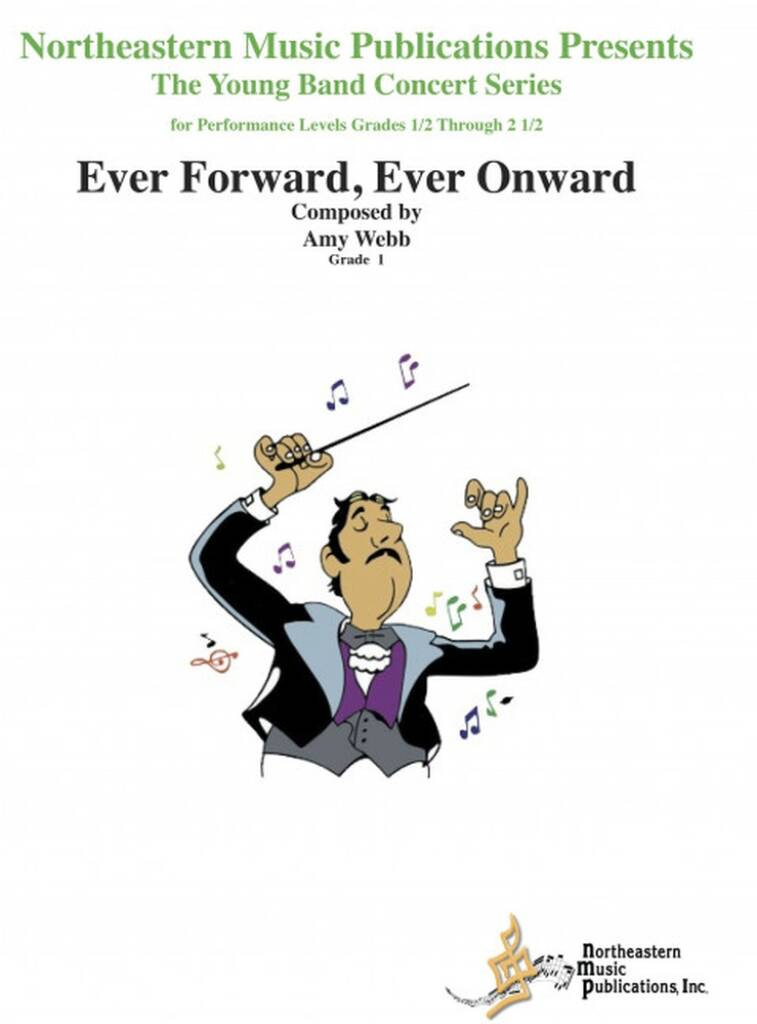
Ever Forward, Ever Onward - Amy Webb
Ever Forward, Ever Onward is a wonderful piece written in concert B-flat and only uses notes within the scale. The clarinets do not go over the break. If students have been playing for at least a semester, this piece will be just challenging enough to make them want to work, but not so hard that they give up. The lines are interesting, too, no matter what instrument you can play. Students will love to play this and I hope you have fun. 1st trumpet's highest note is A.
Estimated dispatch 7-14 working days
-
 £435.40
Symphony No 1 for Wind Band - Solitude Standing - Stig Nordhagen
The two movements in this symphony have quite similar structure and length, and this is no coincidence. As a composer, I try to create two musical stories that comes from the same starting point and thought, but they sound and feel different. Music often describes something you cant say in words. This composer stands in the middle of the symphony, here personalized as trombone solo (or euphonium) and tries "Solitude Standing" to make a bridge between the two parts. - Stig Nordhagen -
Estimated dispatch 7-14 working days
-
£71.00
Oberhessische Bauerntnze - Ottmar Gerter
These four entertaining movements originated in the Thirties. They are an example of popular original compositions of high quality. The work was originally written for small orchestra. Norbert Studnitzky has arranged this series of dances for wind band and at the same time also retained longer chamber music pasages as in the original work.Thus here we have a work for wind band which on the one hand is suitable for developing a musical sense of humour in a playful way and which can also be performed on stage with a group of folk dancers. Ottmar Gerster studied in Frankfurt/main and then taught composition an several colleges of music in Leipzig. his music aims to be accesible to all listeners, even when he uses advanced composition techniques.
Estimated dispatch 7-14 working days
-
Athabasca - Peter Meechan
The stunning Athabasca Glacier, in the Columbia Icefield in the Canadian Rockies, provided the inspiration for this work. After having visited the Glacier in 2016, I knew that it would find a place in my music - the sheer magnitude of it was stunning, the visual was breath-taking, and the rate at which it is receding (5 meters per year) completely devastating.Now sadly collapsed, beneath the Glacier there were great, expansive ice caves - thankfully they were photographed by explorers, and it is these photos that provided the inspiration for the work; an imaginary walk through these fragile, beautiful structures; what music would sound like in them, what talking would sound like in them; and what moments of listening would sound like in them.When writing the piece I also wanted to try and acknowledge the diminishing nature of the Glacier. Whilst not being something you can visibly notice by simply observing for a short time, it is still happening in front of very eyes. This is represented by the tempos in the piece - almost doubling from the original tempo to the fastest tempo of the work (around 2/3rds of the way through), and - hopefully - almost imperceptibly.When commissioned by Ray Baril and the Edmonton Winds to write a new work for them, the Alberta connection between the group and the Glacier was impossible to resist.Peter Meechan 2018
Estimated dispatch 5-14 working days
-
Letters For Home - Peter Meechan
Letters for Home is a three movement work, commissioned by East Lancashire Concert Band with support from Arts Council England, to commemorate the start of the First World War, and the role played in the war by the 'Accrington Pals'. Before each movement a reading should be made - these may be a letter sent from The Front, WW1 poetry, thoughts and reflections recorded elsewhere, or new words, written by local poets, school children or others.Whilst specifically concerned with the First World War, each of the work's movements broadly outlines emotions that would form part of any soldiers lives during any war - and as such, performances of this work can easily be adapted to reflect other wars both modern and historical, and locally sourced words for the readings is highly encouraged.The first movement, "The Bittersweet Love Song" is the story of a soldier saying goodbye to his loved one before leaving for war. The opening passages are of the soldier, perhaps putting to the back of his mind the danger he is facing, singing a love song to his wife or girlfriend. In the following passages we hear his loved one singing "I love you", played by the flute section.We again hear the soldier singing - this time with more of a sense of what lies ahead for him, but now the response is further away as they gradually move more distant from each other. The movement ends without conclusion, but with chords for the soldier's song played hauntingly over the percussion.The second movement, "The Trench", is more self-explanatory. It combines bravado in the percussion opening with the whole band coming together as one - as a unit, before again we hear fear and trepidation in the brass, once more failing to reach a resolution. Perhaps the thoughts of the soldier are interrupted as the percussion once more calls the men to arms. The movement ends with gun shots in the percussion.The final movement, "In Memory", opens with a repetition of the love song from the opening movement, before a slow lament, again never resolving, is heard. It keeps finding a new key, a new place, intending to represent the cyclical nature of war, and again without resolution, suggesting that war is also often that way.Letters for Home is dedicated to Ian McGuinness, whose support, enthusiasm, and sheer hard work led to this work being commissioned and performed, and to the East Lancashire Concert Band, who gave the premiere on 27 September 2014, at the Town Hall, Accrington, home of the Accrington Pals, with the final revision of the work being completed in November of the same year.
Estimated dispatch 5-14 working days
-
£95.00
The Gilded Theatre - Kenneth Hesketh
The Gilded Theatre was commissioned by the National Youth Wind Orchestra of Great Britain on the occasion of its fortieth anniversary. They gave the first performance on 10th August 2008, at St. John's Smith Square, London conducted by James Gourlay.The Gilded Theatre can, in some ways, be seen as a continuation of dramatic forms as presented in a previous piece by Hesketh, Diaghilev Dances. Unlike the Dances, however the music in The Gilded Theatre is conceived as one continuous span and stretches of music are also subtitled and refer to stock characters or scenarios redolent of the commedia dell'arte or 17th Century French Theatre.The subtitles are Rideau, Les Idiots Ou Les Amants, Le Combat Commence, Desespoir, L'apparition, Folie, La Mort, Rideau. The music narative progresses through dramatic, comedic, romantic and aggressive moods supporting the idea of the abstract play to which the the above subtitles refer. Throughout the piece the composer has sought to challenge the players both technically and emotionally, and it is the players themselves who are in fact the protagonists in the piece.
In stock: Estimated delivery 1-3 days
 View Music