
Results
-
 £144.99
Suite Marchigiana - Luciano Feliciani
According to a famous statement by Herder, folk songs represent the archives of a nation's knowledge, the expression of its heart and theimage that reflects its history and identity. Suite Marchigiana is a three movement piece, inspired by folk songs from the Marche in central Italy, a region with a very ancient and rich folkloristic heritage. The first movement elaborates on the well-known Pasquella. The Pasquella comes from a traditional winter begging ritual where a group of musicians go from house to house singing verses, wishing their audience good health, wealth and abundance, in return for small amounts of money, food and wine. The second movementis an Andante Triste inspired by an old song called Sona la mezzanotte (The Clock Strikes Midnight), a melancholic song that reminds us of unhappy love stories, bereavement, and so on. Luciano Feliciani concludes the suite with the Saltarello Marchigiano, which is bright and sparkling, and therefore in complete contrast with the previous movement. Although unproven, the Saltarello is thought to have its origins in the 'saltatio' (a latin dance). While the choreae were group dances, circular in structure and with a rhythmic progression, the saltationes were more lively in character. The fast, frenetic and joyous saltarello was without any doubt the most famous musical expression of rural central Italy in the nineteenth century.
Estimated dispatch 7-14 working days
-
 £78.99
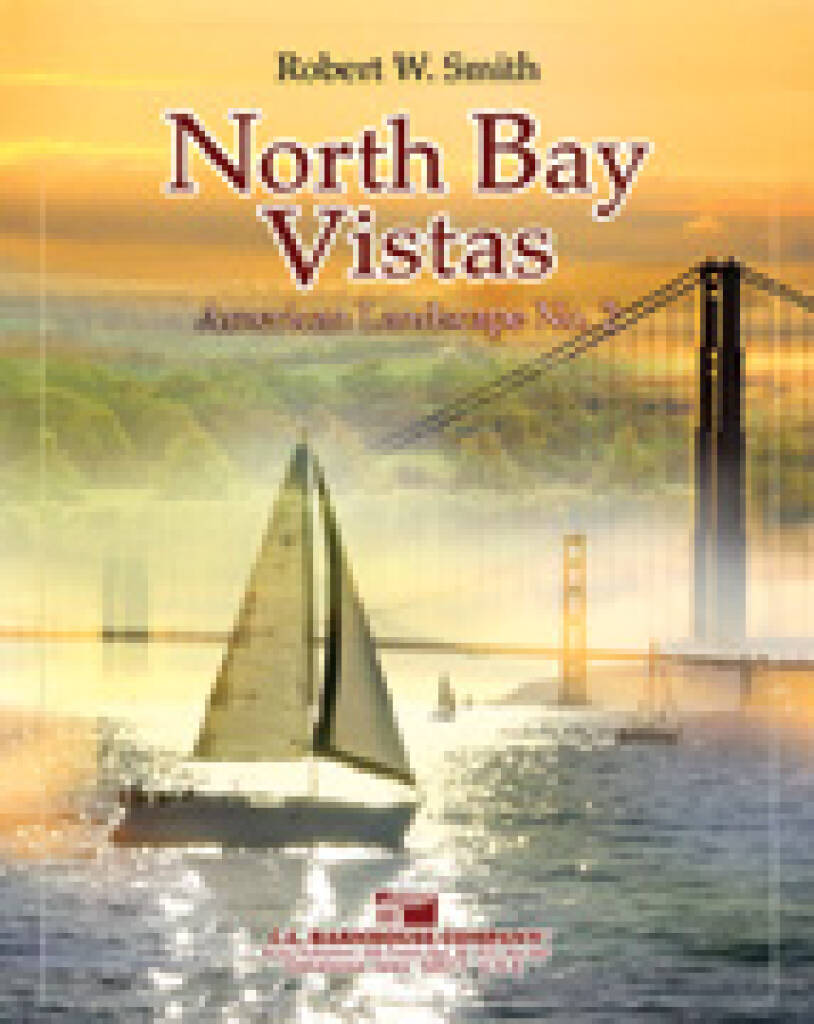
North Bay Vistas - Robert W. Smith
Composer Robert W. Smith's journey to the San Francisco Bay Area inspired this musical panorama. Beginning with an intriguing fanfare statement representing the unforgettable skyline of San Francisco and the unique images of the Golden Gate and Bay Bridges, our journey begins north over the waters of the bay. Sailing across the water, we are treated to magnificent vistas including both the city and the surrounding mountains. An early morning sunrise looking down on the vineyards of Sonoma was the inspiration for the center of the piece. The early morning mist combined with light and shadow creates a very peaceful scene that is not soon forgotten. The piece concludes with the return to the city providing a new perspective of this truly unique American landscape.
Estimated dispatch 7-14 working days
-
£69.99
Firebrook Prelude - James Curnow
Captivated by the rolling hills, majestic horse farms and beautiful horses of the Central Kentucky Bluegrass region, James Curnow has named this exciting overture after one of the most scenic areas near his home. After a fanfare opening, the Percussion section provides high energy for the main theme. A contrasting middle section showcases the expressive abilities of your ensemble. With a return of the main theme, momentum builds steadily to the exciting conclusion.Exhilarating!
Estimated dispatch 7-14 working days
-
 £139.99
Inspiration - Jan de Haan
Inspiration was commissioned by the Solothurnischer Kanotonal Musikverband in Switzerland in 1993. The composition begins with an A-theme written in a Phrygian tonality and, after an enormous climax, moves on into a quicker B-section, characterized by the use of wide interval jumps. Then follows the development in which both themes return individually and together. Peace and quiet is restored in the slow middle movement, based on the B-theme. The movement comes to a close with a tutti B-theme, brutally interrupted by fragments from the A-theme. Without a break, the final movement of this contrastive piece develops from these fragments. The theme of this extremelyrhythmical closing movement is built up of elements from the A-theme, whilst the B-theme (from the slow middle movement) returns in full once more. Before the piece comes to a close in a resounding fortissimo, the cornet soloist performs the A-theme from the back of the auditorium, to special effect.
Estimated dispatch 7-14 working days
-
 £144.99
Ross Roy - Jacob de Haan
Jacob de Haan was commissioned to compose this concert piece by the "St. Peters Wind Symphony" from Brisbane, Australia. "Ross Roy" is the monumental late 19th century villa where St. Peters Lutheran College was founded in 1945. The villa has always remained the school symbol. In this composition, Jacob de Haan sees the "Ross Roy" as a metaphor for the years spent at school (a monument in time), where one's personality is formed. So, the opening theme the artist calls the Ross Roy theme initially has monumental characteristics.The rhythmic motion, which strides along in the lower register and percussion at the beginning of the next section is typical of "Tempo di Marcia". Thismovement, accompanied by repetitions of sound, is a metaphor for the structure and discipline in school. This is the introduction to a march theme, symbolic of "passing through" the classes up to the final examinations.Then, the Ross Roy theme is dealt with again, now in a playful, humorous variation. As if the composer is saying there should also be time for a smile in school. The same theme can be heard in major key and a slower tempo in the following section, expressing pride and self-confidence. This is also the introduction to the expressive middle section that represents love, friendship and understanding.We then return to the march theme in a slightly altered construction. The oriental sounds, constituting the modulation to the final theme, are symbols of the diversity of cultures in the school. The characteristic final theme first sounds solemn, but turns into a festive apotheosis. It is no coincidence that the final cadence is reminiscent of the close to a traditional overture, for the school years can be considered the "overture" to the rest of one's life. The premiere of "Ross Roy" was conducted by Jacob de Haan in Brisbane, on August 22, 1997.
Estimated dispatch 7-14 working days
-
 £105.80
No War - Marco Somadossi
The theme of this composition is immediately evident from the title, which almost requires no further explanation. It will never be possible to represent or reproduce the full implications of a tragedy such as war, all too often forgotten, concealed, exploited or written off as being an evil that is "necessary" for the development of civilisation. War changes the course of human history: man kills man, fathers bury their sons, children take up arms, and mankind is devastated by evil, choosing death over life. The atrocities, repeatedly perpetrated and evident to all observers, are an offence to human dignity. Yet they are tolerated and, at times, even re-interpreted as inevitable remedies for "obstacles" to the global economy, in order- it would seem- to build "a better world". And all this goes on despite the fact that the terrible scars left by past wars are still evident and should serve as a warning to ensure that such tragedies do not return to devastate our world. "No War" is thus a heart-felt protest against any form of culture that justifies war as a means of gaining wealth and power, satisfying the economic needs of the richest countries at the expense of the poorest nations. In so doing the one truly fundamental value is annihilated, that of human life.
Estimated dispatch 7-14 working days
-
 £176.50
Masquerade - Philip Sparke
MASQUERADE was commissioned by Stadtmusik Willisau from Switzerland (Reto Gdel, conductor) to celebrate their 175th anniversary in 2003 and first performed by them in November that year. 1. OvertureThe first movement opens with a fanfare-like figure, featuring the brass, before the main them is introduced over staccato chords. After a short, syncopated interlude a legato theme is introduced in the tenor register and material is developed until the music slows temporarily. The opening theme returns and the 'tenor' tune is taken up by the whole band until the opening fanfare returns to close the movement. 2. ElegyThe slow movement opens intensely with a bare two-part theme, whichleads to a passionate chorale-style melody. A second theme is introduced and leads to a climax, a return of the chorale theme and a pianissimo repeat which again leads to a full-band climax. The two-part theme returns quietly to create a peaceful close. 3 InterludeA short movement which changes the mood to introduce:- 4 FinaleThree violent chords preface a lively syncopated opening theme. The trumpets introduce a second idea, which is treated fugally, and this in turn leads to the main melodic idea of the movement, over staccato chords. A contrasting subject is then introduced in the middle of the band, followed by echoes of the first movement fanfare. The opening theme returns and material is revisited until the opening fanfare returns in full to end the work triumphantly.
Estimated dispatch 7-14 working days
-
 £144.99
Jungle - Thomas Doss
In this fascinating piece we experience an exciting adventure in the jungle. The entrance into the "green hell" turns out to be very dangerous with wild monkeys and the roaring of elephants accompanying our way through the dark forest. There seems to be something lurking behind every tree and all of a sudden, a horde of savage cannibals appears. A wild hunt sets off and we escape at the last second by jumping from a cliff into the savage water below. Exotic birds welcome us in a new landscape and from somewhere in the distance we can hear a bamboo flute playing. This is a journey of no return.... The effects (elephants, wild monkeys, exotic birds and rain) should be producedwith much creativity - individual ideas are always desirable and welcome.
Estimated dispatch 7-14 working days
-
 £149.99
Jericho - Bert Appermont
Jericho is the musical translation of the well-known story from the book of Joshua about the capture of the city of Jericho by the Israelites.Part 1 depicts the cruel journey through the desert to Canaan, the promised land. An emotional lamentation for the yearning for a home, for the end of a roaming existence.The capture of Jericho is the theme of part 2. The city cannot be captured immediately and Jehovah orders an impressive army to march around the city for six days. On the seventh day, they marched around the city seven times and the priests blew their trumpets and the people cried so loud that the walls of Jericho came tumbling down. The Jews stormed the city and drove theinhabitants away. The music clearly reveals the marching army and you can hear the walls falling down with a tremendous noise. However, there is quite some artistic freedom in the actual story.A majestic and grand melody subsequently evokes the triumphant emotions that emerged as the fortified city fell (part 3).Following a personal and romantic interpretation, the scene ultimately ends in a typical Jewish feast (part 4) whereby the virtuosity of melodies played by the woodwinds and the passionate rhythms refer to traditional Jewish music. All themes are repeated in this last part in various forms, often simultaneous and in duelling counterpoint. The piece ends with fragments from the main theme of part 1 in major: peace and quiet return at last.
Estimated dispatch 7-14 working days
-
 £60.99
Canticum - James Curnow
MusicWorks - Grade 2 One of the classics of young band literature, this composition by James Curnow is found on many state lists throughout the country. Described as a song of jubilation, Canticum opens with a very distinctive and rhythmic main fast theme. The beautifully melodic slow 3/4 theme alternates between various choirs of the ensemble then leads to a dynamic return of the main theme and powerful coda. A must for every band program! (3:35)
Estimated dispatch 7-14 working days
 View Music