
Results
-
 £102.80
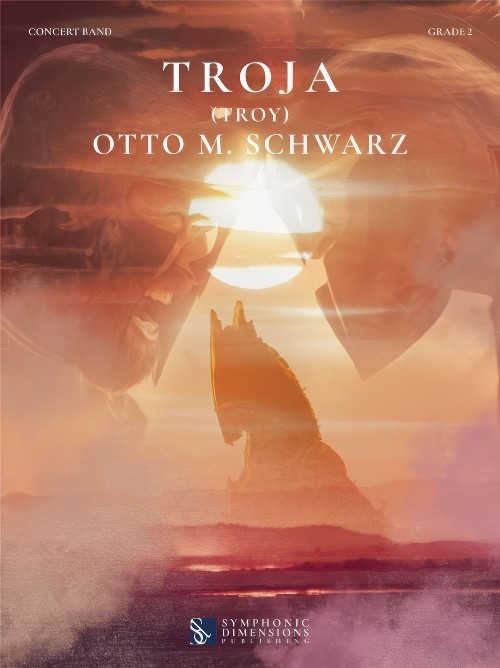
Troja (Troy) (Concert Band - Score and Parts) - Schwarz, Otto M.
The Greek poet Homer wrote about Troy and the Trojan War, which probably took place in what is now Asia Minor, in his Iliad in the 8th century B.C. Nowadays, the term Trojan generally refers to a malware program that is used to gain unauthorised access to computers. This use comes from the legendary Trojan Horse, which saw the turning point in the battle between Greeks and Trojans through the cunning of Odysseus. Let us return to the beginning of the story: Paris, son of the king of Troy, is tasked by Zeus with judging the beauty of the three goddesses Aphrodite, Pallas Athena, and Hera. Aphrodite, the goddess of love, flatters Paris by promising him the most beautiful woman in the world. Soon afterwards, on a journey to Greece, Paris meets the beautiful Helen, who immediately falls in love with him. Since however she is the wife of Spartan king Menelaus, she eventually lets herself be kidnapped by Paris voluntarily. The Greeks then form a large army and go to war against Troy to retrieve Helen, leading to a ten-year siege of the city. The city is eventually conquered not through combat, however, but through Odysseus' cunning ploy. He has the idea of building an enormous wooden horse with warriors hidden inside. The horse is placed at the gates of the city. Thus, the Trojans are tricked into giving up the siege when, despite various warnings, they bring the horse into the city to dedicate it to the goddess Athena. At night, the soldiers climb out of the horse and open the gate for the Greek army. The troops storm the city and burn it to the ground. The royal family and all the Trojan warriors are killed, only Aeneas, the son of Aphrodite, escapes. Later, following many years' wanderings he and his acolytes will become known as the founders of the Roman people. There are various accounts of the fate of the beautiful Helen. She is said to have returned to Sparta with Menelaus and to have ruled there until the end of her life. Or maybe not...Duration: 6.00
Estimated dispatch 7-14 working days
-
 £225.00
Snowdonia (Concert Band - Score and Parts) - Glyn, Gareth - Noble, Paul
From the composer's home on Anglesey, the magnificent mountain range of Eryri ('abode of the eagles'), known as Snowdonia in English, can be seen clearly, and it is this fine view that spurred him to compose this tone-poem. Just as the mountains change from season to season, and the view alters as one climbs the slopes, there are several distinct and contrasting sections to the piece itself. First we hear the bustle and excitement of the area in summer, as tourists flock to the foot of Snowdon; then an impression of the confident striding of those setting off to climb. After a brisk climax, the codetta to the energetic theme becomes the basis of a new, folk-like, idea which develops into a majestic anthem suggesting the grandeur of the mountain-range. The famous little train of Snowdon is brought to mind by a repetitive, mechanical idea which leads to a section combining both the main themes of excitement and grandeur, and to a powerful climax. Then, after a moment of silence, the atmosphere changes completely. Here is the ineffable solitude - and timeless beauty - of Snowdonia; but from the cellos (saxophone) we soon hear the folk-like theme slowly re-asserting itself, resolving into a peremptory fanfare which leads back to the opening mood and a return of the opening theme. But the final word is given to the 'solitude' motive, now transformed into a resolute chorale representing the eternal permanence of these extraordinary mountains.
Estimated dispatch 7-14 working days
-
 £112.50
CAPRICE FOR TRUMPET AND BAND (Concert Band) - Zdechlik, John
Caprice for Trumpet and Band was written in 1994. It was commissioned by Robert E Foster, Conductor of the University of Kansas Symphonic Band. The premier performance was presented on March, 9 1995 in Lawrence, Kansas at the 61st annual conference of the American Bandmasters Association. The soloist was William Campbell, Professor of Trumpet at The University of Kansas. It was the intent of Robert Foster and the composer to produce a work which was challenging for a professional trumpet player yet also playable by an outstanding college student. The piece consist of two contrasting themes in the allegro section followed by a lyrical middle section. Then the first two themes return in altered fashion.Duration: 7:30 American Grade 5
Estimated dispatch 7-14 working days
-
 £89.95
Purcell Variants (Concert Band - Score and Parts) - Meechan, Peter
Purcell Variants is based on Purcell's Queen Mary's Funeral Music, which consists of four canzonas, two elegies and an anthem.The first movement begins by sounding some of Purcell's original music in the trombones and horns, underpinned by a timpani roll with the woodwind articulating the beginnings and endings of the phrases. This leads into a cadenza for trumpet and alto saxophone before the movement heads in different directions, leading us to its mysterious end, where the original music is sounded this time in the 'stabs' of the clarinets and alto saxophone.Originally composed for the funeral of Queen Mary in 1695, Purcell's original funeral music was used later that same year for Purcell's own funeral - he died aged only 34. The second movement is an elegy, inspired by this story. After an introduction (a disjointed last post), the main melody of the movement is introduced by the solo euphonium, with other solo roles for flute, oboe and alto saxophone. This is then taken over by the trumpets who lead us into the middle section of the movement. This is a quasi funeral march, inspired by the image of Purcell's coffin being taken to its final resting point. The main melody returns in the flute, oboe and alto saxophone, this time more elaborated. The movement ends with a snare drum fading away - perhaps a metaphor.The Finale is a fast and furious movement combining thematic material from the two previous movements with new rhythmical ideas. This takes us through to the final passage - the triumphant return of Purcell's original theme.Duration: 13.00
Estimated dispatch 7-14 working days
-
 £144.99
Ross Roy (Concert Band - Score and Parts) - De Haan, Jacob
Jacob de Haan was commissioned to compose this concert piece by the "St. Peters Wind Symphony" from Brisbane, Australia. "Ross Roy" is the monumental late 19th century villa where St. Peters Lutheran College was founded in 1945. The villa has always remained the school symbol. In this composition, Jacob de Haan sees the "Ross Roy" as a metaphor for the years spent at school (a monument in time), where one's personality is formed. So, the opening theme the artist calls the Ross Roy theme initially has monumental characteristics.The rhythmic motion, which strides along in the lower register and percussion at the beginning of the next section is typical of "Tempo di Marcia". This movement, accompanied by repetitions of sound, is a metaphor for the structure and discipline in school. This is the introduction to a march theme, symbolic of "passing through" the classes up to the final examinations.Then, the Ross Roy theme is dealt with again, now in a playful, humorous variation. As if the composer is saying there should also be time for a smile in school. The same theme can be heard in major key and a slower tempo in the following section, expressing pride and self-confidence. This is also the introduction to the expressive middle section that represents love, friendship and understanding.We then return to the march theme in a slightly altered construction. The oriental sounds, constituting the modulation to the final theme, are symbols of the diversity of cultures in the school. The characteristic final theme first sounds solemn, but turns into a festive apotheosis. It is no coincidence that the final cadence is reminiscent of the close to a traditional overture, for the school years can be considered the "overture" to the rest of one's life. The premiere of "Ross Roy" was conducted by Jacob de Haan in Brisbane, on August 22, 1997.Duration: 9:20
Estimated dispatch 7-14 working days
-
 £106.99
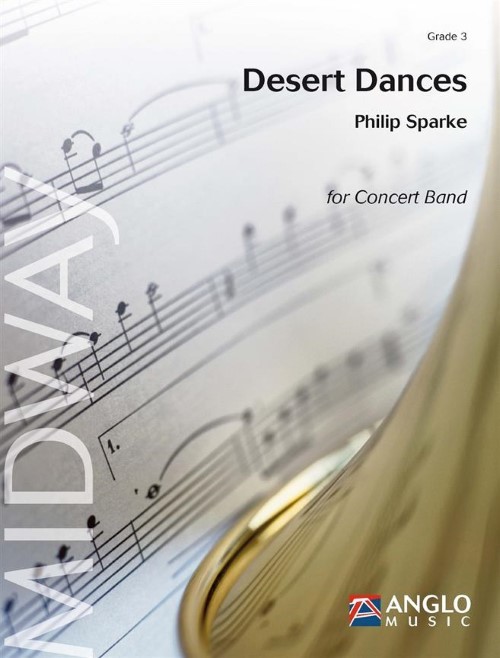
Desert Dances (Concert Band - Score and Parts) - Sparke, Philip
Henderson is a city in Clark County, Nevada, just southeast of Las Vegas and surrounded by desert: this was the inspiration for the title. Desert Dances opens with a lively introduction, mostly in 3/4, which pervades the faster sections of the piece. This subsides to introduce a slower dance which expands to a full-band climax. The introduction soon returns and leads to the main theme of the piece, a waltz-like melody played by the full ensemble. A short bridge passage follows, which leads to a legato central theme. This is played twice and heralds the return of the main theme and a short coda which closes the work. An imaginative work for concert or contest with nice features throughout all groups of the band.Duration: 4.45
Estimated dispatch 7-14 working days
-
 £99.99
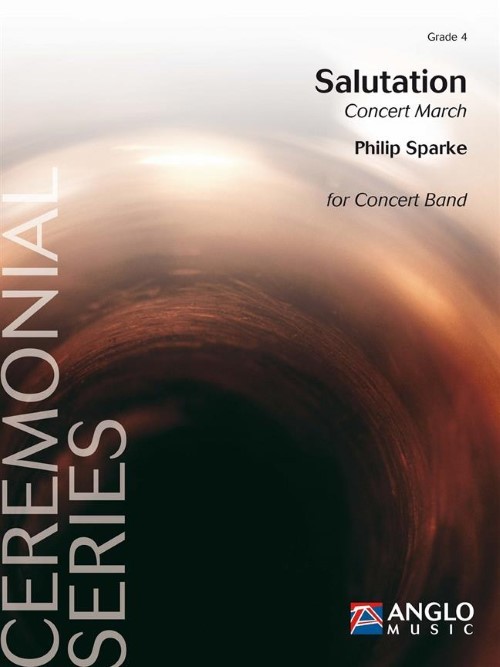
Salutation (Concert Band - Score and Parts) - Sparke, Philip
Salutation was commissioned by Japanese conductor and broadcaster, Yutaka Nishida, a dear friend of the composer Philip Sparke. Salutation follows fairly conventional march form. A short fanfare introduces the main theme, played by clarinets and saxophones. A bridge passage, mainly in the brass, heralds a change of key and a legato second subject, again played initially by the clarinets, which leads to the conventional trio theme, which is then repeated by the full band. Sections of the second subject lead back to the home key and a return of the main theme, embellished with woodwinds.Duration: 4.45
Estimated dispatch 7-14 working days
-
 £450.00
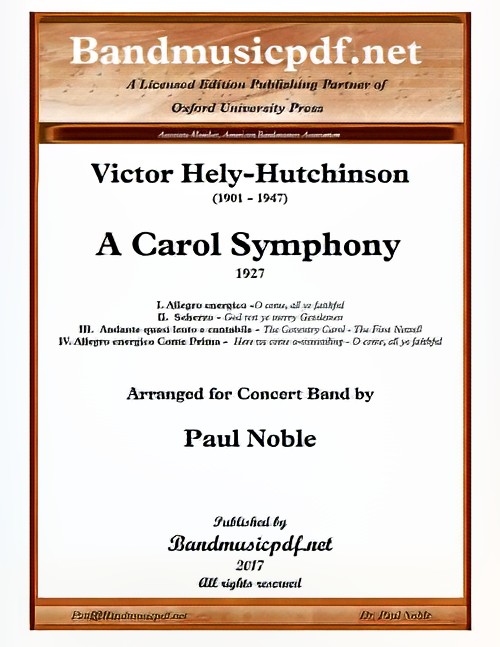
A Carol Symphony (Concert Band - Score and Parts) - Hely-Hutchinson, Victor - Noble, Paul
Victor Hely-Hutchinson is best known for his Carol Symphony, composed in 1927, from which the third movement was used for the title music of the 1943 Children's Hour and 1984 BBC children's television adaptation of John Masefield's The Box of Delights, in particular the variation on the theme of The First Nowell. The first movement is based on O come, all ye faithful, with the second movement being based on God rest ye merry Gentlemen. The third movement includes The Coventry Carol and The First Nowell, with the final movement concluding with Here we come a-wassailing and a return to O come, all ye faithful. The movements may be performed separately. This arrangement for Concert Band adds not only another new seasonal offering, but a very strong piece for advanced bands around the world.
Estimated dispatch 7-14 working days
-
 £125.00
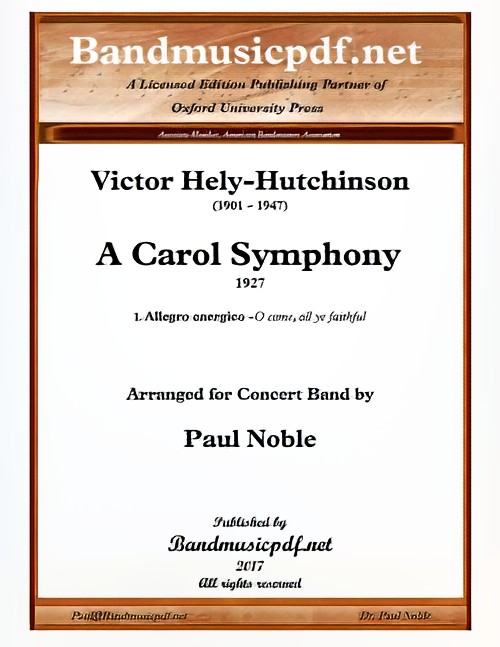
A Carol Symphony, 1st Movement (Concert Band - Score and Parts) - Hely-Hutchinson, Victor - Noble, Paul
Victor Hely-Hutchinson is best known for his Carol Symphony, composed in 1927, from which the third movement was used for the title music of the 1943 Children's Hour and 1984 BBC children's television adaptation of John Masefield's The Box of Delights, in particular the variation on the theme of The First Nowell. The first movement is based on O come, all ye faithful, with the second movement being based on God rest ye merry Gentlemen. The third movement includes The Coventry Carol and The First Nowell, with the final movement concluding with Here we come a-wassailing and a return to O come, all ye faithful. The movements may be performed separately. This arrangement for Concert Band adds not only another new seasonal offering, but a very strong piece for advanced bands around the world.
Estimated dispatch 7-14 working days
-
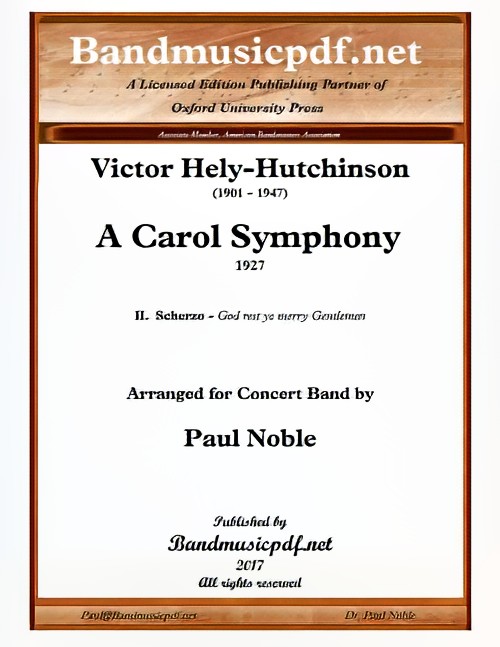 £125.00
A Carol Symphony, 2nd Movement (Concert Band - Score and Parts) - Hely-Hutchinson, Victor - Noble, Paul
Victor Hely-Hutchinson is best known for his Carol Symphony, composed in 1927, from which the third movement was used for the title music of the 1943 Children's Hour and 1984 BBC children's television adaptation of John Masefield's The Box of Delights, in particular the variation on the theme of The First Nowell. The first movement is based on O come, all ye faithful, with the second movement being based on God rest ye merry Gentlemen. The third movement includes The Coventry Carol and The First Nowell, with the final movement concluding with Here we come a-wassailing and a return to O come, all ye faithful. The movements may be performed separately. This arrangement for Concert Band adds not only another new seasonal offering, but a very strong piece for advanced bands around the world.
Estimated dispatch 7-14 working days
 View Music