
Results
-
 £19.95
HIGH SPIRITS (Prestige Concert Band Extra Score) - Wiffin, Rob
Extra Score. This concert overture is ideal for that lighter moment in a concert programme. The musical language is unambiguously tonal and the piece sets out to be attractive and joyful throughout, being upbeat in both style and tempo. There are several themes running through the piece but there is a unifying factor in the close link between the first main theme and the central slow section, and then the return of the opening idea which brings the work to its conclusion. Duration: 8:30
Estimated dispatch 7-14 working days
-
£99.95
HIGH SPIRITS (Prestige Concert Band Set) - Wiffin, Rob
Score and Parts. This concert overture is ideal for that lighter moment in a concert programme. The musical language is unambiguously tonal and the piece sets out to be attractive and joyful throughout, being upbeat in both style and tempo. There are several themes running through the piece but there is a unifying factor in the close link between the first main theme and the central slow section, and then the return of the opening idea which brings the work to its conclusion. Duration: 8:30
Estimated dispatch 7-14 working days
-
 £68.00
Fanfare for Hope - A. Eric Heukeshoven
Fanfare for Hope was commissioned in honor of the inauguration of Father James P. Burns, the 14th President of Saint Mary's University of Minnesota. The fanfare is based on the hymn tune Melita, more commonly known as the Navy Hymn, "Eternal Father, Strong to Save," with the text "My hope is built on nothing less..." serving as the inspiration for the piece. The opening brass fanfare features the uplifting first notes of the tune transitioning into a legato treatment for the woodwinds and horns. The theme builds as the brass and percussion eventually return leading back to the original fanfare. The music ends triumphantly, with the entire ensemble joining in celebration.
Estimated dispatch 12-14 working days
-
 £90.00
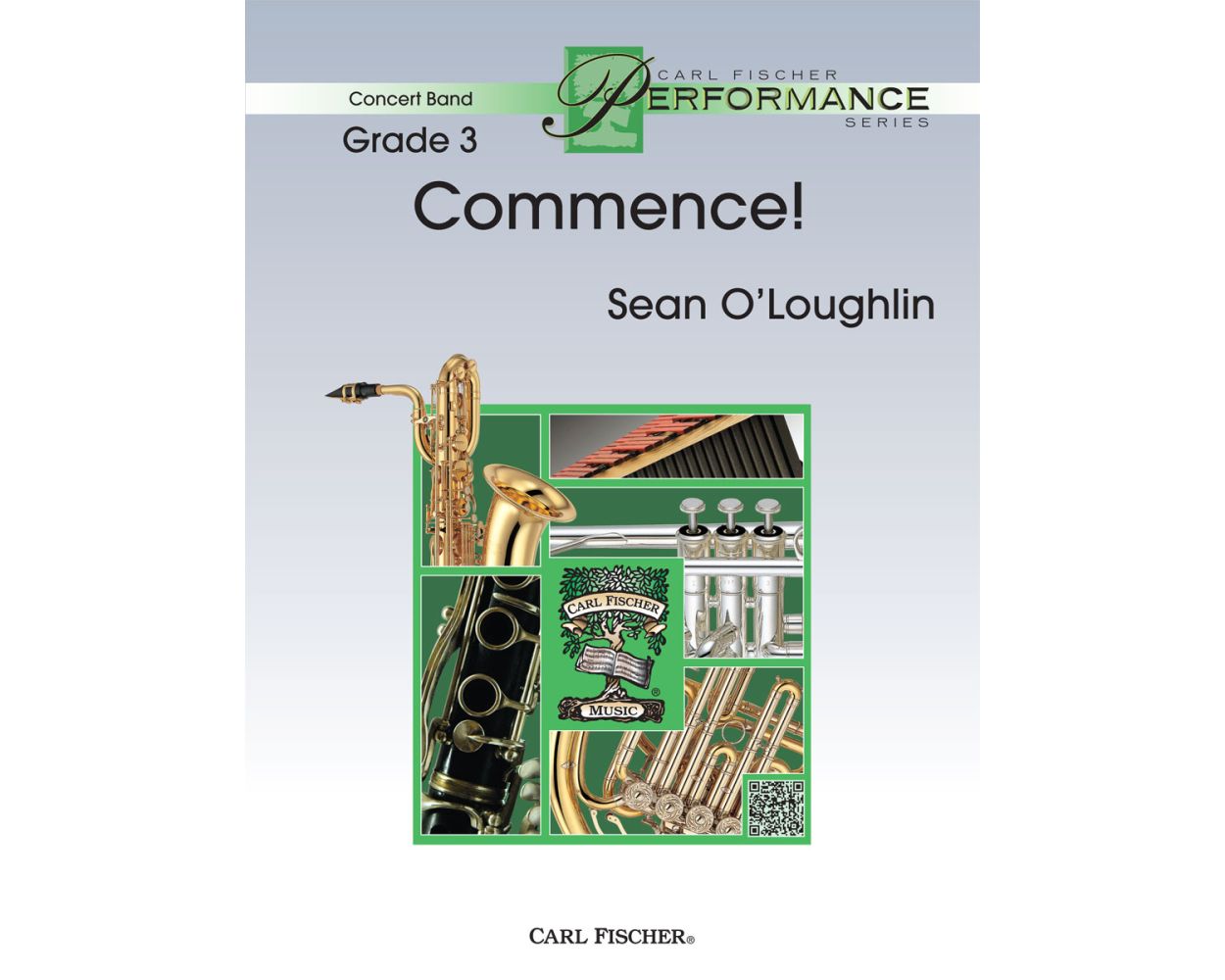
Commence!
A driving composition from Sean O'loughlin,Commence!begins with a spirited theme that oscillates between triple and duple meter. After developing into a heartfelt lush brass chorale, the lilting theme returns again. The composition concludes with a dramatic return of the B theme and a rousing finale. A beautiful piece,Commence!is astrong choice for any contest or festival.
Estimated dispatch 12-14 working days
-
 £71.00
Catawba Crossing
Named for the beautiful Catawba River, this piece begins with a brilliant fanfare, revealing the principle motive upon which the entire composition is based. Shifting tonalities and colorful scoring are the hallmark of the opening section. This is followed by an expressive con moto section that provides the piece with dramatic contrast. Once the opening theme returns, Catawba Crossing develops into a rousing march in 6/8 time, followed by a return to the opening material, bringing the piece to an exciting conclusion. An impressive choice for contest or festival performance.
Estimated dispatch 12-14 working days
-
 £137.99
Odyssee Wind Band Set (Score & Parts)
The Odyssee tells the story of Odysseus, the undaunted hero. In times long ago the blind poet Homer wrote this famous epic. The "Odyssey" follows the "Iliad", the story of the bloody war between the Greek and the Trojans. This battle ends after ten years thanks to the Odysseys famous trick. the Trojan Horse. The Odyssey is not a war epic, but a story about perseverance, loyalty, adventure, and the survival instinct of its ingenious hero. In The Odyssey, Homer describes how Odysseus, the king of Ithaca, had to endure another ten years of affliction after the ten years of war in Troy before he could finally return to his home land. During those years, his wife, Penelope, had to try and keep her many admirers away. These men not only wanted het hand but also the kingship. To prove her husbands worth, she played a trick: "As soon as I have finished weaving this shroud for my father-in-law, Laertes, I will choose one of you to become my husband", she promised them. But during the night, she secretly loosened what she had woven during the day, prolonging the time until Odysseus would finally return. After twenty long years, when he finally stood at the door, she wondered: Is this really my husband? Is he an imposter? Cunningly, she asked him to move the bed, because only she and her husband know that the bed was immovable and was build around an old three trunk! Odysseus was deeply moved: this really was his wife, his Penelope! Nearly three thousands years later, the loyalty and strength of this character, and all the dangerous adventures that Odysseus survived thanks to courage and intelligence, still moves us today. Odyssee by Jan Bosveld is not just an adventure story, but rather a characteristic piece in which memories of Homers story can be heard. The composition opens with a firm, stirring theme describing our hero, Odysseus, in detail: This man is not to be taken lightly. The further development of this short introduction completes this character sketch: trustworthy, perseverant, and a genius. After that we can picture Odysseus on the lonely beach of Ogygia. Do the trumpets depict his memories of the war of Troy? Does he think of his wife, as we recognise the weaving loom of Penelope in the murmuring eighth? In the solemn, plaintive part that follows, we can imagine Penelope feeling lonely, sitting in the womens room with her servants.One of the girls plays the harp, but that does not clear the sombre atmosphere. Then we can imagine seeing the sorceress Circe, who changed Odysseus men into swine. After she gives a simple magic sign something follows that reminds us of the sound of pigs grunting. Then the Odysseus theme resounds: the hero comes to savi his comrades. Assisted by Hermes, he forces Circe to lift the spell. The piece ends the same way as it began, with an animated theme: Odysseus is still the same, undefeated and not to be taken lighty! 07:45
Estimated dispatch 7-14 working days
-
 £36.95
A Manx Lullaby (Concert Band - Score and Parts) - Wiffin, Rob
A quiet, gentle piece dedicated to the Isle of Man Wind Orchestra. In February 2014 Rob Wiffin went to the Isle of Man to conduct a workshop with the Isle of Man Wind Orchestra. The year is particularly significant - Island of Culture 2014 is the largest cultural celebration in the history of the Isle of Man. This simple lullaby does not contain any traditional Manx material but was written specifically for the wind orchestra. It is in familiar ABA form but the middle section adds just a moment of piquancy and tension before the return of the original theme dissipates it.Duration: 3.12
Estimated dispatch 7-14 working days
-
 £420.99
Four Earth Songs (Concert Band - Score and Parts) - Putz, Marco
The hymn Nun ruhen alle Wlder (Now All Forests Rest), arranged by J.S. Bach (No. 6, So sei nun, Seele, deine, from Cantata BWV 13), is a guiding light throughout this four-movement composition. Pu?tz wrote this work as a musical outcry against the wilful, profit-driven destruction of our environment. When Bach used the word "ruhen" (to rest) over 350 years ago, it probably had a different nuance from the meaning it has today. At the beginning of the 21st century - the so-called age of progress - "nun ruhen alle Wlder" should mean "now all forests die" . Massive industrialization and globalization, coupled with pure greed, corruption, political scandals, an ever-widening gap between the rich and poor, and other such senseless human actions, are pushing our blue planet closer and closer to the point of no return. This work is not intended to be a ranting accusation. It should remind us of the beauty and harmony that can exist all around us in nature, if we take care of it. Pu?tz hopes that this will, one day, help put a greater emphasis on humanity's survival, and coexistence with nature rather than the exploitation described earlier. All four texts were created by Australian poet Graeme King, whose works were discovered by Pu?tz, by chance on the internet. Pu?tz was especially captivated by King's clarity, and intrigued by the possibilities of adapting and melding the strong rhythmical structure of King's writing with his own musical language. The four movements are as follows: 1. Tears of Nature 2. Grrrevolution 3. Stand up! 4. Tomorrow The world premire of Four Earth Songs took place on 7 July 2009 at the 14th WASBE-Conference in Cincinnati (USA). This work is dedicated in friendship to Jouke Hoekstra, conductor, and the Frysk Fanfare Orkest (the Frisian Fanfare-Orchestra).Duration: 27:30
Estimated dispatch 7-14 working days
-
 £137.95
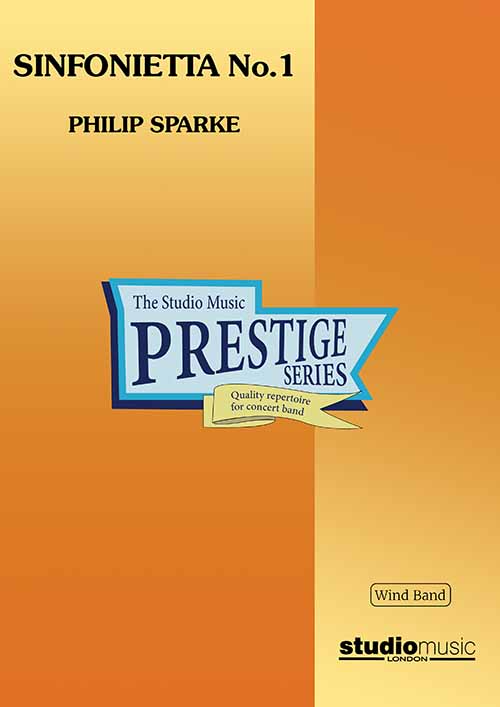
Sinfonietta No.1 (Concert Band - Score and Parts) - Sparke, Philip
Sinfonietta No.1 was commissioned by the Foundation of Friends of the Marine Band of the Royal Netherlands Navy. It was first performed by them in 'De Doelen', Rotterdam on the 13th November 1990 (in a joint concert with the Royal Marines Band from Great Britain) which celebrated the 325th anniversary of the Netherlands Marine Corps and coincided with the 45th anniversary of the band and the 175th anniversary of naval music in the Netherlands.The work is in three, linked movements:I: OvertureSeveral contrasting motivic ideas open the work, but none manage to develop into a theme of any sort. Eventually a short theme appears on clarinet, alto saxophone and horn but it is swept away by runs of triplets from the woodwinds. The theme returns, accompanied by the triplets from the woodwinds. The theme returns, accompanied by the triplets, and this leads to a return of the opening material to close the movement.II: AriaThe second movement opens with violent outbursts from the timpani until a simple, mournful tune is presented by flute and bassoon over a sparse accompaniment by the lower brass. Trumpets introduce a quicker, turbulent central section but this leads back to a brief repeat of the original tune, bringing the movement to a peaceful close.III. ScherzoThe final movement is a fast and furious scherzo which bursts into life with a flurry of notes. The vivacious main (woodwind) theme is first played by the flutes and then by the whole woodwind section. A cornet then takes centre stage with a fanfare-like theme which is then taken up by the brass. A bridge passage then leads to a version of this theme for full band. The original flute tune is then developed until the horns introduce a chorale tune which is taken up by saxes and then full band until the opening material reappears. The woodwind and brass themes are then combined and lead to a forceful version of the chorale which becomes more and more dissonant until the opening of the Overture returns to bring the work to a rousing finish.Recorded on QPRM134D THE KINGS GO FORTH, Central Band of the Royal Air Force
Estimated dispatch 7-14 working days
-
£27.95
Sinfonietta No.1 (Concert Band - Score only) - Sparke, Philip
Sinfonietta No.1 was commissioned by the Foundation of Friends of the Marine Band of the Royal Netherlands Navy. It was first performed by them in 'De Doelen', Rotterdam on the 13th November 1990 (in a joint concert with the Royal Marines Band from Great Britain) which celebrated the 325th anniversary of the Netherlands Marine Corps and coincided with the 45th anniversary of the band and the 175th anniversary of naval music in the Netherlands.The work is in three, linked movements:I: OvertureSeveral contrasting motivic ideas open the work, but none manage to develop into a theme of any sort. Eventually a short theme appears on clarinet, alto saxophone and horn but it is swept away by runs of triplets from the woodwinds. The theme returns, accompanied by the triplets from the woodwinds. The theme returns, accompanied by the triplets, and this leads to a return of the opening material to close the movement.II: AriaThe second movement opens with violent outbursts from the timpani until a simple, mournful tune is presented by flute and bassoon over a sparse accompaniment by the lower brass. Trumpets introduce a quicker, turbulent central section but this leads back to a brief repeat of the original tune, bringing the movement to a peaceful close.III. ScherzoThe final movement is a fast and furious scherzo which bursts into life with a flurry of notes. The vivacious main (woodwind) theme is first played by the flutes and then by the whole woodwind section. A cornet then takes centre stage with a fanfare-like theme which is then taken up by the brass. A bridge passage then leads to a version of this theme for full band. The original flute tune is then developed until the horns introduce a chorale tune which is taken up by saxes and then full band until the opening material reappears. The woodwind and brass themes are then combined and lead to a forceful version of the chorale which becomes more and more dissonant until the opening of the Overture returns to bring the work to a rousing finish.Recorded on QPRM134D THE KINGS GO FORTH, Central Band of the Royal Air Force
Estimated dispatch 7-14 working days
 View Music