
Results
-
 £274.99
Symphony No. 2: States Of Mind, Opus 87 - Teo Aparicio-Barberán
I- Logos (reason)II- Pathos (emotion)III- Ethos (credibility)The ancient Greeks believed that music shaped the character of man. In Egyptian temples, music was an essential part of the magical rites to alter the course of nature or to treat illness.And today we know that sound can actually alter matter. The secret of music lies in harmony and mathematics, as many great musicians and experts have always known.One of the most important qualities of music is that it enables the listener to focushis attention inwards instead of on what is around him. It is indisputable that music can inspire emotion. Music leads us into a universe of emotions that are difficult to put into words. In short, music reaches into corners of our soul and thoughtsthat words cannot reach and makes it possible to more clearly describe these different States of mind.The composer of this symphony also believes that each "musical argument" must be constructed so that it will induce the desired reaction in thelistener.Music: more than wordsIn recent times, most orchestral symphonies have been based on a story, a text or something similar so that their composition must be structured accordingly.The intention of this work by Teo Aparicio-Barbern is quitedifferent. The composer describes the three elements of the argument as the only formal structure of the work. Since certain philosophers in world history were able to subdivide grammatical argument, why shouldnt that also be possible for the musicalargument?Since ancient times the power of the spoken word has captivated mankind. How can an argument move people and mobilise the masses? Where does the power of words come from today? The answer lays not so much in what people say but in how theysay it.Rhetoric is one of the oldest humanist disciplines in Western civilisation. Aristotle, in the 4th century BC, called it the art of persuasion. Indeed, the terms rhetoric and persuasion are mutually interchangeable.More than 2000 years agoAristotle structured his rhetoric according to the following three elements: the logos, the pathos and the ethos.Logos (words, reason) is the reasoning that gives freedom to the structure of the text by expressing what one wishes to say usingspecialist terms. With logos we create arguments to receive public approval and to defend our ideas.Pathos, the second element, refers to the effective use of public psychology. Pathos can be considered as the capacity to induce the desired emotionalresponse in the public, by creating an emotional connection with the public so that they accept our message.The third element, ethos (credibility), refers to the character of the speaker and is perhaps the most important of the three elements.Aristotle based his concept of ethos upon his belief that truth and justice will always have the upper hand over anger. He believed that what was true and good was easier to prove and was more persuasive.This second orchestral symphony from thecomposer from Enguera follows these three parameters of the argument according to Aristotle. Each movement tries to summon a different state of mind in the listener so that the message itself can be better understood and appreciated. Apart from thesethree general concepts the music is only structured, as Claude Debussy would say, in a "formative way".The first movement, logos, is based on a scherzo melody that undergoes various changes in rhythm and harmony. The arguments are presented by meansof conventional techniques of composition. The second movement, pathos, is characterised by suggestions of sound. It is subdivided into two large parts. The first part is based on a five seven sequence with five sounds that are repeated in differentenvironments, structures and dynamics. The second part, which is largely tonal, brings out more directly the emotional overtones that each argument must have. The third movement, ethos, is a faithful rendition of the composers personality. In thislast part, clear rhythmic sequences stand out, there are large dynamic contrasts and lots of tone variation. In addition, and this is quite in keeping with the composers earlier work, the harmony in States of Mind is handled in a manner that is bothoriginal and efficient, as a result of which Aparicio-Barberns message is well understood by the listener.This second symphony by Teo Aparicio-Barbern is devoted to "my dear Henrie Adams, a guiding light in this eternally dark musical world. Thankyou for everything."
Estimated dispatch 7-14 working days
-
 £94.99
Biberussa - Bert Appermont
'Biberussa', the old name of the small town of Beverst in Belgium, is a combination of the words 'biber' and 'ussa', meaning beaver and river. This concert march was composed for the 100th anniversary of the Koninklijke Harmonie (Royal Concert Band) 'Ons Verlangen' from Beverst, a place where the composer had his first musical training. After the opening passage, a proud, heroic theme is heard. As a contrast, it is followed by a simple chorale melody and both themes then appear simultaneously in a grand tutti passage. This is followed by a cantabile trio with a majestic reprise of the main theme bringing the work to a close.
Estimated dispatch 7-14 working days
-
 £64.99
Christmas Fantasia - Satoshi Yagisawa
Christmas Fantasia was commissioned by Seika Girls High School Band and its director, Mr. Yoshihisa Fujishige, for its annual concert, premiering in December of 2009. The composer followed the band's request to employ a melody similar to Holst's Jupiter as well as Christmas songs. This pops composition is a rarity among the many works of Yagisawa.
Estimated dispatch 7-14 working days
-
£202.99
Porco Rosso - Joe Hisaishi
From the 1992 Japanese animated film about an Italian World War I flying ace who, for a wartime misdeed, was transformed into an anthropomorphic pig. The flamboyant post-war story of Porco Rosso (Crimson Pig) battling air pirates is full of intrigue and romance, and the film's diverse and lush soundtrack is one of the more rare Studio Ghibli scorings. Mr. Tomoki Ubata, (band director at Ina Gakuen Sr. High School) assisted with medley design as we both became intrigued with the music.The sixth song, Kyouki ~ hishou (insanity & soaring), appearing on Joe Hisaishi's album "My Lost City", is often performed for his concerts. Due to its complexity I am sure this is one of Hisaishi's favorites. I also added the French chanson "Le Temps des cerises" (Antoine Renard) that Madame Gena sings in the film. This is my favorite of all chansons; I was happy to include this bittersweet, beautiful melody.The following themes are contained in the arrangement:1. Le Temps des cerises2. Jidai no kaze (Wind of the Times)3. Mammaito4. Pikkoro no onnatachi (Women of Piccolo)5. Porco e Bella6. Kyouki ~ hishou (Insanity & Soaring)7. Tooki jidai o momomede (Seeking for Far Times)You can hear how the story folds without a screen.(Kazuhiro Morita)
Estimated dispatch 7-14 working days
-
£202.99
Spirited Away - Joe Hisaishi
This is an arrangement of Ghibli's Anime film, "Spirited Away". It consists of six themes including No-Face, One Summer Day, The Bottomless Pit, Yubaba's Panic, Always with Me, and Reprise. I also added an alternate introduction using The Dragon Boy. The No-Face opener is somewhat avant-garde with technical difficulties so select the opening that is best suited to your ensemble. The arrangement concept was created by Mr. Tomoki Ubata of Ina Gakuen Sr. High School. His wonderfully crafted ideas always impress me. Especially, in the arrangement, mallet percussion and piano are effectively used to sound like a music box and the lyrical melody of Reprise is superimposed. This scene is the best part of the entire arrangement and is very emotional. All these fine melodies from the film transport both audience and performers to the fantastic world of anime. (Kazuhiro Morita)
Estimated dispatch 7-14 working days
-
£106.95
Merry-Go-Round - Yukiko Nishimura
As the title suggests, this new piece from composer Yukiko Nishimura depicts the joy of riding on a merry-go-round or carousel. The main melody is delightful and memorable. Yukiko's orchestration colors are unique and fresh. Her harmonic sensibilities lead a bit toward the Jazz idiom making her compositions different and very interesting.
Estimated dispatch 7-14 working days
-
 £76.99
Drei Knige - Peter Cornelius
With his arrangement of Drei Knige, originally composed for voices, Robert van Beringen makes a welcome contribution to the christmas repertoire for bands. In this work by the German composer Peter Cornelius (1824 - 1874) the mediaeval choral Wie schn leuchtet der Morgenstern comes to the fore as a counter melody.
Estimated dispatch 7-14 working days
-
 £84.99
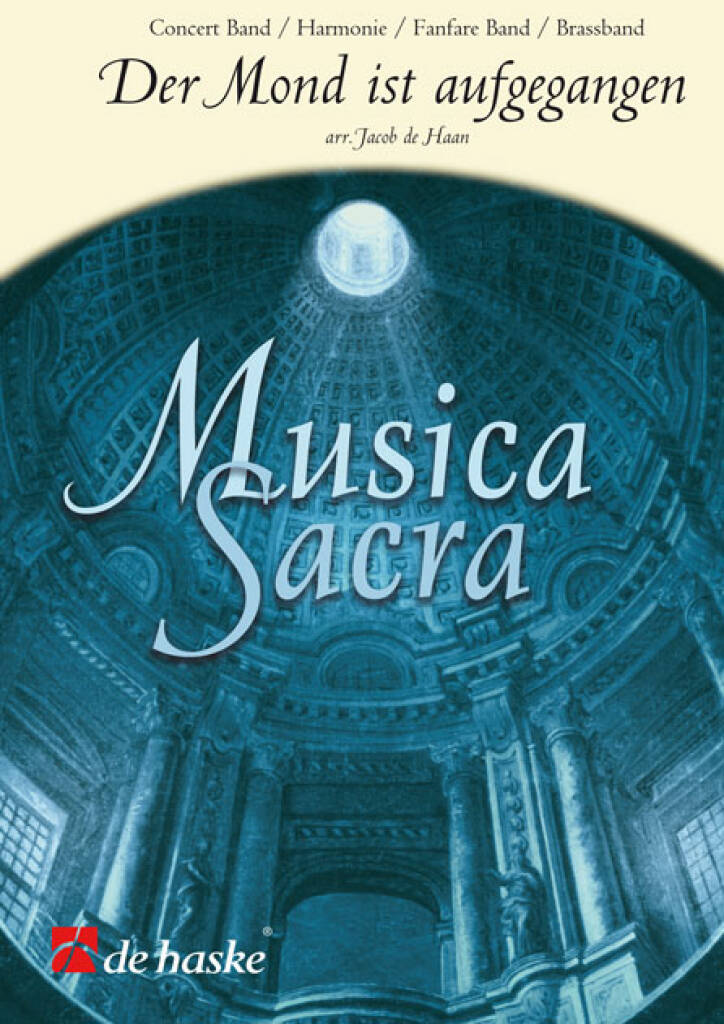
Der Mond ist aufgegangen
The lyrics to Der Mond ist aufgegangen (The Moon Is Risen) come from Matthias Claudius, one of Germany's best-known poets. The 1779 poem with the original title Abendlied (Evening song) was set to music by Johann Abraham Peter Schulz and has become perhaps the most famous Abendlied in the German-speaking world. Johann de Haan has created a delightful arrangement of this poignant melody. The wind orchestra can optionally be accompanied by a choir (Dutch and German texts are provided).
Estimated dispatch 7-14 working days
-
 £76.99
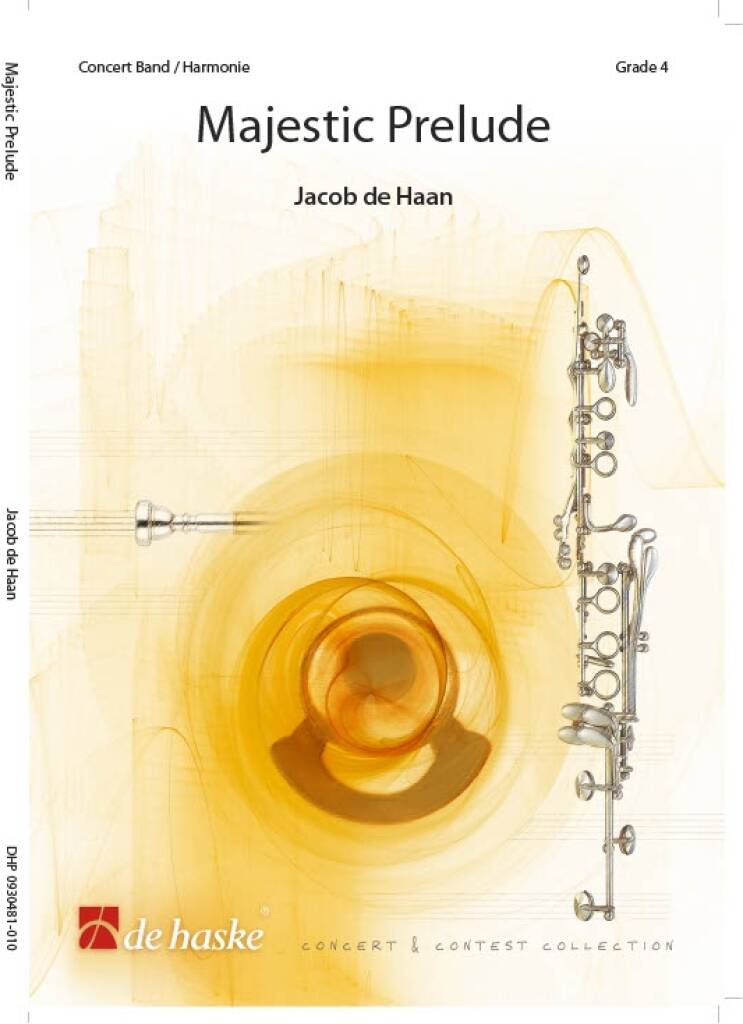
Majestic Prelude - Jacob de Haan
In Majestic Prelude the instrumental music is closely connected to the text and vocal music. The work is based on a well-known psalm melody. As the title suggest, it begins with a majestic introduction, in which several sections of the psalmare heard. Various instruments play around with fragments of the familiar tune. This composition is an excellent opening piece for a concert!
Estimated dispatch 7-14 working days
-
 £84.99
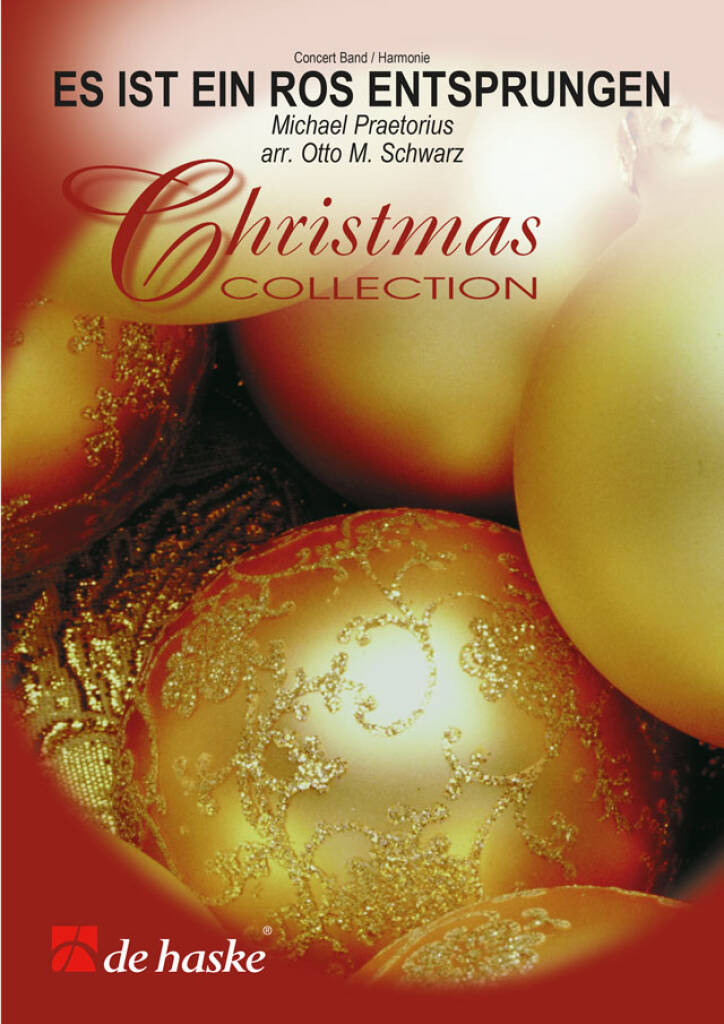
Es ist ein Ros Entsprungen - Michael Praetorius
The many sided and productive Michael Praetorius (1571-1621) is knwon as a composer of dance music, sacred music and music for the advent and Christmas time. He worked as Kapelmeister to the court at Wolffenbuttel, but he was also asked to serve in other places, includin Dresden. Praetorius was valued for the new impulses he gave to music by means of his use of instrumental accompaniment. His main contribution is his theoretical work "Syntagma Musicum", one of the most important musical refernce books, in connection with instruments and instrumentation in the early 17th Century. "Es ist ein ros entsprungen" is a well known ancient melody which has inspired numerous composers andarrangers througout the Centuries. Otto M. Schwarz has made a choral arrangement.
Estimated dispatch 7-14 working days
 View Music