
Results
-
 £99.99
Ukrainian Bell Carol - Mykola D. Leontovich
The Ukrainian Bell Carol is part of a large choral work entitled Shchedryk by the Ukrainian composer Mykola Dmytrovich Leontovych (1877-1921). It was first performed by students of Kiev University in December 1916. The tune is an adaptation of an old 'shchedrivka', a song traditionally sung on Ukrainian New Year's Eve (January 13th) which hopes for good fortune in the year to come. In Shchedryk, Leontovych added his own the lyrics which concern the legend claiming that when Jesus was born, all the bells on earth started ringing in his honour.The tune has since been the inspiration of at least four different Christmas carols, but Philip Sparke has sourcedthe original Ukrainian melody to create this stirring arrangement.
Estimated dispatch 7-14 working days
-
 £91.99
Prelude on an Irish Folk Tune - Philip Sparke
The Irish folk tune, which appears towards the end of the piece, is Slane, a hymn tune version of the much older folk melody The Banks of the Bann. In Prelude on an Irish Folk Tune, fragments of the folk tune hint at what is to come later in the piece, but another folk-like tune is predominant. This later acts as a descant to Slane when it finally appears. Add a little Sparke sparkle to any concert with this lovely interlude.
Estimated dispatch 7-14 working days
-
 £122.50
Letter from Home - Philip Sparke
In Letter from Home Philip Sparke portrays the many feelings and emotions that a letter from home can evoke. This intimate work opens with a gentle woodwind melody, which gradually becomes more confused as new emotions are introduced. Finally resignation sets in, but a sense of peace and balance is restored with the final chorale. In this emotional work Philip Sparke truly captures the highs and lows of being away from home.
Estimated dispatch 7-14 working days
-
 £149.99
Southend Celebration - Philip Sparke
The work opens with a stern fanfare in bare fifths, which leads to a cantabile theme introduced by alto saxophone. This builds to a climax and reintroduces the fanfare, which slowly evolves into the subsequent vivo. A perky tune emerges on flute, saxophone and trumpet, which, after a short bridge passage, leads to a contrasting melody on low clarinets and saxophones. After some development a true 'second subject' appears for the whole band. A recapitulation leads briefly back to the opening fanfare before the vivo returns to close the work in celebratory mood.
Estimated dispatch 7-14 working days
-
 £71.50
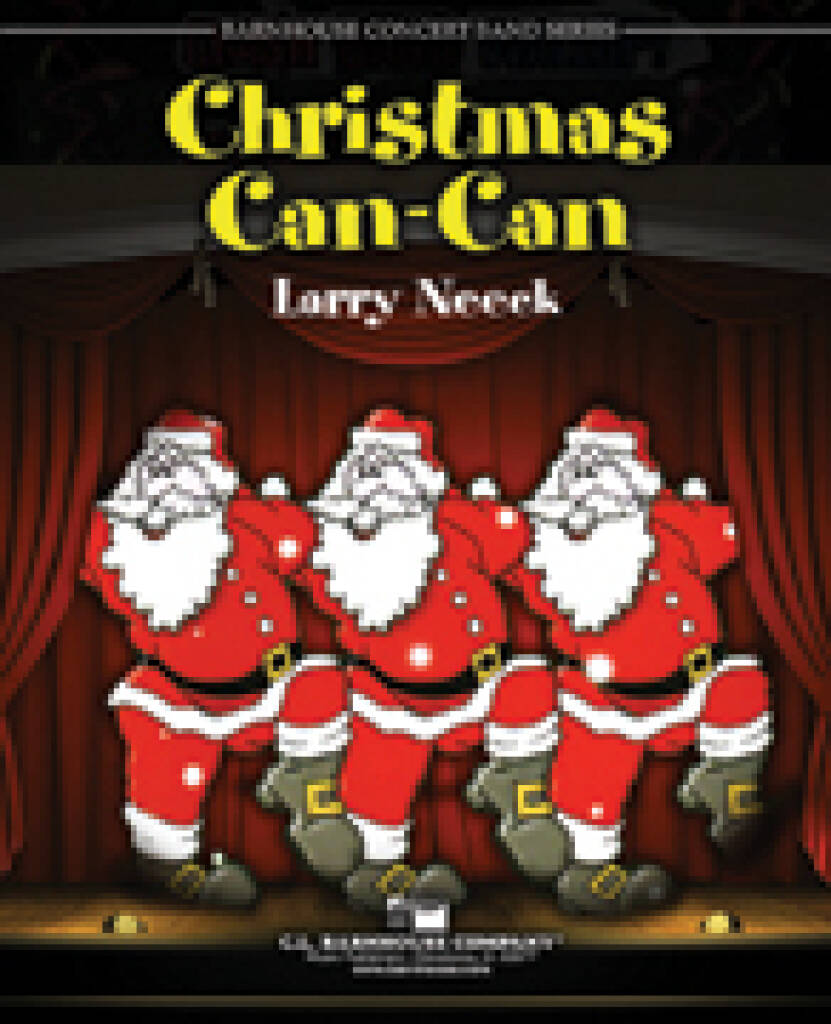
Christmas Can-Can - Larry Neeck
In this humorous and light-hearted romp, this famous melody is paired with Jingle Bells, a few other Christmas carols, and other well-known musical quotes. The variety of settings allows all sections of your band to shine, and the grand finale will bring down the house. A clever twist to a well-known theme, "Christmas Can-Can" is a real crowd-pleaser for your next holiday concert.
Estimated dispatch 7-14 working days
-
 £89.99
I'm Still Standing - Elton John
I'm still standing is another way of saying "You haven't beaten me yet" and is an ode to stamina. This world famous song by Elton John has been arranged by newcomer Sven Van Calster. The stirring rhythm and the infectious famous melody enable this piece to be played at any concert, irrespective of the level of your orchestra. Always a topper!
Estimated dispatch 7-14 working days
-
 £104.99
Fanfare and Jubilation - Naoya Wada
Fanfare and Jubilation was commissioned by the Yahata Technical High School Band (Fukuoka, Japan) to celebrate the 40th edition of their annual concert, and is dedicated to its directors, Mr. Satoru Yoshihara and Ms. Akane Morimoto. The premiere took place on June 14, 2007 in Kitakyushu City, Fukuoka, Japan with Mr. Satoru Yoshihara conducting.The piece is comprised of two parts: a festive opening fanfare; and a scintillating melody that reflects the celebratory atmosphere. Its melodic character, uplifting mood and punchy wit make Fanfare and Jubilation equally suitable as an opening piece or a concert work.
Estimated dispatch 7-14 working days
-
 £76.99
Hymn of Glory - Bert Appermont
This melodic hymn begins with a lyrical melody, handled by various instrument groups. After a gradual build, a first climax is reached, in which the brass instruments give full vent to their glorious sound in jubilation. Now we hear a second theme,resounding in the euphoniums, which ushers in a moment of rest. Then the excitement gathers again, building to a great tutti. The main theme is taken up once more, sounding now as a kind of universal gratitude.
Estimated dispatch 7-14 working days
-
£184.99
Rubicon - Bert Appermont
The Rubicon is a river in Northern Italy which Julius Caesar crossed with his army in 49 BC in defiance of the leaders of Rome, who feared his power. A civil war against rival Pompey ensued, which culminated in Caesar seizing power as the absoluteruler of Rome. The phrase "crossing the Rubicon" therefore refers to any person committing himself irrevocably to a risky, decisive and irrevocable of course of action.The work consists of three parts that deal with this important moment in history.Part 1 (Meditation) symbolises Caesars request to the Gods to assist him in his difficult choice. In a slow introduction we hear the melancholy and beseeching sounds of the duduk (alternatively, this part can be played by a soprano saxophone)and of the soprano solo singer over the bourdon accompaniment. The soprano solo singer then sings "dona tibi pacem" (give him rest) in a melodious and probing theme.In Part 2 (Battle of Pharsalus) trumpets and trombones resound alternately ina stately Roman fanfare, producing a stereophonic effect. This develops into a martial theme in which Caesars impressive army goes to battle against the army of rival Pompey. While the theme of Caesars army fades away, Pompeys theme emerges as anaive dance in six-eight time. His army is definitely in the majority and it believes it can easily defeat the enemy. Suddenly trumpets and trombones clash on two sides of the orchestra: Caesars army advances and attacks. A fierce battle ensues inwhich the two themes are played alternately as well as simultaneously. Thanks to his shrewd battle tactics, Caesar manages to win this legendary battle after all: his theme resounds ever louder in trumpets and horns until everything dies out andchanges into a kind of reconciliation between the soldiers of the two armies. The melancholy "dona tibi pacem" from part 1 now serves as a reconciliation theme.Caesar is now the sole ruler of the New Roman Empire, which would be destined to leave itsmark on our Western civilisation to this day. The third part is a sparkling succession of dance music (Dance) with many Greek and Roman elements in which Caesars victory is praised and celebrated. It is common knowledge that the culture(arts, gods, etc.) of the Romans drew heavily on Greek culture. I have therefore used an authentic Greek theme (the Seikolos song) several times in this part (bar 17 in the euphonium, bar 60 in the base section, bar 68 in the sopranosaxophone) to suggest the music of that era and to evoke the right atmosphere. After a gradual increase in tempo in the entire orchestra, the opening melody gloriously resounds once more, surrounded by virtuoso dance music. The work ends withbombastic brass fanfares in which Caesars theme triumphs once more.NOTE FOR THE CONDUCTOR:The Armenian duduk and the monochord that are used in the introduction give a special tone to the music, but could be substituted (soprano saxophone instead ofthe duduk) or left out (monochord). The soprano solo is also doubled within the orchestra and could therefore also be left out if necessary, although it does provide the work with an extra dimension. The male voices in the introduction and the finalecould possibly be replaced with a synthesizer with choral setting.As a visual and acoustic element in part 2, the trumpets, the e-flat cornet, the small drum and trombones can be stood up and placed at two sides of the orchestra (bar 80).Seen fromthe point of view of the conductor, put the trumpets, the e-flat cornet and the small drum in the left section and the trombones in the right section of the orchestra. This also helps to create a visual contrast between the two themes of the secondpart. The players can be seated again at bar 97 or bar 121. The soprano soloist can be placed in or in front of the orchestra, depending on what gives the best result. For the conclusion of the work the soprano solo can be sung from afar (from thewings) to create additional atmosphere.This work was composed especially for the "St Joseph" brass band from Pey/Echt (Belgium) with conductor Mark Prils.
Estimated dispatch 7-14 working days
-
£109.99
Dublimania - Menno Bosgra
This new work is based on Irish folk music.In the first part, the main theme is presented as a ballad, starting with the piccolo (as replacement for the flute which is widely used in Ireland), moving on the wood section to end with the entire orchestra.It then changes to a kind of rock style theme: powerful, rhythmic accompaniment with effects in dampers, a pedal point and the use of the spoons which is typical of Irish music (Irish pub), high-range bongo drum (replacement for the Bodhran), etc.In this second part I introduced a second theme as a counterbalance, played by several groups, which has clearly a more legato character and therefore sounds more melodious.The climaxof the work starts in the low-range brass section with its marcato theme that is developed with a great deal of rhythmicity in the accompaniment, clusters, etc. into a percussion solo interspersed by the orchestra in five-eight time with frequent parallel movement in chords (folk music style).Towards the end, theme 2 recurs twice: first as heard earlier with an extra counter melody and accompaniment pattern, then in a canonical form, in which the theme is played by three groups. The conclusion is a repeat of the middle section in five-eight time.I have tried to use many of the colours of a wind orchestra by having the wood sections and brass section play alone and making extensive use of dampers. Percussion also has a prominent role throughout the work.
Estimated dispatch 7-14 working days
 View Music