
Results
-
 £48.00
Solitude (Concert Band - Score and Parts) - Phillips, Todd
Imagine sitting in a canoe traveling down the peaceful river, blessed by the solitude of nature as the bow cuts quietly through the water. Lost in thoughts of comfort and peace, the solitude, that only nature can provide. Escaping the hustle and bustle of hurried lives to watch the deer maneuver through the woods and the birds fly through the air. In the last section, picture the majestic eagle soaring from the treetops as he makes his way out of sight. You, your students, and audience will enjoy the "Solitude" of this work.
Estimated dispatch 7-14 working days
-
£180.00
STAR WARS TRILOGY (Concert Band) - Williams, John - Hunsberger, Donald
John Williams has rightfully earned a place in the hearts of all film lovers with his numerous brilliant scores to some of the best movies of the last half century. Capable of writing music ranging from tender, intimate moods to galactic battles, Williams carefully constructs each score as a separate, freestanding entity, not just background snippets. The selections in this exciting collection include "The Imperial March (Darth Vader Theme)," "Princess Leia's Theme," "The Battle in the Forest," "Yoda's Theme," and "Star Wars (Main Theme)." (16:52)
Estimated dispatch 7-14 working days
-
£60.99
They are Coming Wind Band Set (Score & Parts)
There are people who are capable of planning well. They live their lives in a well-structured manner and know exactly what they have to do. On the other hand, there are also people who are the exact opposite: they want to do too many things at once and are often somewhat absent-minded, which occasionally results in frantic situations. The outcome of one such situation is 'They are coming'. John Emerson Blackstone had been working on a new composition for some time when he received a telephone call from his editor, who told him that the deadline was approaching rapidly, even worse, that it would expire at the end of that same day and that he would drop by in person to fetch the composition! Blackstone set to work in a frenzy and completed the last details. When his editor arrived, the piece was finished ..... and got its definitive title: 'They are coming'. 02:30
Estimated dispatch 7-14 working days
-
 £137.99
Three Onegin Dances Wind Band Set (Score & Parts)
Tchaikovsky is best known for his purely instrumental compositions. However, we must not underestimate him as a composer of operas. Many of his operas such as ?Pique Dame and Eugene Onegin are still performed regularly throughout the world. Eugene Onegin (also called Jevgeny Onegin), composed in 1877-1878, was not called an opera by Tchaikovsky himself, but "lyric scenes". The work is entirely dominated by lyricism. However, there are two moments that contrast sharply with this lyricism: two ball scenes, for which Tchaikovsky wrote a waltz and a polonaise.After opening with a less well-known allegro dansant, this arrangement features the aforementioned waltz, which can be considered a beautiful Russian equivalent of the Faust Waltz by Charles Gounod. In the opera, this waltz is actually played by a military band. The arrangement concludes with the pompous polonaise (also mentioned above) which opens the last act: the ideal music to characterize high aristocracy in the salon of a palace in St. Petersburg. 0:09:30
Estimated dispatch 7-14 working days
-
£189.95
TUBA CONCERTO (Gregson) (Tuba/Concert Band) - Gregson, Edward
Score & Parts. The concerto is in three movements, following the usual quick-slow-quick pattern: Allegro deciso, Lento e mesto, Allegro giocoso. The first has a sonata form shell with two contrasting themes, the first rhythmic in character, the second lyrical. There is a reference made in the development section to the opening theme of Vaughan Williams's tuba concerto, but this merges into the other material in the development section. The second movement unfolds a long cantabile melody for the soloist, which contrasts to a ritornello idea. The central climax of the movement triumphantly heralds the main theme from the band. The last movement is in rondo form, alternating the main theme with two episodes. The first of these is a broad sweeping tune, the second is jazz-like in style. After a short cadenza, reference is made to the opening of the concerto, and the work ends with a triumphal flourish. Duration: 18 mins. American Grade 4.5
Estimated dispatch 7-14 working days
-
£32.95
TUBA CONCERTO (Gregson) (Tuba/Concert Band) Extra Score - Gregson, Edward
Extra Score only. The concerto is in three movements, following the usual quick-slow-quick pattern: Allegro deciso, Lento e mesto, Allegro giocoso. The first has a sonata form shell with two contrasting themes, the first rhythmic in character, the second lyrical. There is a reference made in the development section to the opening theme of Vaughan Williams's tuba concerto, but this merges into the other material in the development section. The second movement unfolds a long cantabile melody for the soloist, which contrasts to a ritornello idea. The central climax of the movement triumphantly heralds the main theme from the band. The last movement is in rondo form, alternating the main theme with two episodes. The first of these is a broad sweeping tune, the second is jazz-like in style. After a short cadenza, reference is made to the opening of the concerto, and the work ends with a triumphal flourish. Duration: 18 mins.
Estimated dispatch 7-14 working days
-
£135.95
TWO IRISH FOLK MELODIES (Trumpet Solo with Intermediate Concert Band) - Hunsberger, Donald
Two charming components of the Carnaval project, scored by Donald Hunsberger for trumpet soloist Wynton Marsalis and the Eastman Wind Ensemble are combined in this freshly engraved setting. The accompaniment is accessible to high school ensembles, including "'Tis the Last Rose of Summer" and "Believe Me, if All Those Endearing Young Charms," this work will provide an opportunity to feature your trumpet soloist with these lush Irish folk tunes. (5:00)
Estimated dispatch 7-14 working days
-
£59.40
Valdres - Schissel, Loras
One of the most distinctive of marches, VALDRES has been described as a "petite Norwegian tone-poem set in march-time". Loras Schissel's splendid new arrangement of the famous Norwegian march "Valdres" was created by blending several concert versions of the piece that were created by composer Johannes Hanssen during the last years of his life. Perfect for concert or contest use, this superior edition should be in the library of all good bands!
Estimated dispatch 7-14 working days
-
 £64.95
DANCING LADY (Programme Concert Band) - Wiffin, Rob
Originally written as the last movement of Sands of Time, a piece for clarinet choir. This Latin piece is perfect for full band.
Estimated dispatch 7-14 working days
-
 £115.00
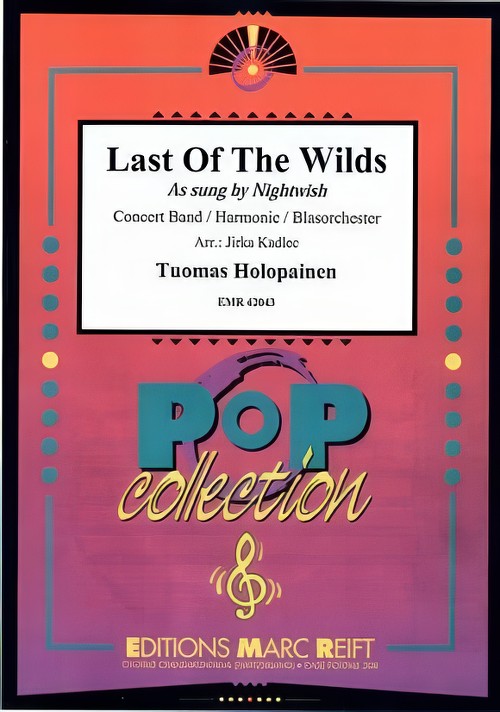
Last of the Wilds (Concert Band - Score and Parts) - Holopainen, Tuomas - Kadlec, Jirka
As sung by NightwishDuration: 3.30
Estimated dispatch 7-14 working days
 View Music