
Results
-
 £45.54
Above and Beyond (Concert Band - Score and Parts)
If you're looking for an exciting opener, look no more. From the first measure to the last, you'll discover dramatic sounding melodies that are creatively scored against a background of bold rhythms and contemporary harmonies. This piece has it all and is certain to be popular for many years to come. A guaranteed winner!
Estimated dispatch 7-14 working days
-
£144.99
Ante Lucem (Concert Band - Score and Parts)
This meditative work describes the final minutes before the night slips away and officially turns to day, the last few moments before a new dawn. The composition is based on the old Austrian folk tune Auf dem Berg bin i gern which has been used as the main theme in a wonderfully atmospheric way. Calm yet effective! 07:40
Estimated dispatch 7-14 working days
-
£43.56
Aura Lea (Concert Band - Score and Parts)
This classic American folk song has inspired generations of musicians throughout the last two centuries. Arranged by composer/music educator Robert W. Smith, this setting of "Aura Lea" features melody throughout the band as they explore the lyrical theme and performance style. Suitable for concert and festival performance, this will become a staple in your repertoire.
Estimated dispatch 7-14 working days
-
£179.99
Austrian Overture (Concert Band - Score and Parts)
Austria is an industrious country. During the last century--which was characterized by extreme changes--the hard-working and ambitious people achieved a great deal, enduring two world wars and numerous political skirmishes. Despite all the problems involved in a change from a dual monarchy to a small state, Austria has found its independence. With his Austrian Overture, Thomas Doss looks toward the future. The first part of the composition provides an optimistic outlook; along with the happiness and energy, some musical humor is also present: while the horns powerfully express joy, small yodeling melodies sound throughout. As the rhythm continues in search of new ways to go, catchy tunes compete to be heard. However, in addition to the energetic, diligent Austria, there's also the quiet landscape where one can enjoy repose and beauty. These aspects - as well as the freedom of spirit and cultural life -are conveyed in the second part of the work through the surprising linking of chords, romantic phrasing, and tender melodies. But life never stands still: creativity, ambition, and work are the driving forces of our existence. Embracing this thought, a reprise of the first part provides a compelling ending. 10:26
Estimated dispatch 7-14 working days
-
 £49.50
Big Time Boogie (Concert Band - Score and Parts)
An excellent concert piece for very young featuring tempo and style changes making it a perfect teaching tool as well. Also includes an optional keyboard part. Very strong from the first note to the last.
Estimated dispatch 7-14 working days
-
£37.62
Blue Suede Sneakers (Concert Band - Score and Parts)
Don't miss this one! This Tom Molter tune will have your youngsters rockin' and rollin' as though the 1950's never went away! A very fun way to expose your students to this wonderful era of music. A true classic from the first note to the last!
Estimated dispatch 7-14 working days
-
 £139.99
Cobra Wind Band Set (Score & Parts)
Shortly after the Second World War, a combative movement of Danish, Belgian and Dutch artists chose the cobra snake - extremely dangerous yet considered sacred - as a symbol of their resistance to strict guideliness of form. The name "Cobra" also happens to contain the first letters of the cities Copenhagen, Brussels ans Amsterdam, from where most of the movement's members came. The Cobra movement, which existed from November 1948 until November 1951, can with some justicication be called the last major avant-garde movement of the 20th century.The source of inspiration for the composition Cobra comes from four paintings: "Obhobning" by the Dane Egill Jacobsen; "La jeune fille et la mort" by the Belgian Pierre Alechinsky; "Orgeldraaier" and "Le rythme joyeux de la ville" by the Dutch artists Karel Appel and Corneille. Obhobning means "pile-up", which is represented musically in the first part by a melodic and harmonic pilling up of perfect fourth's. The first part is also characterized by a rhythmic feeling, which the painting gives through its use of numerous black stripes. In the painting La jeune fille et la mort, Pierre Alechinsky places a young girl opposite Death. The second part features the constantly pulsating motion of live while a creeping, dark, melodic line develops. The tension between life and death is tangible as a battle reveals itself. In part three, one hears the Orgeldraaier by Karel Appel, as cheerful and playful as an organ grinder's music. The painting Le rythme joyeux de la ville by Corneille is busy and extremely dynamic, a perfect source of inspiration for a powerful, rhythmic ending to this composition. 0:09:57
Estimated dispatch 7-14 working days
-
£109.99
Concerto Dynamico (Concert Band - Score and Parts)
Concerto Dynamico is a sparkling work opening with a majestic introduction in which the whole band presents the main theme. The volume together with the broad melodic lines, create a robust opening that leads to a dazzling allegro. Syncopated rhythms produce a cheerful note, supported by the percussion. A charming andante follows, in which various instrument groups play the main theme. In the succeeding moderato marziale, the same theme can be heard as in the last allegro giocoso, but with another rhythm. Concerto Dynamico ends with a shortened repeat of the slow middle movement. 07:00
Estimated dispatch 7-14 working days
-
£84.99
Creamy and Crispy Wind Band Set (Score & Parts)
This composition of Marc Cunningham has four parts, and takes place on a sunny day in a picturesque town. 1. Promenade Many people walk through the city. The band passes through the streets. People are strolling along the avenues and amorous couples are sitting on a park bench. 2. Lovey Dovey One of these couples is knee-deep in love. 3. Crispy and Creamy Here the contrasts between a crisp staccato section in two-four time signature and a smooth legato section in three-four time signature are depicted. Is Crispy the boy and Creamy the girl? 4. Farewell In the last particle the couple says goodbye. We still think back to the walk through the city. It sounds a little less happy now. Not everyone is good at saying goodbye, sometimes a tear flows. 07:45
Estimated dispatch 7-14 working days
-
 £110.00
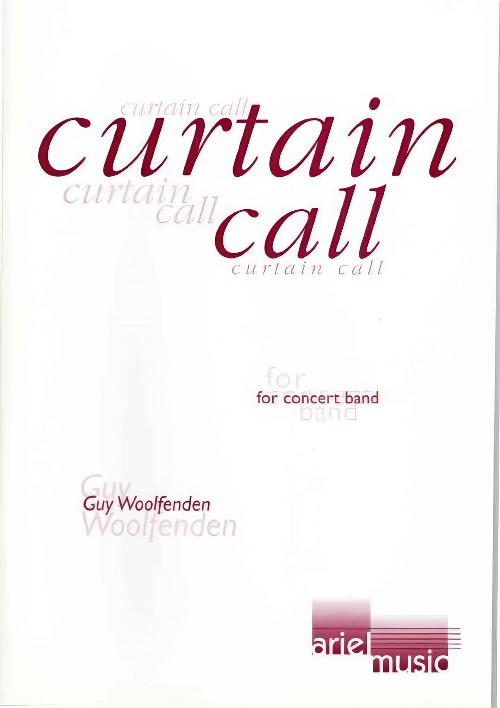
CURTAIN CALL (Concert Band) - Woolfenden, Guy
Includes:Solemn MarchValse TristeFinaleThe thematic material for the first movement, Solemn March, started life as a coronation procession in Trevor Nunn's legendary production of The Revenger's Tragedy, a notorious Jacobean blood and guts play by Cyril Tourneur. Trevor Nunn was also the director of a much loved production of All's Well That Ends Well, starring Dame Peggy Ashcroft and Harriet Walter, from which the Valse Triste comes, featuring a haunting melody tailor-made for the oboe. The last movement, Finale, is a reworking of the curtain call music for Bill Alexander's amazing production of Richard III starring Antony Sher, who memorably played the role on crutches.
Estimated dispatch 7-14 working days
 View Music