
Results
-
£134.99
Marche au Supplice - Hector Berlioz
Hector Berlioz (1803-1869) once remarked: "My life is a novel that greatly interests me." Experiences in his personal life had a great influence on his compositions. Symphonie Fantastique, written in 1830, is also autobiographical: he subtitled the work Episode in the Life of an Artist. The symphony echoes his feelings for an actress. The Marche au Supplice (march into torture) he described as: "The artist dreams he has killed his beloved, that he has been sentenced to death and is being led to the scaffold. The procession moves to the notes of a march that is now sombre and turbulent, now radiant and stately, and in which boisterous outbursts suddenly dissolve intothe heavy sound of marching feet."
Estimated dispatch 7-14 working days
-
 £420.99
Sinfonietta - Jan Van der Roost
Sinfonietta consists of four movements that have no thematic or musical relationship with each other. Each movement has its own character and atmosphere, which displays a variety of qualities and possibilities of the modern concert band. The four movements are entitled The Landing; The Sword Dance; Nightfall by the River and Towards the Future. Together they build into a mini- symphony full of colour and contrasts.
Estimated dispatch 7-14 working days
-
 £420.99
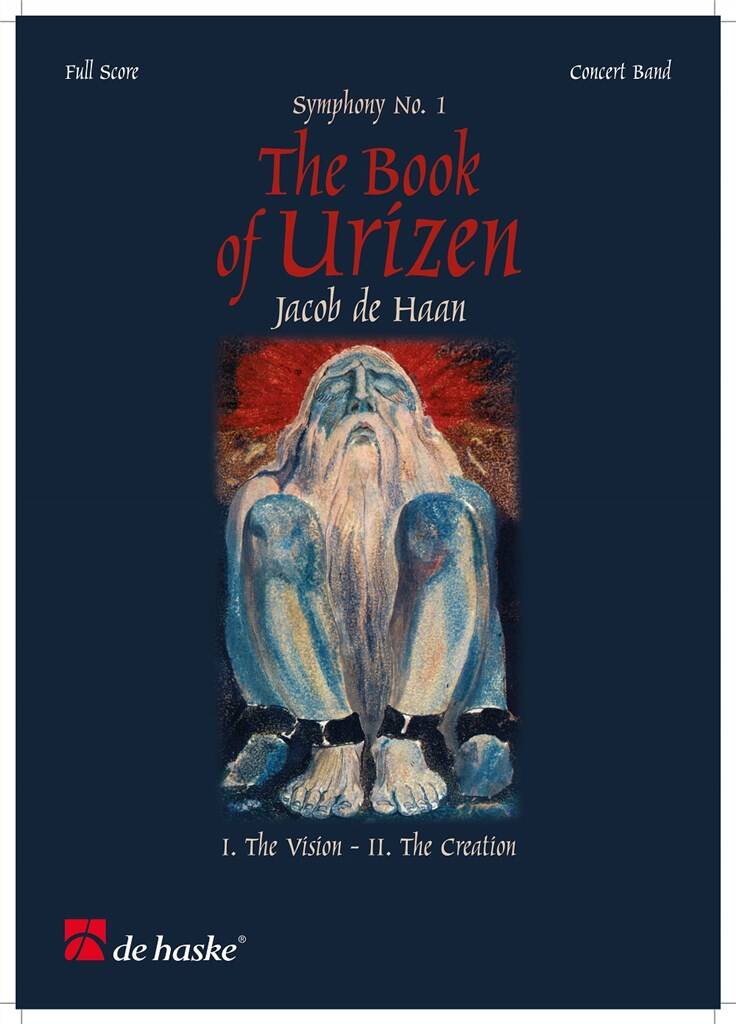
The Book of Urizen I + II - Jacob de Haan
The Book of Urizen is Jacob de Haan his first Symphony for concert band, solo soprano, and a male narrator in which sound collages of expressions are used. The piece is inspired by the compelling visionary poem of the samename (which the poet illustrated himself) by the Englishman William Blake (1757-1827). The Vision, first movement and The Creation, second movement of The Book of Urizen are available by following editionnumber: DHP 1043551. The Web, the third movement of The Book of Urizen is available by the following edition number: DHP 1125252. Download the audio samples from the 'Attachments'.
Estimated dispatch 7-14 working days
-
£72.99
Europa - Marc-Antoine Charpentier
Jan de Haan combines a famous prelude and a famous finale from the pens of two famous European composers. Both familiar themes are still frequently played today. The prelude, from Marc Antoine Charpentier's Te Deum, is featured asthe theme for today's Eurovision Song Contest. The finale, from the final movement of Beethoven's Ninth Symphony, has become the European Anthem. Your band will enjoy performing these master works that have been carefully scoredin a four-part flexible instrumentation. Dur: 2:40 (Grade 2)
Estimated dispatch 7-14 working days
-
 £104.99
Intermezzo - Satoshi Yagisawa
Intermezzo is the second movement of Satoshi Yagisawa's Clarinet Concerto. The concerto was first performed by Higashi-Hiroshima Wind Ensemble in Hiroshima, Japan in 2010 with guest performer Shinsuke Hashimoto, clarinettist with the Hiroshima Symphony Orchestra and was conducted by Atsushi Kageyama. Inspiration for this work came from the fact that both Satoshi Yagisawa and Shinsuke Hashimoto graduated from Musashino Academia Musicae.Clarinet Concerto>/I> is the pinnacle of Satoshi Yagisawa's "Concerto Series" which also features his Suite Concertante for Piano and WindOrchestra, Trumpet Concerto, Trombone Concerto, Saxophone Concertino, andConcertino for Solo Percussion and Wind Orchestra.Yagisawa's characteristic heartfelt theme in the second movement is especially popular and consequently--entitled Intermezzo--it is often performed independently.Soloist: Grade 4
Estimated dispatch 7-14 working days
-
£91.99
Eliza's Aria - Elena Kats-Chernin
Eliza's Aria is a classical aria from the ballet Wild Swans, composed by Uzbekistan composer Elena Kats-Chernin. The piece was first recorded by soprano Jane Sheldon and the Tasmanian Symphony Orchestra, and released on the ABC Classics label. This recording was subsequently used in the 2007 Lloyds TSB "For the Journey" television and cinema advertisements and also received extensive radio airplay in December 2007. It was also used as the basis for "The Journey Continues" a dance track by DJ Mark Brown, featuring Sarah Cracknell of Saint Etienne, which was released in February 2008.
Estimated dispatch 7-14 working days
-
 £149.99
Columbus - Rob Goorhuis
Christopher Columbus was born in Genoa in 1451. His father was a wool merchant. Originally he seemed destined to follow in his father's footsteps, and thus sailed the oceans to countries as far apart as Iceland and Guinea. In 1476 his ship was sunk during a battle off the coast of Portugal. Columbus saved his own life by swimming to shore. In 1484 he conceived the idea of sailing to the Indies via a westward sea route, but it was only in 1492 that he was able to realize this plan. On this first voyage he was in command of three ships: the flag-ship, called the Santa Maria, the Pinta, and the Ni?a. From Spain Columbus sailed via the Canary Islands to the Bahamas, whichhe sighted on October 12th 1492. Without being aware of it Columbus discovered the 'New World' he thought he had landed in the eastern part of Asia. The motif from Dvok's 9th Symphony 'Aus der neuen Welt' forms a little counterfeit history at this point in the composition. After this first voyage Columbus was to undertake another three long voyages to America. These voyages were certainly not entirely devoid of misfortune. More than once he was faced with shipwreck, mutiny and the destruction of settlements he had founded. After Columbus had left for Spain from Rio Belen in 1503, he beached his ships on the coast of Jamaica. The crew were marooned there and it was only after a year that Columbus succeeded in saving his men and sailing back to Spain with them. In the music the misunderstanding about which continent Columbus discovered in his lifetime resounds, for does this part in the composition not contain Asiatic motifs? Poor Columbus! In 1506 the famous explorer died in Valladolid.
Estimated dispatch 7-14 working days
-
 £52.10
Ode an Die Freude - Ludwig van Beethoven
This Ode to Joy is the choral finale of Beethoven's 9th Symphony, composed in 1823, using a poem written in 1785 by Friedrich von Schiller. During the Olympic Games of 1956, 1960 and 1964, Ode to Joy was played as the national anthem for the German Unity Team, and in 1972 it was chosen as the anthem for the Council of Europe. In 1985, it was chosen by the Heads of State, and the Government of the European Union as the official anthem of the European Union.
Estimated dispatch 7-14 working days
-
 £186.20
Concerto for Alto Saxophone and Band - Ronald Binge
Ronald Binge was born on 15 July 1910 at Derby, England. He studied harmony and counterpoint on his own and tried his hand at arranging and composing during the many years he worked as a pianist and musician in movie theatres. In 1934 he met the conductor of Italian descent Annunzio Paolo Mantovani (1905-1980) and started writing numerous arrangements for the symphony orchestra of this very popular conductor. In fact, Binge is the inventor of the famous 'Mantovani Sound' (with echo effects by the strings) which charmed and pleased millions of music lovers and television spectators all over Europe in the fifties and sixties. In 1952 he scored a hit with ' Elisabethan Serenade'. Binge also wrote classical music and even a series of wind band compositions such as the most popular 'Cornet Carillon'. Ronald Binge died on 6 September 1979 at Ringwood. He dedicated his Concerto for Alto Saxophone (1956) to the famous American saxophone virtuoso Sigurd Rascher (1907-2001), the pioneer of the classical saxophone. At the request of the Dutch wind band publisher Pieter Jan Molenaar, Binge wrote a version for symphonic band. Unfortunately both the editor and the composer died some time later in 1979 and could not attend the premiere of this version by the Dutch Royal Marine Band conducted by Jaap Koops and with Johan Perik as soloist. The concerto consists of three parts. In the dynamic and quick 'Allegro Spirituoso' one can hear the melody alternately with the soloist and the accompanying band. The second part is more lyrical, though passionate as well and it is better known as it is often performed on itself under its title 'Romance'. The final part 'Rondo Allegro Giocoso' is written in rondo form as its title indicates and it allows the soloist to demonstrate his virtuosity in a very lively dialogue with he band.
Estimated dispatch 7-14 working days
-
 £186.20
Le Chant de l' Arbre - Serge Lancen
Serge Lancen was born in Paris in 1922. The whole of his life has been dominated by music. He wrote his first work at the age of four. He studied with Tony Aubin at the Paris Conservatoire. In 1949 he won a prize for his Etudes, and some time later he was awarded the Prix de Rome.His work as composer is very varied and includes a number of solo concerti (for example for flute, double bass and piano), a Sinfonietta and a large number of works in the light symphonic genre (many of these commissioned by the French Radio), chamber music, film music, and during the last ten years various works for wind band, such as the Manhattan Symphony, Festival in Kerkrade, Symphonie de Paris and this beautiful Chant de l'Arbre (Song of the Tree).
Estimated dispatch 7-14 working days
 View Music