
Results
-
 £38.20
Bayerische Defileermars - Ad Scherzer
Adolf Scherzer was military bandmaster with the 7th Bavarian Infantry Regiment at Ingolstadt from 1849 to 1864. His Bayerischer Defilier Marsch (Bavarian Parade March), dating from the second half of the nineteenth century, is one of the most popular German marches of all times. The fanfarelike trumpet calls backed by chromatic woodwind passages give this solemn march its quite original character. Willy Hautvast's fine arrangement for the modern wind band makes this legendary march finally available to all our wind bands.
Estimated dispatch 7-14 working days
-
 £51.60
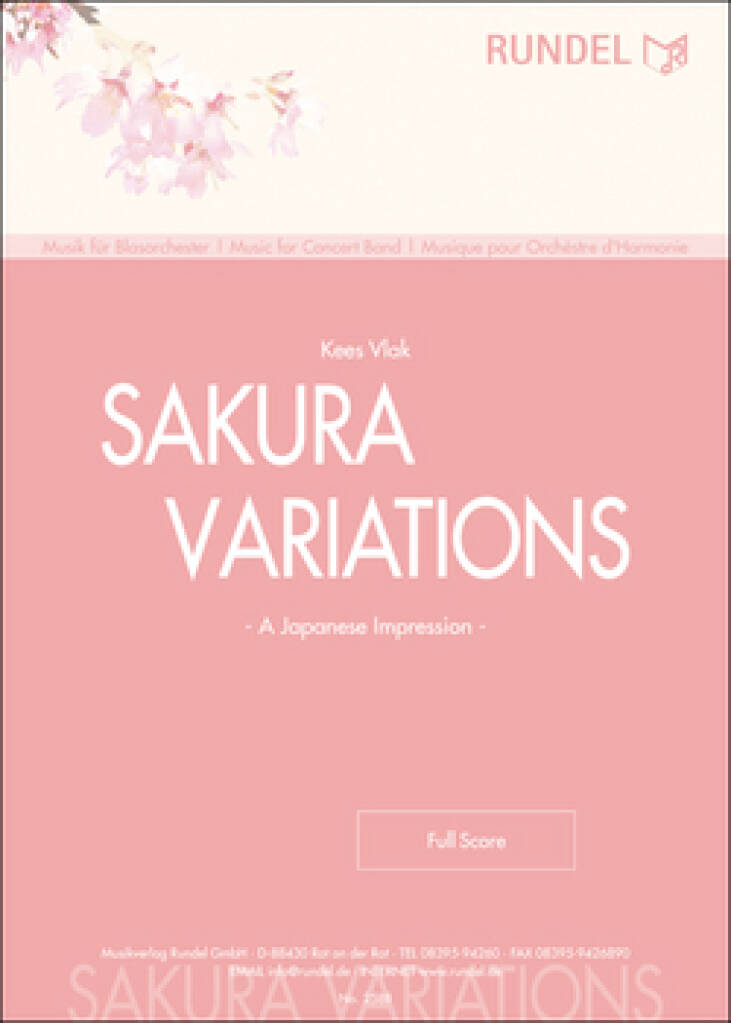
Sakura Variations - Kees Vlak
The blooming of the cherry trees each spring is a great event in Japan. In the evening friends meet under the pink and white cherry blossoms for a picnic. It is a striking sight, especially in big cities. Vendors sell Japanese food, entertainers andclowns perform, and the typically cautious Japanese seem to be more relaxed during the cherry blossom, or "Sakura". Kees Vlak captured this atmosphere with his "Sakura Variation"; its theme employs a subtle drum rhythm. The first variation is titled"clowns" and opens with three bass drum strikes. The theme appears in 3/4 time and is repeated several times with surprising changes. An impetuous tempo with dissonant elements suggests a clown's mischievous behaviour. The second variation in a minormode sounds very sad and dramatic. Is this the sadness when thinking of the end of the cherry blossom, as all the petals "snow" down from the trees? The cherry trees will bloom again next year, so the finale celebrates a joyful "Sakura".
Estimated dispatch 7-14 working days
-
 £91.20
King Arthur - Antonio Petrillo
The legendary figure of Arthur, British leader, is mainly the result of folklore and literary invention. According to the tales Arthur, who in the most ancient sources is called "Warlord," defended Great Britain from the Saxon invaders between the fifth and sixth centuries. In the introductory measures of the piece, we can hear the basic themes developing freely one after the other. The first movement (Allegretto - march) describes Arthur with his most faithful riders galloping on his horse for simple rides in the woods or hunting moments. The second movement (Vivace - gigue), describes court dances to celebrate his victories over the Saxons. The third and last movement (Moderato - grandiose) portrays the special relationship between Arthur and Excalibur, the magical and mysterious sword that only he managed to extract from the rock before being proclaimed king. Excalibur's scabbard is said to have the power to protect King Arthur from being wounded in battle.
Estimated dispatch 7-14 working days
-
 £126.50
Italian impressions - Angelo Sormani
"Italy is truly a magical land that has touched my heart beyond measure." These are the words describing the feelings that accompanied the various visits of the American conductor Wesley Broadnax in our country. Italian Impressions, a composition dedicated to Broadnax, portrays these feelings in three main sections that develop without interruption throughout the piece. The first section, "Magic Land," describes a trip to Rome and is a tribute to the splendor and magic of some of the venues in this city. Rich in historical and cultural significance, these places are moving because of their surprising architecture and artistic genius. The second part, "The Huge Castle," depicts his visit in the Umbrian Region. It is a reflective and suspended immersion in music that describes landscapes characterized by ancient houses, churches, courtyards, and squares. "Assisi," says Wesley, "is the city that glitters in the night sky, comparable to a huge castle!" The third part, "Medieval Ballad," is a reference to the city of Siena and Tuscany more generally. The main theme of this movement recalls medieval atmospheres and is based on the fourteenth-century ballad "Ecco la primavera" by Francesco Landino. The original material is presented, elaborated, and juxtaposed with new thematic motives, which lead to an energetic conclusion of the piece.
Estimated dispatch 7-14 working days
-
 £77.90
La matita di leonardo - Luciano Feliciani
2019 coincided with the 500-year anniversary of the death of Leonardo Da Vinci, one of the greatest men of genius in history, a universal genius who was a scientist, philosopher, architect, painter, musician, engineer, anatomist, botanist, designer, and planner. This composition entitled La Matita di Leonardo (Leonardo's Pencil), represents an ideal journey into the mind of the Tuscan genius: in the first part of the piece, percussion instruments underline the ticking of the passage of time that anticipates the birth of the idea, while short thematic cells in various instruments alternate, drawing the rhythmic melodic line. On this background, we hear the main theme entrusted to the dark tones of trombone and euphonium. The music proceeds with a growing pace and an adventurous character to represent the genesis of Leonardo's machines, which are in fact the result of the drawings of his pencil. In the second, more animated part, a new theme is introduced, varied, and elaborated, thus giving life to a vigorous movement meant to describe the drawings that come to life, leaving the pages of Leonardo's codes. In the coda the two themes overlap, transporting the listener towards a resolute and rhythmically energetic conclusion in an enthralling and engaging finale.
Estimated dispatch 7-14 working days
-
£81.90
Kuda, kuda v udalilis - Pyotr Ilyich Tchaikovsky
The aria 'Kuda, kuda v udalilis' is sung by Lensky, fianc of Olga and friend of Onegin in the second act of Tschaikowsky's opera Eugene Onegin: Lensky challenged Onegin to a duel in response to Onegin's advances on Olga. Now, on the morning of the duel, Lensky looks back on his happy youth as he waits for Onegin to arrive. He realizes that he will probably die in the duel and that he does not particularly care if he does. The only great loss in his death would be that he would never see Olga again.
Estimated dispatch 7-14 working days
-
£299.70
Concertino for Organ - Thomas Trachsel
This work was created by an order from the wind orchestra Feldmusik Sarnen and its conductor Rolf Schumacher on the occasion of his anniversary concert in the Hofkirche in Lucerne. The organist at the premiere was the organist of the court church Wolfgang Sieber. I tried to illuminate the Hofkirche and its organ in all three movements. In the Toccata the full force of the organ becomes clear, while in the second movement one is reminded more of praying monks in the cloister. In the final, all important topics are processed again. The organ part is very difficult to master, the accompaniment in the wind orchestra should be feasible for a wind orchestra grade 4 (approx. 1st class). (Edition Symphonic Works)
Estimated dispatch 7-14 working days
-
£248.99
Hydra Concerto - Ferrer Ferran
The innovative Spanish composer Ferrer Ferranhas taken Greek mythology as an inspiration forhis concerto for trumpet and concert band. Hydra,the water monster decapitated by Hercules andIolaus, terrorised the area of Lerna, near Argos.The concerto is in three sections which contrastwith each other. The first section is rhythmical andtriumphant, the second is calm and melodious andthe last part provides an aggressive ending. Awelcome addition to the repertoire for solo trumpetand concert band.
Estimated dispatch 7-14 working days
-
£102.99
Jazz Suite No. 2 - March - Dimitri Shostakovich
In 1938 Shostakovich composed his Second Jazz Suite at the request of the recently founded State Orchestra for Jazz conducted by Victor Knushevitsky. This suite was originally scored for a complete symphony orchestra to which four saxophones, an accordion and a guitar had been added. The Jazz Suite no. 1 in three movements, composed in 1934, had been written for a smaller ensemble. The title 'Jazz Suite' is rather misleading, as the composer definitely uses the style of light music. Back in 1928, the twenty-two-year-old Shostakovich had already composed some light music. A bet among friends to make an orchestration of the popular song 'Tea for Two' in less then one hour time, causedhim to compose 'Tahiti Trot'. Shostakovich easily won the bet as he completed the original and witty arrangement within only forty minutes!
Estimated dispatch 7-14 working days
-
£99.99
Jazz Suite No. 2 - Dance II - Dimitri Shostakovich
In 1938 Shostakovich composed his Second Jazz Suite at the request of the recently founded State Orchestra for Jazz conducted by Victor Knushevitsky. This suite was originally scored for a complete symphony orchestra to which four saxophones, an accordion and a guitar had been added. The Jazz Suite no. 1 in three movements, composed in 1934, had been written for a smaller ensemble. The title 'Jazz Suite' is rather misleading, as the composer definitely uses the style of light music. Back in 1928, the twenty-two-year-old Shostakovich had already composed some light music. A bet among friends to make an orchestration of the popular song 'Tea for Two' in less then one hour time, causedhim to compose 'Tahiti Trot'. Shostakovich easily won the bet as he completed the original and witty arrangement within only forty minutes!
Estimated dispatch 7-14 working days
 View Music