
Results
-
 £116.40
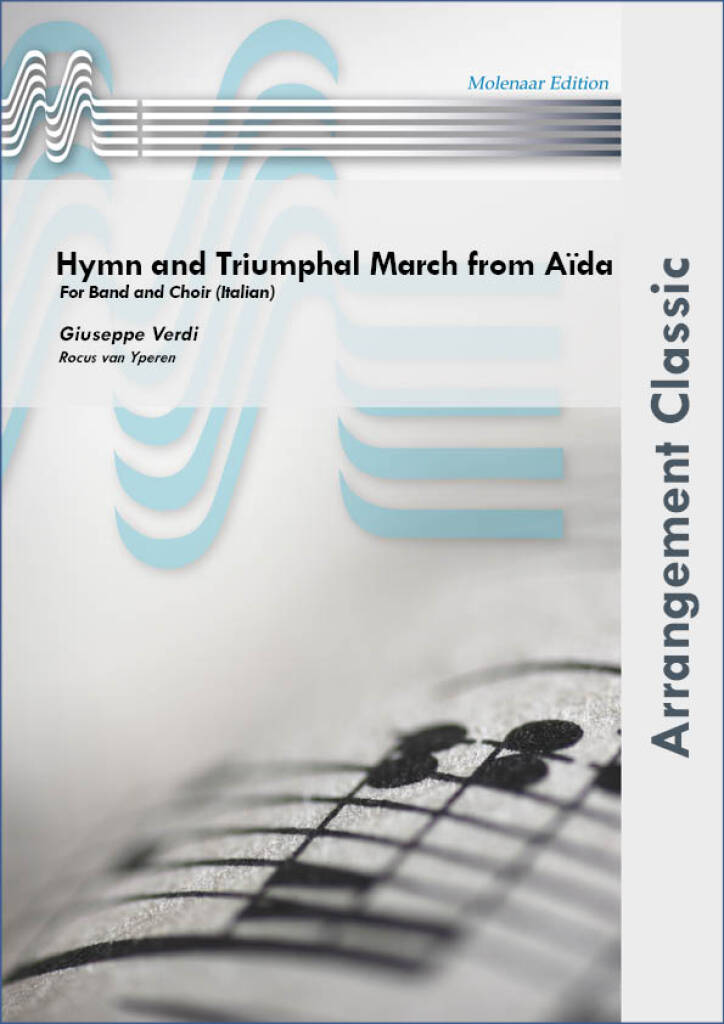
Hyman and Triumphal March from Aida - Giuseppe Verdi
Many composers have written a triumphal march, with maybe the best known one being by Italian opera composer, Giuseppe Verdi for his 1871 grand opera, Aida, where, in the second act, Radames leads the Egyptian army on its return following their victory over the Ethiopians. The triumphal scene gives directors the opportunity for elaborate spectacle typical of the grand opera of the period in the nineteenth century. Arranged by Rocus van Yperen
Estimated dispatch 7-14 working days
-
 £90.30
Three Folk Sketches - Henk van Lijnschooten
This is a simple three-part suite from folk songs. The first part is a combination of various french songs, the second is based on the famous 'two king's children'('daar waren twee koningskinderen'), with the third part as a scottish round.
Estimated dispatch 7-14 working days
-
 £90.30
Liberation - Kees Vlak
This imposing work has been commissioned by the BFO Dutch Music Center and the VARA radio. Kees Vlak has been inspired by the Liberation which put an end to the Second World War.
Estimated dispatch 7-14 working days
-
 £140.80
Rhapsody From Scotland - Henk van Lijnschooten
This rhapsody is based on popular folktunes and dances such as 'Annie Laurie', 'Gina Body', 'Meet a Baby', 'Hundred Pipers' and 'Auld Lang Syne'. Henk van Lijnschooten is second to none to picture the legendary, mysterious, though fascinating Scotland.
Estimated dispatch 7-14 working days
-
 £186.20
Wald Sinfonie - Kees Vlak
It was during his stay at Freiburg, Germany, where he was attending a Music Festival, that Kees Vlak found his inspiration for this romantic work. At this festival he was awarded a prize for one of his compostitions, which was played by several bands from different countries. The composer was staying in the small village of Horben, hidden among pine woods on a mountain at the border of the Black Forest. From the balcony of his room he had a splendid view on the Schawinsland Valley, scarcely hidden by the tops of the huge pines. Each morning a blackbird singin in a huge pine next to his window woke him up. This bird song opens the composition.Whenever possible the composer and his wife went for a walk in the Black Rorest. The rediscovery of this wonderful area is expressed by the steadily increasing number of tone colours, used in the orchestration. Each village still boasts its own folk music and dances. More than one hundred bands were playing all around; the Black Forest seemed to be the scene of one huge festival. The image of the Black Forest is also linked to that of hunting scenes, so the next theme is being introduced by hunting horn themes. The second theme paints the lake "Titisee". At first the lake is very calm, but a stiff breeze sets both water and music alike in motion. The small town of Titisee is very popular with tourists and is famous for its woodcutting, its clockworks and musical boxes. It is a popular folk tune, played by a musical box that makes the link with the next theme. The joy and cheerfulness of the dancing village people is expressed by a movement which works out the initial theme.On leaving the little town, one can hear once more the hunting music from the wood as well as the song of the birds. The new theme is againg closely linke d to the hunt and played by the typical German helicon-like euphoniums.this theme interacts with the wecond theme and the word ends with a grnd finale meant as a musical hommage tot this wonderful area.
Estimated dispatch 7-14 working days
-
 £90.30
Little Swedish Suite - Mary Ann Gilby
The outer movements of this Little Suite are based on traditional Swedish folkdances. The melancholy second movement sings of the girl Hilla and her love for Duke Hillebrand, unattainable for her, as the 18th century Love-ballad by G. Mohnicke tells us.
Estimated dispatch 7-14 working days
-
 £131.30
Hymns And Dances II - J. Slothouwer
In 1990 Jochem Slothouwer composed Hymns and Cances II. This work for symphonic band and harp (ad libitum) is based on Hymns and Dances I for piano, mixed choir and percussion. The compostition is based on the contrast between hymnlike melodies and dance music episodes. The work, in five connected parts, seems to look for a reconciliation of both melodic and rythmical elements. The initial theme with the horns and the answer of the band form the base of the first part.The second part, charcterized by a vitorous dance rhythm, is dominated by the percussionn and syncopated motifs with the brass. A melody with the euphoniums almost imperceptibly slips into the ensemble and gradually gets to the foreground. The dance and the hymn reach a real climax interrupted by a short and dark intermezzo (part three). The clear sonority of part four, a fiery tarantella with many small byt virtuoso solos, is a new contras. The final adagio reuses the previously developed ideas of part one and ends in sheer ecstasy.
Estimated dispatch 7-14 working days
-
 £186.20
Voyages - Coby Lankester
In the suite Voyages (Travels) Mrs. Lankester has set to music six impressions collected during several stays in France. Originally the six pieces were part of different ballet music scores. In this excellent arrangement by Marcel Peeters they have been gathered into one suite in which the travel impressions serve as a guideline. The first part suggests a Village Fair, whereas the second part expresses explicitly the composer's admiration for Paris in The Invitation. The third part, Nostalgia (Le Lac) is a rather nostalgic reverie about a French lake. The fourth part Reminiscences of Daumier, has to be considered as a tribute to the 19th century painter Honor Daumier of Marseille, famous for his political caricatures. The fifth part, Homage to Mompou, honours the memory of the Spanish composer and pianist Federico Mompou, creator of the primavista style. The suite closes with a cheerful Final Dance (Le Retour), depicting the journey back home.
Estimated dispatch 7-14 working days
-
 £116.40
Little Suite No. 1 - Malcolm Arnold
Sir Malcolm Arnold (1921) put an end to his career as leading trumpeter with several famous London symphony orchestras to become a full-time composer. He became world famous with his soundtrack music for 'The Bridge over the River Kwai', but he composed a lot of orchestral, vocal, ballet and chamber music. He wrote several works for wind band and for brass band, such as three 'Little Suites for Brassband'. The 'Little Suite Number 1' Opus 53 for orchestra (followed by the Second Opus 78) consists of a 'Prelude' (Maestoso), a 'Dance' (Allegretto) and a well-known 'March' (Allegro con brio). The march is still on the concert repertoire of many British military bands.
Estimated dispatch 7-14 working days
-
 £61.00
Trumpet Tune - W. Boyce
Originally the second movement of Boyce's Voluntary in D, this piece has become popular in the English Church as a postlude for occasions such as weddings. In this edition it has been extensively re-arranged by Rodney Parker in baroque style for two solo trumpets and band.The solo trumpets are best placed apart, ideally above and to each side of the band but not too far away. The piece should be played in a clear baroque style with special attention to dynamics and articulation. The accompaniments should never overpower the soloists and it should always be performed lightly. This is most important for the Tuba and other bass instruments for which this piece is a fitness test!
Estimated dispatch 7-14 working days
 View Music