
Results
-
 £144.95
FANFARE TO PLANET EARTH and MILLENNIUM MARCH (Prestige Concert Band - Score and Parts) - Fanshawe, David - Sparke, Philip
These two works may be performed individually or, as published, together. Fanfare to Planet Earth - the Fanfare opens dramatically with heraldic trumpets answered by sforzando strikes on deep percussion. The Fanfare embraces the splendour and grandeur of our planet Earth, molto grandioso, and culminates in a chordal cluster - a blaze of brass and percussion in G major, describing feelings of optimism at the start of the 21st century. Performance time 1'50". Millennium March - constructed along classical lines, the theme of Millennium March is catchy and not without humour. Its recurring motif on trumpets, con brio, develops the opening bars of the Fanfare. The March gathers momentum through several dramatic key-changes and ends with a surprise flourish of chromaticism, marked Tempo Apocalyptic. Cannons and fireworks are optional! Performance time 4'10'
Estimated dispatch 7-14 working days
-
£32.95
FANFARE TO PLANET EARTH and MILLENNIUM MARCH (Prestige Concert Band - Score only) - Fanshawe, David - Sparke, Philip
These two works may be performed individually or, as published, together. Fanfare to Planet Earth - the Fanfare opens dramatically with heraldic trumpets answered by sforzando strikes on deep percussion. The Fanfare embraces the splendour and grandeur of our planet Earth, molto grandioso, and culminates in a chordal cluster - a blaze of brass and percussion in G major, describing feelings of optimism at the start of the 21st century. Performance time 1'50". Millennium March - constructed along classical lines, the theme of Millennium March is catchy and not without humour. Its recurring motif on trumpets, con brio, develops the opening bars of the Fanfare. The March gathers momentum through several dramatic key-changes and ends with a surprise flourish of chromaticism, marked Tempo Apocalyptic. Cannons and fireworks are optional! Performance time 4'10'
Estimated dispatch 7-14 working days
-
 £144.99
Ross Roy (Concert Band - Score and Parts) - De Haan, Jacob
Jacob de Haan was commissioned to compose this concert piece by the "St. Peters Wind Symphony" from Brisbane, Australia. "Ross Roy" is the monumental late 19th century villa where St. Peters Lutheran College was founded in 1945. The villa has always remained the school symbol. In this composition, Jacob de Haan sees the "Ross Roy" as a metaphor for the years spent at school (a monument in time), where one's personality is formed. So, the opening theme the artist calls the Ross Roy theme initially has monumental characteristics.The rhythmic motion, which strides along in the lower register and percussion at the beginning of the next section is typical of "Tempo di Marcia". This movement, accompanied by repetitions of sound, is a metaphor for the structure and discipline in school. This is the introduction to a march theme, symbolic of "passing through" the classes up to the final examinations.Then, the Ross Roy theme is dealt with again, now in a playful, humorous variation. As if the composer is saying there should also be time for a smile in school. The same theme can be heard in major key and a slower tempo in the following section, expressing pride and self-confidence. This is also the introduction to the expressive middle section that represents love, friendship and understanding.We then return to the march theme in a slightly altered construction. The oriental sounds, constituting the modulation to the final theme, are symbols of the diversity of cultures in the school. The characteristic final theme first sounds solemn, but turns into a festive apotheosis. It is no coincidence that the final cadence is reminiscent of the close to a traditional overture, for the school years can be considered the "overture" to the rest of one's life. The premiere of "Ross Roy" was conducted by Jacob de Haan in Brisbane, on August 22, 1997.Duration: 9:20
Estimated dispatch 7-14 working days
-
 £123.20
3 Letzte Motetten (Concert Band - Score and Parts) - Bruckner, Anton - Doss, Thomas
Anton Bruckner (b. 4.9.1824, Ansfelden, d. 11.10.1896, Vienna) didn't have it easy. Throughout his life, the Austrian composer was plagued by self-doubt. Anton Bruckner came from a simple, rural background. After the death of his father, he was accepted as a choirboy at the monastery of Sankt Florian in 1837. After several years as a school assistant and his own organ and piano studies, he first worked as organist in St. Florian, then from 1855 as cathedral organist in Linz. Introduced to music theory and instrumentation by Simon Sechter and Otto Kitzler, he discovered Richard Wagner as an artistic role model, whom he admired throughout his life and also visited several times in Bayreuth. In 1868 Anton Bruckner became professor of basso continuo, counterpoint and organ at the Vienna Conservatory; ten years later court organist; and in 1891 finally honorary doctor of the University of Vienna. He was considered an important organ virtuoso of his era, but had to wait a long time for recognition as a composer. It was not until Symphony No.7 in E major, composed between 1881 and 1883, with the famous Adagio written under the effects of Wagner's death, that he achieved the recognition he had hoped for, even if he was reluctant to accept it given his inclination towards scepticism and self-criticism. Anton Bruckner was a loner who did not want to follow a particular school or doctrine. He composed numerous sacred vocal works, such as his three masses, the Missa Solemnis in B flat minor (1854), the Te Deum (1881-84) and numerous motets. As a symphonic composer, he wrote a total of nine symphonies and many symphonic studies from 1863 onwards, tending to revise completed versions several times over. Bruckner's orchestral works were long considered unplayable, but in fact were merely exceptionally bold for the tonal language of their time, uniting traditions from Beethoven through Wagner to folk music, on the threshold between late Romanticism and Modernism. Anton Bruckner composed about 40 motets during his lifetime, the earliest a setting of Pange lingua around 1835, and the last, Vexilla regis, in 1892. Thomas Doss has compiled some of these motets in this volume for symphonic wind orchestra. These motets show many characteristics of personal expression, especially Bruckner's colourful harmony in the earlier works, which is in places aligned with Franz Schubert (changes between major and minor; and movements in thirds). Later works are characterised by many components which, in addition to the expanded stature of the movements, include above all a sense of the instrumentation as an outward phenomenon and the harmony as a compositional feature that works more internally. Some aspects of Bruckner's work are the result of his long period of study, which familiarised him not only with the tradition of his craft, but also gave him insights into the "modernity" of his time in such composers as Wagner, Liszt and Berlioz. From this developed his personal standpoint, which always pursues the connection between the old and the new.Duration: 14.00
Estimated dispatch 7-14 working days
-
 £256.00
14 Motetten (Concert Band - Score and Parts) - Bruckner, Anton - Doss, Thomas
Anton Bruckner (b. 4.9.1824, Ansfelden, d. 11.10.1896, Vienna) didn't have it easy. Throughout his life, the Austrian composer was plagued by self-doubt. Anton Bruckner came from a simple, rural background. After the death of his father, he was accepted as a choirboy at the monastery of Sankt Florian in 1837. After several years as a school assistant and his own organ and piano studies, he first worked as organist in St. Florian, then from 1855 as cathedral organist in Linz. Introduced to music theory and instrumentation by Simon Sechter and Otto Kitzler, he discovered Richard Wagner as an artistic role model, whom he admired throughout his life and also visited several times in Bayreuth. In 1868 Anton Bruckner became professor of basso continuo, counterpoint and organ at the Vienna Conservatory; ten years later court organist; and in 1891 finally honorary doctor of the University of Vienna. He was considered an important organ virtuoso of his era, but had to wait a long time for recognition as a composer. It was not until Symphony No.7 in E major, composed between 1881 and 1883, with the famous Adagio written under the effects of Wagner's death, that he achieved the recognition he had hoped for, even if he was reluctant to accept it given his inclination towards scepticism and self-criticism. Anton Bruckner was a loner who did not want to follow a particular school or doctrine. He composed numerous sacred vocal works, such as his three masses, the Missa Solemnis in B flat minor (1854), the Te Deum (1881-84) and numerous motets. As a symphonic composer, he wrote a total of nine symphonies and many symphonic studies from 1863 onwards, tending to revise completed versions several times over. Bruckner's orchestral works were long considered unplayable, but in fact were merely exceptionally bold for the tonal language of their time, uniting traditions from Beethoven through Wagner to folk music, on the threshold between late Romanticism and Modernism. Anton Bruckner composed about 40 motets during his lifetime, the earliest a setting of Pange lingua around 1835, and the last, Vexilla regis, in 1892. Thomas Doss has compiled some of these motets in this volume for symphonic wind orchestra. These motets show many characteristics of personal expression, especially Bruckner's colourful harmony in the earlier works, which is in places aligned with Franz Schubert (changes between major and minor; and movements in thirds). Later works are characterised by many components which, in addition to the expanded stature of the movements, include above all a sense of the instrumentation as an outward phenomenon and the harmony as a compositional feature that works more internally. Some aspects of Bruckner's work are the result of his long period of study, which familiarised him not only with the tradition of his craft, but also gave him insights into the modernity of his time in such composers as Wagner, Liszt and Berlioz. From this developed his personal standpoint, which always pursues the connection between the old and the new.Duration: 39.00
Estimated dispatch 7-14 working days
-
£144.99
Magic Overture (Concert Band - Score and Parts)
Magic Overture was written as an anniversary present for the B?rgermusik G?tzis in Austria.The magic of the music and landscape in the Austrian region of Vorarlberg are in abundance in the charming village of G?tzis.Visiting a place as wonderful as this helps one appreciate local traditions and experience the joy of living. Once touched by the magic, every visitor will gladly return time after time. This new overture reflects the carefree cheerful atmosphere, taking the band on a walk through the village on an icy winters night to participate in the sparkling celebrations of the villagers. 07:45
Estimated dispatch 7-14 working days
-
£174.99
The Golden City Wind Band Set (Score & Parts)
Prague, also named 'The Golden City', has been the cultural and administrative capital city of the Czech Republic for thousands of years. The city is beautifully situated on the river Moldau. Every year millions of tourists visit Prague. It is one of the most popular cities of Eastern Europe. With it's mysterious little squares, dark alley ways and cobblestone streets, the 'City of the 100 Towers' is a unique mixture of architecture, dominated by monumental buildings, numerous churches and the oldest castle of Europe. The Bohemian capital city remains timeless. Visit the fort and be amazed at the lovely views over the Charles Bridge. Spend your time carefully browsing through the little stalls filled with paintings, photos, jewelery and hand-decorated products, accompanied by the sounds of the street musicians in the background. Notice the famous 15 th century astronomical clock that indicates the time every hour with a parade of the twelve apostles. When composing this piece, it was Jan Bosveld's intention to depict the atmosphere of this metropolitan city with over one million inhabitants, rather than to create a fairly literal musical portrait. One of the many other names of Prague is 'The City of the Clocks'. This can be heard throughout the piece depicted by the tubular bells. The piece consists of three movements (slow-fast-slow) and was written in a rhapsodic format. Jan Bosveld was commissioned to write 'The Golden City' by the Dutch Music Lend and Information Centre (MUI), a department of the library for the province of Gelderland in Arnhem, the Netherlands. 14:30
Estimated dispatch 7-14 working days
-
 £95.99
5 Tantum Ergo (Concert Band - Score and Parts) - Bruckner, Anton - Doss, Thomas
Anton Bruckner (b. 4.9.1824, Ansfelden, d. 11.10.1896, Vienna) didn't have it easy. Throughout his life, the Austrian composer was plagued by self-doubt. Anton Bruckner came from a simple, rural background. After the death of his father, he was accepted as a choirboy at the monastery of Sankt Florian in 1837. After several years as a school assistant and his own organ and piano studies, he first worked as organist in St. Florian, then from 1855 as cathedral organist in Linz. Introduced to music theory and instrumentation by Simon Sechter and Otto Kitzler, he discovered Richard Wagner as an artistic role model, whom he admired throughout his life and also visited several times in Bayreuth. In 1868 Anton Bruckner became professor of basso continuo, counterpoint and organ at the Vienna Conservatory; ten years later court organist; and in 1891 finally honorary doctor of the University of Vienna. He was considered an important organ virtuoso of his era, but had to wait a long time for recognition as a composer. It was not until Symphony No.7 in E major, composed between 1881 and 1883, with the famous Adagio written under the effects of Wagner's death, that he achieved the recognition he had hoped for, even if he was reluctant to accept it given his inclination towards scepticism and self-criticism. Anton Bruckner was a loner who did not want to follow a particular school or doctrine. He composed numerous sacred vocal works, such as his three masses, the Missa Solemnis in B flat minor (1854), the Te Deum (1881-84) and numerous motets. As a symphonic composer, he wrote a total of nine symphonies and many symphonic studies from 1863 onwards, tending to revise completed versions several times over. Bruckner's orchestral works were long considered unplayable, but in fact were merely exceptionally bold for the tonal language of their time, uniting traditions from Beethoven through Wagner to folk music, on the threshold between late Romanticism and Modernism. Hymns for four-part mixed choir a cappella (1846, St. Florian) No. 1 in E flat major (WAB 41/3): Quite Slow No. 2 in C major (WAB 41/4): Andante No. 3 in B flat major (WAB 41/1): Slow No. 4 in A flat major (WAB 41/2): Slow Hymn for five-part (SSATB) mixed choir and organ No. 5 in D major: Solemnly They are simple works, completely subordinate to their liturgical use, which nevertheless already show numerous characteristics of personal expression. These small pieces were able to stand up to the harsh scrutiny of the mature master: in 1888, Bruckner subjected them to a revision in which he made only minor corrections.Duration: 11.00
Estimated dispatch 7-14 working days
-
 £250.00
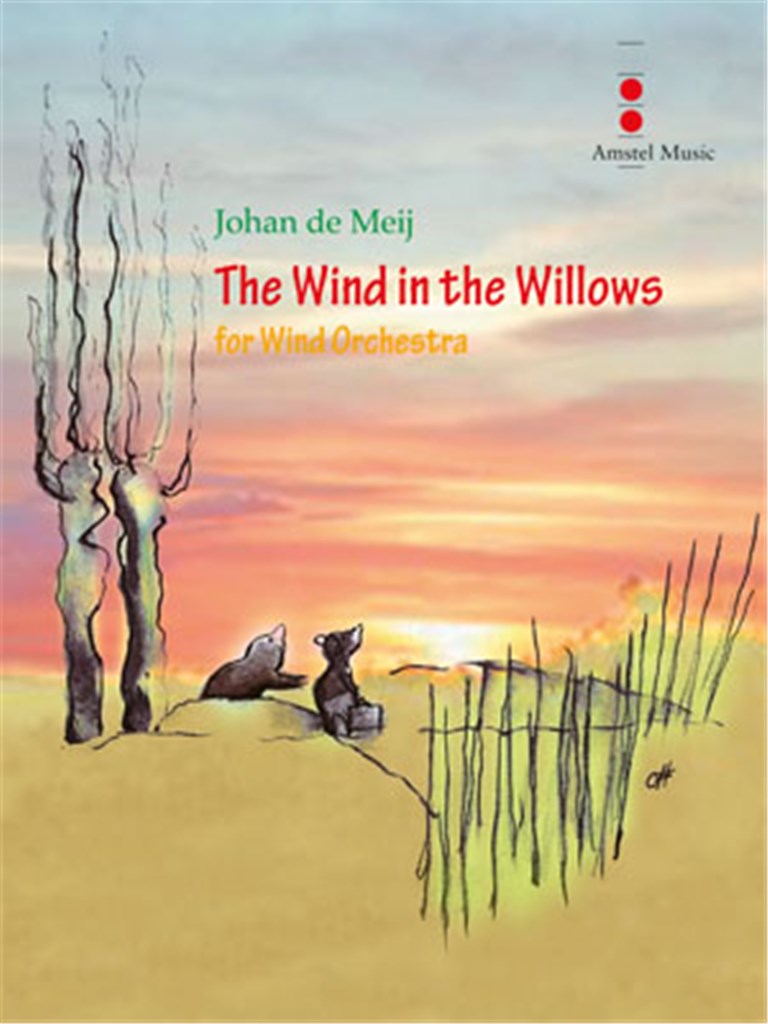
The Wind in the Willows (Concert Band - Score and Parts) - De Meij, Johan
A book for those who keep the spirit of youth alive in them; of life, sunshine, running water, woodlands, dusty roads, winter firesides, said author Kenneth Grahame (1859-1932) about his children's book The Wind in the Willows. Initially, he wrote the stories about Ratty, Mole, Badger and Toad to read to his visually handicapped son Alistair, but after the publication in book form in 1908, it became a worldwide success. It was later also turned into a film and a television series. What appealed ti the composer most is the friendly, very cosy atmosphere that Grahame has managed to create with his optimistic narrative style full of high spirits, an atmosphere that reminds thecomposer of his own carefree youth. It was therefore a great pleasure to set this book to music! The four movements successively describe: I) The River- The river, which flows through the habitat of the animals like a lifeline, regularly is the scene of pleasant boat trips and picnics. The animals lead their untroubled lives here. The four-tone main motif [A-C-D-C] is extensively presented by the brass section, and returns in the following movements as a countermelody. II) Ratty and Mole -The bright, energetic Rat and the melancholy doubter Mole are inseparable friends and have many adventures. Their opposite characters are illustrated by separate musical themes. III) Mister Toad - The wilful, haughty Mister Toad is indeed a unique case: time after time, he runs into tricky situations, and with his indomitable passion for fast, preferably stolen, cars he causes quite a lot of damage... IV) The Return of Ulysses - After Toad Hall, the majestic residence of Mister Toad, is recovered from the weasels and stoats of the Wild Wood, who had captured the estate in a cowardly way, our friends get ready for a banquet. They celebrate the victory with a triumphant parade, and so both the book and the music conclude with a happy ending. Duration: 17.00
Estimated dispatch 7-14 working days
-
 £84.99
To a Friend (Concert Band - Score and Parts) - De Haan, Jacob
When you have been playing in a band for a long time, you will know that music belongs to the most beautiful moments in life, but also to the roughest times. Making music together can give you strength when things are difficult. To a Friend is a wonderfully comforting work for anyone going through a dark time. Jacob de Haan composed the work for his father in law, Gerard Bosch, a musician to the core. The piece received its first performance just weeks before his passing. On a sun-kissed evening, his friends, the musicians of his two music societies, Oefening Baart Kunst (Practice Makes Perfect) Otterlo, and the Re?nie Orkest Artillerie Trompetterkorps (Reunion Band Artillery Trumpet Corps), played the work for Gerard, an unknowing yet beautiful goodbye. Duration: 3.45
Estimated dispatch 7-14 working days
 View Music