
Results
-
 £84.99
Creamy and Crispy Wind Band Set (Score & Parts)
This composition of Marc Cunningham has four parts, and takes place on a sunny day in a picturesque town. 1. Promenade Many people walk through the city. The band passes through the streets. People are strolling along the avenues and amorous couples are sitting on a park bench. 2. Lovey Dovey One of these couples is knee-deep in love. 3. Crispy and Creamy Here the contrasts between a crisp staccato section in two-four time signature and a smooth legato section in three-four time signature are depicted. Is Crispy the boy and Creamy the girl? 4. Farewell In the last particle the couple says goodbye. We still think back to the walk through the city. It sounds a little less happy now. Not everyone is good at saying goodbye, sometimes a tear flows. 07:45
Estimated dispatch 7-14 working days
-
£154.99
Of Castles and Legends (Concert Band - Score and Parts)
The programmatic composition Of Castles and Legends is basedon the German legend of the white maiden who lived in the smallcity of Volkmarsen. It tells the tale of invading evil knights whokidnap a beautiful maiden, who through sheer panic commandedher spirit into the hands of God and by jumping into the abyss fromthe highest tower of the castle where she was being held. Fromthat day onward, she appeared from time to time, in shiny whitegarments, a sign of eternal heavenly joy. A fantastically descriptivepiece which portrays this tragic legend through the power of music. 10:00
Estimated dispatch 7-14 working days
-
 £84.99
Rosanna (Concert Band - Score and Parts) - Paich, David - Sheppard, Mike
In 1982, rock band Toto scored a worldwide hit with Rosanna. This song is more than five minutes long, much longer than was usual for hits at the time, though perhaps it was exactly this fact that contributed to its enormous success. The London arranger Mike Sheppard, who knows the pop and rock scene through and through, made a wonderfully colourful version of this rock standard. Duration: 4.15
Estimated dispatch 7-14 working days
-
 £179.99
Up in the Sky (Concert Band - Score and Parts) - Schwarz, Otto M.
One of man's great dreams has always been to fly high through the air like a bird, free as a bird. There are ancient Greek legends such of those of Daedalus and Icarus, and indeed as early as the 9th century attempts at flight are reputed to have taken place in Arabia. It wasn't until 1783, however, that the invention of hot air ballooning by the Montgolfier brothers in France propelled man through the air for the first time. This colourful work depicts every step of this adventurous ballooning story.Duration: 13.00
Estimated dispatch 7-14 working days
-
 £375.00
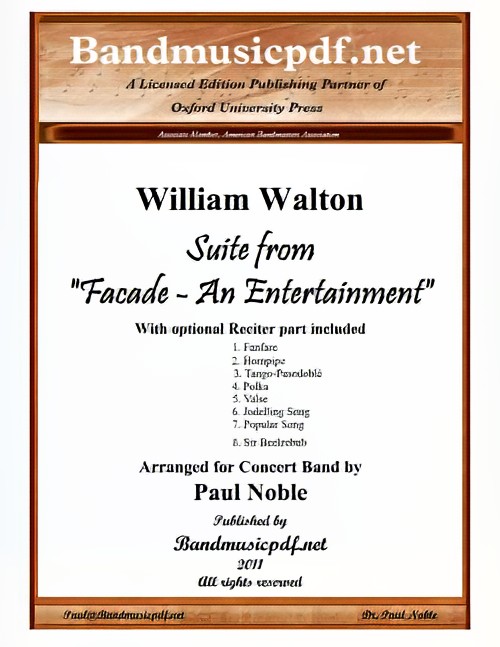
Facade - An Entertainment, Suite from (Concert Band with Optional Narrator - Score and Parts) - Walton, William - Noble, Paul
This Suite from Facade - An Entertainment, composed by William Walton, with poems by Dame Edith Sitwell, presents for the first time a grouping of movements selected and arranged by Paul Noble for Concert Band and optional Reciter. The original composition was written between 1921 and 1928, containing forty-three numbers. They had their origin in a new style of poetry that Edith Sitwell evolved in the early 1920s, poems that her brother Osbert later described as 'experiments in obtaining through the medium of words the rhythm and dance measures such as waltzes, polkas, foxtrots... Some of the resulting poems were sad and serious... Others were mocking and gay... All possessed a quite extraordinary and haunting fascination.' Possibly influenced by the dance references in some of the numbers, Osbert declared that the poems might be further enhanced if spoken to a musical accompaniment. The obvious choice of composer was the young man who lived and worked in an attic room of the Sitwell brothers' house in Carlyle Square W[illiam] T[urner] Walton, as he then styled himself. The now historic first performance of the Facade Entertainment took place in an L-shaped first-floor drawing-room on January 24, 1922. Accompaniments to sixteen poems and two short musical numbers were performed by an ensemble of five players. The performers were obscured from the audience by a decorated front curtain, through which a megaphone protruded for Edith to declaim her poems. This was, as she put it, 'to deprive the work of any personal quality'. The first public performance of Facade was given at the Aeolian Hall on June 12, 1923. By now, fourteen poems had been set, others revised or rejected, and an alto saxophone added to the ensemble. The occasion gave rise to widespread publicity, both pro and contra, and the name of the twenty-one year old W. T. Walton was truly launched. In the ensuing years the Facade has gone through revisions and additions, with full orchestral arrangements of selected movements being made without the Reciter. Former Band Director Robert O'Brien arranged some movements for band, again without Reciter, which are now out of print. So this 'history making' addition is the first opportunity for Concert Bands to present some movements of Facade with poems as originally intended. The luxury of electronic amplification allows the full ensemble to perform without necessarily overshadowing the Reciter. And the arrangements are written with considerable doubling so that the ensemble may play in full, or reduced in size as may be desired for proper balance. And, though not encouraged, the arrangements are written so that the band can perform the music without the Reciter. Program notes are adapted in part from those written by David Lloyd-Jones and published by Oxford University Press in the Study Score of William Walton's Facade Entertainments.
Estimated dispatch 7-14 working days
-
 £160.00
DANCE SUITE (Concert Band) - Muldowney, Dominic
Includes:1. Hey2. Pavane/Waltz3. Polka4. Waltz/Galliard5. Tangos6. Break-DanceDance Suite displays a variety of historical dance forms from a twentieth century viewpoint. The six dances move forward historically from the ancient Hey, through Waltz and Polka, to the sophisticated Tango and the jazz tradition. The rhythm that typifies each dance is constantly under attack, sometimes from a different dance style altogether. These intrusive elements are most obvious in the final dance and prompts the double meaning of the title.I. HEYHey is constructed like a mediaeval motet, where the main blocks of material are rhythmically unconnected to one another. The percussion is the most disconnected of all and seems to have arrived from a Chinese carnival. The scoring alludes to the eight, four and two foot pipes of a baroque organ.I. PAVANE/WALTZAfter a nod in the direction of Dowland's Lachrimae Pavan, the piece seems to wander to and fro between the 16th century and the 19th century world of the Lehr waltz.I. POLKAThe Polka is derived from a four bar fragment found in Stravinsky's sketchbook for The Rite of Spring above which is written: "Dieppe Polka".I. WALTZ/GALLIARDThis is a reversal of the date-shift process in the second movement, in that the wandering goes backwards rather than forwards, particularly to the William Byrd of the Fitzwilliam Virginal Book.I. TANGOSA slow sentimental tango is sandwiched between an abstract deconstructed one, both of which are developed in Dominic Muldowney's opera The Voluptuous Tango.I. BREAK-DANCEBreak-Dance is the fastest, hardest and strangest movement. Its exuberance fractures the texture, which slowly crumbles midway through the movement, only to be resurrected mirror fashion. The piece is a species of palindrome with no true centre, hence: "Break-Dance".Conductors are free to make a selection from these dances for festival or competition programmes, when limited performance time is available.
Estimated dispatch 7-14 working days
-
 £84.50
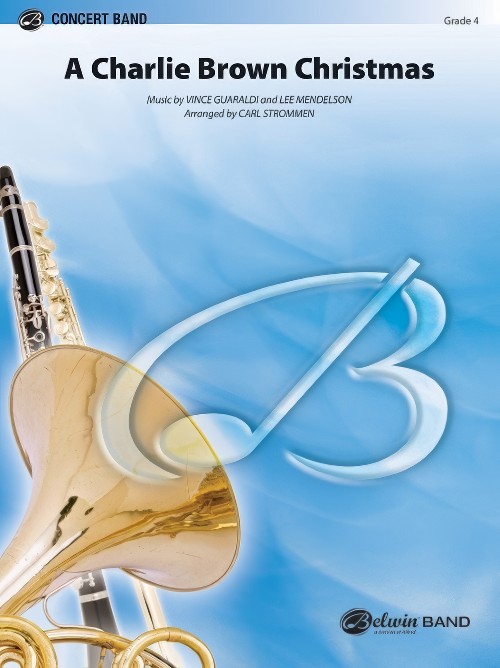
A Charlie Brown Christmas (Concert Band - Score and Parts) - Guaraldi & Mendelson - Strommen, Carl
Each year at the time of the holiday season, those lovable Peanuts? characters find their way into the homes of millions of fans through their famous television specials. Charlie and his friends are musically accompanied by great songs (arranged here by Carl Strommen), such as Linus and Lucy * Skating * Christmas Time Is Here * O Tannenbaum. Duration: 5.00
Estimated dispatch 7-14 working days
-
 £144.95
FANFARE TO PLANET EARTH and MILLENNIUM MARCH (Prestige Concert Band - Score and Parts) - Fanshawe, David - Sparke, Philip
These two works may be performed individually or, as published, together. Fanfare to Planet Earth - the Fanfare opens dramatically with heraldic trumpets answered by sforzando strikes on deep percussion. The Fanfare embraces the splendour and grandeur of our planet Earth, molto grandioso, and culminates in a chordal cluster - a blaze of brass and percussion in G major, describing feelings of optimism at the start of the 21st century. Performance time 1'50". Millennium March - constructed along classical lines, the theme of Millennium March is catchy and not without humour. Its recurring motif on trumpets, con brio, develops the opening bars of the Fanfare. The March gathers momentum through several dramatic key-changes and ends with a surprise flourish of chromaticism, marked Tempo Apocalyptic. Cannons and fireworks are optional! Performance time 4'10'
Estimated dispatch 7-14 working days
-
£32.95
FANFARE TO PLANET EARTH and MILLENNIUM MARCH (Prestige Concert Band - Score only) - Fanshawe, David - Sparke, Philip
These two works may be performed individually or, as published, together. Fanfare to Planet Earth - the Fanfare opens dramatically with heraldic trumpets answered by sforzando strikes on deep percussion. The Fanfare embraces the splendour and grandeur of our planet Earth, molto grandioso, and culminates in a chordal cluster - a blaze of brass and percussion in G major, describing feelings of optimism at the start of the 21st century. Performance time 1'50". Millennium March - constructed along classical lines, the theme of Millennium March is catchy and not without humour. Its recurring motif on trumpets, con brio, develops the opening bars of the Fanfare. The March gathers momentum through several dramatic key-changes and ends with a surprise flourish of chromaticism, marked Tempo Apocalyptic. Cannons and fireworks are optional! Performance time 4'10'
Estimated dispatch 7-14 working days
-
£144.99
Ross Roy (Concert Band - Score and Parts) - De Haan, Jacob
Jacob de Haan was commissioned to compose this concert piece by the "St. Peters Wind Symphony" from Brisbane, Australia. "Ross Roy" is the monumental late 19th century villa where St. Peters Lutheran College was founded in 1945. The villa has always remained the school symbol. In this composition, Jacob de Haan sees the "Ross Roy" as a metaphor for the years spent at school (a monument in time), where one's personality is formed. So, the opening theme the artist calls the Ross Roy theme initially has monumental characteristics.The rhythmic motion, which strides along in the lower register and percussion at the beginning of the next section is typical of "Tempo di Marcia". This movement, accompanied by repetitions of sound, is a metaphor for the structure and discipline in school. This is the introduction to a march theme, symbolic of "passing through" the classes up to the final examinations.Then, the Ross Roy theme is dealt with again, now in a playful, humorous variation. As if the composer is saying there should also be time for a smile in school. The same theme can be heard in major key and a slower tempo in the following section, expressing pride and self-confidence. This is also the introduction to the expressive middle section that represents love, friendship and understanding.We then return to the march theme in a slightly altered construction. The oriental sounds, constituting the modulation to the final theme, are symbols of the diversity of cultures in the school. The characteristic final theme first sounds solemn, but turns into a festive apotheosis. It is no coincidence that the final cadence is reminiscent of the close to a traditional overture, for the school years can be considered the "overture" to the rest of one's life. The premiere of "Ross Roy" was conducted by Jacob de Haan in Brisbane, on August 22, 1997.Duration: 9:20
Estimated dispatch 7-14 working days
 View Music