
Results
-
 £256.00
14 Motetten - Anton Bruckner
Anton Bruckner (b. 4.9.1824, Ansfelden, d. 11.10.1896, Vienna) didn't have it easy. Throughout his life, the Austrian composer was plagued by self-doubt. Anton Bruckner came from a simple, rural background. After the death of his father, he was accepted as a choirboy at the monastery of Sankt Florian in 1837. After several years as a school assistant and his own organ and piano studies, he first worked as organist in St. Florian, then from 1855 as cathedral organist in Linz. Introduced to music theory and instrumentation by Simon Sechter and Otto Kitzler, he discovered Richard Wagner as an artistic role model, whom he admired throughout his life and also visited several times in Bayreuth.In 1868 Anton Bruckner became professor of basso continuo, counterpoint and organ at the Vienna Conservatory; ten years later court organist; and in 1891 finally honorary doctor of the University of Vienna. He was considered an important organ virtuoso of his era, but had to wait a long time for recognition as a composer. It was not until Symphony No.7 in E major, composed between 1881 and 1883, with the famous Adagio written under the effects of Wagner's death, that he achieved the recognition he had hoped for, even if he was reluctant to accept it given his inclination towards scepticism and self-criticism.Anton Bruckner was a loner who did not want to follow a particular school or doctrine. He composed numerous sacred vocal works, such as his three masses, the Missa Solemnis in B flat minor (1854), the Te Deum (1881-84) and numerous motets. As a symphonic composer, he wrote a total of nine symphonies and many symphonic studies from 1863 onwards, tending to revise completed versions several times over. Bruckner's orchestral works were long considered unplayable, but in fact were merely exceptionally bold for the tonal language of their time, uniting traditions from Beethoven through Wagner to folk music, on the threshold between late Romanticism and Modernism.Anton Bruckner composed about 40 motets during his lifetime, the earliest a setting of Pange lingua around 1835, and the last, Vexilla regis, in 1892.Thomas Doss has compiled some of these motets in this volume for symphonic wind orchestra.These motets show many characteristics of personal expression, especially Bruckner's colourful harmony in the earlier works, which is in places aligned with Franz Schubert (changes between major and minor; and movements in thirds). Later works are characterised by many components which, in addition to the expanded stature of the movements, include above all a sense of the instrumentation as an outward phenomenon and the harmony as a compositional feature that works more internally. Some aspects of Bruckner's work are the result of his long period of study, which familiarised him not only with the tradition of his craft, but also gave him insights into the "modernity" of his time in such composers as Wagner, Liszt and Berlioz.From this developed his personal standpoint, which always pursues the connection between the old and the new.
Estimated dispatch 7-14 working days
-
 £95.99
5 Tantum Ergo - Anton Bruckner
Anton Bruckner (b. 4.9.1824, Ansfelden, d. 11.10.1896, Vienna) didn't have it easy. Throughout his life, the Austrian composer was plagued by self-doubt. Anton Bruckner came from a simple, rural background. After the death of his father, he was accepted as a choirboy at the monastery of Sankt Florian in 1837. After several years as a school assistant and his own organ and piano studies, he first worked as organist in St. Florian, then from 1855 as cathedral organist in Linz. Introduced to music theory and instrumentation by Simon Sechter and Otto Kitzler, he discovered Richard Wagner as an artistic role model, whom he admired throughout his life and also visited several times in Bayreuth.In 1868 Anton Bruckner became professor of basso continuo, counterpoint and organ at the Vienna Conservatory; ten years later court organist; and in 1891 finally honorary doctor of the University of Vienna. He was considered an important organ virtuoso of his era, but had to wait a long time for recognition as a composer. It was not until Symphony No.7 in E major, composed between 1881 and 1883, with the famous Adagio written under the effects of Wagner's death, that he achieved the recognition he had hoped for, even if he was reluctant to accept it given his inclination towards scepticism and self-criticism.Anton Bruckner was a loner who did not want to follow a particular school or doctrine. He composed numerous sacred vocal works, such as his three masses, the Missa Solemnis in B flat minor (1854), the Te Deum (1881-84) and numerous motets. As a symphonic composer, he wrote a total of nine symphonies and many symphonic studies from 1863 onwards, tending to revise completed versions several times over. Bruckner's orchestral works were long considered unplayable, but in fact were merely exceptionally bold for the tonal language of their time, uniting traditions from Beethoven through Wagner to folk music, on the threshold between late Romanticism and Modernism.Hymns for four-part mixed choir a cappella (1846, St. Florian)No. 1 in E flat major (WAB 41/3): Quite SlowNo. 2 in C major (WAB 41/4): AndanteNo. 3 in B flat major (WAB 41/1): SlowNo. 4 in A flat major (WAB 41/2): SlowHymn for five-part (2 S, A, T, B) mixed choir and organNo. 5 in D major: SolemnlyThey are simple works, completely subordinate to their liturgical use, which nevertheless already show numerous characteristics of personal expression. These small pieces were able to stand up to the harsh scrutiny of the mature master: in 1888, Bruckner subjected them to a revision in which he made only minor corrections.
Estimated dispatch 7-14 working days
-
£106.95
Dream, Imagine, Live - Larry Clark
The inspiration for this piece comes from one of Henry David Thoreau's most famous quotes - Go confidently in the direction of your dreams! Live the life you've imagined. It was Thoreau's vision that we contemplate a simpler life and be deep thinkers about what we want our lives to be. The piece is divided into three distinct sections based on the same three-note motive. The first section is intense and bold, the second is introspective and lyrical and the third is dance-like, almost reminiscent of a Celtic folk song, in lilting in 6/8. This perfect contest or festival selection will highlight your band's strengths.
Estimated dispatch 7-14 working days
-
 £228.70
Celebration for Band - John Brakstad
Many Norwegian bands have grown up around factories, but Norwegian factories are often located in the countrysides - by a fjord or lake, by a river or waterfall that provided power for the factory. The factory was the foundation for the existence of the community, but it was also essential for the community's cultural life, choirs, bands etc. (cp. British brass bands and mining). "Celebration for band" tries to give a picture of the environment and life around a band like this, with both factory noise and the natural world (Pastorale), as well as the challenges and development of the band itself. The composition is built up of five connected episodes: - Fanfare and Prologue (concludes with a feeling of the untamed power of the river) - Pastorale I: " At the river" - Intermezzo: " The Factory" (starts with the opening of water for the turbines: snare drum. Factory whistle and bell call to work, and the spinning and weaving machinery starts up.) - Pastorale II: " Summer evening on the fjord." - Finale: " Challenge and Progress"
Estimated dispatch 7-14 working days
-
 £77.90
La matita di leonardo - Luciano Feliciani
2019 coincided with the 500-year anniversary of the death of Leonardo Da Vinci, one of the greatest men of genius in history, a universal genius who was a scientist, philosopher, architect, painter, musician, engineer, anatomist, botanist, designer, and planner. This composition entitled La Matita di Leonardo (Leonardo's Pencil), represents an ideal journey into the mind of the Tuscan genius: in the first part of the piece, percussion instruments underline the ticking of the passage of time that anticipates the birth of the idea, while short thematic cells in various instruments alternate, drawing the rhythmic melodic line. On this background, we hear the main theme entrusted to the dark tones of trombone and euphonium. The music proceeds with a growing pace and an adventurous character to represent the genesis of Leonardo's machines, which are in fact the result of the drawings of his pencil. In the second, more animated part, a new theme is introduced, varied, and elaborated, thus giving life to a vigorous movement meant to describe the drawings that come to life, leaving the pages of Leonardo's codes. In the coda the two themes overlap, transporting the listener towards a resolute and rhythmically energetic conclusion in an enthralling and engaging finale.
Estimated dispatch 7-14 working days
-
£137.00
L'Arco Della Vita - Holsinger
Composer David Holsinger's insightful view of the "Arc of Life" is brought to musical life with L'Arco Della Vita. Departing from usual compositional styles, this work is set on the framework of piano and melodic percussion, presenting a series of ever-winding variations and subsequent vanishing end which provide a musical experience unlike any other. Challenging, but musically rewarding, L'Arco Della Vita utilizes the total soundscape of the concert band. A thought-provoking and engaging work from a master composer!
Estimated dispatch 7-14 working days
-
 £98.20
Space Lab - Giuseppe Ratti
A long pedal-note of evanescent chords, based on empty parallel fifths, announces the theme;flutes and reed instruments exploit some almost imperceptible micro-fragments, supported by muted trumpets, creating what is an almost surreal and spatial atmosphere. This was Giuseppe Ratti's starting point for his "Space Lab", a laboratory of sounds and, later (when the main theme is taken up once more), of rhythms. Although it may sound complicated, this piece is ultimately based on a single motif: the descending fourth played on the second beat by the woodwinds. In this piece, Giuseppe Ratti, with his usual pallet of clear, transparent colours at hand, appropriate for the general public, together with simple, effective themes, has sought to experiment with new atmospheres and rhythms. First of all we hear the entire theme in the Allegro. Then the rhythm changes in a simple but at the same time complex manner: almost a genetic mutation. The part leading up to the final Lento flows smoothly for the listener but requires great skill and experience on the part of those performing it. In the final lento the main theme reappears in all its simplicity and sincerity, purified of all contrasts. A metaphor for a life that leads us towards unimaginable frontiers but which, in the end, always brings us back to the point from where we started.
Estimated dispatch 7-14 working days
-
£106.95
A Land Remembered - Larry Clark
A Land Remembered is based on the novel of the same name by Patrick D. Smith, which tells the story of pioneering families in the early days of Florida. The piece is set in three continuous movements, each depicting elements of the story, from the open fanfare, "A New Life in a New Land" to the beautiful "On the Prairie" and the strident final movement, "Hardships on the Rugged Frontier." This piece will demonstrate the skill and musicality of your concert-level band.
Estimated dispatch 7-14 working days
-
 £174.99
Two Symphonic Interludes - Harrie Janssen
Based on the poems by German poet Carl Hauptmann (late Romanticism) and the English poet William Wordsworth (early Romanticism). Carl Hauptmann was in poor health as a child, but highly intelligent. He studied philosophy, psychology and biology. In the latter he was admitted to the degree of doctor. His marriage provided financial independence, so that he could focus on his studies. Hauptmann wrote various novels, plays, poetry and scientific works. Night Twilight floats above the valley's night mists are hanging, there's a whispering brook. Now the covering veil is lifting quite: come and look! See the magicland before our gaze: tall as dreams the silver mountains stand, crossed by silent silver paths shining from a secret land. Noble, pure, the dreaming country sleeps. By the path the shadow black and hogh of a beach. a wisp of a white smoke creeps to the dark'ning sky. Where the valley is the darkest hued countless little lights shine silently. O my soul! Drink of solitude! Carl Hauptmann Wordsworth 'introduced' a new type of poetry, based on the speech of the common man. This was his answer to the poetry of the classicism which was bound by rigid rules. His definition of poetry was: the spontaneous overflow of powerful feelings from emotions recollected in tranquility. My heart leaps up when I behold a rainbow in the sky My heart leaps up when I behold A rainbow in the sky: So was it when my life began. So is it now I am a man. So be it when I shall grow old, Or let me die! The Child is father of the Man. And I could wish my days to be Bound each to each by natural piety. William Wordsworth In a truly poetic manner Harrie Janssen has transformed the contemplative thoughts of the poets into two compositions for Concert Band.
Estimated dispatch 7-14 working days
-
 £33.50
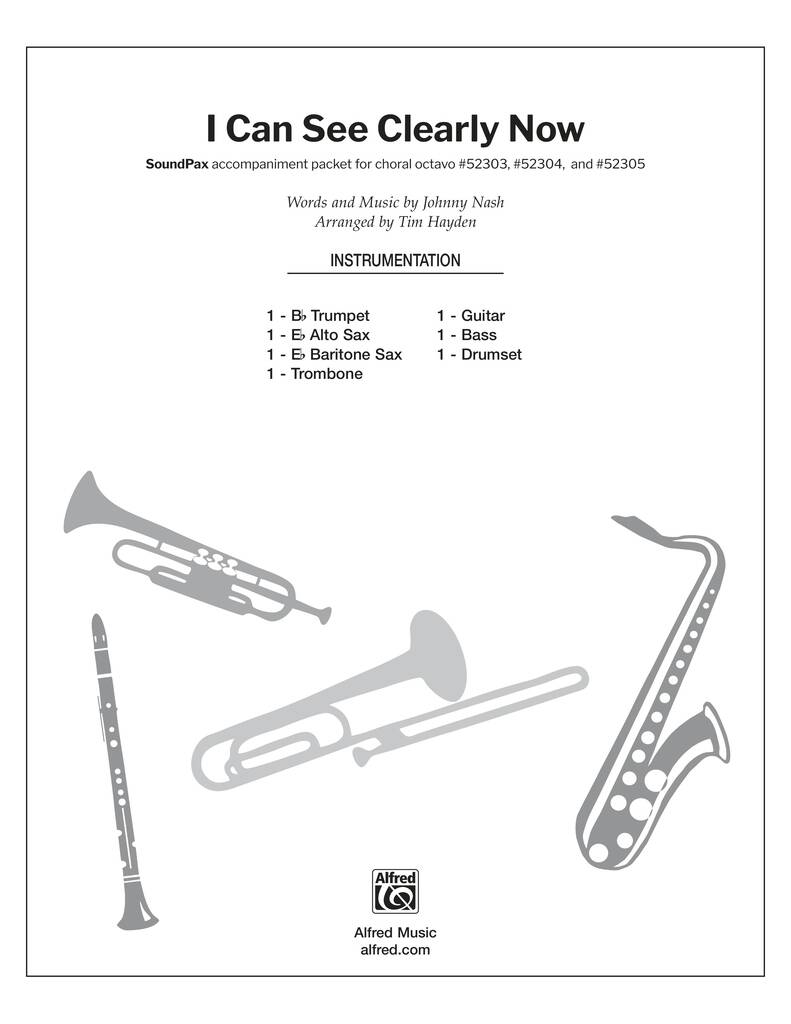
I Can See Clearly Now - Johnny Nash
Welcome a "bright, sun-shiny day" with this fresh take on the chart-topping classic. This arrangement leaps to life with a funky groove that maintains its momentum from start to finish. Fun interplay between voices and some bluesy responses are a blast to sing and lead to a full-throttle celebration of "blue skies" ahead. This pop staple is a surefire way to deliver positivity on any program. Raise the roof with optional SoundPax parts for horns and rhythm section!
Estimated dispatch 7-14 working days
 View Music