
Results
-
 £132.10
ROMANCING THE STONE (Advanced Concert Band) - Silvestri, Alan - Valta, Jan
Movie: Romancing the Stone (To Live In A Novel/ Now Here's The Real Life/Jungle On Foot/To Kiss The Diamond/The Boat And The Crocodile Shoes) Duration: 7:42 American Grade 4
Estimated dispatch 7-14 working days
-
 £67.95
SMASH, The Music of (Intermediate Concert Band) - Scott, Jason
The music of SMASH is rich and colourful. From the brilliant songwriting team of Marc Shaiman and Scott Wittman, the television show chronicles the life and times of mega-star Marilyn Monroe during the creation of a Broadway musical based on her story, is the core of the hugely successful NBC musical drama. Titles from the first season include "Secondhand White Baby Grand," "Let's Be Bad," "Don't Forget Me," "The 20th Century Fox Mambo," and "Let Me Be Your Star." This stirring arrangement is sure to provide a "smashing" Broadway-style performance! Duration: 4:15
Estimated dispatch 7-14 working days
-
 £77.22
The Great Land Run - Anderson, Jackson
An exciting journey through the old west, "The Great Land Run" paints an exhilarating picture of 1889 Oklahoma. A fanfare-like main theme at the beginning is followed by the night around the campfire. As the settlers rest, a gentle storm washes over them bringing forth the questions of what tomorrow may bring. As morning rises, they head back on their way to stake their plot of land and new life. A powerful recap of the main theme drives this piece to an exciting end. With multiple opportunities for solos in the flute, clarinet, oboe, and trumpet, this piece will offer a fun, yet challenging experience for any concert band! Highly recommended!
Estimated dispatch 7-14 working days
-
£71.28
The Trumpeter of Krakow
"The Trumpeter of Krakow" is a colorful programmatic piece which depicts the ancient legend of a trumpeter who saved Krakow from the Tartar invasion of 1241 by sounding a warning and, in doing so, sacrificed his own life. The music includes the "Hejnal," an authentic Polish hymn which is played today in Krakow on every hour in memory of the ancient trumpeter.
Estimated dispatch 7-14 working days
-
£144.99
Voyage with the VOC Wind Band Set (Score & Parts)
The United East India Company, or Verenigde Oostindische Compagnie (VOC) was one of the first international trading companies in the Netherlands. Voyage With The VOC follows the route of a ship (first movement) on a visit to the Rajah of Yogakarta (second movement) to load up the ship before returning home (third movement). The fourth movement describes the hard life of a sailor before the fifth movement sees the ship safely to harbour once again. 06:30
Estimated dispatch 7-14 working days
-
 £209.99
La Terre - Rob Goorhuis
In the composition 'La terre' several aspects of Earth have been translated into sounds in an associative manner. The first part depicts Nature, Mother Earth, stability, the soil which is the source of life. Earth symbolizes tradition, rituals, fertility. In the music of the composition this can be heard in tonic and ostinato passages. Furthermore, human emotions such as gladness, sorrow, wonder, resignation, hope and despair, indissolubly connected as they are to mankind's life on earth, are musically reflected in sudden gusts of expression. Earth for us human beings is the solid ground on which everything in life takes place. In the second part different moodsare evoked in a sort of toccata. Now and then the music sounds fragmented, at other times as a solid whole. The robustness of the music in this part has its roots in the earth, originates from it. It reflects stability and strength, but love and nostalgia are also present in soft and fragile tones. 'La terre' is a musical narrative about Earth, in which music has been given ample room to show its many-sided beauty.
Estimated dispatch 7-14 working days
-
 £119.60
Frankenstein - Kelly Bennette
This tone poem entitled Frankenstein is based on the original novel by Mary Shelley (1797-1851). Victor Frankenstein creates life from pieces of many dead bodies. Soon, his monster comes to life. Though very intelligent, the monster has the maturity of a child. In a fit of rage, the monster kills William, Victor's younger brother. The monster finds Victor in The Alps and asks him to make him a mate. Victor makes him a mate, but kills her. The enraged monster tells Victor, "I will be with you on your wedding night." The monster forces his way into the wedding and kills Victor's fiance, Elizabeth. Victor chases the monster all the way to the Arctis where he dies of exhaustion. The monster finds Victor's body and realizes he has nothing to live for and goes away to die.
Estimated dispatch 7-14 working days
-
 £129.99
Canzona di Bacco - Oliver Waespi
This piece comprises a series of variations on the melody of "Ami, dans cette vie" ("Friend, in this life), an 18th century French song. Like the famous poem "Canzona di Bacco" by Lorenzo de' Medici, this song invites the listener to enjoy life, friendships, love and wine while there is still time to do so. The epicurean nature of this text contrasts with a deeply melancholic melody, a contradiction which is explored in the present work. After a somewhat turbulent first part, the original melody is revealed in a serene and pensive middle section which highlights several soloists. In the last movement, the atmosphere is transformed to become increasingly exuberant, like a Bacchus incantation. The piece concludes with a final dazzling statement of the original theme. Canzona di Bacco was commissioned by the Vesoul Municipal Wind Band, who premiered the work on 24 June 2022 at the Edwige Feuillre Theatre in Vesoul (France), under the direction of Mathieu Anguenot.
Estimated dispatch 7-14 working days
-
 £332.99
Cantica de Sancto Benedicto - Jacob de Haan
Cantica de Sancto Benedicto is a three-movement work for mixed choir, soprano solo, concert band and organ ad libitum - on Latin lyrics that relate to the life of Saint Benedict. It was commissioned by the city of Norcia in Italy, whereBenedict was born. The holy Benedict (480-547) is considered the founder of monastic life within the Roman Catholic Church. His enormous influence is especially owing to his monastic rule, the Regula Benedicti.Jacob de Haan has named the movements ofCantica de Sancto Benedicto after the Holy Trinity: the Father (Gloria Patri), the Son (Gloria Filio) and the Holy Spirit (Gloria Spiritui Sancto). The lyrics of thehymn Gemma Caelestis, (which, like the othertexts, were originally used in Gregorian chant) are voiced by the choir. To this purpose, Jacob de Haan composed new, choral-like, homophone music. The sequence Laeta Quies is rendered by the soprano; the verses (divided over the threemovements) are alternated with those of Gemma Caelestis. The work closes with an impressive grand finale, in which texts are used from the proprium of the mass in honor of the saint's day of the holy Benedict (11 July). Notes to the conductor:For this cantata, there are various possibilities for the performance. The first involves a performance in which the choir and soprano parts are only accompanied by organ. Such a performance has several advantages: since the band never soundstogether with the choir and the soprano, no balance problems occur, and even a performance with a large concert band and a small cantata choir is conceivable. A special layout is also possible - with which you can set up a three-dimensionalperformance in a church. For example, the choir can sing in the chancel, accompanied by the choir organ; the soprano can stand on the gallery, accompanied by the main organ; and the band can be seated in another part of the church. The choir couldalso sing from a gallery. With layouts like this, working with two conductors is advisable. Choral parts available separately.
Estimated dispatch 7-14 working days
-
 £123.20
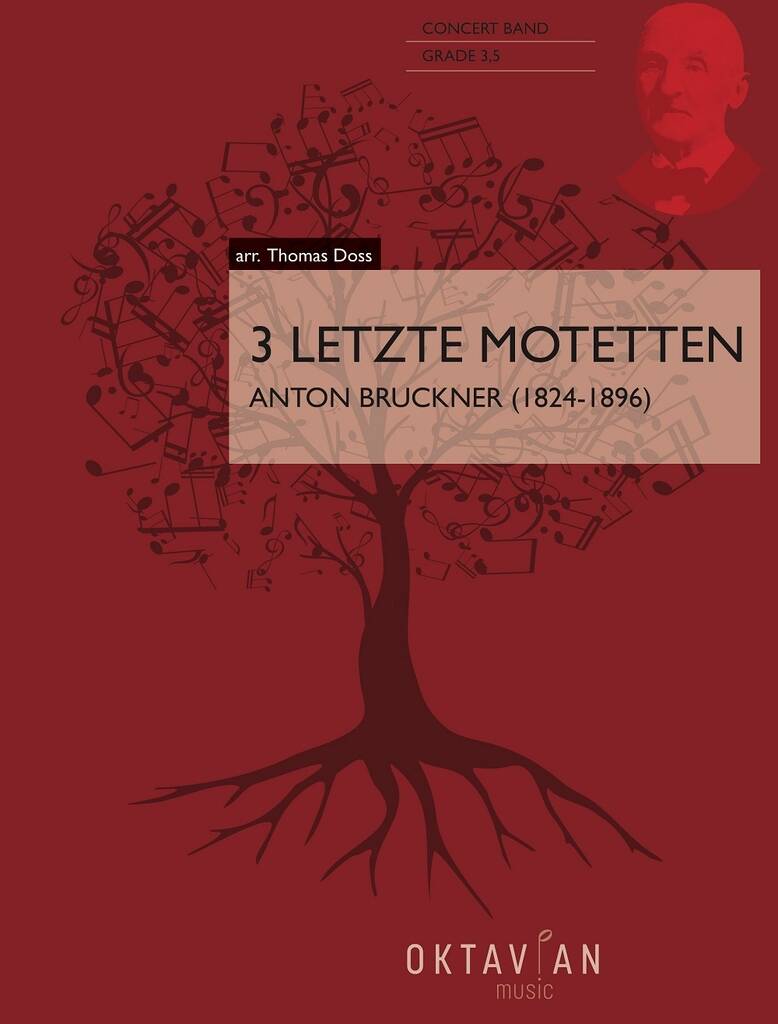
3 Letzte Motetten - Anton Bruckner
Anton Bruckner (b. 4.9.1824, Ansfelden, d. 11.10.1896, Vienna) didn't have it easy. Throughout his life, the Austrian composer was plagued by self-doubt. Anton Bruckner came from a simple, rural background. After the death of his father, he was accepted as a choirboy at the monastery of Sankt Florian in 1837. After several years as a school assistant and his own organ and piano studies, he first worked as organist in St. Florian, then from 1855 as cathedral organist in Linz. Introduced to music theory and instrumentation by Simon Sechter and Otto Kitzler, he discovered Richard Wagner as an artistic role model, whom he admired throughout his life and also visited several times in Bayreuth.In 1868 Anton Bruckner became professor of basso continuo, counterpoint and organ at the Vienna Conservatory; ten years later court organist; and in 1891 finally honorary doctor of the University of Vienna. He was considered an important organ virtuoso of his era, but had to wait a long time for recognition as a composer. It was not until Symphony No.7 in E major, composed between 1881 and 1883, with the famous Adagio written under the effects of Wagner's death, that he achieved the recognition he had hoped for, even if he was reluctant to accept it given his inclination towards scepticism and self-criticism.Anton Bruckner was a loner who did not want to follow a particular school or doctrine. He composed numerous sacred vocal works, such as his three masses, the Missa Solemnis in B flat minor (1854), the Te Deum (1881-84) and numerous motets. As a symphonic composer, he wrote a total of nine symphonies and many symphonic studies from 1863 onwards, tending to revise completed versions several times over. Bruckner's orchestral works were long considered unplayable, but in fact were merely exceptionally bold for the tonal language of their time, uniting traditions from Beethoven through Wagner to folk music, on the threshold between late Romanticism and Modernism.Anton Bruckner composed about 40 motets during his lifetime, the earliest a setting of Pange lingua around 1835, and the last, Vexilla regis, in 1892.Thomas Doss has compiled some of these motets in this volume for symphonic wind orchestra.These motets show many characteristics of personal expression, especially Bruckner's colourful harmony in the earlier works, which is in places aligned with Franz Schubert (changes between major and minor; and movements in thirds). Later works are characterised by many components which, in addition to the expanded stature of the movements, include above all a sense of the instrumentation as an outward phenomenon and the harmony as a compositional feature that works more internally. Some aspects of Bruckner's work are the result of his long period of study, which familiarised him not only with the tradition of his craft, but also gave him insights into the "modernity" of his time in such composers as Wagner, Liszt and Berlioz.From this developed his personal standpoint, which always pursues the connection between the old and the new.
Estimated dispatch 7-14 working days
 View Music