
Results
-
£106.95
Haleakala (House of the Sun) - Carl Strommen
Named for a volcano on the Hawaiian island of Maui, Haleakala is a boldly conceived and sumptuously scored tribute to the wonder of nature. A series offerilliant fanfares, with prominent use of the brass section, leads to a broad chorale theme for the wind section that soon acquires a noble counter melody from the horn choir. After a splendidly sonorous climax, the fanfare material returns to close the piece in a grand style. This selection will work particularly well as a concert opener.
Estimated dispatch 7-14 working days
-
£64.99
The Spirit Soars - James Curnow
Certain to become a staple of Grade 3 band literature this great new composition represents James Curnow at his finest. Beginning and ending with an exciting fanfare that contrasts various melodic, rhythmic, harmonic and stylistic concepts, The Spirit Soars captures the enduring spirit of today's youth in music.The joyous scherzo energized with buoyant energy and an exquisite contrasting lyrical theme, many moods, and a grandioso finale all combine to ensure this piece becomes a landmark of literature for this level.Plan your next concert around this great new piece from CMP!Take wing!
Estimated dispatch 7-14 working days
-
£37.50
Stonewood - Paul Curnow
This piece works beautifully for concerts, festivals, or as a ceremonial work. It will become a staple of your Grade 1 music library. The thrilling opening fanfare sets the stage for an ennobling Woodwind theme. There is a lot of dynamic interest as additional instruments reinforce the sound and combine into a glorious and unified statement.Consider this one for use with large groups too, such as massed bands. The grand nature of the piece lends itself perfectly to that arena. A brilliant fanfare-style ending brings the piece to a forceful conclusion.Stunning!
Estimated dispatch 7-14 working days
-
£45.95
America - Samuel F. Smith
A stately fanfare in the upper brass and woodwinds serves as an introduction to this fresh and easy treatment of America. After the main theme appears, a transition sets up a key change from B-flat to E-flat and builds to a climax punctuated by a trumpet and snare drum tag. An excellent patriotic salute!
Estimated dispatch 7-14 working days
-
 £116.40
Suite de Salon - Henk van Lijnschooten
Commissioned by the NIB, the Dutch Wind Music Institute, with the financial support of the 'Fonds voor de scheppende Toonkunst'.CommentaryThis suite brings us back to the 18th century when an important part of the musical life took place in the salons, the favorite quarters of monarchs and important people.There is a ball and we can hear the music in four successive short movements.1. Entree. After an opening fanfare we see the solemn reception of the guests. The composer uses some 17th century musical principles such as the echo dynamics.2. Invitation a la Danse. The guests proceed to the ballroom and are officially introduced. This movement has a 'classical' character.3. Chiaconna. A solemn dance of Spanish origin with a single theme that is repeated with different embellishments and accompaniments.4. Danse Finale. A cheerful dance announces the departure of the guests, but, for sure, the feast will have lasted much longer than this suite.
Estimated dispatch 7-14 working days
-
 £116.40
Bound Sketches - Rolf Hoogenberg
I Prelude (start)II Landscape ( measure 17)III Crowded and Urbanization (measure 68)In case of lack of time or potential technical problems, it is possible to skip the third part. One can make a straight jump from measure 65 to measure 109.In 'Bound Sketches' the composer links two musical sketches Waterland by means of the theme of the prelude.Rolf Hoogenberg was born at Middenmeer (Province of Northern Holland) in The Netherlands in 1984. At nine he started studying the trombone with Wim de Vreugd at the Waterland music school. Since September 2001 he has been studying trombone and wind band conducting at the Amsterdam Conservatory of Music.For the 1998/1999 Musical Olympics he composed a work for Fanfare band, called 'Townscape' about Purmerend, the small town where he lives. With this composition he did not only win those Musical Olympics, but was also warded the NIB (Dutch Wind Music Institute) Prize for the best wind band composition of that season. The composer Johan de Meij handed him the prize during the ABCO concert on 12 December 1999.'Bound Sketches' was commissioned by the Waterland Music Festival for its 50th anniversary. By means of this commission, the festival foundation hopes to stimulate wind band music in the Waterland area.
Estimated dispatch 7-14 working days
-
 £78.20
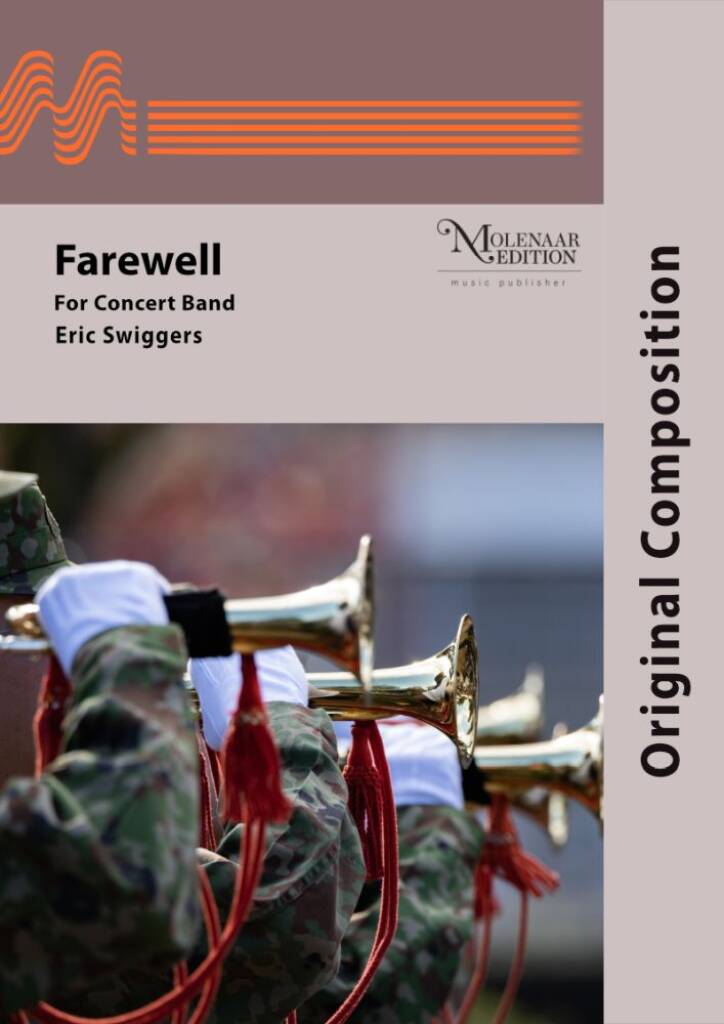
Farewell - Eric Swiggers
Farewell was composed at the farewell of Fanfare Trompetterkorps Der Cavalerie in 1993. The work is based on 2 of the most famous tattoo signals in military music: "Reveille" and "Tattoo." Farewell opens festively with blasting trumpets and then continues with a somewhat melancholy melody based on the reveille theme. After interweaving all the signals and themes in the work's climax, the work ends quietly, with "in the distance" a lone trumpet playing the tattoo signal....
Estimated dispatch 7-14 working days
-
 £176.50
Masquerade (Concert Band - Score and Parts) - Sparke, Philip
Masquerade was commissioned by Stadtmusik Willisau from Switzerland (Reto Gdel, conductor) to celebrate their 175th anniversary in 2003 and first performed by them in November that year.1. Overture: The first movement opens with a fanfare-like figure, featuring the brass, before the main them is introduced over staccato chords. After a short, syncopated interlude a legato theme is introduced in the tenor register and material is developed until the music slows temporarily. The opening theme returns and the 'tenor' tune is taken up by the whole band until the opening fanfare returns to close the movement.2. Elegy: The slow movement opens intensely with a bare two-part theme, which leads to a passionate chorale-style melody. A second theme is introduced and leads to a climax, a return of the chorale theme and a pianissimo repeat which again leads to a full-band climax. The two-part theme returns quietly to create a peaceful close.3 Interlude: A short movement which changes the mood to introduce...4 Finale: Three violent chords preface a lively syncopated opening theme. The trumpets introduce a second idea, which is treated fugally, and this in turn leads to the main melodic idea of the movement, over staccato chords. A contrasting subject is then introduced in the middle of the band, followed by echoes of the first movement fanfare. The opening theme returns and material is revisited until the opening fanfare returns in full to end the work triumphantly.Duration: 15:30
Estimated dispatch 7-14 working days
-
 £137.99
Hanover Festival (Concert Band - Score and Parts) - Sparke, Philip
The Hanover Wind Symphony, New Jersey, USA was founded in 1984 by its conductor Peter Boor. He commissioned Hanover Festival to celebrate the band's 15th Birthday and the first performance took place on October 27th 1999. The piece starts with a solemn brass fanfare. Woodwinds join in and the music subsides into an expressive chorale. A climax is reached and the fanfare returns. Trumpets introduce an explosive vivo section, characterised by an energetic theme from the horns and low clarinets. A bridge passage with strong brass chords leads to a playful section that introduces a legato central theme under woodwind figures. This is taken up by the full band, the playful music returns and the original horn tune is reintroduced. Finally the opening fanfare returns, this time accompanied by music from the vivo section, until a fast and furious coda closes the work.Duration: 8:20
Estimated dispatch 7-14 working days
-
 £79.95
Variations on 'Was Lebet' (Concert Band - Score and Parts) - Wainwright, Andrew
Variations on 'Was Lebet' is based on the German chorale of the same name, the first line of which translates as 'O worship the Lord in the beauty of holiness!' The opening fanfare figure in the Trumpets should be supported by bold, organ-like sostenuto chords in the lower band. Ensure that the fanfare in the Trumpets and Trombones from bars 25 to 28 is given equal articulation and volume in the antiphonal parts. After this majestic introductory section, the first of five contrasting variations is presented, although the tune is never realised in full form until the final variation, with fragments gradually being revealed as the piece progresses.Variation I is somewhat classical in approach, with its energy coming from a regular contrast between cantabile references to the theme, set against lively staccato figures. Ensuring a lightness of touch will be important here; the music should be poised and never sound frantic. As a result, careful attention should be paid to the tempo marking, being no quicker than 136 beats per minute. Snippets of the chorale come and go, with the last phrase of the hymn completing the movement. This final statement, at bar 95, should be an immediate change in tempo and a separate statement to the music that comes before.Variation II is plaintive in mood, giving the listener the chance to reflect on the following words, which form part of the second verse: 'Comfort thy sorrows and answer thy prayerfulness, Guiding thy steps as may best for thee be.' There is opportunity for rubato in this movement, at the discretion of the conductor.Variation III is somewhat quirky and volatile in nature, and takes its inspiration from the 3rd and 4th verses which describe the fearful times in life that we must entrust to the Lord. Driven by the Percussion section in particular, there are references here to Variation I with its chorale-like figures and hurtling scalic figures, and there is a feeling of a lack of resolution. A somewhat abrupt ending suggests that our sense of completeness in Christ is yet to be resolved. It is important that clarity and tempo are maintained in the bass line between sections L and M. Aim for consistency of line in the bass parts, particularly with the trade-offs between players here.There is a French romantic feel to the waltz in Variation IV, with the opportunity for various soloists to display their musicianship. A sense of ironic humour pervades throughout. The Clarinet and Bassoon duet from section U should be playful and display a lightness of touch, with that sense of style continued throughout the movement.Variation V is fugal in nature, with each section of the band being handed the theme at various points. Again it is important that a steady tempo is set at Y in order to maintain control. The sense of momentum gradually increases to a grandiose presentation of the full theme, beginning at section CC, affirming our completeness in the Lord, with the words of the first and last verses reiterated: O worship the Lord in the beauty of holiness! Bow down before him, his glory proclaim; With gold of obedience and incense of lowliness, Kneel and adore him, the Lord is his name.Duration: 11.45
Estimated dispatch 7-14 working days
 View Music