
Results
-
 £106.99
Prelude to a Celebration (Concert Band - Score and Parts) - Sparke, Philip
Prelude to a Celebration is a fantastic way to open any concert in the tradition of great symphonic openers. The work starts with a triumphant yet majestic fanfare from the trumpet section which gives the basis for the whole work. A rollicking and driving faster section follows for the woodwind which leads into a broader trio before the opening fanfare returns to bring the work to a majestic conclusion. Whatever the occasion (or celebration) Prelude to a Celebration is one piece that is sure to have your audience on the edge of their seat and start your performance off in the finest of styles.Duration: 5:15
Estimated dispatch 7-14 working days
-
 £64.95
Clouds That Sail in Heaven (Concert Band - Score and Parts) - Stalter, Todd
Clouds That Sail in Heaven is a concert fanfare based on the hymn All Creatures of Our God and King. Short strands of this famous melody are combined to form intricate and expressive textures, and the fanfare is punctuated with exciting syncopated figures and bold percussion scoring. Kick off your next concert with this grand opener.Duration: 2.15
Estimated dispatch 7-14 working days
-
 £84.99
Young Pheasants in the Sky (Concert Band - Score and Parts) - Yagisawa, Satoshi
This fantastic, stirring fanfare was written with the composer's wish that the young musicians performing it would fly into the bright future like pheasants. The first part of the piece is a fanfare, which is suitable for opening ceremonies, and the second part is a lush chorale-like movement. Your band can perform both parts together or you could perform each one separately. This short opening work will start any concert in real style.Duration: 2:30
Estimated dispatch 7-14 working days
-
 £84.50
Buffalo Dances (Concert Band - Score and Parts) - Smith, Robert W.
The lake region around Buffalo, Minnesota, is one of great geographic beauty and historic significance. Originally part of the region known as the Big Woods, the area was covered with hardwoods that were so thick in their overlapping branches, it was difficult to see the road ahead or sky above. The white elm trees grew to six feet in diameter and up to majestic heights of over one hundred feet.The Dakota People lived and prospered in this area between the lakes for 300 years. Buffalo was a favourite hunting and fishing ground for the Dakotas until the arrival of the first European fur traders and settlers. The richness of the natural resources served as a catalyst for modern development, which led to the very progressive region that continues to grow to this day.Buffalo Dances honours the natural beauty, Native-American heritage and the modern prosperity of Buffalo. Beginning with a majestic fanfare, the piece continues with flowing, Native-American inspired melodies over driving rhythmic figures. The centre of the piece is comprised of a simple original hymn song that reflects on the natural beauty of the region. Accompanied by the sounds of Native-American dance, the intensity returns. If one listens carefully the sound of snorting buffalo can be heard amid the festive atmosphere before the return of the concluding fanfare.
Estimated dispatch 7-14 working days
-
 £82.95
Rising Dragons (Concert Band - Score and Parts) - Smith, Robert W.
Commissioned by the Korean Navy Symphonic Band under the direction of Lt. Commander Joon Hyung Park, Rising Dragons pays tribute to the legacy of Yi Sun Shin and his impact on naval operations throughout the world. Beginning with a commanding fanfare, the authoritative statement gives way to the lone flute representing the solitude and reflection that any great leader must endure. The mechanized sounds of the turtle ships are brought to musical life through melody that rises and falls like the sea. The sea battle is depicted with opposing forces of percussion giving way to a final victorious fanfare. A line from a poem written by Yi Sun Shin inspires the title: "I call to the sea, and the dragons are moved."Duration: 9.15
Estimated dispatch 7-14 working days
-
 £48.95
With Valor and Honor (Concert Band - Score and Parts) - Williams, Mark
This stately, heroic march depicts the dignity and heroism of those who serve in uniform, whether in the armed forces or at home in police, fire and other uniformed services. Written to be performed at a deliberate, unhurried tempo, this work begins with a repeated percussion "vamp", to which the opening fanfare theme is added. The fanfare then provides the primary melodic material of the piece. Stunning! Duration: 2.45
Estimated dispatch 7-14 working days
-
 £48.95
March of the Majestics (Concert Band - Score and Parts) - Sheldon, Robert
An excellent selection for concert, contest or graduation ceremonies, March of the Majestics is a bold and stately processional march, full of dignity and character. The opening fanfare leads to a majestic melody that first appears in the upper voices, and later played by the lower brass and woodwinds. The return of the original fanfare ends the piece with a regal flourish. Duration: 2.00
Estimated dispatch 7-14 working days
-
 £42.50
Regimental Honor (Concert Band - Score and Parts) - Moss, John
Every band program should incorporate marches into their regular concert programming, and here is an excellent march from John Moss that will rehearse easily and sound great. Written in a stately moderate tempo, it opens with a majestic brass fanfare followed by a statement of the melody by the clarinets. After a contrasting theme is introduced, we return to a harmonized version of the opening fanfare for a powerful finish.
Estimated dispatch 7-14 working days
-
 £164.99
Wilten Festival Overture (Concert Band - Score and Parts) - Sparke, Philip
To celebrate the 350th anniversary of the Stadtmusikkapelle Wilten in Innsbruck Philip Sparke composed Wilten Festival Overture. A bold fanfare, led by the horns, forms the opening of the work from which an expressive theme unfolds until the full band reaches a climax. Short solo statements from saxophone, horn and trumpet lead to a recapitulation of this theme which melts into a rhythmic Vivo. A robust melody is is then played by the clarinets and taken up by the whole band before a legato figure leads to a cantabile theme, again presented by the clarinets. The original Vivo melody reappears before the opening fanfare is briefly heard and the work comes to an end with a short Coda. A great experience for the whole band!Duration: 8:00
Estimated dispatch 7-14 working days
-
 £2.25
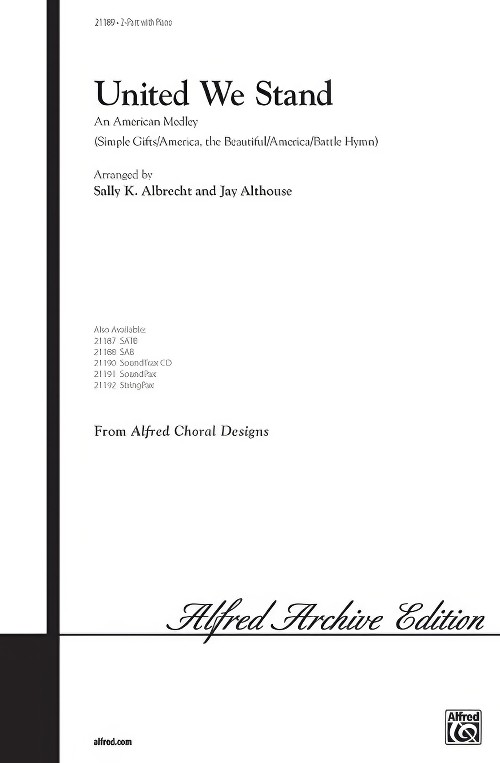
£2.25United We Stand (An American Medley) (2-Part Choral Octavo) - Albrecht & Althouse
This stirring tribute to America is the perfect finale for your upcoming concert. After a stunning opening fanfare, excerpts of "Simple Gifts," "America, the Beautiful," "America," and the chorus of "Battle Hymn" are presented, leading up to a big final statement of the fanfare. The audience may also sing along on two sections of the choral. All three voicings are compatible, making this the perfect choice for a festival or joint finale. Add the full Concert Band arrangement and/or the StringPax and get your entire school involved.
Estimated dispatch 7-14 working days
 View Music