Searching for Brass Band Music? Visit the Brass Band Music Shop
We've found 122 matches for your search

Results

  • £134.99

    The Legend of Ratu Kidul - Filip Ceunen

    The Legend of Ratu Kidul carries us into the world of Indonesian mythology, on the island of Java:Once upon a time, the Queen of the Southern Seas was a kind and beautiful princess. She was the daughter of Prabu Munding Wangi, the favourite ofthe entire court and the local people. Her royal father doted on his daughter. Her name was Dewi Kadita, but many called her Dewi Srengenge or the Angry Princess.Prabu Munding Wangi longed for an heir, but Dewi Kadita's mother couldn't fulfil thiswish. So he took a second wife, called Poetri Moentiara, who was very jealous of the lovely princess and her mother. She begged the king to banish both her rivals from court. However Prabu Munding Wangi didn't do as she asked. He loved his first wifeand her daughter. The second wife bore him a healthy heir, but the monarch remained firm. So Poetri Moentiara called upon the renowned witch, Djahil. She promised her a princely reward, if Dewi Kandita and her mother were banished. Djahil thought fora moment and incanted this rapal (spell): "May leprosy befall you both". Soon both mother and daughter began to suffer this dreadful disease. According to the law of the land, they were to be banished to the wild forest high on the mountain. With aheavy heart, King Munding Wangi saw the law carried out. So the two set off on their way to the forest, covered in terrible sores. A great sadness fell across the land, except for Poetri Moentiara, the second wife of the king, who had achieved heraim. The princess fell on hard times. In the forest lived a hermit, who took pity on the mother and daughter. The queen couldn't bear the shame and within a few days had died. Now Dewi Kandita was all alone in the world. There was still the hermit,however, who fortunately provided food and shelter in a cave temple. He bound her weeping sores but couldn't relieve her emotional pain. Dewi Kandita became increasingly bitter and eventually left the hermit. She travelled southward from village tovillage, further and further, until eventually she reached the shores of the Southern Sea. She climbed upon a high cliff and gazed out onto the sea that spread before her. She was tempted to dive into the deep green and blue. In the cool waters shewould be able to forget all her pain and suffering. Suddenly awaking from these thoughts, she jumped into the deep. The gods, who had looked on Dewi Kandita throughout her hardships, were filled with deep compassion. So they transformed her into apowerful spirit of the netherworld, Ratu Kidul, and to this day she resides in her grand palace under the sea.

    Estimated dispatch 7-14 working days

     PDF View Music

  • £110.00

    Out of the Deep (from Requiem) (Concert Band with Optional Choir - Score and Parts) - Rutter, John - Noble, Paul

    John Rutter's Requiem is a musical setting of parts of the Latin Requiem with added psalms and biblical verses in English, completed in 1985. This arrangement is scored for soprano, mixed choir and Concert/Wind Band. It may be performed by band alone. Five of its seven movements are based on text from the Latin Requiem Mass, while the second movement is a setting of Out of the deep (Psalm 130) and the sixth movement is an anthem The Lord is my Shepherd (Psalm 23) which Rutter had earlier written. The cello solo of the second movement is maintained, but also scored as a bassoon solo. The first movement combines the Introit and Kyrie, the third is Pie Jesu, with soprano solo. The central movement is a lively Sanctus, followed by Agnus Dei and finally Lux aeterna. In the Agnus Dei and Lux aeterna, Rutter combines the liturgical Latin text with English biblical verses. The arranger has added the tolling of the bell at the end, which can be as few or as many as may be appropriate for the occasion.

    Estimated dispatch 7-14 working days

     PDF View Music

  • £10.95

    DEEP RIVER (Programme Concert Band Extra Score) - Geldard, Bill

    Extra Score. Deep River was first published in 1875 and was made popular by a small choir from Fisk University in Nashville, Tennessee, who performed across the United States and Europe. For this arrangement, Bill Geldard draws on his vast experience in the world of Big Bands and this brings back memories of the 20's and 30's style, particularly the likes of Duke Ellington and Count Basie. Duration 4:56

    Estimated dispatch 7-14 working days

     PDF View Music

  • £54.95

    DEEP RIVER (Programme Concert Band) - Geldard, Bill

    Deep River was first published in 1875 and was made popular by a small choir from Fisk University in Nashville, Tennessee, who performed across the United States and Europe. For this arrangement, Bill Geldard draws on his vast experience in the world of Big Bands and this brings back memories of the 20's and 30's style, particularly the likes of Duke Ellington and Count Basie.

    Estimated dispatch 7-14 working days

     PDF View Music

  • £75.00

    The Cherry Tree Carol (Concert Band with Optional Choir - Score and Parts) - Noble & Willcocks

    The Cherry Tree Carol is a Christmas carol with roots that go deep and wide: from medieval England back to the 12th century Crusader kingdoms and ultimately to early Christian communities of the Middle East who worshipped in Syriac, a liturgical form of Aramaic, the language of Jesus. The song itself is very old, reportedly sung in some form at the Feast of Corpus Christi in the early 15th century. The ballad relates an apocryphal story of the Virgin Mary, presumably while traveling to Bethlehem with Joseph for the census. In the most popular version, the two stop in a cherry orchard, and Mary asks her husband to pick cherries for her, citing her child. This arrangement represents one in the Series of Band Arrangements compatible with David Willcocks' Carols for Choirs.

    Estimated dispatch 7-14 working days

     PDF View Music

  • £317.99

    Music of the Spheres (Concert Band - Score and Parts) - Sparke, Philip

    The piece reflects the composer's fascination with the origins of the universe and deep space in general. The title comes from a theory, formulated by Pythagoras, that the cosmos was ruled by the same laws he had discovered that govern the ratios of note frequencies of the musical scale. ('Harmonia' in Ancient Greek, which means scale or tuning rather than harmony - Greek music was monophonic). He also believed that these ratios corresponded to the distances of the six known planets from the sun and that the planets each produced a musical note which combined to weave a continuous heavenly melody (which, unfortunately, we humans cannot hear). In this work, these six notes form the basis of the sections MUSIC OF THE SPHERES and HARMONIA. The pieces opens with a horn solo called t = 0, a name given by some scientists to the moment of the Big Bang when time and space were created, and this is followed by a depiction of the BIG BANG itself, as the entire universe bursts out from a single point. A slower section follows called THE LONELY PLANET which is a meditation on the incredible and unlikely set of circumstances which led to the creation of the Earth as a planet that can support life, and the constant search for other civilisations elsewhere in the universe. ASTEROIDS AND SHOOTING STARS depicts both the benign and dangerous objects that are flying through space and which constantly threaten our planet, and the piece ends with THE UNKNOWN, leaving in question whether our continually expanding exploration of the universe will eventually lead to enlightenment or destruction.Duration: 15:30

    Estimated dispatch 7-14 working days

     PDF View Music

  • £317.99

    Music of the Spheres - Philip Sparke

    The piece reflects the composer's fascination with the origins of the universe and deep space in general. The title comes from a theory, formulated by Pythagoras, that the cosmos was ruled by the same laws he had discovered that govern the ratios of note frequencies of the musical scale. ('Harmonia' in Ancient Greek, which means scale or tuning rather than harmony - Greek music was monophonic). He also believed that these ratios corresponded to the distances of the six known planets from the sun and that the planets each produced a musical note which combined to weave a continuous heavenly melody (which, unfortunately, we humans cannot hear). In this work, these six notesform the basis of the sections MUSIC OF THE SPHERES and HARMONIA. The pieces opens with a horn solo called t = 0, a name given by some scientists to the moment of the Big Bang when time and space were created, and this is followed by a depiction of the BIG BANG itself, as the entire universe bursts out from a single point. A slower section follows called THE LONELY PLANET which is a meditation on the incredible and unlikely set of circumstances which led to the creation of the Earth as a planet that can support life, and the constant search for other civilisations elsewhere in the universe. ASTEROIDS AND SHOOTING STARS depicts both the benign and dangerous objects that are flying through space and which constantly threaten our planet, and the piece ends with THE UNKNOWN, leaving in question whether our continually expanding exploration of the universe will eventually lead to enlightenment or destruction.

    Estimated dispatch 7-14 working days

     PDF View Music

  • £169.95

    Call of the Cossacks (Concert Band - Score and Parts) - Graham, Peter

    Call of the Cossacks is part of the series of 'travelogue' features by Peter Graham, following in the footsteps of Cry of the Celts and Windows of the World. The Cossacks were a nomadic people whose ethnic makeup included Ukrainians, Tartars, Poles and Jews. A similarly wide range of Eastern European folk music features in this work, from Gypsy to Klezmer. Movement 1, Procession of the Tartars is cast in the old-style band 'patrol' and adapts a Klezmer folk song Fun Tashlach. The second movement, Doyle's Lament, is an original melody featuring solo alto saxophone while the final movement, Cossack Wedding Dance, is deep in Fiddler on the Roof territory - a pot pourri of Klezmer, Gypsy and Cossack styles. Each movement can be programmed separately.

    Estimated dispatch 7-14 working days

     PDF View Music

  • £151.99

    Out of the Dark - Thomas Doss

    A Miner's TaleThis work is dedicated to the miners, who often had to perform their duties under the most difficult conditions, frequently risking their lives. Many lost their lives in accidents throughout history, and many families lost their fathers. A Miner's Tale describes the beginning of a shift, marked by the signal on the wooden board. The foreman and the miners begin their arduous work underground. Suddenly, danger strikes, leading to a terrible collapse.Trapped beneath the rubble, the miners are overwhelmed by fear, despair, and loneliness. Only their camaraderie and the memory of their loved ones keep them going. In the darkest moment, in the dim light of their fading mining lamp, a vision of Saint Barbara - the patron saint of miners - appears before them. Shortly thereafter, they hear the sound of approaching rescue. Overcome with joy and relief, they begin to hum the Steigerlied" in exhaustion.Bar 3 - The signal on the wooden board announces the start of a new underground shiftBar 10 - Glck auf! (Miner's traditional greeting: "Good luck!")Bar 24 - Foreman and miners - the shift begins Bar 62 - Hardships deep underground Bar 91 - Sudden danger arisesBar 100 - Fear of never returningBar 108 - Thoughts of familyBar 121 - Resigned to fateBar 132 - Vision of Saint Barbara and rescueBar 146 - "Steigerlied" - Homecoming and church bells

    Estimated dispatch 7-14 working days
  • £118.99

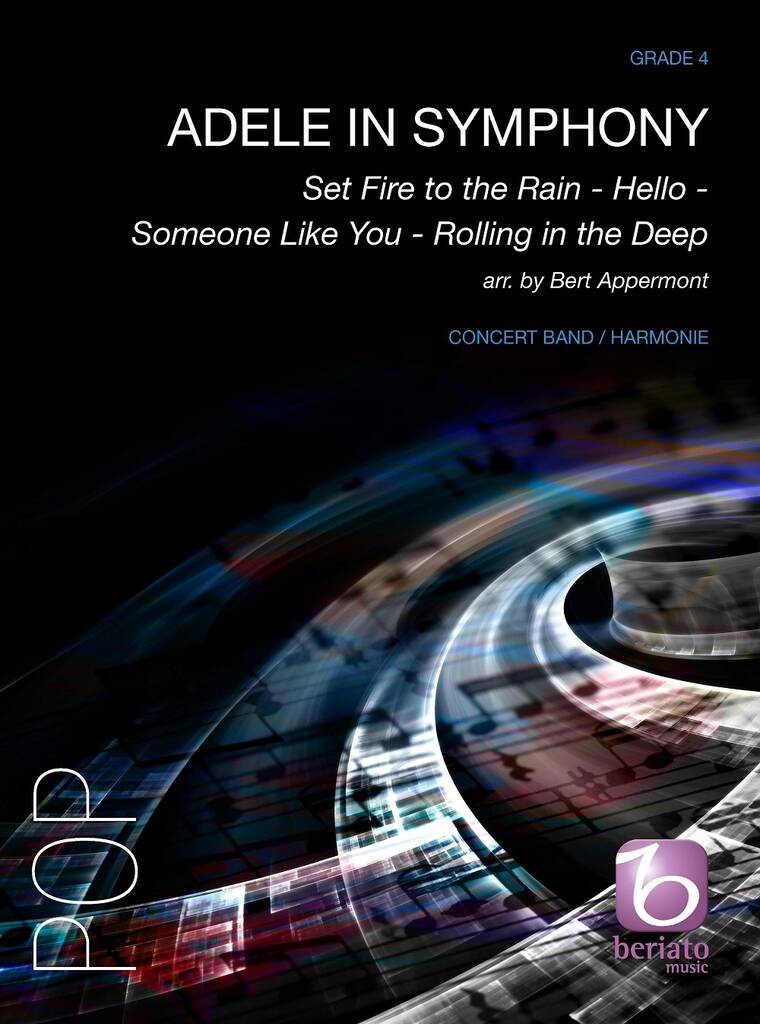
    Adele in Symphony - Adele Adkins

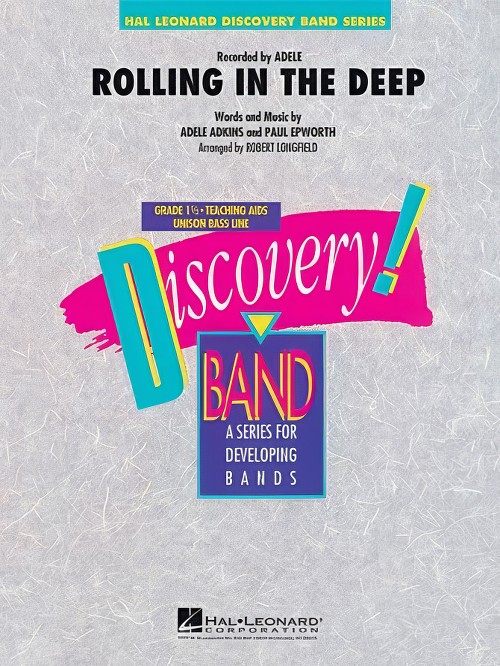
    Following the success of Coldplay in Symphony, Bert Appermont created a symphonic arrangement for Adele's music in his cinematic writing style. For this medley, he used beautiful melodic elements from her greatest hits, such as 'Set Fire to the Rain', 'Hello', 'Someone Like You' and 'Rolling in the Deep'.

    Estimated dispatch 7-14 working days

     PDF View Music