
Results
-
 £164.95
SCOTTISH DANCE SUITE (Chester Wind Band) - Musgrave, Thea
Score & Parts. The Scottish Dance Suite is based on traditional Scottish folk songs and dances, though several less well-known tunes are used. For instance in the second of the four movements, one can hear the older tune of The bonnie Earl of Moray, and in the first movement, the tune is the one to which Burns wrote his famous poem Robin shure in hairst. In the last movement, two well-known tunes alternate, but at the end several of the tunes used in the work all combine together to make an exciting climax. Duration: 8mins.
Estimated dispatch 7-14 working days
-
£32.95
SCOTTISH DANCE SUITE (Chester Wind Band) Extra Score - Musgrave, Thea
Extra score only. The Scottish Dance Suite is based on traditional Scottish folk songs and dances, though several less well-known tunes are used. For instance in the second of the four movements, one can hear the older tune of The bonnie Earl of Moray, and in the first movement, the tune is the one to which Burns wrote his famous poem Robin shure in hairst. In the last movement, two well-known tunes alternate, but at the end several of the tunes used in the work all combine together to make an exciting climax. Duration: 8mins.
Estimated dispatch 7-14 working days
-
 £106.99
Dance of the Whale (Concert Band - Score and Parts) - Sparke, Philip
Dance of the Whale was commissioned by the Spanish music foundation, Musica et Orbi, at the instigation of its president, Frank De Vuyst. It is part of a unique project which involved nine composers each writing a short movement, describing an animal of the composers' choice, to form a suite called Bestiarium. A consortium of bands around the world helped to fund the project and the world premiere of the suite took place in March 2013 in Medellin, Colombia. Dance of the Whale uses the tenor instruments of the band to describe a lazy and graceful dance by a blue whale and is dedicated to endangered species around the world.Duration: 4:45
Estimated dispatch 7-14 working days
-
 £214.95
Dance Movements (Prestige Concert Band - Score and Parts) - Sparke, Philip
Dance Movements was commissioned by the United States Air Force Band and first performed by them in February 1996. A tour-de-force for a large band, the work is in four continuous movements which have dance rhythms and moods as their basis. The second movement features the woodwinds and the third is for brass.Winner of the prestigious "Sudler Award" for new music for wind band 1997.Performance time 20'30"Recorded on QPRM129D VENETIAN SPELLS, Central Band of the Royal Air Force - 'Molto Ritmico'Recorded on QPRM130D FIESTA!, Central Band of the Royal Air Force
Estimated dispatch 7-14 working days
-
£49.95
Dance Movements (Prestige Concert Band - Score only) - Sparke, Philip
Score only.Dance Movements was commissioned by the United States Air Force Band and first performed by them in February 1996. A tour-de-force for a large band, the work is in four continuous movements which have dance rhythms and moods as their basis. The second movement features the woodwinds and the third is for brass. Winner of the prestigious "Sudler Award" for new music for wind band 1997.Performance time 20'30"Recorded on QPRM129D VENETIAN SPELLS, Central Band of the Royal Air Force - 'Molto Ritmico'Recorded on QPRM130D FIESTA!, Central Band of the Royal Air Force
Estimated dispatch 7-14 working days
-
 £79.99
Juba Dance (from Symphony No.1 in E minor) (Concert Band - Score and Parts) - Price, Florence - Bocook, Jay
Florence Price (1887-1953) is noted as the first African-American female composer of symphonic works, and is only in recent years beginning to receive the recognition so richly deserved. Her Symphony No. 1 was completed in 1932 and first performed in 1933 by the Chicago Symphony Orchestra. Here is a sparkling transcription for band of the third movement (Juba Dance). Duration: 3:45
Estimated dispatch 7-14 working days
-
 £57.50
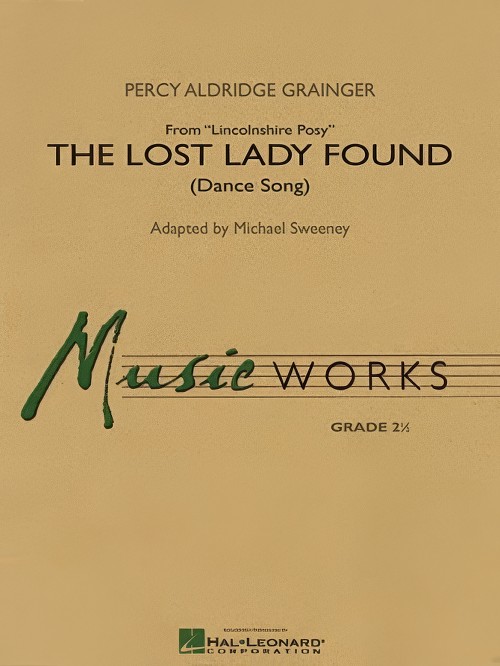
The Lost Lady (Dance Song from Lincolnshire Posy) (Concert Band - Score and Parts) - Grainger, Percy Aldridge - Sweeney, Michael
The final movement of Percy Grainger's masterwork Lincolnshire Posy is arranged here for younger bands with reduced instrumentation. Similar to his earlier adaptation of "Horkstow Grange", Michael Sweeney carefully maintains the structural and harmonic integrity of the original while providing an authentic-sounding version at an easy level. Certain to become a "must have" for the young band repertoire. Duration: 2.50
Estimated dispatch 7-14 working days
-
 £49.50
Introduction And Dance (Concert Band - Score and Parts) - Handel, George Frideric
George Frederick Handel (1685-1759) originally wrote this "Sarabande" as the third movement of his Suite No. 4 for harpsichord. Ralph Gingery expertly arranged this rich stately music (used as the theme in the film "Barry Lyndon") for successful performance by younger bands. However, the work also remains a rewarding and valuable piece for more mature ensembles.
Estimated dispatch 7-14 working days
-
 £91.99
Sunscapes - Wilson
This exciting work depicts the lively and sunny nature of the state of Florida. Opening with a brilliant and majestic section highlighting the state's bright and vibrant culture, a flowing melody follows, representing the calming winds and consistent breeze of the state. Dance is a large part of Florida's culture, especially in its southern region, and the 7/8 rhythm captures an Afro-Latin style dance movement. The chorale/hymn section is based on the "Florida Song," which is a traditional school song of many schools, including Florida A&M in Tallahassee. The work then recapitulates and moves toward a driving and joyful conclusion. An excellent contest/festival work!
Estimated dispatch 7-14 working days
-
£79.99
Rustic Dance - Youthful Suite, Movement 2 - Percy Aldridge Grainger
Estimated dispatch 7-14 working days
 View Music