
Results
-
£125.00
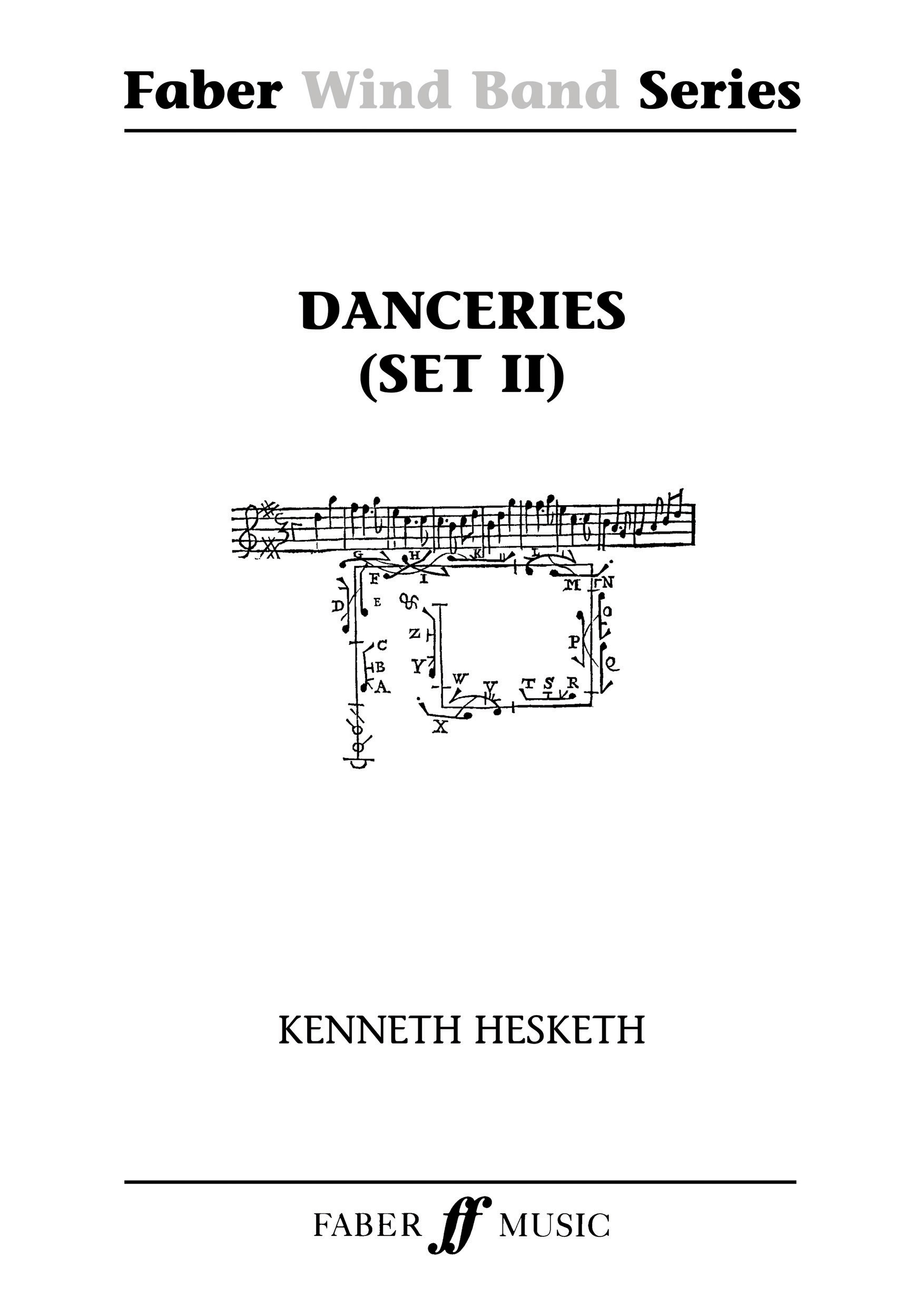
Danceries (Set II) - Kenneth Hesketh
Danceries Set II was commissioned by Keith Allen and Birmingham Symphonic Winds, supported by PRS for Music Foundation and the RVW Trust. The world premire of this work was given by Birmingham Symphonic Winds, conducted by Keith Allen, at the CBSO Centre, Birmingham in 2011. This second set of Danceries continues the format established in Danceries (Set I), namely in using material taken from Playford's Dancing Master, a collection of folk and popular tunes published in the seventeenth century, to form the basis of an extended dance suite. In this set, the melodies have been more abstracted and project only a distant echo of their original forms, but as before, each movement is self-contained, colourful and direct, with its own distinct mood.The outer movements - Jennie's Bawbee and Peascod's Galliarda - share a use of driving percussion writing with a military air. Tom Tinker's Toye and Heart's Ease (movements two and three) are both settings of original melodies. All movements are more extended than in the first set, with a freer use and approach to the material; melodies now occur in various keys and are supported by a greater variety of harmonic colouring. The result is a richer, even more exhilarating set of dances. Danceries has come of age!
In stock: Estimated delivery 1-3 days
-
 £115.00
BOHEMIAN DANCES (Concert Band) - Woolfenden, Guy
Includes:1. Shepherds and Shepherdesses2. Florizel and Perdita3. Dance of the SatyrsOne of my favourite Shakespeare plays is The Winter's Tale, and I have written music for three completely different productions during my time as Head of Music to the Royal Shakespeare Company. One, starring Judi Dench as both the mother, Hermione and her daughter, Perdita, had a big band Tribal Love-Rock score; another had a more classical, but timeless feel to it, and the last was an excellent small-scale touring production, for which I was allowed only a handful of instruments. It is from this source that the basic themes for Bohemian Dances, and an earlier version Three Dances for Clarinet Choir, have emerged. Act IV of the play is set in the kingdom of Bohemia - hence the title of the work.Shakespeare calls for "A Dance of Shepherds and Shepherdesses", which gives Florizel, the son of Polixenes, (King of Bohemia) a chance to become better acquainted with the beautiful Perdita, the lost daughter of Leontes, (King of Sicilia). This movement is written in seemingly tricky and ever-changing metres, but is rhythmically quite logical and melodically catchy.The slower second movement 'Florizel and Perdita' is the lovers' pas de deux: a gentle, slow waltz-like tune, initially presented by the principal oboe, is contrasted with a lndler-like double time melody, at the end of which a solo clarinet makes a link to the last movement.'Dance of the Satyrs' is a rip-roaring, foot-stamping dance performed in the play by 'three carters, three shepherds, three neat-herds, and three swine-herds', who enter in outrageous costumes representing the lecherous half-man, half-goat of Greek mythology. This dance is referred to as a "gallimaufry of gambols" - now where have I heard that word before?! - GW
Estimated dispatch 7-14 working days
-
 £53.46
Dances Fantastique
This exciting new work for concert band is a set of three delightful dances. Opening with a bold fanfare statement, the first dance reveals the melodic material that is the basis for all three movements. The title of this movement, Double Dance, is derived from the second statement of the melody, appearing in doubled rhythmic values. The second movement, Round Dance, the melody is written as a three part round. You could not have a Round Dance without a Square Dance, which is the title of final movement. Lots of fun percussion instruments add interesting timbres throughout. This interesting and clever composition is perfect for contest and festival.
Estimated dispatch 7-14 working days
-
 £174.99
The Graces of Love (Concert Band - Score and Parts) - Waespi, Oliver
The Graces of Love (Le Gratie d'Amore) is the title of a book published in 1602 by Cesare Negri, the famous dance master of the Milan court in the Renaissance. It contains numerous dance tunes and precise descriptions of courtly dances. It also includes the tune Il bianco fior (The White Flower) on which the first movement of my piece is based. A vigorous dance in three-four, it leads to an acceleration and a sudden shift to an even meter towards the end. The second movement, calm and contemplative in character, features the tune Vaghe bellezze... (Veiled Beauty...). Widely spaced melodic parts surround two solos during which the tune is varied and developed. Finally, the third movement contains a Saltarello based on a tune by Vincenzo Galilei, the father of the famous astronomer, Galileo Galilei. It brings the work to a close with a hypnotic rhythm which is noble and virtuosic at the same time.Duration: 12.45
Estimated dispatch 7-14 working days
-
 £69.95
Aylesbury Dances (Concert Band - Score and Parts) - Wiffin, Rob
The suite Aylesbury Dances was commissioned by the Aylesbury Concert Band to mark the occasion of their 25th Anniversary in 2019. Its three movements depict different aspects of Aylesbury: I. Pavane: The Town - Having read something of the town's history and its architecture I decided I wanted to write something ceremonial with the feel of music from Tudor times. Aylesbury was given its charter and borough status in 1554 by Mary Tudor so I took that as my starting point but then added some harmony that moves forward in time. This fits with the town's motto: Semper Prorsum (Always forward) and also with the Band's evolution from Aylesbury Town Band to Aylesbury Community Concert Band to Aylesbury Concert Band. The music can be defined as a pavane, or a cortege. The sense of procession is slightly disturbed by a 'Blue Leanie' moment. The Blue Leanie is an iconic Aylesbury building, an oblique rhombic prism which stands at an angle of 17% inclination. I took a quaver out of the time signature (I know the maths don't work!) to reflect this and added some bluer harmony at that point. This opening movement gives a sense of the grandeur and heritage of Aylesbury town and a chance for my friends from the brass section to warm up! II. Siciliana: Waterside - To balance the outer two movements, the middle movement of the suite has a slow lilting 6/8 rhythm. It is in the style of a Siciliana, a dance form originating in the baroque era. It is a graceful, tender and melancholic dance, cast here in a minor key and featuring the dark voice of the cor anglais. The Siciliana was often linked with pastoral scenes and Aylesbury itself sits amid some beautiful countryside. It may, therefore, seem a bit of a stretch to call this movement 'Waterside', especially as Aylesbury is so far from the sea, but the town has a theatre of that name and that was the genesis for this particular music. There is a statue of Ronnie Barker in the grounds of the Waterside theatre as he started his career in repertory theatre in Aylesbury, so I included a fleeting reference to the theme music of the comedy programme 'Open all Hours'. III. Frolic: Ducks in a Row - It was impossible to write a piece connected with Aylesbury without considering the famous Aylesbury ducks. Duck rearing was a major industry in the town in the 19th century. The white Aylesbury Duck is a symbol of the town, appearing on its coat of arms and in the logo of the Aylesbury Concert Band! This movement is all about trying to get the little darlings in a row so they can sing their 'Duck Chorus' together but they keep on scattering, flying off or swimming away as quickly as they can manage. It's a bit like watching ducks disperse when my dog jumps into the stream after them. Eventually we get more of them in a row - even though they protest. Hidden amongst the ducks is a reference to Erica Miller, saxophonist and chairman of the band, and there's even a veiled reference to a shark in the hope of getting them out of the water. Ducks in a Row is a fun romp bringing this suite of Aylesbury Dances to a suitably celebratory conclusion.- Rob Wiffin.Duration: 9.15
Estimated dispatch 7-14 working days
-
 £73.50
Three Miniatures for Winds and Percussion (Concert Band - Score and Parts) - Sheldon, Robert
Dance like no one is watching, sing like no one is listening and live each day as if it were your last. This famous poem has many versions and is attributed to several authors, yet its simple, eloquent message speaks volumes to millions of people worldwide. The composition therefore has a first movement entitled Joyful Dance, the second movement is Simple Song, and the final movement is a Celebration. Each movement is quite brief but distinctly different, each expressing the feelings inherent in the poem from which the work was drawn. Duration: 5.00
Estimated dispatch 7-14 working days
-
£119.99
The African Connection Wind Band Set (Score & Parts)
Carl Wittrock's wide interest in global folk-music resulted in this concert-piece based on original African rhythms. Obviously, the percussion section has a conspicious role to play, but the band too may indulge itself in moments of thoroughly delightful excitement. The introduction depicts the awakening of nature, and develops into a dance. The (main) motif of this dance is from a dance entitled Apollo and comes from Gambia. Its accompaniment consists of an ostinato pattern by balaphon-master Maudo Susa. The quiet middle movement is based on the rhythm of the 'gigbo' : a traditional dance from Ghana. In the final movement -which also bears a slight resemblance to a theme from 'The Lion King'- the so-called 'Kono' rhythm is used. The work is played most advantageously using djembes. Challenge and please your percussion section with 'The African Connection'. Carl Wittrock's brede interesse voor de wereldmuziek resulteerde in dit op originele Afrikaanse ritmes gebaseerde concertwerk. Het slagwerk speelt uiteraard een opvallende rol, maar ook het orkest kan zich op een heerlijke manier uitleven. De inleiding schildert het ontwaken van de natuur, welke overgaat in een dans. Het motief van deze dans (Apollo) is afkomstig uit Gambia. De begeleiding bestaat uit een ostinaatpatroon van de balafon-meester Maudo Susa. De basis van het rustige middendeel is gelegen in het ritme van de Gigbo, een traditionele dans uit Ghana. Het laatste deel (met enige gelijkenis met The Lion King) maakt gebruik van het zogenaamde Kono ritme. Het werk komt het best tot zijn recht als er gebruik wordt gemaakt van djembes.Daag uw percussie sectie uit en doe ze een groot plezier met: The African Connection! 06:30
Estimated dispatch 7-14 working days
-
 £105.00
Danceries (Set I) (Concert Band - Score and Parts) - Hesketh, Kenneth
The term 'Danceries' can be found in a copy of Playford's Dancing Master, an extensive collection of folk and popular tunes of the seventeenth century (and no doubt earlier). This publication was used by master fiddle players to teach the various dance steps of the day to a nobleman's house or a king's court. Whilst this present set of 'Danceries' cannot be said to be an aid to terpsichorean agility, it will at least set feet tapping! The melodies themselves are a mixture of new and old--well, nearly. Where the old occurs it has been adapted in mood and composition and is often interspersed with completely new material. The harmonies and rhythms bring a breath of the new into these themes and add to the drama of the set.Movement 1: Lull me beyond thee. Gentle and lilting, almost a barcarole, this movement is very much a reverie. The original tune had the name 'Poor Robin's Maggot' - a rather disconcerting title; maggot, however, in seventeenth-century parlance meant whim or fancy. This theme can also be found in The Beggar's Opera by John Gay (first performed in 1728) under the title 'Would you have a young lady' (Air 21).Movement 2: Catching of Quails. A colourful, buoyant scherzo on an original melody. The thematic material is shuttled around the band to contrast with full-bodied tuttis. The last few bars fade away to almost nothing before a final surprise!Movement 3: My Lady's Rest. A tender pavane, also on an original theme, with Moorish leanings. Solos for principal winds and brass contrast with warmer tutti passages. The movement culminates with a final presentation of the theme before evaporating in held flute and trumpet chords.Movement 4: Quodling's delight. The final movement to the set combining one of the melodies from Playford's Dancing Master ('Goddesses') with an original contrasting melody. A dramatic and exuberant ending to the set of 'Danceries'.Duration: 12.00
Estimated dispatch 7-14 working days
-
 £179.99
Amazonia (Concert Band - Score and Pars) - Van der Roost, Jan
This major concert work consists of five movements:1st movement: La Laguna del Shimbe. Situated high up in the Andes mountains in Northern Peru are the Huaringas, a group of lagoons in isolated and mysterious surroundings. The water has healing powers and for centuries traditional healers have settled there in small villages. From far the sick come to the Huaringas to be treated in nightly rituals, in which the hallucinating juice of the San Pedro cactus gives the prophet a look inside his patient. The biggest lagoon is the "Laguna del Shimbe", one of the countless wells of the immense Amazon stream.2nd movement: Los Aguarunas. Further downstream in Northern Peru we come across the rain tribe of Los Aguarunas. It's a proud, beautiful and independent race, which has never succumbed to domination, not even from the Incas. They live from everything the forest has to offer: fish, fruit, plants... They also grow some crops and live as semi-nomads. They take their fate into their own hands and after having made contact with modern civilisation, they have integrated new elements into their lives without betraying their own ways.3rd movement: Mekaron. Mekaron is an Indian word meaning "picture", "soul", "essence". The Indians are the original inhabitants of the Amazon region. They either live in one place as a group or move around a large region. They all have their own political system, their own language and an intense social life. At the same time they are master of music and medicine. "Everywhere the white man goes, he leaves a wilderness behind him", wrote the North American Indian leader Seatl in 1885. As a result of these contacts with the whites, the disruption of most Indian societies began. (In this century alone, 80 tribes have vanished completely).4th movement: Ktuaj. This is the name of the initiating ceremony of the Krah tribe in the Brazilian state of Goias, in which young boys and girls enter adult life. They are cleansed with water, painted with red paint and covered with feathers, after which the ritual dance holds the entire tribe spell-bound.5th movement: Paulino Faiakan. In 1988 the Indian chiefs Faiakan and Raoni Kaiapo came to Europe to protest against the building of the Altamira dam in Brazil. As a result of the dam the Indians would be driven from their traditional land and enormous artificial would be created. The project was supported financially by, amongst others, the European Community. In February 1989 the Indian tribes around Altamira held a protest march for the first time in their history together. Amongst other things they paid tribute tot Chico Mendez, who, murdered in 1988, was the leader of the rubber syndicate and a fierce opponent of the destruction of the Brazilian rain forest. Brazilian and world opinion was awakened. The building of the dam was, albeit temporarily, stopped.Duration: 12:30
Estimated dispatch 7-14 working days
-
 £64.99
Three English Folk Dances (Concert Band - Score and Parts) - Curnow, James
This nicely paced and skilfully orchestrated suite characterises the three main categories of ancient English folk dances. The opening Sword Dance is lively in nature and contrasts with the WaltzSong style of the second movement. The concluding movement is a Morris Dance, typified by a rustic nature and dancers with pads of bells to accentuate the rhythm. The result is an elegant work for band with vibrancy and energy.Duration: 4:30
Estimated dispatch 7-14 working days
 View Music