
Results
-
£65.50
Rights of Our Nation - Joseph Compello
Rights of Our Nation is an original march in an American style by popular composer Joseph Compello. Marches are important to the history of the modern concert band and young musicians can benefit alot from studying this style early in their training. Compello's march has all of the signature elements that have made his music so popular with developing bands.
Estimated dispatch 7-14 working days
-
 £71.50
Echoes of Nostalgia - Matthew R. Putnam
Dedicated to the late John Kinyon, this new overture for band is an homage in all the best ways. Lush harmonies, beautiful melodies, and an accessible form are all on display. Teaching with this piece will be made easy, as Matthew R. Putnam knows how to make your band sound its best.
Estimated dispatch 7-14 working days
-
 £78.99
In Times Of Triumph - James Swearingen
Dynamic and vibrant James Swearingen composition for mid-level bands that features spirited "gigue" like melodies which produce a vigorous energy that's guaranteed to be enjoyed by students and audiences everywhere. The bright sections are contrasted by a lush and expressive slower section that's full of the flowing melodic lines which have made this composer's music so popular. Lots of tasty writing for the percussion section will keep them both involved and interested. Includes short solos for flute and trumpet. Dramatic, exciting and perfect for concert or contest performances! VERY HIGHLY RECOMMENDED!
Estimated dispatch 7-14 working days
-
 £37.95
The Year of the Dragon (Prestige Concert Band - Score only) - Sparke, Philip
The 2017 version of The Year of the Dragon was commissioned by the Siena Wind Orchestra and given its world premiere on June 17th 2017 in Bunkyo Civic Hall, Tokyo, conducted by the composer.The original wind band arrangement of The Year of the Dragon was made in 1985, a year after the composer wrote the brass band version. At that time he was still learning the intricacies of writing for wind band (and still is!) and in the 32 years which have elapsed since then, his approach to scoring for the medium has developed and, hopefully, improved.Here are the main differences between the two versions:In the 1980's, the wind band movement was much less international than it is now. British wind bands were still to some extent based on the military band tradition of the time, which tended to use rather smaller instrumentation than the then-dominant American university model. The new version embraces a much more international instrumentation, including low woodwinds and string bass, as well as an expanded percussion section.In the original version there was a touch of naivety in the way the composer wrote for the woodwinds; much of their articulation was transferred too literally from the brass version, resulting in some unidiomatic writing, which he has tried to improve in the new version.In addition to the above, Philip's own compositional style has matured and developed in the intervening 32 years. There are some passages in the original which he simply would not write today - not because they are 'wrong', but because his way of writing has changed. The new version is perhaps how he would have written it today, rather than simply dressing the original version in new clothes.The work is in three movements:Toccata opens with an arresting side drum figure and snatches of themes from various sections of the band, which try to develop until a broad and powerful theme from the middle of the band asserts itself. A central dance-like section soon gives way to the return of this theme, which subsides until faint echoes of the opening material fade to a close.Interlude takes the form of a sad and languid solo for alto saxophone. A chorale for the whole band introduces a brief spell of optimism but the saxophone solo returns to close the movement quietly.Finale is a real tour-de-force for the band with a stream of rapid semi-quavers running throughout the movement. The main theme is heroic and march-like but this is interspersed with lighter, more playful episodes. A distant fanfare to the sound of bells is introduced and this eventually returns to bring the work to a stirring close.
Estimated dispatch 7-14 working days
-
£199.95
The Year of the Dragon (Prestige Concert Band - Score and Parts) - Sparke, Philip
The 2017 version of The Year of the Dragon was commissioned by the Siena Wind Orchestra and given its world premiere on June 17th 2017 in Bunkyo Civic Hall, Tokyo, conducted by the composer.The original wind band arrangement of The Year of the Dragon was made in 1985, a year after the composer wrote the brass band version. At that time he was still learning the intricacies of writing for wind band (and still is!) and in the 32 years which have elapsed since then, his approach to scoring for the medium has developed and, hopefully, improved.Here are the main differences between the two versions:In the 1980's, the wind band movement was much less international than it is now. British wind bands were still to some extent based on the military band tradition of the time, which tended to use rather smaller instrumentation than the then-dominant American university model. The new version embraces a much more international instrumentation, including low woodwinds and string bass, as well as an expanded percussion section.In the original version there was a touch of naivety in the way the composer wrote for the woodwinds; much of their articulation was transferred too literally from the brass version, resulting in some unidiomatic writing, which he has tried to improve in the new version.In addition to the above, Philip's own compositional style has matured and developed in the intervening 32 years. There are some passages in the original which he simply would not write today - not because they are 'wrong', but because his way of writing has changed. The new version is perhaps how he would have written it today, rather than simply dressing the original version in new clothes.The work is in three movements:Toccata opens with an arresting side drum figure and snatches of themes from various sections of the band, which try to develop until a broad and powerful theme from the middle of the band asserts itself. A central dance-like section soon gives way to the return of this theme, which subsides until faint echoes of the opening material fade to a close.Interlude takes the form of a sad and languid solo for alto saxophone. A chorale for the whole band introduces a brief spell of optimism but the saxophone solo returns to close the movement quietly.Finale is a real tour-de-force for the band with a stream of rapid semi-quavers running throughout the movement. The main theme is heroic and march-like but this is interspersed with lighter, more playful episodes. A distant fanfare to the sound of bells is introduced and this eventually returns to bring the work to a stirring close.
Estimated dispatch 7-14 working days
-
 £210.80
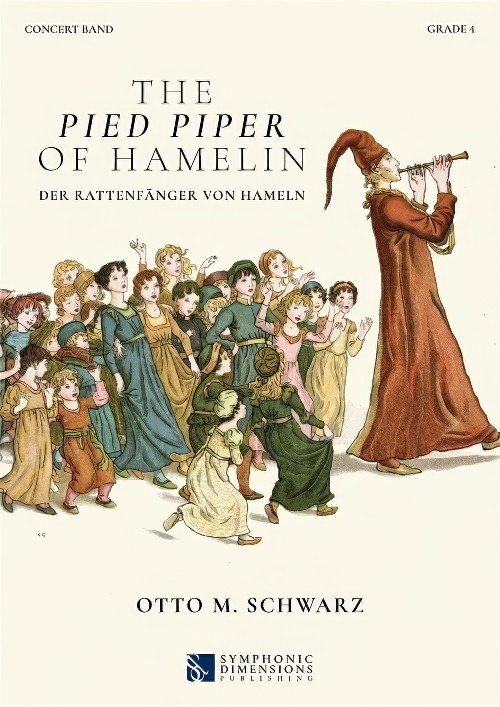
The Pied Piper of Hamelin (Concert Band - Score and Parts) - Schwarz, Otto M.
Stories, sagas and legends--who among us don't know them? Always delivered with a tinge of brutality, these cautionary tales are a legacy of moral education from times past: inquisitive children alone in the forest are generally eaten by a witch; the 'Soup-Kasper' of Hoffmann's Struwwelpeter dies from starvation rather than eating his soup; anyone letting in strangers usually gets devoured; anyone who plays with matches gets burned; and thumb-suckers get their thumbs cut off. The list of unfortunate demises is almost endless.In the tale of The Pied Piper of Hamelin, parents lose their children through greed, ridicule, scorn and a failure to appreciate art. There is still a street in the town of Hamelin in which neither drumming nor playing has not been allowed since 130 children disappeared into a mountain, never to be seen again. This composition by Otto M. Schwarz opens with exactly this scene, taking us back to the year 1284. As in many towns at the time, Hamelin in Germany suffered with hygiene problems--rats and mice began to multiply rapidly, and the town was overrun with the plague. There appeared a man dressed in colourful clothes who promised the locals to free them from this burden. They agreed and settled on a fee. Then the man pulled out a pipe and began to play. When the rats and mice heard this, they followed him. He led the animals into the Weser River, where they all drowned. Back in town, the people refused to pay him. They didn't recognise this man's skills and knowledge and were only prepared to pay for simple labour. A pact with the devil was made, which led to the Pied Piper leaving the town in a furious rage. One Sunday, when many people were at church, he returned, took out his flute and began to play. The town's children were so enchanted by his playing that they followed him. He led them out of the town and disappeared with them forever into a mountain forever. Of all the children, only two survived--however one was mute, and one was blind. In the street from which the children left Hamelin, music may no longer be played in memory of this event. The work may be performed in two different versions: 1. Purely instrumental (without narrator)--the GPs (pauses) must be kept short 2. With narrator--he speaks in the GPs but not during the music.Duration: 14.15
Estimated dispatch 7-14 working days
-
 £76.99
The Bells of Christmas (Concert Band - Score and Parts) - Fahnholz, Simon
"The idea behind this song is to remind everyone, for all those who have forgotten, how colourful and exciting Christmas was during their childhood. Christmas is a magical time and, after all, no matter how old we are, we are all still children at heart." These words were written by Chris de Burgh about his 2009 hit, The Bells of Christmas, inspired by Dickens' A Christmas Carol. Simon Fahnholz has now made an excellent version of this Christmas hit for concert band.Duration: 2:45
Estimated dispatch 7-14 working days
-
 £179.90
Heartbeat of a City (Concert Band - Score and Parts) - Schwarz, Otto M.
A city is founded, it has a heart that beats. But visible achievements such as buildings and infrastructure merely bear witness to what its true heart is made of, the people who have lived, and still live, in the city. The pulse of the city, brought to life by its heartbeat, changes over time. Who hasn't seen those time-lapse images showing twinkling lines of car lights as people make their way to work, while others stand at traffic lights, only moving as if at the push of a button? These are like life flowing in the veins, driven by a strong heart. Leonardo da Vinci had already imagined the rivers as the blood vessels of the Earth. In any city, though, it's not the rivers but the movement and activities of the people who live there. The heart doesn't always beat steadily, however, but its rhythm can be influenced by joy, fear, and many other things. Every city has its own pulse. This is also true of the university city of Marburg, where people from over 100 nations now live together in a cosmopolitan and tolerant community. This work describes the city from its founding in 1222, and the charity of Saint Elizabeth, all the way to the present day.Duration: 9.15
Estimated dispatch 7-14 working days
-
 £150.00
Diversions on a Theme of Paganini (Concert Band - Score and Parts) - Lane, Philip - Noble, Paul
This work is made up of eight short movements and was originally scored for brass quintet, being commissioned for performance by the London Gabrieli Ensemble. The full orchestra version was made in 2000 for a commercial recording by the Royal Ballet Sinfonia conducted by Gavin Sutherland, and the band arrangement was completed in 2009. The title is important in that the pieces are more musings than variations on the famous theme. The introduction stands somewhat apart, rather in the way the opening of Dohnanyi's Variations on a Nursery Tune does, and the subsequent diversions play with the theme, or parts of it, in movements lyrical, bombastic, or plain frivolous. The individual titles of the movements are self-explanatory, except to add that the last one always reminds the composer, for some reason, of final credits going up at the end of a film or television programme. Titles of the eight movements: 1. Introduction and Theme; 2. In Pieces; 3. Toccata; 4. Chaconne; 5. Cortege; 6. Popular Song; 7. Five-A-Side; 8. Epilogue. This piece will be a great workout for your band, with lots of opportunities for soloists, some rhythmic challenges, and great emotional stretches.
Estimated dispatch 7-14 working days
-
 £98.00
Zeus: King of the Gods - Romeyn, Rob
This monumental programmatic work from the pen of Rob Romeyn captures the myth and legend of Zeus, the mythical master of the gods and men. A sky god, he controls lightning, which he uses as a weapon, and thunder. It opens as Zeus becomes involved in the Trojan war, hurling lightning bolts at his opponents. The tension soon subsides as we are introduced to the eternally beautiful Hera, whom Zeus would eventually marry. The music then ensues as our story unfolds, as Zeus made his domain the mountaintops and clouds where he could survey all creation, and inflict pain and justice on all evildoers. Tension builds as Zeus battles Typhon in hand to hand combat, ending ultimately with Zeus throwing the enormous Mt. Etna at the monster, pinning him underneath. From here, the tension subsides, and a beautiful lyrical section builds to an ending of incredible power and grandeur as Zeus again reaffirms his stature as the ruler of Mt. Olympus. This exceptional work is a wonderful addition to any concert or festival performance!Duration: 8.15
Estimated dispatch 7-14 working days
 View Music