
Results
-
 £274.99
Stone Age - Thomas Doss
Stone Age, Middle Age and New Age are the three distinct sections of this single movement work at the highest level. Whilst Stone Age has a menacing and ancient atmosphere, an old German song can be made out in Middle Age vocals, guitar, recorder or even bagpipes can be incorporated into the melody, which gradually gives up merry Celtic dances. In New Age, the 'present', the Celtic sounds finally connect with untamed, rousing dance rhythms.
Estimated dispatch 7-14 working days
-
 £154.99
Chansons Bachiques Wind Band Set (Score & Parts)
In this four-movement suite, every moment sings of a different type of French wine. All these wines have their origins in the little French village of Savigny-les-Beaune in Burgundy and are made by wine-grower Pierre Guillemot. It was the excellent quality of the wines that inspired Rob Goorhuis into writing this composition. The first three movements deal with three red wines made of the Pinot Noir grape which all bear the Premier Cru designation. The final movement was inspired by a white wine made of Pinot Blanc and Chardonnay. In the nature of their musical material, the various movements not only give a characterisation of the taste of the wines. they also hint at impressions of the respective vineyards and their surroundings. 1st Movement Les Narbantons - Giocoso 2nd Movement Les Jarrons - Gracioso 3rd Movement Les Serpentieres - Festivo 4rd Movement Dessus des Golardes - Vivaci. 13:00
Estimated dispatch 7-14 working days
-
 £179.99
Amazonia (Concert Band - Score and Pars) - Van der Roost, Jan
This major concert work consists of five movements:1st movement: La Laguna del Shimbe. Situated high up in the Andes mountains in Northern Peru are the Huaringas, a group of lagoons in isolated and mysterious surroundings. The water has healing powers and for centuries traditional healers have settled there in small villages. From far the sick come to the Huaringas to be treated in nightly rituals, in which the hallucinating juice of the San Pedro cactus gives the prophet a look inside his patient. The biggest lagoon is the "Laguna del Shimbe", one of the countless wells of the immense Amazon stream.2nd movement: Los Aguarunas. Further downstream in Northern Peru we come across the rain tribe of Los Aguarunas. It's a proud, beautiful and independent race, which has never succumbed to domination, not even from the Incas. They live from everything the forest has to offer: fish, fruit, plants... They also grow some crops and live as semi-nomads. They take their fate into their own hands and after having made contact with modern civilisation, they have integrated new elements into their lives without betraying their own ways.3rd movement: Mekaron. Mekaron is an Indian word meaning "picture", "soul", "essence". The Indians are the original inhabitants of the Amazon region. They either live in one place as a group or move around a large region. They all have their own political system, their own language and an intense social life. At the same time they are master of music and medicine. "Everywhere the white man goes, he leaves a wilderness behind him", wrote the North American Indian leader Seatl in 1885. As a result of these contacts with the whites, the disruption of most Indian societies began. (In this century alone, 80 tribes have vanished completely).4th movement: Ktuaj. This is the name of the initiating ceremony of the Krah tribe in the Brazilian state of Goias, in which young boys and girls enter adult life. They are cleansed with water, painted with red paint and covered with feathers, after which the ritual dance holds the entire tribe spell-bound.5th movement: Paulino Faiakan. In 1988 the Indian chiefs Faiakan and Raoni Kaiapo came to Europe to protest against the building of the Altamira dam in Brazil. As a result of the dam the Indians would be driven from their traditional land and enormous artificial would be created. The project was supported financially by, amongst others, the European Community. In February 1989 the Indian tribes around Altamira held a protest march for the first time in their history together. Amongst other things they paid tribute tot Chico Mendez, who, murdered in 1988, was the leader of the rubber syndicate and a fierce opponent of the destruction of the Brazilian rain forest. Brazilian and world opinion was awakened. The building of the dam was, albeit temporarily, stopped.Duration: 12:30
Estimated dispatch 7-14 working days
-
 £209.99
Diamond Concerto (Euphonium Concerto No.3) (Euphonium Solo with Concert Band - Score and Parts) - Sparke, Philip
Diamond Concerto was commissioned by Musikverein Morschied from Germany - Dr. Eric Grandjean, conductor - for a special concert featuring Steven Mead as guest soloist. Together they gave the world premiere on 28th April 2012 in the town theatre of Idar-Oberstein. The commission is a highlight in the 30-year friendship between composer and soloist, which has included many mutual CD projects and concerts and, now, a concerto. Sparke had Steven Mead's special euphonium sound in his head throughout the composition process and made free use of the variety of styles which the world-renowned virtuoso has made his own during his highly successful solo career.The village of Morschied lies to the west of Frankfurt am Main in the area known as the German Road of Precious Stones, which is famous for its thriving gem industry. Because of this it was decided to give the commission a local connection by choosing the title, Diamond Concerto. Each of the three movements is named after a famous diamond:Earth Star is rather stern in mood, opening with a free fantasy for the soloist over a static chord from the band. This leads to an Allegro Moderato in minor mode where small motives are gradually repeated and developed by both band and soloist.Ocean Dream uses a varied quote from the composer's Music for Battle Creek, including a melting slow melody that was originally written with Steven Mead in mind.Blue Heart was written, at Steven Mead's suggestion, in bebop style and takes the form of a jazz waltz. The quasi-improvisatory central section features a call-and-response passage for the soloist and upper woodwinds.Duration: 15:45
Estimated dispatch 7-14 working days
-
 £53.95
Westwood Trail (Concert March) (Concert Band - Score and Parts) - Wagner, Douglas E.
Your audience will experience the Old West and all the imagery that follows when they hear Westwood Trail. With sonorities that are indeed fresh and melodic lines that move beautifully (with an occasional 'twist'), this distinctive new concert march moves boldly onto the scene. Bands and marches are made for each other, and this terrific piece jumps to the top of the list!Duration 2:15
Estimated dispatch 7-14 working days
-
 £279.99
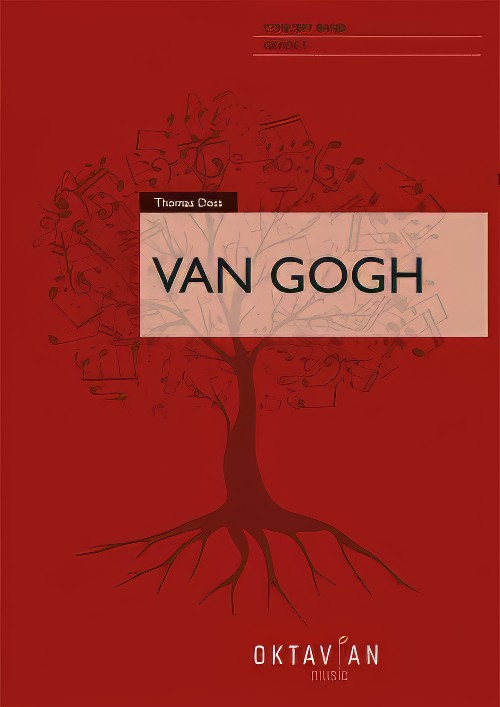
Van Gogh (Concert Band - Score and Parts) - Doss, Thomas
This composition is not a work inspired by the life of the famous painter, but rather an attempt at a pictorial immersion into his world. In addition to Van Gogh's character and tragic life, the technique he employed to create his works, the bright colours of his paintings and his view of nature served as inspiration for this musical work. Point by point, stroke by stroke, Van Gogh brought his own world to life on canvas.On the life of Van Gogh: The Dutch artist Vincent van Gogh was one of the most important pioneers of Modernism, despite being relatively unknown during his own lifetime. As an artist, he chose a life of poverty and seclusion. From today's perspective, his important woks were created from 1880 onwards, when he had already more or less succumbed to madness. While his earlier works could still be classed as contemporary, he matured into a pioneer of Expressionism with his later work indicating an increasing self-awareness. He was just 37 years old when he died but he created over 750 paintings and 1600 drawings in the last ten years of his life.The structure of the work:Start: Brushes and Paints: Van Gogh retired to Arles in southern France where he found his artistic home. The colours and flowering gardens of this landscape awakened in him an unbelievably great creative power.A: A Picture Comes into Being: Van Gogh's psychotic episodes and bouts of depression did not stop him from painting wonderful pictures. Hardly anyone recognised his genius during his lifetime, on the contrary, he often felt misunderstood.C: Paris - Arles: In Paris (from 1886), Van Gogh became inspired by the French art scene. His works found few takers, however. He met and befriended the painter Paul Gauguin, but the lack of success made Van Gogh short tempered, and he began to drink. Eventually, he moved from Paris to Arles in the south of France to establish an artists' collective with Gaugin. Within a few weeks, the two got into such a violent argument that Van Gogh attacked his friend with a knife. The friends parted ways and afterwards Van Gogh cut off his right ear. In 1889 he voluntarily admitted himself into a mental hospital at St. Remy, suffering from hallucinations and fearing that he would lose his mind.G: The Starry Night One of his most famous paintings, created in 1898.H: Death and Brotherly Love Vincent van Gogh accepted an invitation to Auver-sur-Oise in 1890. This was one of his most intensive creative periods. He also went there for treatment, but his mental state hardly improved. After an extended walk, he injured himself fatally with a pistol under mysterious circumstances. Not even to his beloved brother Theo, who had supported him all his life, did he reveal on his deathbed how the accident had occurred.J: Art Market Today, Van Gogh's paintings are among the most expensive paintings on the art market. How ironic, given that he could hardly sell a painting during his lifetime. "I put my heart and soul into my work and lost my mind in the process." (Vincent van Gogh)Duration: 13.15
Estimated dispatch 7-14 working days
-
 £70.50
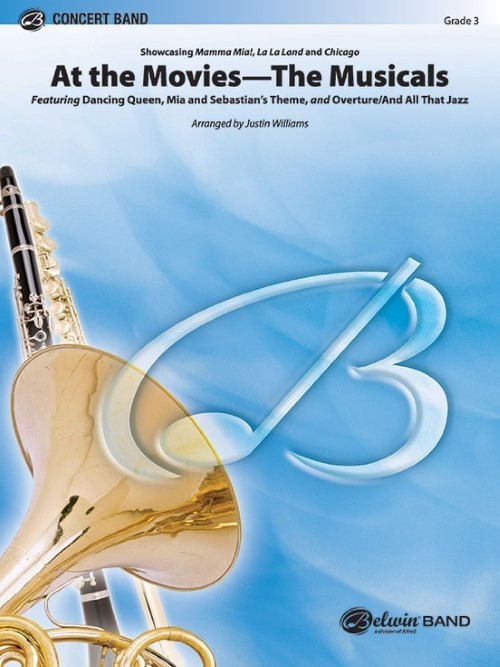
At the Movies - The Musicals (Concert Band - Score and Parts) - Williams, Justin
Musicals and movies are a match made in heaven! Mamma Mia, La La Land, and Chicago are three timeless masterpieces of this immensely popular genre. Incorporating "Dancing Queen," "Mia and Sebastian's Theme," and "Overture/And All That Jazz," At the Movies - The Musicals provides a memorable and exciting journey into the wonderland of movie musicals.Duration: 3.45
Estimated dispatch 7-14 working days
-
 £84.99
Russian Gipsy Song Wind Band Set (Score & Parts)
The origin of the song Piet Swerts arranged for concert band in Russian Gipsy Song probably lies with Russian gypsies, who know it under the title Dorogoj Dlinnojn and who ardently consider it their mental property.The melody of this Russian folk song is better known under the title Those Were the Days My Friend, the song that singer Mary Hopkins made famous in 1968. Within a year after she had issued this song, well over five million records of it had been sold. There are also versions in French (Les temps des fleurs), Spaans (Qu? tiempo tan feliz), Italian (Quelli erano giorni), and German (An jenem Tag) of this song full of nostalgia about the "good old days." 0:02:15
Estimated dispatch 7-14 working days
-
 £110.00
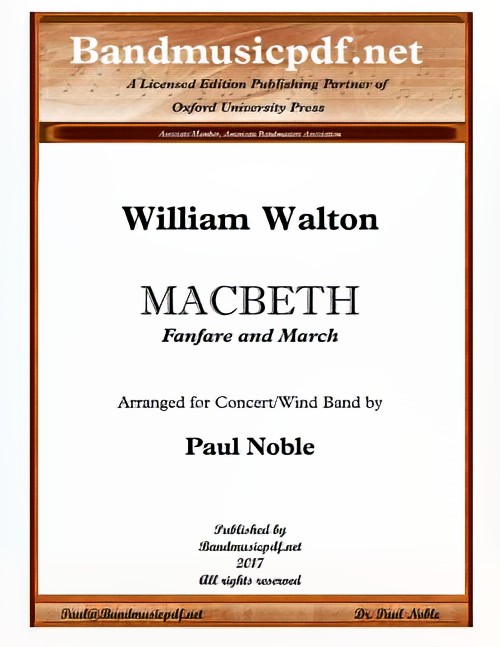
Macbeth (Fanfare and March) (Concert Band - Score and Parts) - Walton, William - Noble, Paul
The following program notes are taken from those by Christopher Palmer, the arranger for orchestra from William Walton's incidental music for John Gielgud's production of Macbeth in 1941-42. The music was recorded and taken on tour with the production. Up to now it has remained in manuscript and unknown. Although this piece is called Fanfare and March, the principal march is in fact the banquet music (with its clever suggestion of bagpipes on the woodwind, hence my ad lib parts for extra flutes and oboes). Walton made several different versions of this for dramatic purposes, and here some of them have been pieced together. The central section of Trio is the March (Show) of the Eight Kings (Act 4, Scene 1) which reveals to Macbeth that Banquo's issue, not his, will rule in Scotland.
Estimated dispatch 7-14 working days
-
£118.99
Asteroid Wind Band Set (Score & Parts)
Asteroids and comets have played an important role throughout the history of life on earth. It is quite probable that the dinosaurs have been exterminated by an asteroid's impact in the Gulf of Mexico. Huge tidal waves and fire storms wiped out all life. This is the year 2067 according to the Christian calendar. A collision has just taken place in the asteroid belt between Mars and Jupiter and caused an asteroid to enter the earth's power of gravitation. It is instoppably approaching the blue planet. As its peoples have been fighting each other continuously, they missed the building of a global defence system against dangers coming from space. A scanner records the asteroid and immediately sends a message to the President of the Anglo-American Union. The probability that the asteroid will hit the earth is judged 50% by the experts. Plans are made to shoot the celestial body with rockets live with hydrogen bombs or laser guns in order to throw it off its track, but they fail. The asteroid's size seems to threaten the existence of mankind. Those in the know stare at the night sky in bewilderment. But for the time being, there is still peace on earth.... 0:07:45
Estimated dispatch 7-14 working days
 View Music