
Results
-
 £73.50
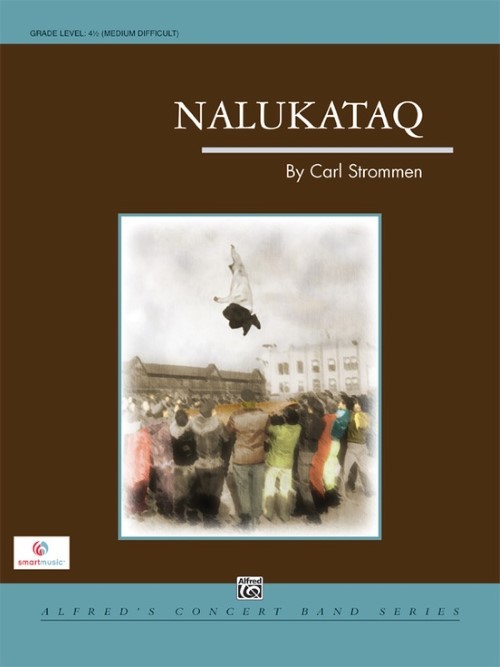
Nalukataq (Concert Band - Score and Parts) - Strommen, Carl
The festival of Nalukataq (Nah-loo'-ka-tahk) (the blanket toss) takes place in June and marks the end of a safe and successful whaling season. Nalukataq describes the events prior, during and after the hunt. Very exciting and uplifting!
Estimated dispatch 7-14 working days
-
 £104.99
Flashing Winds (Concert Band - Score and Parts) - Van der Roost, Jan
This flashing piece was commissioned by 'Het muziekverbond van West-Vlaanderen' and is dedicated to the 'Arlequino' youthband. Colourfully and effectfully instrumentated, this piece speeds towards its finale without any tempo changes. The chord-blocks, which characterized the introduction, unite this virtuoso piece by reappearing in the end.Duration: 4:00
Estimated dispatch 7-14 working days
-
 £53.95
Monsters, Unite! - Kelly Dugger
Monsters, Unite! by Kelly Dugger is a fun beginning band piece that is sure to be a hit, not only at Halloween time but all year round. Monsters all around the world are waking up to a calling to unite. Some are big, hairy creatures, and others are delicate and fairy-like. They walk and fly long distances to find each other. In the end, they all come together, marching as one. Just when you think they've marched off into the distance, they come together to surprise the audience. Unique percussion effects---timpani glissando and theremin (or flexatone)---add to the spooky sound. A tuba solo at the end is followed by a surprising scream that will leave the performers and the audience giggling!
Estimated dispatch 7-14 working days
-
 £214.80
Skies - Oliver Waespi
Program notes by Oliver Waespi on his composition Skies:Skies is the plural of Sky. We may wonder are there several skies? Is the sky we all long for not the same for everybody? While travelling on foot and "in the open air" I have observed the firmament often in quite different shapes, so that I can say I have indeed experienced the sky in different ways. Years ago I already wanted to portray "my sky" in music; I finally have been able to realise this long-cherished dream.This composition deals with the sky, more precisely with my sensual and emotional experience of the sky in all its aspects. Two point of views are combined in this composition: one showing the sky as it presents itself to me, the other showing the sky as I observe it. The music was bom simultaneously by intemal and extemal inspiration: it describes nature but also the emotional and spiritual experience of nature. To me, the experience of nature is not abstract, but it is connected with concrete ages, places or people from my neighbourhood. This is why I have combined several parts of this composition with certain landscapes.The sky presents itself in different landscapes in the most varied ways: for the sensual experience, there is no sky as such. The indications of places spread all over the score, are primarily clues for myself; they represent certain atmospheres, which I have experienced especially in England and Scotland. They can however also be useful to the musicians and the audience, providing they know those landscapes and the celestial atmospheres linked to them.The music is independent from the atmospheres described in the subtitles, as those are rather connected to a tragic nature, and so the music is not based on any program. Musically spoken, the composition has a symphonic structure, which means that the complete musical material is derived from three contrasting main themes. In the first part, the description of a noctumal sky ("Night") two themes are developed in an organic way; the first, rather "dusky", is to be found with the horns, the second, "in bright daylight", with the oboe and flute, the third, "more quiet" , with the brass instruments. In the next part, we have clouds and rain over the Isle of Skye (one of the Hebrides islands in Scotland) and here several elements of the first theme are still more developed. Then we get an increasingly dark mood, which is released, in heavy chords. Then suddenly, the sun breaks through and the music gets a majestic character. We have a new shape of the initial theme, first with the French horns and then with the trombones. The music gets a quicker tempo and flows into a quick movement describing the winds and waves at sea ("Wind and Waves"). Three themes are gathering and some variations are developed. The music gets more and more energetic and, after a climax, calms down again. Then we have a kind of "summer pastoral" which suggests summer at the South coast of Cornwall ("South Coast of Penwith Peninsuia in Summer"). This is certainly not the hotte st summer in Europe, but still it is beautiful in this country that is blessed with so much rain. In the "pastoral" , the sea is already sketched in broad outlines in the French horn solo. The magnificence of an aftemoon at the seaside is developed at the end of the composition ("Noon at Treen Cliff', a rock protruding in the sea next to Porthcumo at the South Coast of Cornwall); here the music gets stronger and stronger and after a majestic climax it vanishes completely.
Estimated dispatch 7-14 working days
-
 £189.99
Masked - Alex Shapiro
Masked by Alex Shapiro is composed in the exact shape of a Classical Minuet and Trio waltz, though the music--a whimsical if somewhat demented masked ball (or, balls, in this case)--bears little connection to that of Mozart or Haydn. Historically, third movement Minuets gave way to the joke-like Scherzo, and the Trio section tips its hat to some welcome levity. This is one of four movements in Suspended, a piece is composed in the tradition of an 18th century Classical symphony: four contrasting movements which serve specific functions and reveal a story. The work begins in absolute rage and chaos, then alternates between moments of grief and bleakness. Grim reality shifts to a macabre, circus-like insanity, and by the end, flickers of genuine hope contrast a pervasive sense of dread, and finally arrive at more optimistic possibilities. To perform the piece, you'll need an audio system capable of playing the prerecorded audio tracks from a laptop computer via a small digital audio interface connected to an audio mixer. Download information is provided in the printed piece.
Estimated dispatch 7-14 working days
-
 £122.00
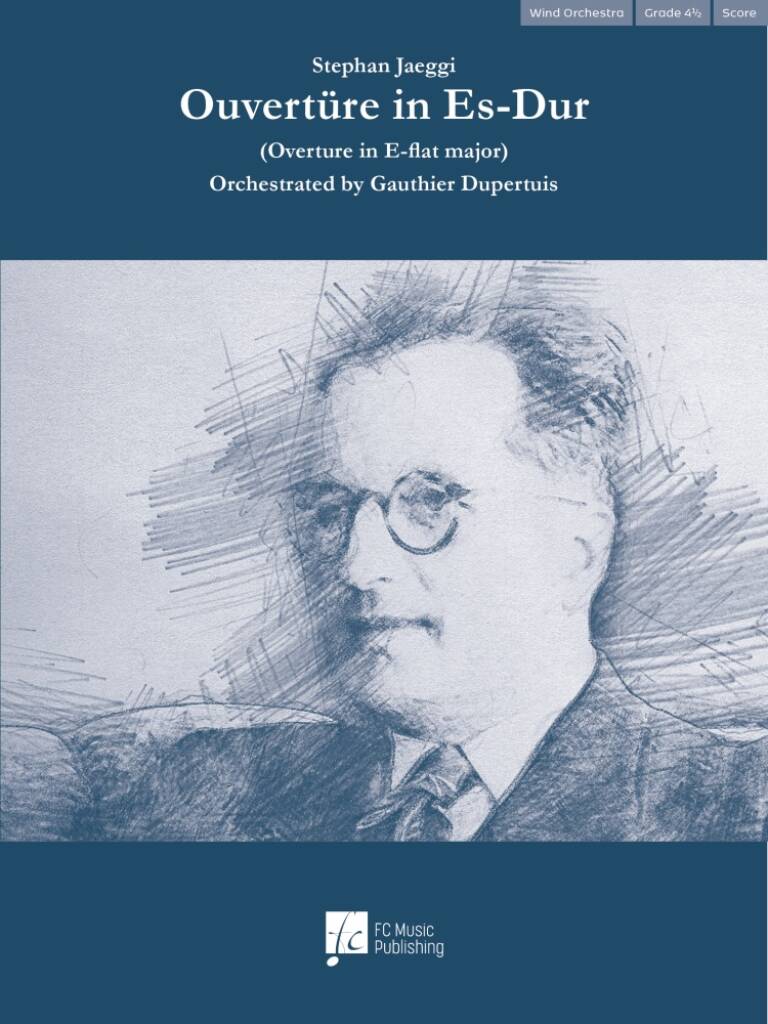
Ouvertre in Es-Dur - Stephan Jaeggi
As part of the year 2023, dedicated to Swiss composers, the Swiss Wind Band Association has commissioned Gauthier Dupertuis to write a new orchestration of the Overture in E-flat major by Stephan Jaeggi. Indeed, an update of the instrumentation was necessary for the interpretation of this work with modern orchestras.Therefore, the orchestration that Gauthier Dupertuis proposes and which he wanted to be faithful to the original while meeting current standards, will allow today's orchestras to performthis piece of classical-romantic inspiration.Stephan Jaeggi was a Swiss composer and conductor who was born into a large family in Fulenbach (Canton of Solothurn) in 1903. He began playing the clarinet at the age of 13, then studied music at the Basel Conservatory and attended his military training with the Swiss Army Band. Thereafter, he became the conductor of several wind orchestras. In this role, and also that of a composer, Stephan Jaeggi went on to achieve great success. His early death in 1957 put a premature end to Stephan Jaeggi's creative life. All the more reason why his work lives on with unbroken power to this day.
Estimated dispatch 7-14 working days
-
 £98.20
Space Lab - Giuseppe Ratti
A long pedal-note of evanescent chords, based on empty parallel fifths, announces the theme;flutes and reed instruments exploit some almost imperceptible micro-fragments, supported by muted trumpets, creating what is an almost surreal and spatial atmosphere. This was Giuseppe Ratti's starting point for his "Space Lab", a laboratory of sounds and, later (when the main theme is taken up once more), of rhythms. Although it may sound complicated, this piece is ultimately based on a single motif: the descending fourth played on the second beat by the woodwinds. In this piece, Giuseppe Ratti, with his usual pallet of clear, transparent colours at hand, appropriate for the general public, together with simple, effective themes, has sought to experiment with new atmospheres and rhythms. First of all we hear the entire theme in the Allegro. Then the rhythm changes in a simple but at the same time complex manner: almost a genetic mutation. The part leading up to the final Lento flows smoothly for the listener but requires great skill and experience on the part of those performing it. In the final lento the main theme reappears in all its simplicity and sincerity, purified of all contrasts. A metaphor for a life that leads us towards unimaginable frontiers but which, in the end, always brings us back to the point from where we started.
Estimated dispatch 7-14 working days
-
 £60.99
Jamaica - Timothy Travis
Jamaica is an island in the Caribbean. In 1494 it was discovered by Christopher Columbus, who used it as private property until 1509. After some skirmishes it fell under British rule and the sugar trade on the island flourished. After the abolition of slavery in 1834 it was only granted Home Rule in 1944, but it remained a member of the British Commonwealth of Nations. Whereas the export of cane sugar used to be Jamaica's main export product for many years, nowadays music has taken over this role. At first American music used to be very popular on the island. Later, however, Jamaican musicians started to experiment and thus in the end created their ownmusical style called Reggae. Well-known Reggae musicians are Bob Marley and Peter Tosh. The most important instruments used in Reggae are the bass and the drums. Together they form the base for the style: the riddim. A bass drum accent on the second and fourth beat are characteristic of a typically reggae drum beat. To this syncopic patterns are often added. The rhythm guitarist plays chords in a characteristic Reggae rhythm, not on, but between the beats.
Estimated dispatch 7-14 working days
-
 £124.99
Shamadan Dance - Thomas Doss
This work has been written within the framework of the Obertne project by the Bezirksblasmusikverband Linz-Land (Austria). It was dedicated to Anton Forstner as a thank you for his years of support to wind music in the Linz-Land District. The Shamadan is an old oriental folk dance full of symbolism in which a female dancer - often on the occasion of a wedding - balances a candelabra on her head as a token of spiritual light. In this work, the euphonium takes up the role of the dancer. At the very beginning, the soloist already has the opportunity to shine in an unaccompanied recitative. Next, the soloist and band alternate, and in the course of the work the band also plays an important part with various technical highlights. More variation is created with a solo passage accompanied by percussion and hand claps, culminating beautifully in a grand tutti towards the end of the piece. Challenging music with much to enjoy!
Estimated dispatch 7-14 working days
-
 £109.99
Filadelfia - Jacob de Haan
Filadelfia is a small town in the province of Vibo Valentia in the southern Italian region of Calabria. In 1783 the town suffered a devastating earthquake. This work depicts the events before and after the disaster, and starts peacefully, with dance-like music sounding in the streets. After this the earthquake destroys everything, causing deep despair. In the end, the town is being rebuilt, which calls for a festive celebration!
Estimated dispatch 7-14 working days
 View Music