
Results
-
 £171.00
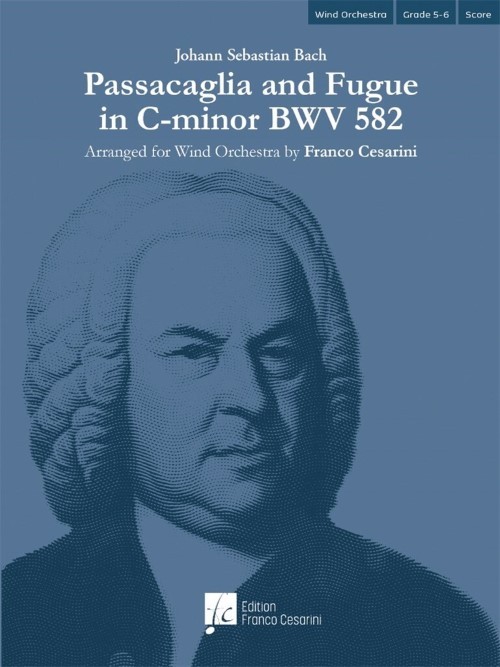
Passacaglia and Fugue in C minor BWV 852 (Concert Band - Score and Parts) - Bach, Johann Sebastian - Cesarini, Franco
The Passacaglia is a set of instrumental variations based on an ostinato bass. Bach's Passacaglia and Fugue in C-minor for organ represents the pinnacle of what had been achieved in this compositional form at that time. In Franco Cesarini's arrangement for large wind orchestra, the particularly careful interpretation of the original piece enables him to exploit all the sound colors at his disposal, and in this sumptuous guise Bach's work also takes on a grandiose dimension, albeit tinged with late-Romanticism. The exposition of the beautiful theme begins in the bass part, immediately creating a solemn and serious atmosphere which is accentuated by the intensely pathetic character of the first variations. Up to the tenth variation it remains confined to the bass, but in subsequent ones it also passes to the soprano and alto register. The integrity of the theme is also embellished with elegant arpeggios, in whose lower and higher extensions the theme can be distinguished. Towards the end it returns to the bass in an impressive thickening of the polyphonic texture that swiftly re-establishes the key of C-minor. The "Thema fugatum" which follows immediately does not constitute a Fugue in its own right, rather it is nothing but the twenty-first and most extensive variation of the Passacaglia. This time Bach uses only the first half of the theme, superimposing a rhythmic countersubject that considerably enlivens the entire development of the composition. The polyphonic discourse becomes increasingly dense, until the building tension peaks in a powerful "Neapolitan sixth" chord, followed by a sudden pause. This culminating moment then leads to the coda and final cadence on a bright C-major chord. Duration: 12.45
Estimated dispatch 7-14 working days
-
 £102.80
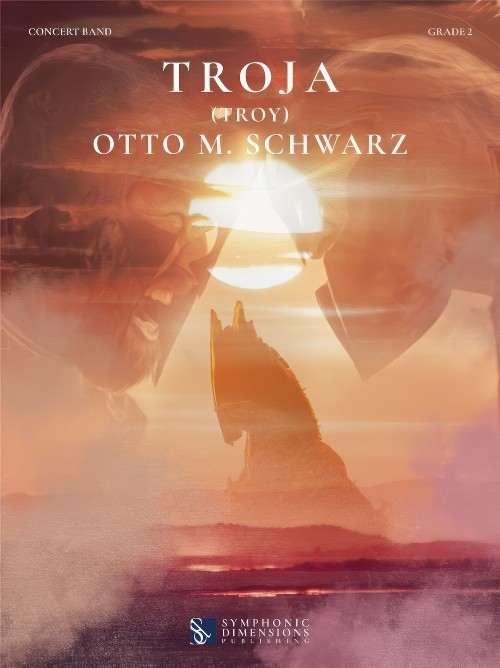
Troja (Troy) (Concert Band - Score and Parts) - Schwarz, Otto M.
The Greek poet Homer wrote about Troy and the Trojan War, which probably took place in what is now Asia Minor, in his Iliad in the 8th century B.C. Nowadays, the term Trojan generally refers to a malware program that is used to gain unauthorised access to computers. This use comes from the legendary Trojan Horse, which saw the turning point in the battle between Greeks and Trojans through the cunning of Odysseus. Let us return to the beginning of the story: Paris, son of the king of Troy, is tasked by Zeus with judging the beauty of the three goddesses Aphrodite, Pallas Athena, and Hera. Aphrodite, the goddess of love, flatters Paris by promising him the most beautiful woman in the world. Soon afterwards, on a journey to Greece, Paris meets the beautiful Helen, who immediately falls in love with him. Since however she is the wife of Spartan king Menelaus, she eventually lets herself be kidnapped by Paris voluntarily. The Greeks then form a large army and go to war against Troy to retrieve Helen, leading to a ten-year siege of the city. The city is eventually conquered not through combat, however, but through Odysseus' cunning ploy. He has the idea of building an enormous wooden horse with warriors hidden inside. The horse is placed at the gates of the city. Thus, the Trojans are tricked into giving up the siege when, despite various warnings, they bring the horse into the city to dedicate it to the goddess Athena. At night, the soldiers climb out of the horse and open the gate for the Greek army. The troops storm the city and burn it to the ground. The royal family and all the Trojan warriors are killed, only Aeneas, the son of Aphrodite, escapes. Later, following many years' wanderings he and his acolytes will become known as the founders of the Roman people. There are various accounts of the fate of the beautiful Helen. She is said to have returned to Sparta with Menelaus and to have ruled there until the end of her life. Or maybe not...Duration: 6.00
Estimated dispatch 7-14 working days
-
 £85.00
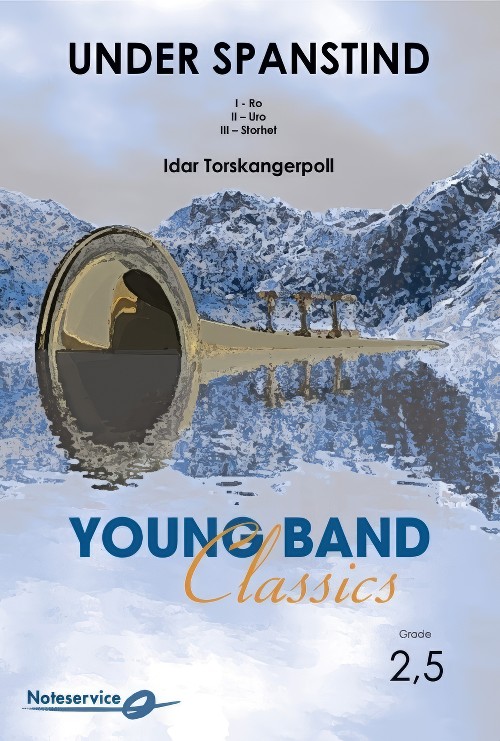
Under Spanstind (Concert Band - Score and Parts) - Torskangerpoll, Idar
Suite in Three MovementsThis piece of music is a commissioned work for Lavangen School band and their band music convention in 2019. The piece was performed under the mountain Spanstind (located far north in Norway) by a band consisting of approx 400 amateur musicians. The mountain Spanstind is 1457 meters high and drops into the valley Spansdalen below, an especially scenic venue.The composition is inspired by the sami joik (folk song) Ru?gu?ohkka, the song to Spanstinden. It is also inspired by the nature of the surroundings. Mvt 1 "Ro" (calmless) describes the feeling of calmness in the midnight sun. Mvt. 2 "Uro" (unrest) describes a scene of wind, snow, avalance and the big forces of nature. Mvt 3 "Storhet" (greatness) describes the feeling of greatness the nature has, and how we experience it as majestic and exalted.The piece can be played with the movements alone, or one can add the signals played by soloist(s) off-stage or in the back of the hall. The signals are to be played before, in between, and after the 3 movements. All instruments can be soloists. The soloist performs the signals rhythmically aleatoric, where each soloist repeats the signal 4 times in his or her own tempo. Signal 1 is played before Mvt 1, signal 2 is played between Mvt 1 and 2, signal 3 is played between Mvt 2 and 3, and signal 4 is played while the band holds the last note (long, use stagger breathing). after a while, all the soloists end on the same note and the music fade out.Duration: 6.30
Estimated dispatch 7-14 working days
-
 £80.00
Clarinet Concerto (The Fallen) (Clarinet Solo with Concert Band - Score and Parts) - Wilson, Jeffery
The three movements are 'Conflict', 'The Fallen' and 'Resolution', themes that are freely interpreted musically. In 'Conflict', the solo clarinet begins with an ascending figure based on octave leaps, while the accompaniment contrasts with marcato quavers and harsh dissonances. The melody features seventh intervals, and while the movement is marked 3/4 the accompaniment is often 6/8. This is more evident in the second theme where the clarinet line moves much more by step. The development takes these ideas and the cadenza comes from yet more conflict between the now calm clarinet and dissonant clashes in the accompaniment. 'The Fallen' is the slow movement and poignantly features notes from 'The Last Post' in the opening and a beautiful working of 'David of the White Rock' later on. The final movement 'Resolution' is a Rondo in 6/8, brighter but with hints of the initial conflict through the sevenths in the meno mosso sections which interrupt the flow. Another long cadenza takes short ideas from the piece before the work comes to a triumphant end with all four E notes across the whole range, echoing the beginning. Wilson set out to write a concerto for a versatile instrument and has found ways to exploit its capabilities while keeping tonal centre. There are frequent altissimo notes within all three movements. Wilson does use the very low notes, most notably in the cadenzas, but much of the work is high, presumably to allow the clarinet to carry over the wind band accompaniment. A good command of all notes right up to A sharp an octave above the stave is needed, plus technique to travel to and from altissimo notes (legato). The piece is around 25 minutes long. Printing is clear and the piano accompaniment comes as a spiral bound volume.
Estimated dispatch 7-14 working days
-
 £48.95
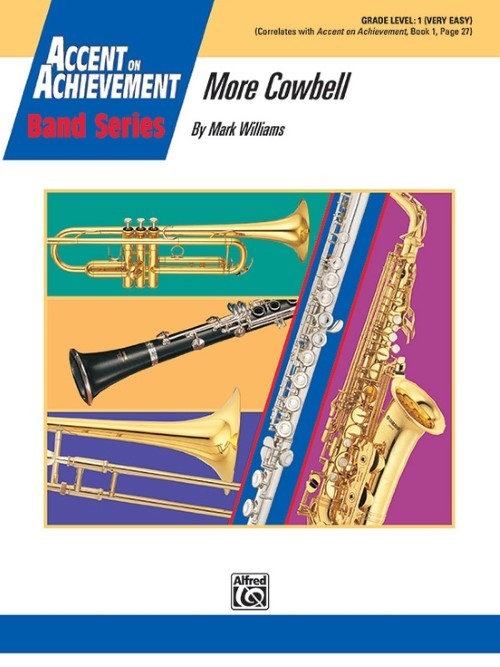
More Cowbell (Cowbell Feature with Concert Band - Score and Parts) - Williams, Mark
More Cowbell was inspired by the famous television skit featuring a rock band, a record producer, and an over-zealous cowbell player. If the cowbell player is good at hamming it up (and rocking out!), you could try the following staging suggestions: Cowbell player plays with intensity and lots of movement, and starts moving in measure 17 toward the front of the band, ending up next to the conductor in measure 24, bowing to the audience on beat 4. Conductor gives a stern look and gestures to student to get back in the percussion section (possibilities: "slit throat" gesture with side of first finger followed by pointing forcefully to the back, or similar gestures). Student slinks back, starts playing cowbell again, but quietly this time. Playing gradually picks up intensity, and player starts again toward the front in measure 41, reaching the front by measure 48. In measure 48, either A) Conductor waves hands violently for student to stop, or B) have a couple of students place a large blanket over the cowbell player. This works, but only for one measure (player quits and doesn't move in bar 49). Cowbell player resumes playing with a vengeance in measure 50 (either in spite of the teacher or under the blanket!). Make sure your new "rock star" takes another bow at the end of the piece. Have fun, and may your life always have more cowbell! Duration: 2.00
Estimated dispatch 7-14 working days
-
 £143.00
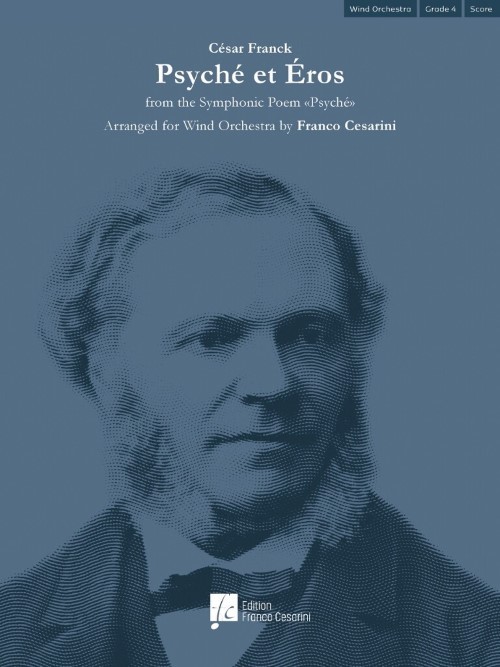
Psyche et Eros (Concert Band - Score and Parts) - Franck, Cesar - Cesarini, Franco
Cesar Franck, composer, pianist, organist and music teacher, completed Cupid and Psyche, his sixth and last symphonic poem in 1887. It was first performed in Paris in 1888 and was a complete success, but the piece later fell completely into oblivion, and it was only thanks to some meticulous research that it has returned to concert halls. The intricate love affair between Psyche and Cupid is an original story of the Metamorphoses, written in the 2nd century AD by Apuleius. The tale is about overcoming obstacles in love and their final union. The symphonic poem is divided into three parts and calls for a choir. The movement that is the subject of this arrangement, Psyche et Eros, is positioned at the end of the second part. Franco Cesarini's version for wind orchestra carefully illustrates the nuances of the instrumental colours, and represents a real test aimed at demonstrating the musicality and interpretative skills of orchestras and their conductors. Duration: 10.30
Estimated dispatch 7-14 working days
-
 £104.99
Solemnitas (Concert Band - Score and Parts) - Van der Roost, Jan
This short but solemn overture was written on the occasion of the 110th jubilee of Harmonie Hautcharage, Luxembourg. It is an homage to Jean-Paul Frisch and his son Gerard (the present conductor), who each have been conducting the ensemble for many years. Under their leadership, the band has developed and improved remarkably. The very first musical theme, presented during the introduction of this little overture, is based on the letters hidden in the names Jean-Paul and Gerard Frisch (in which h is considered b - as it is in German), thus aiming the spotlight on both key figures in the history of Harmonie Hautcharage. After the rather stately intro, the allegro is more joyful and lighthearted, thus depicting the optimism of the many young players of the band. The end is exciting and energetic: it radiates positivity and belief in the future. Duration: 5.30
Estimated dispatch 7-14 working days
-
 £85.00
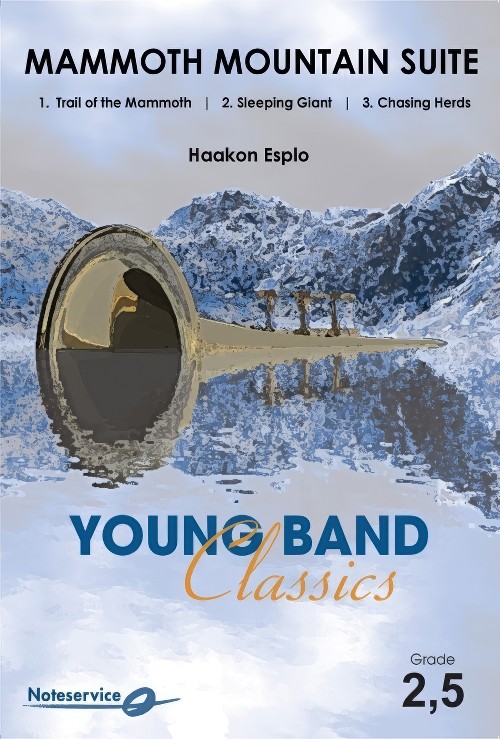
Mammoth Mountain Suite (Concert Band - Score and Parts) - Esplo, Haakon
Suite in Three Movements. Mammoths were a family of elephants that, with one exception, died out at the end of the last ice age. Their closest living relative is the Asian elephant. In many places in the world one can find mammoth remains. In Norway (especially in Gudbrandsdalen), 20 discoveries of teeth and skeletal remains have been made after mammoths that lived here between 40,000 and 50,000 years ago. On cave paintings and carvings you can see many pictures of mammoths with other animals. Pictures of killed mammoths have also been found with humans. Mammoth Moutain Suite describes a bunch of hunters looking for mammoths. Imagine the majestic animals, what it felt like to see the herd in the mountains and what it sounded like when the 6 ton heavy and 3.5 meter tall mammoths were on the run. Duration: 7.30
Estimated dispatch 7-14 working days
-
 £284.99
Symphony for Wind Ensemble (Concert Band - Score and Parts) - Stephenson, James M.
The symphony is in four movements. The first movement starts a single triangle note, followed by a guitar strum. The movement anxiously attempts to churn into action, only to be stifled repeatedly by the single triangle note. Finally, with the guitar as inspiration, the main theme gets under way, revealing an almost Spanish, or even Eastern European flavor. Ideas and themes get reworked, developed, repeated and augmented throughout the movement, before finally closing out just as it began, but in reverse: this time guitar followed by triangle. The second movement steals from an angular and shrieking motif of the first, but is presented in opposite fashion: with the warm blend of the low brass. Hints of iconic military symbolism are interspersed throughout this movement, as homage to the commissioning ensemble. The main theme is inverted and awarded to a solo trumpet midway before giving way to a brass fanfare, though not done loudly, but here muted, from afar. The low brass return at the end, fading away to nothing as the bell tolls. The third movement is merely a short interlude - a break, in almost Gershwin-like fashion - from the seriousness of the movements that precede and follow. Lastly, the fourth movement is a wild one: with mixed meters and plentiful percussion penned to propel the movement throughout. The movements' themes are all reworkings of material presented earlier. Duration: 25.00
Estimated dispatch 7-14 working days
-
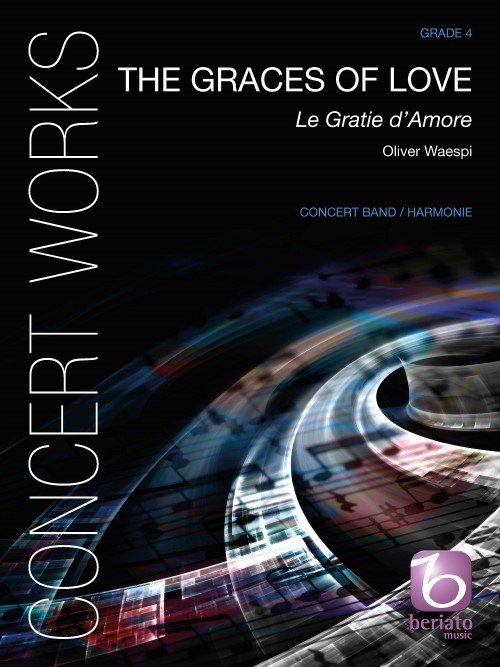 £174.99
The Graces of Love (Concert Band - Score and Parts) - Waespi, Oliver
The Graces of Love (Le Gratie d'Amore) is the title of a book published in 1602 by Cesare Negri, the famous dance master of the Milan court in the Renaissance. It contains numerous dance tunes and precise descriptions of courtly dances. It also includes the tune Il bianco fior (The White Flower) on which the first movement of my piece is based. A vigorous dance in three-four, it leads to an acceleration and a sudden shift to an even meter towards the end. The second movement, calm and contemplative in character, features the tune Vaghe bellezze... (Veiled Beauty...). Widely spaced melodic parts surround two solos during which the tune is varied and developed. Finally, the third movement contains a Saltarello based on a tune by Vincenzo Galilei, the father of the famous astronomer, Galileo Galilei. It brings the work to a close with a hypnotic rhythm which is noble and virtuosic at the same time.Duration: 12.45
Estimated dispatch 7-14 working days
 View Music