
Results
-
 £89.99
Heroes Near and Far (Concert Band - Score and Parts) - Saucedo, Richard L.
Each of the five movements of this innovative work is designed to invoke a particular type of emotion associated with leadership. Courage is stately in nature and written in a marcato style. Vision is playful in character and focuses on mixed meters as well as mixed emotions. The lyrical and sensitive Compassion is meant to stir the soul, while the contrasting Selflessness offers some of the most intense and demanding music of the set. The energetic final movement Heroes will bring to mind your own favourite superhero! Educator and speaker Scott Lang helped develop the concept for this unique work, and has made available supplemental curricula centred around leadership and character development. This material is tied to the Common Core Standards relating to reading, writing, music, art, and critical thinking. Each movement and its accompanying curriculum can stand on its own, allowing the director the flexibility of using as much or as little as desired. A tremendous resource for today's teacher!Duration: 9:30
Estimated dispatch 7-14 working days
-
 £102.99
Crazy for Christmas (Concert Band - Score and Parts) - Appermont, Bert
Christmas is the time of the year where everyone comes together, and peace, family and friendship bonds are strengthened. When selecting repertoire for your Christmas concert, it's difficult to find new arrangements that are both challenging and fun to work on, as well as fun for the audience. Crazy for Christmas is one of those pieces by the Belgian composer Bert Appermont. He uses canons and even fugues throughout this arrangement and foresees a spectacular ending. It is based on Il est ne le divin Enfant and Away in a Manger but refers wittily to Jingle Bells, Deck the Halls, The Twelve Days of Christmas and Hark, the Herald Angels Sing. So crazy all the way!Duration: 5.15
Estimated dispatch 7-14 working days
-
 £59.99
Memento (Concert Band - Score and Parts) - Buckley, Robert
2nd Movement of A Tribute to Arthur DelamontFamed bandmaster Arthur Delamont always programmed a hymn in his concerts and Memento is an homage to that proud tradition. Starting with a simple and reverent solo trumpet and introducing other brass instruments one by one, the introduction has the sound of a brass band. The woodwinds join in and, with the use of rich textures and dynamic scoring, the work builds to a powerful climax and then resolves once again with the solo trumpet. Ideal for festival use, Memento will give your ensemble an opportunity to explore expression and nuance. The second movement of A Tribute to Arthur Delamont, Memento was commissioned by the West Vancouver Youth Band.Duration: 4:00
Estimated dispatch 7-14 working days
-
 £72.99
Flying Colors (Concert Band - Score and Parts) - Buckley, Robert
Third Movement of A Tribute to Arthur Delamont.Imagine a band far off in the distance marching toward you - soft at first, the music becomes louder and louder; the red capes of the band sway in the wind, getting closer and closer. It was this image that inspired Flying Colors. Famed bandmaster Arthur Delamont always programmed a march in his concerts, and the hallmark of his band was their red capes. The work begins very softly with a distant snare drum beat. The trumpets enter quietly with the melody, and with each new melodic entry the music grows and intensifies to a roaring finish. This is a fresh new take on a march, and is sure to please players and audiences alike! Flying Colors is the third movement of A Tribute to Arthur Delamont and was commissioned by the West Vancouver Youth Band.Duration: 3:10
Estimated dispatch 7-14 working days
-
 £72.99
Front and Center (Concert Band - Score and Parts) - Buckley, Robert
First Movement of A Tribute to Arthur Delamont.Famed bandmaster Arthur Delamont always started his concerts with a rousing overture, and Front and Center is in this proud tradition. In a non-stop 9/8 rhythm, this piece explodes with energy and effervescence. Full of powerful fanfares, lively melodies, driving percussion and dynamic contrasts, this exciting concert opener moves through different musical colours without ever losing its relentless drive. An exhilarating tour-de-force showcasing all sections of the band! Front and Center is the first movement of A Tribute to Arthur Delamont and was commissioned by the West Vancouver Youth Band.Duration: 3:15
Estimated dispatch 7-14 working days
-
 £520.99
A Colour Symphony (Concert Band - Score and Parts) - Sparke, Philip
Philip Sparke's third symphony, A Colour Symphony, was commissioned by "sinfonischen blasorchester wehdel" conducted by Thomas Ratzek. In the four movements (white, yellow, blue and red) the composer creates links between the instrumentation and harmonic elements and the actual colour of the spectrum the movement stands for. In order to create the greatest richness possible, Philip Sparke used a very large instrumentation including low woodwinds, harp, piano and celli. A Colour Symphony is an impressive and iconic addition to the standard repertoire for large symphonic bands. Philip Sparke's third symphony, A Colour Symphony, was commissioned by "sinfonischen blasorchester wehdel" conducted by Thomas Ratzek. In the five movements (white, yellow, blue, red and green) the composer creates links between the instrumentation and harmonic elements and the actual colour of the spectrum the movement stands for. In order to create the greatest richness possible, Philip Sparke used a very large instrumentation including low woodwinds, harp, piano and celli. A Colour Symphony is an impressive and iconic addition to the standard repertoire for large symphonic bands.Duration: 26:00
Estimated dispatch 7-14 working days
-
 £34.95
Dreaming of Dreams (Concert Band - Score and Parts) - Kelly, Thomas
Dreaming of Dreams is a slow-paced and feel-good piece, composed by Thomas Kelly, a Dublin-born composer and trombonist. His music has been performed by both amateur and professional musicians and ensembles in Ireland and the UK and he has studied under Adam Gorb and Paul Patterson.
Estimated dispatch 7-14 working days
-
 £450.00
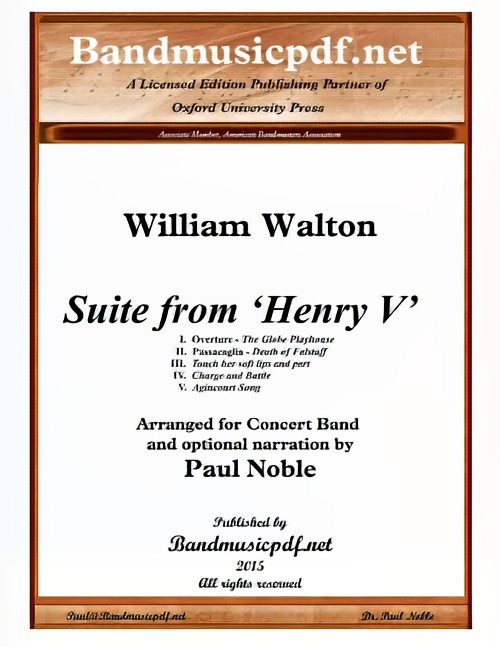
Henry V, Suite from (Concert Band with Optional Narrator - Score and Parts) - Walton, William - Noble, Paul
The Suite from Henry V is an arrangement for Concert Band and optional narrator, adapted from the 1963 orchestral arrangement of William Walton's musical score from the 1944 film Henry V. The suite, originally arranged for orchestra by Muir Mathieson, is in five movements, and occupies a very significant role in the history of music and of Shakespearean studies. Performances exist in a variety of formats because the adaptation of the narration to a film suite is subject to choice. To be chronologically correct, the order of movements from the original suite has been altered to adhere to the narration of the play. And the choice of speeches has required considerable research by classicists who are familiar with the writings of Shakespeare. It has been the endeavour of this arranger to research and present this suite in as authentic a manner as possible, understanding that it might well become the standard by which Concert Bands of the future will adapt and present this music. The arranger is indebted to Anna Warren, a resident of Twickenham and a graduate in Modern Languages (French and Italian) and History from the University of Bristol and a postgraduate from The Institute of Education, the University of London, for her knowledge and insight into the formation of the narration.
Estimated dispatch 7-14 working days
-
 £110.00
I Was Glad When They Said Unto Me (Choir with Concert Band - Score and Parts) - Parry, Hubert C. - Noble, Paul
I Was Glad is an introit commonly used in the Anglican Church, and also used as an anthem traditionally sung at the coronation of the British monarch. Its most famous setting was written in 1902 by Sir Hubert Parry. Parry's version was composed for the coronation of King Edward VII in 1902, and revised in 1911 for that of King George V, when the familiar introduction was added. This setting employs antiphonal choir effects and brass fanfares. Apart from the imperial splendour of the music, the chief innovation is the incorporation in the central section of the acclamations Vivat Rex... or Vivat Regina... (Long live King/Queen...) with which the King's or Queen's Scholars of Westminster School have traditionally greeted the entrance of the monarch since the coronation of King James II in 1685. This section is generally omitted when the anthem is performed on other occasions. At the last coronation, that of Elizabeth II in 1953, the acclamation took the form of Vivat Regina Elizabetha. Parry's setting of I Was Glad was performed on 29 April 2011 at the Westminster Abbey wedding of Prince William, Duke of Cambridge and Catherine, Duchess of Cambridge (formerly Kate Middleton) as the processional music for the bride and her father and the bridal attendants. It had previously been performed at the wedding of the Duke's parents, Charles, Prince of Wales and Diana, Princess of Wales in 1981.
Estimated dispatch 7-14 working days
-
 £99.95
Stories and Dreams (Concert Band - Score and Parts) - Wiffin, Rob
Energetic, wide-ranging and stimulating in its musical ideas, Stories and Dreams is a work of considerable musical interest to both listener and performer. Comprising three movements: The March of the Smiling Soldier (3.30), Stories I could tell (4.15) and Hope (3.30), this suite is only moderate in technical difficulty but is full of musical interest. The first movement is a slightly tongue-in-cheek march, the second is lyrical and poignant taking its atmosphere from the enigma implicit in its title, and the finale vivacious and life-affirming.Duration: 11.15
Estimated dispatch 7-14 working days
 View Music