
Results
-
 £164.95
Roman Trilogy (Prestige Concert Band - Score and Parts) - Ellerby, Martin
This work falls into three movements, all concerned with the subject of the Italian capital city of Rome, rather like previous tributes to other European citites in Paris Sketches, Venetian Spells and The Cries of London. The emphasis is on atmosphere and drama, be they respectful or joyful! It is acknowledged that Ottorino Respighi has influenced this work though his own eternal Rome tributes are not challenged here, rather saluted and celebrated.The three movements are: 1. Collosea di Romaan evergrowing march mood, builds in intensity and density as we approach the mighty Colosseum, the amphitehatre of Classical Rome, where deadly spectacles were once played out. We should not forget that countless thousands died here whilst even more laughed in the name of entertainment: their memory is reflected in the coda. In its unique way this icon of Rome is one of the most tragic historical places.2. Capella Sistinathe Sistine Chapel of the Vatican City is observed in a series of chorales and interludes. The visitor can look 360o around and be presented with a series of Biblical representations and commentaries. The music attempts to reflect these contrasting panels whilst ultimately bowing to the glory of this magnificent artistic creation. The coda is enigmatic, inconclusive - a single viewing cannot reveal all the mysteries and beauties within. 3. Fonatani di Trevitime for laughter and fun! The Trevi Fountain is one of Rome's finest and visually overboard locations! This is indicated as a Burletta: 'a la dolce vita' which means 'the sweet life'. This burletta (meaning 'little joke') makes use of tarantella and saltarello rhythms and features a pair of tambourines which are associated with these forms. La Dolce Vita was also a film by the renowned Italian director Federico Fellini featuring a memorable scene in the Trevi with a wet Enita Ekberg: something modern day visitors are discouraged from emulating!Duration: 11:15Recorded on Polyphonic QPRM161D ROMAN TRILOGY (TheRoyal Northern College of Music Wind Orchestra).
Estimated dispatch 7-14 working days
-
£37.95
Roman Trilogy (Prestige Concert Band - Score only) - Ellerby, Martin
This work falls into three movements, all concerned with the subject of the Italian capital city of Rome, rather like previous tributes to other European citites in Paris Sketches, Venetian Spells and The Cries of London. The emphasis is on atmosphere and drama, be they respectful or joyful! It is acknowledged that Ottorino Respighi has influenced this work though his own eternal Rome tributes are not challenged here, rather saluted and celebrated.The three movements are: 1. Collosea di Romaan evergrowing march mood, builds in intensity and density as we approach the mighty Colosseum, the amphitehatre of Classical Rome, where deadly spectacles were once played out. We should not forget that countless thousands died here whilst even more laughed in the name of entertainment: their memory is reflected in the coda. In its unique way this icon of Rome is one of the most tragic historical places.2. Capella Sistinathe Sistine Chapel of the Vatican City is observed in a series of chorales and interludes. The visitor can look 360o around and be presented with a series of Biblical representations and commentaries. The music attempts to reflect these contrasting panels whilst ultimately bowing to the glory of this magnificent artistic creation. The coda is enigmatic, inconclusive - a single viewing cannot reveal all the mysteries and beauties within. 3. Fonatani di Trevitime for laughter and fun! The Trevi Fountain is one of Rome's finest and visually overboard locations! This is indicated as a Burletta: 'a la dolce vita' which means 'the sweet life'. This burletta (meaning 'little joke') makes use of tarantella and saltarello rhythms and features a pair of tambourines which are associated with these forms. La Dolce Vita was also a film by the renowned Italian director Federico Fellini featuring a memorable scene in the Trevi with a wet Enita Ekberg: something modern day visitors are discouraged from emulating!Duration: 11:15Recorded on Polyphonic QPRM161D ROMAN TRILOGY (TheRoyal Northern College of Music Wind Orchestra)
Estimated dispatch 7-14 working days
-
 £137.99
Theme Park Fun! Wind Band Set (Score & Parts)
In Theme Park Fun! your orchestra pays a visit to an amusement park. During your visit, you will experience some spectacular rides and attractions this theme park offers. The uniqueness of Theme Park Fun! is the interplay between music and (moving) images. Animations and illustrations support the visual composition.Part 1: The Entrance & Parade [with animation]The opening of the park is a fact. A day full of fun and pleasure awaits! You and the other visitors will be confronted with all the rides, attractions and adventures the theme park has to offer. Which ride shall we do first?! There is so much to do and experience on this day in the park! A parade of colorful floats and park figures is passing by.Let the fun begin!Part 2: The Haunted House [with animation]The only ride in the park that is not related to fun, is the Haunted House. Here visitors will be challenged to visit a house full of ghosts, creepy figures and other ominous things. The clock strikes twelve, there is no turning back. Ghosts are whispering, yelling, screaming... Fortunately it is almost one oclock, so we can leave this creepy place quickly.Part 3: The Swinging Galleon [with illustrations]What a huge pirate ship! Each time you swing back and forth, you will feel that weird feeling in your stomach. When you are thrown completely into the top you will have a fantastic view over the park, but you can not enjoy it for long. Before you know the ship swings back the other way.Part 4: The Fairy Tale Ride [with illustrations]After all those exciting and spectacular rides and attractions, it is time for a peaceful tour in The Fairy Tale Ride. Surrounded by a fairytale setting, you will discover fable figures, talking animals and colorful designs. Such a beauty and tranquility. Having had this experience, we are ready again for the big rides in the park!Part 5: The Bumper Cars [with illustrations]Now its time to crawl behind the wheel of the Bumper Cars! Shall we all chase the conductor?! Before you know you are hit by another visitor or you will bump against someone else. In this tough ride you can prove yourself as a real driver, or perhaps as a really bad one.Part 6: The Roller Coaster [with illustrations]The largest, fastest and scariest ride in the park ... we should definitely do the Roller Coaster! All together in the train, the over-the-shoulder restraints are lowering... be ready to ride. The train leaves the station and is heading for the big lift hill. It will be very scary when the train reaches the top and the train will be plunged down the first drop! Loops, corkscrews and other spectacular coaster elements will follow... Before you know it, the ride of your life is over. Shall we ride it again?!Part 7: Leaving the Park [with animation]Unfortunately everything comes to an end. This day in the theme park is over, but we have a lot new experiences to talk about! The memories of all the funny and spectacular rides will come up when we walk through the park to the exit. Just one look over the shoulder, the amusement park figures are waving at us. Hopefully we will come back again soon! 14:30
Estimated dispatch 7-14 working days
-
 £137.99
Three Onegin Dances Wind Band Set (Score & Parts)
Tchaikovsky is best known for his purely instrumental compositions. However, we must not underestimate him as a composer of operas. Many of his operas such as ?Pique Dame and Eugene Onegin are still performed regularly throughout the world. Eugene Onegin (also called Jevgeny Onegin), composed in 1877-1878, was not called an opera by Tchaikovsky himself, but "lyric scenes". The work is entirely dominated by lyricism. However, there are two moments that contrast sharply with this lyricism: two ball scenes, for which Tchaikovsky wrote a waltz and a polonaise.After opening with a less well-known allegro dansant, this arrangement features the aforementioned waltz, which can be considered a beautiful Russian equivalent of the Faust Waltz by Charles Gounod. In the opera, this waltz is actually played by a military band. The arrangement concludes with the pompous polonaise (also mentioned above) which opens the last act: the ideal music to characterize high aristocracy in the salon of a palace in St. Petersburg. 0:09:30
Estimated dispatch 7-14 working days
-
 £36.95
I Don't Know Why! (Concert Band - Score and Parts) - Wiffin, Rob
I Don't Know Why is an unashamed homage to Stevie Wonder although there is not a note of his music in it. The piece follows the format of verse, chorus and then a shout chorus. It mostly needs a light, swing feel to it except for a bridge section (letters B and F) which needs to be straight. The shout chorus is a little gymnastic but apart from that it should be fun to play and hopefully not too technically challenging.Duration: 3.00
Estimated dispatch 7-14 working days
-
 £102.80
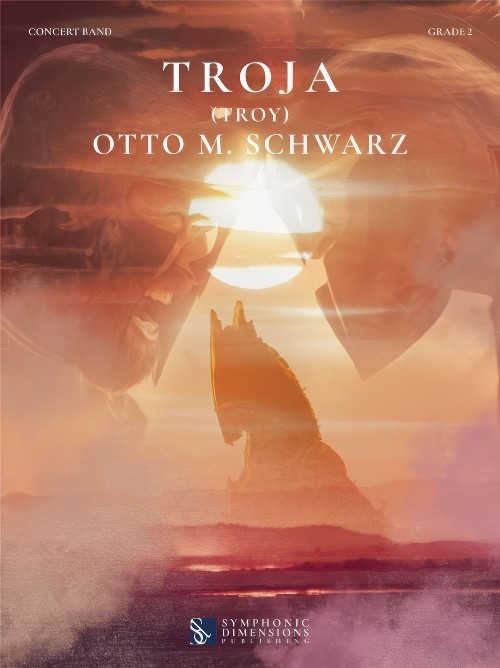
Troja (Troy) (Concert Band - Score and Parts) - Schwarz, Otto M.
The Greek poet Homer wrote about Troy and the Trojan War, which probably took place in what is now Asia Minor, in his Iliad in the 8th century B.C. Nowadays, the term Trojan generally refers to a malware program that is used to gain unauthorised access to computers. This use comes from the legendary Trojan Horse, which saw the turning point in the battle between Greeks and Trojans through the cunning of Odysseus. Let us return to the beginning of the story: Paris, son of the king of Troy, is tasked by Zeus with judging the beauty of the three goddesses Aphrodite, Pallas Athena, and Hera. Aphrodite, the goddess of love, flatters Paris by promising him the most beautiful woman in the world. Soon afterwards, on a journey to Greece, Paris meets the beautiful Helen, who immediately falls in love with him. Since however she is the wife of Spartan king Menelaus, she eventually lets herself be kidnapped by Paris voluntarily. The Greeks then form a large army and go to war against Troy to retrieve Helen, leading to a ten-year siege of the city. The city is eventually conquered not through combat, however, but through Odysseus' cunning ploy. He has the idea of building an enormous wooden horse with warriors hidden inside. The horse is placed at the gates of the city. Thus, the Trojans are tricked into giving up the siege when, despite various warnings, they bring the horse into the city to dedicate it to the goddess Athena. At night, the soldiers climb out of the horse and open the gate for the Greek army. The troops storm the city and burn it to the ground. The royal family and all the Trojan warriors are killed, only Aeneas, the son of Aphrodite, escapes. Later, following many years' wanderings he and his acolytes will become known as the founders of the Roman people. There are various accounts of the fate of the beautiful Helen. She is said to have returned to Sparta with Menelaus and to have ruled there until the end of her life. Or maybe not...Duration: 6.00
Estimated dispatch 7-14 working days
-
 £16.95
Please Don't Go (Concert Band - Score only) - Wiffin, Rob
There could easily be a backstory for this piece. It is ostensibly a Latin dance at samba tempo but it is slightly tinged with a sense of wistfulness and heartache and it is easy to work out where the imploring words of the title Please don't go fit into the melody. It is not technically difficult to play although it needs an appropriate sense of style and rhythm. Parts are comprehensively cued and the piece works without a bass guitar although it is desirable if possible. Similarly, not all the percussion instruments are vital although they add considerably to the feel of the music if you have them.
Estimated dispatch 7-14 working days
-
£82.95
Please Don't Go (Concert Band - Score and Parts) - Wiffin, Rob
There could easily be a backstory for this piece. It is ostensibly a Latin dance at samba tempo but it is slightly tinged with a sense of wistfulness and heartache and it is easy to work out where the imploring words of the title Please don't go fit into the melody. It is not technically difficult to play although it needs an appropriate sense of style and rhythm. Parts are comprehensively cued and the piece works without a bass guitar although it is desirable if possible. Similarly, not all the percussion instruments are vital although they add considerably to the feel of the music if you have them.
Estimated dispatch 7-14 working days
-
 £150.00
Froissart (Concert Band - Score and Parts) - Elgar, Edward - Noble, Paul
Froissart, Op. 19, is a concert overture by Edward Elgar, inspired by the 14th-century Chronicles of Jean Froissart. Elgar was first attracted to the Chronicles after finding mention of them in Walter Scott's Old Mortality. Jean Froissart (c. 1337 - c.1405), often referred to in English as John Froissart, was a medieval French chronicle writer. For centuries, Froissart's Chronicles have been recognized as the chief expression of the chivalric revival of the 14th century Kingdom of England and France. The motto written by Elgar on the manuscript score is a quotation from an 1817 poem by Keats: 'When Chivalry lifted up her lance on high.' Froissart is not a programmatic work: unlike the later Falstaff or even Cockaigne it does not tell a detailed story; it evokes a mood and manner in broad terms. The drama of the dynamics enhances the haunting melodies that identify Elgar's compositions.
Estimated dispatch 7-14 working days
-
 £6.95
£6.95Symphony Performance Folio (Timpani/Percussion) - Monday, Deborah Baker
Here's a highly requested collection of folk tunes and classical works flexibly arranged. All arrangements can be played as a full orchestra, or string orchestra, or concert band, or woodwind ensemble, or brass ensemble, or miscellaneous combination that works for you! A percussion book is also included but not required. The pieces in the book progress from grade 2 to grade 4. Arranger Deborah Baker Monday has creatively arranged each piece for concerts or classroom training. Not to be missed! Includes: Chorale (Drese); Lo, How a Rose E'er Blooming (Praetorius); Old French Hymn; Jana Gana Mana (Tagore); Minuet from Water Music (Handel); My Bonny Lass (Morley); Beach Spring (White); Hatikvah; Rondeau from Abdelazer Suite (Purcell); Menuet from Le Tombeau de Couperin (Ravel); Turkish March from The Ruins of Athens (Beethoven); In the Hall of the Mountain King from Peer Gynt Suite (Grieg); Alborada from Capriccio Espagnol (Rimsky-Korsakov); When Johnny Comes Marching Home.
Estimated dispatch 7-14 working days
 View Music