
Results
-
 £99.95
A RICHER DUST (Symphony No.1) (Speaker and Concert Band - Score only) - Clarke, Nigel
Large A3 score
Estimated dispatch 7-14 working days
-
 £49.95
CATHEDRAL (A Little Ceremonial Music No.2) (Programme Concert Band) - Wiffin, Rob
This contemplative work would be an ideal change of pace for your concert. Duration 3'40"
Estimated dispatch 7-14 working days
-
 £95.99
5 Tantum Ergo - Anton Bruckner
Anton Bruckner (b. 4.9.1824, Ansfelden, d. 11.10.1896, Vienna) didn't have it easy. Throughout his life, the Austrian composer was plagued by self-doubt. Anton Bruckner came from a simple, rural background. After the death of his father, he was accepted as a choirboy at the monastery of Sankt Florian in 1837. After several years as a school assistant and his own organ and piano studies, he first worked as organist in St. Florian, then from 1855 as cathedral organist in Linz. Introduced to music theory and instrumentation by Simon Sechter and Otto Kitzler, he discovered Richard Wagner as an artistic role model, whom he admired throughout his life and also visited several times in Bayreuth.In 1868 Anton Bruckner became professor of basso continuo, counterpoint and organ at the Vienna Conservatory; ten years later court organist; and in 1891 finally honorary doctor of the University of Vienna. He was considered an important organ virtuoso of his era, but had to wait a long time for recognition as a composer. It was not until Symphony No.7 in E major, composed between 1881 and 1883, with the famous Adagio written under the effects of Wagner's death, that he achieved the recognition he had hoped for, even if he was reluctant to accept it given his inclination towards scepticism and self-criticism.Anton Bruckner was a loner who did not want to follow a particular school or doctrine. He composed numerous sacred vocal works, such as his three masses, the Missa Solemnis in B flat minor (1854), the Te Deum (1881-84) and numerous motets. As a symphonic composer, he wrote a total of nine symphonies and many symphonic studies from 1863 onwards, tending to revise completed versions several times over. Bruckner's orchestral works were long considered unplayable, but in fact were merely exceptionally bold for the tonal language of their time, uniting traditions from Beethoven through Wagner to folk music, on the threshold between late Romanticism and Modernism.Hymns for four-part mixed choir a cappella (1846, St. Florian)No. 1 in E flat major (WAB 41/3): Quite SlowNo. 2 in C major (WAB 41/4): AndanteNo. 3 in B flat major (WAB 41/1): SlowNo. 4 in A flat major (WAB 41/2): SlowHymn for five-part (2 S, A, T, B) mixed choir and organNo. 5 in D major: SolemnlyThey are simple works, completely subordinate to their liturgical use, which nevertheless already show numerous characteristics of personal expression. These small pieces were able to stand up to the harsh scrutiny of the mature master: in 1888, Bruckner subjected them to a revision in which he made only minor corrections.
Estimated dispatch 7-14 working days
-
 £75.50
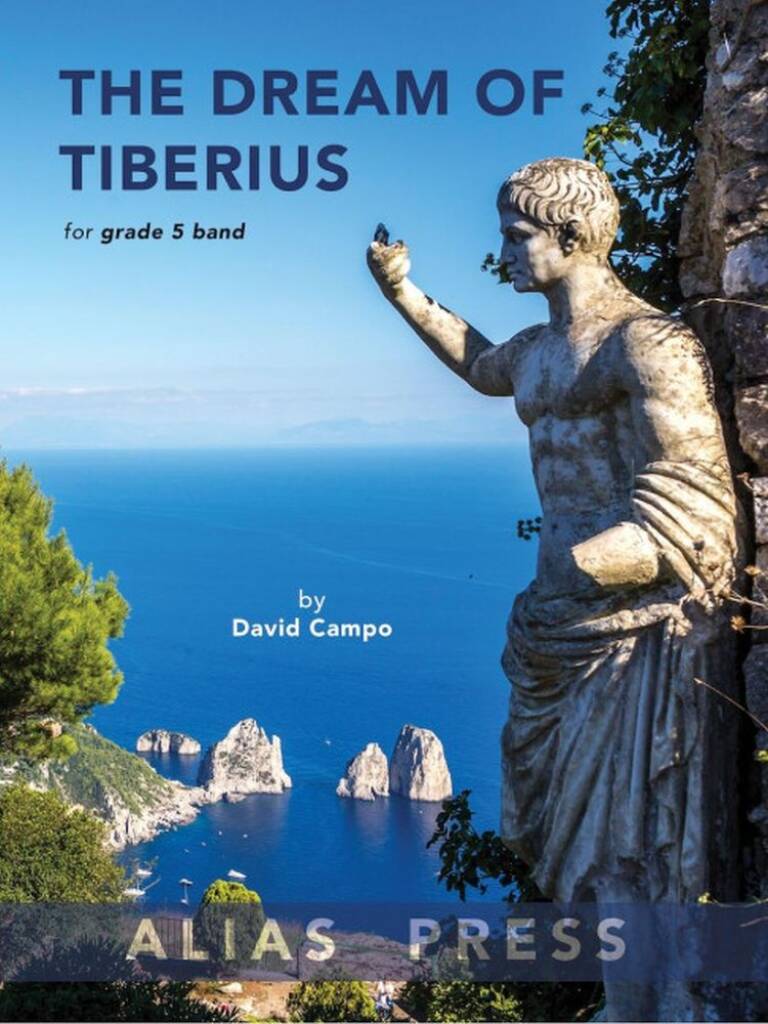
The Dream of Tiberius - David Campo
The Roman Emperor Tiberius was born in 42 BCE to Tiberius Claudius Nero and Livia Drusilla, both descendants of prestigious political families, at a time when Rome was undergoing significant political upheaval. Julius Caesar had begun a brutal civil war in 49 BCE to end Rome's rule as a Republic and consolidate his power as supreme ruler. Following Caeser's assassination in 44 BCE, Tiberius' father backed the forces wishing to return Rome to a Republic, but they were defeated by Caesarian loyalists led by Caeser's heir Octavian. As a result, Tiberius' early life was spent on the run and in political exile with his parents. In 27 BCE, Octavian would become the first Emporer of Rome and assume the name Augustus. Augustus forced Tiberius' parents to divorce and took Tiberius' mother as his new bride, separating the family and forcing Tiberius to live with his father. Upon his father's death, Tiberius went to live with his mother and Emporer Augustus, a situation Tiberius found extremely uncomfortable but one over which he had no control. Having been adopted by the Emperor, Tiberius assumed the military and political life thrust upon him. He proved to be an outstanding military and political leader, and with his marriage to Vipsania Agrippina his life took on a heretofore unknown stability. However, Augustus would intervene in Tiberius' life once more, forcing him to abandon his happy marriage and take Augustus' daughter Julia (Tiberius' step sister) as his new wife. This arrangement, while securing Tiberius' place as Augustus' heir and ensuring he would one day be Emperor of Rome, was disastrous. Julia's drunken licentiousness was a constant source of scandal and embarrassment for Tiberius (and her father, the Emperor) and she was eventually exiled by her father Augustus. Tiberius was named Emperor of Rome upon the death of Augustus in AD 14, assuming his position as the most powerful man on Earth. However, no matter how powerful he had become, Tiberius never felt as if he had ever had any control over his life, having been manipulated from childhood through adulthood by the whims of Augustus. As Emperor, he soon became disgusted with the political intrigue of the Roman Senate and by AD 26 left Rome and took up residence on the island of Capri, where he lived out the rest of his life. History does not regard Tiberius fondly and by all accounts towards the end of his reclusive life on Capri, he had become a miserable, sick and mentally unstable old man reveling in debauchery and cruelty. It is also informative to note that he was Emperor of Rome when Jesus of Nazareth was crucified, and while there is no indication that Tiberius was even aware of the existence of Jesus, as Emperor he was responsible for the appointment of Pontius Pilate as Governor of Judea. Even considering this, it is difficult to look on the life of the Emperor Tiberius and not feel some sympathy and pity. It's in this spirit that I composed "The Dream of Tiberius." I imagine the man sitting in thoughtful seclusion on the beautiful island of Capri imagining what his life might have happily been had not power been thrust upon him: husband, father and humble servant of the people.
Estimated dispatch 7-14 working days
-
 £149.99
Nemu-Susato - Jan Van der Roost
Commissioned by the Japan Band Clinic Committee of Yamaha for the Nemu Band Directors Clinic in Nemu no Sato, May 18-20, 1997.The surprising title of this work is an indication of its content. By combining the somewhat similar names 'Nemu no Sato' and 'Susato' into a new word, Jan Van der Roost has produced a significant and interesting subject. The Yamaha corporation has extensive facilities in Nemu no Sato, Japan, including a concert hall, recording studios, hotel and so on. Concerts, workshops, clinics and other events are held here, including the annual Nemu Band Directors Clinic, which consists of numerous musical events. Jan Van der Roost served as guest conductor andspeaker in 1994. He was invited again for the 1997 clinic, this time with a composition assignment. The difficulty level of his new piece was to be Grade 2 - 3 bands. With this in mind, Mr. Van der Roost strove to create a renaissance-like sound. Simultaneously he wished to create a tribute to Tielman Susato who, like Jan Van der Roost, lived and worked in Antwerp in the 16th century. The first performance of Nemu-Susato was conducted by the composer, performed by the Tokyo Metropolitan Police Band, and took place during the Nemu Band Directors Clinic on May 19, 1997.
Estimated dispatch 7-14 working days
-
 £71.50
Beethoven For Band - Ludwig van Beethoven
This work introduces the major themes from three of the most famous and popular symphonies ever written - Beethovens Symphony No. 5, Symphony No. 7 and Symphony No. 9 - which are readily recognizable and easily learned, serving as a good introduction to some of the great masterpieces of western civilization. (2 minutes 45 seconds)
Estimated dispatch 7-14 working days
-
 £407.00
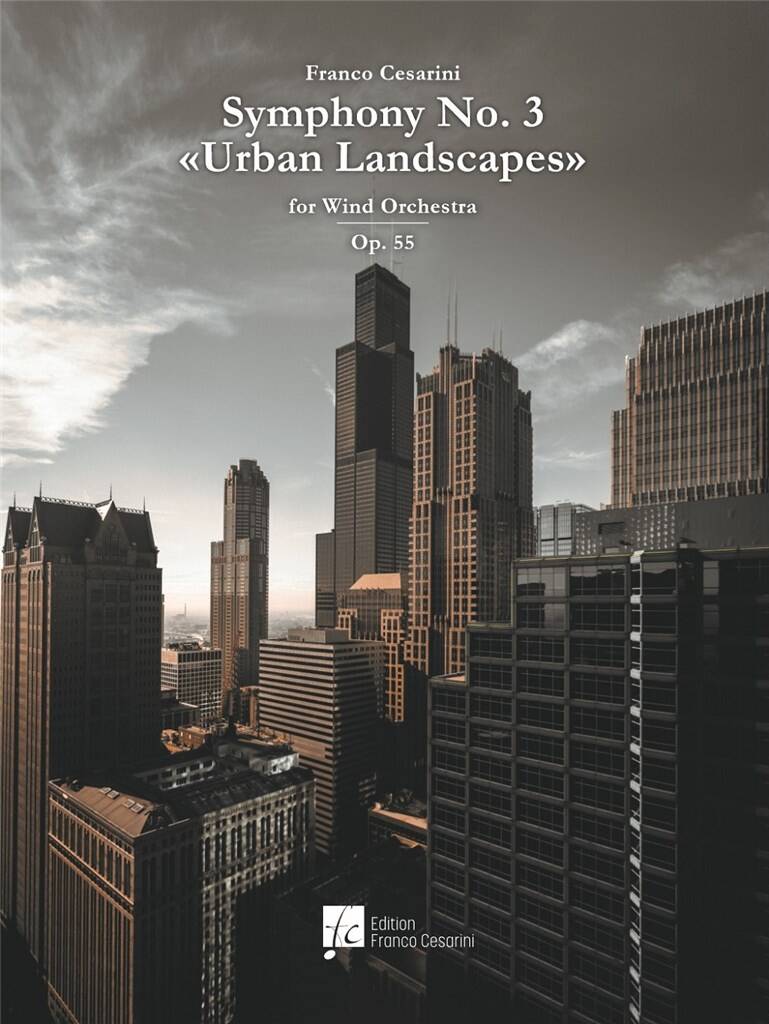
Symphony Nr. 3 Urban Landscapes Op. 55 - Franco Cesarini
Fascinated by the beauty of Chicago, Franco Cesarini has translated his emotions into music: this is how Symphony No. 3 "Urban Landscapes" Op. 55, was born, a musical portrait of this metropolis overlooking Lake Michigan. The composition is divided into three movements: The Wrigley Building from Dawn to Noon, Blue Silhouette and Cloud Gates, which by sharing the same thematic material arranged in cyclical form, strengthen the overall cohesion of the piece. The first movement, preceded by a short slow introduction in which the main theme is presented in an almost dreamlike form, metaphorically represents the city at dawn. The sudden change of time symbolizes the start of activities with all its noises and sounds: you can hear the bell that announces the closing of the subway doors, the sound of cars speeding by, the siren of a patrol car. If the first movement represents the day, the second introduces a nocturnal environment: a melancholic melody played by the English horn anticipates a more animated tempo depicting melodies coming from jazz clubs. Powerful fanfares that take up the second theme of the first movement introduce the third movement. In this finale, the role of the two themes is reversed compared to the first movement and one takes the place of the other in a kind of games of mirrors. Symphony No. 3 "Urban Landscapes" Op. 55: a sumptuous musical portrait of the "Windy City".
Estimated dispatch 7-14 working days
-
 £113.30
Moderate Dances - Angelo Sormani
This piece is a tribute to dance music, especially passionate, intense and meditative dance music. "Moderate Dances" is divided into three movements: a "Tango", a "Slow Waltz" and a "Bossa Nova". Each movement and each dance has its own particular characteristics but, when combined, these different rhythmic beats and times give the piece a feeling of completeness and uniformity. The Tango started to flourish in the suburbs of Buenos Aires in around 1880. There is still some doubt as to its origins, which may be Cuban (Habanera) but are probably African. It was most popular in Argentina and Brazil: here the male protagonist was originally the "gaucho" with his inseparable guitar, later to be replaced by the proud, elegant "compadre". By around 1910 the Tango had spread to Italy and France. New clubs opened, where the upper classes could watch and dance the Tango. Here the dance also underwent some rapid transformations. The exaggerated and extravagant gestures and body movements disappeared. Slow, gliding steps replaced the old rotational movements. The women's red ankle-boots and the partners "staring into each other's eyes" accentuated the erotic nature and sensuality of this dance. So much so that, in 1913, the German government banned soldiers from dancing the Tango. Those who broke the law were immediately discharged from the army. From a strictly musical perspective, the basic instruments were a flute, a harp (the diatonic harp typically played by the Indians of Paraguay) and a violin, or flute, guitar and violin or even clarinet, guitar and violin. These instruments were easy to transport, ideal for playing at parties, in the streets and in courtyards. The musicians played by ear, frequently improvising: there were no scores, no records, which is the main reason why it is impossible to trace the Tango back to its exact origins. However, the Tango's evolution (and growing popularity) was once again fostered by its fundamental ability to absorb "other" cultures, languages and sounds. And it was the arrival of the "bandoneon" (an accordion-like instrument that was invented in Germany and brought to Rio de la Plata by some immigrant), which replaced the flute, that marked the beginning of the Tango's huge success outside Argentina. A number of talented composers, above all the great Astor Piazzola (1921-1992), transformed the bandoneon from a simple accompanying instrument to a solo instrument that was to become the distinguishing feature of the 20th century Tango. The Slow Waltz originated from the Waltz, the typical dance of the Bavarian and Tyrolese peasants in the 1700s. It was composers like Johann Strauss, father and son, who carried the Waltz to its zenith in the 1800s, creating the sensual and melancholy yet joyful and charming dance we are all familiar with. When the Waltz first became popular in Germany, the members of respectable society were shocked at the closeness of the dancing partners, who had always previously danced apart. The main difference between the Waltz and Slow Waltz is that the latter has a slower, more expressive rhythm: the men wear tails and the women wear ball gowns decorated with beads and feathers and couples dance in graceful rotational movements. "Bossa Nova" is the title of the last movement in the piece. Jobim, the great Brazilian musician, described this musical genre as a combination of modern Jazz and Samba. Bossa Nova means "new wave". This was the name of the artistic and musical movement that evolved in Brazil in the late Fifties and was extremely popular throughout the Sixties. The songs are usually about love or social matters, drawing inspiration from the slums of Rio De Janeiro and the lives of their inhabitants. Bossa Nova, with its original compositions and the artistic talent of its musicians, also became hugely popular in the United States and Europe, and top Jazz musicians (Ella Fitzgerald, Stan Getz, Bob Cooper, Charlie Bird, Sonny Rollins, Dexter Gordon, Dizzy Gillespie) started to include Bossa in their repertoires.
Estimated dispatch 7-14 working days
-
 £113.30
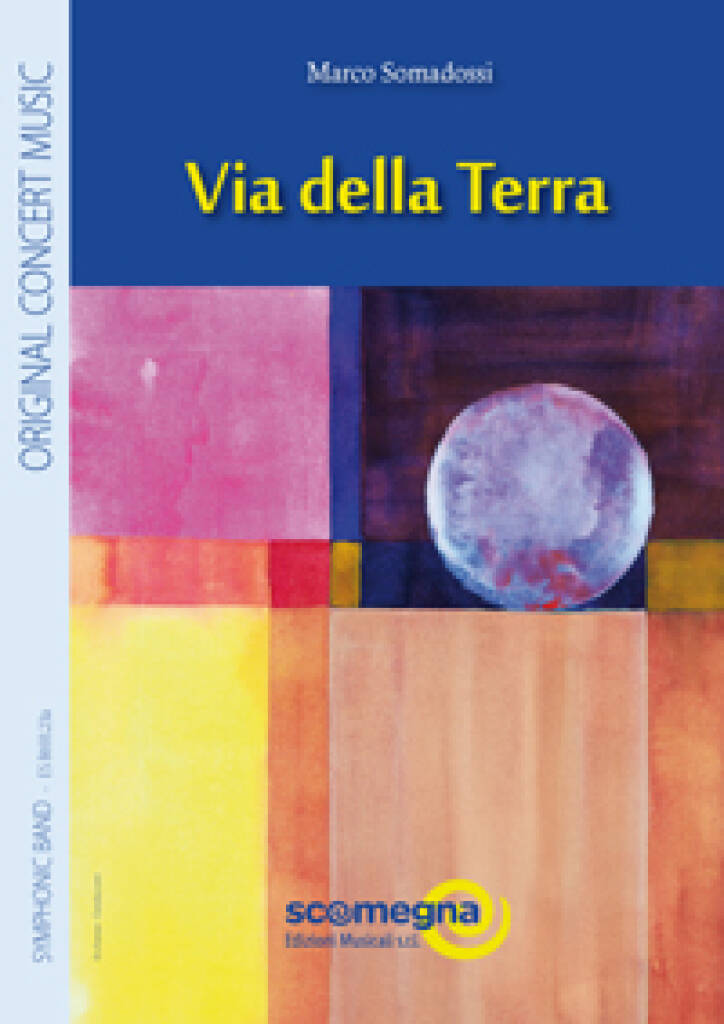
Via Della Terra - Marco Somadossi
Composing music also involves being able to imagine the sound of something that has no sound of its own. "Via della Terra" is a soundtrack without a film, a story without a narrator; "Via della Terra" is a street in a town, but not just any street, because if a street could tell its story, "Via della Terra" would not know where to start or where and indeed if it should finish. Like all "Vie della Terra", this street in this piece is full of sounds, none of which, however, have ever belonged to it for more than a fleeting moment, just long enough to be reflected here and there and then up and away from the earth, to be lost in the air. The steps of Mozart as a child as he whistled a piece of music, never again to be remembered or written; the philosophical thoughts, or mere everyday cares, uttered to a friend by Rosmini (whispered? or declaimed?); the excited or humorous comments of people who saw Depero's futuristic works for the first time; the voices of marketstall owners, rendered louder and more acute by the noisy crowd of women sorting through the stalls of rustling and colourful silk (so many desires; silent pauses between one item of gossip and the next); the absolute and devastating roar of cannons that violated every corner of the town, injuring bodies and mutilating the memories of its inhabitants... followed by a seeming eternity, as the citizens held their breath, waiting... "Via della Terra" is the old imperial road along which the town of Rovereto was built and has developed. "Via della Terra" is music for an imaginary, impossible and simultaneous representation of all its stories. The composer has always lived in this town, which he dearly loves, and on innumerable occasions he has imagined the voices, smells, people and the lives that have been such a part of it. With his composition, "Via della Terra", Marco Somadossi won second prize (no first prize was awarded) at the XXI Corciano International Competition for original band music in the grade 4 category.
Estimated dispatch 7-14 working days
-
 £104.99
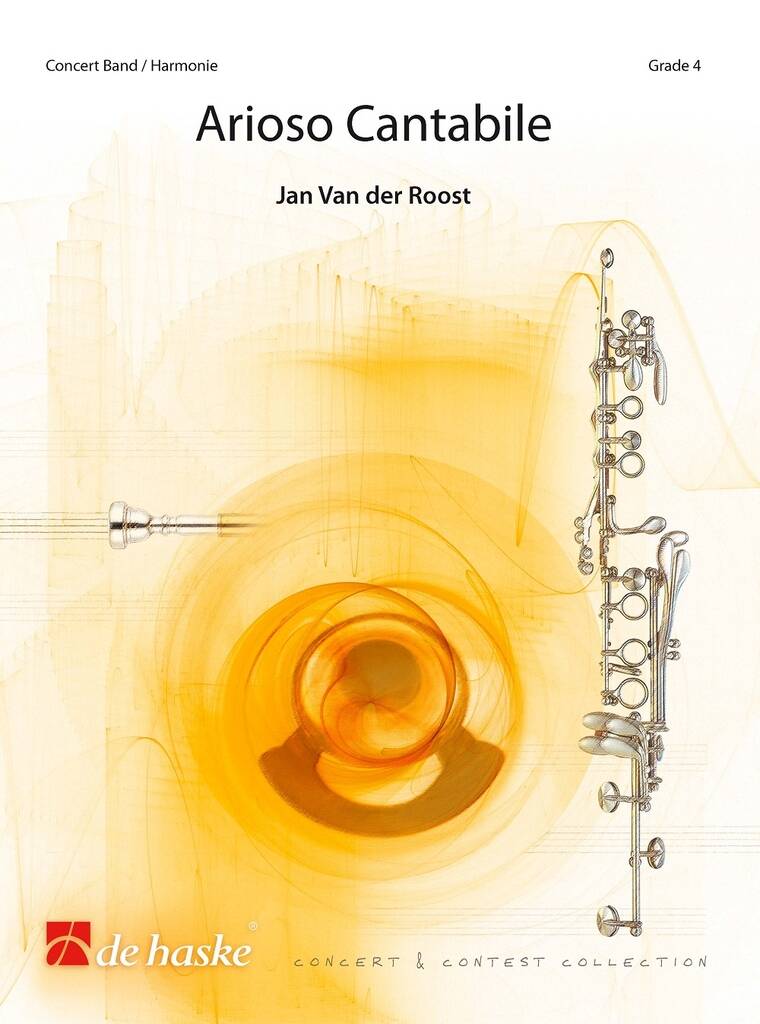
Arioso Cantabile - Jan Van der Roost
This composition exudes serenity and tranquillity, but also intensity and expressiveness - giving it similar qualities to earlier works by Van der Roost, like Canterbury Chorale and Adagio for Winds. Long melodic lines characterize the main themes that arise in different registers and develop through varying keys. The band rather sounds like an organ: the varying timbres and broad musical phrases fully justify the comparison with this majestic instrument. There is no bombast, and the work contains no exaggerated technical or rhythmic tours de force. On the contrary, from a lush richness it moves towards a softening final passage that culminates in a slowly fading final chord: following the many warm harmonies and grand melodies, this work concludes in a contemplative mood.
Estimated dispatch 7-14 working days
 View Music