
Results
-
 £123.20
3 Letzte Motetten - Anton Bruckner
Anton Bruckner (b. 4.9.1824, Ansfelden, d. 11.10.1896, Vienna) didn't have it easy. Throughout his life, the Austrian composer was plagued by self-doubt. Anton Bruckner came from a simple, rural background. After the death of his father, he was accepted as a choirboy at the monastery of Sankt Florian in 1837. After several years as a school assistant and his own organ and piano studies, he first worked as organist in St. Florian, then from 1855 as cathedral organist in Linz. Introduced to music theory and instrumentation by Simon Sechter and Otto Kitzler, he discovered Richard Wagner as an artistic role model, whom he admired throughout his life and also visited several times in Bayreuth.In 1868 Anton Bruckner became professor of basso continuo, counterpoint and organ at the Vienna Conservatory; ten years later court organist; and in 1891 finally honorary doctor of the University of Vienna. He was considered an important organ virtuoso of his era, but had to wait a long time for recognition as a composer. It was not until Symphony No.7 in E major, composed between 1881 and 1883, with the famous Adagio written under the effects of Wagner's death, that he achieved the recognition he had hoped for, even if he was reluctant to accept it given his inclination towards scepticism and self-criticism.Anton Bruckner was a loner who did not want to follow a particular school or doctrine. He composed numerous sacred vocal works, such as his three masses, the Missa Solemnis in B flat minor (1854), the Te Deum (1881-84) and numerous motets. As a symphonic composer, he wrote a total of nine symphonies and many symphonic studies from 1863 onwards, tending to revise completed versions several times over. Bruckner's orchestral works were long considered unplayable, but in fact were merely exceptionally bold for the tonal language of their time, uniting traditions from Beethoven through Wagner to folk music, on the threshold between late Romanticism and Modernism.Anton Bruckner composed about 40 motets during his lifetime, the earliest a setting of Pange lingua around 1835, and the last, Vexilla regis, in 1892.Thomas Doss has compiled some of these motets in this volume for symphonic wind orchestra.These motets show many characteristics of personal expression, especially Bruckner's colourful harmony in the earlier works, which is in places aligned with Franz Schubert (changes between major and minor; and movements in thirds). Later works are characterised by many components which, in addition to the expanded stature of the movements, include above all a sense of the instrumentation as an outward phenomenon and the harmony as a compositional feature that works more internally. Some aspects of Bruckner's work are the result of his long period of study, which familiarised him not only with the tradition of his craft, but also gave him insights into the "modernity" of his time in such composers as Wagner, Liszt and Berlioz.From this developed his personal standpoint, which always pursues the connection between the old and the new.
Estimated dispatch 7-14 working days
-
 £149.40
Storsltt - Øystein Olsen Vadsten
"Storsltt" or in English "Grand Nordic Tune" is one of many original pieces written by composer ystein Olsen Vadsten. "Sltt" is a general term for music played to traditional Norwegian dances."Grand Nordic Tune" was a commissioned work for the Rlingen Musikklag's 70-year anniversary concert in 2022, where the piece was premiered. They wanted something a little pompous, and preferably something in the style of Nordic folk music, which the composer is known for. The title in Norwegian then was obvious, "Storsltt", which in Norwegian has a double meaning, both a big tune and, in a double meaning, pompous or magnificent.As usual, the starting point is a traditional Nordic dance form, and this time the choice fell on the distinctive Swedish "polska", which is played in . The dance, despite its name, reportedly has no connection to Poland, but is entirely of Scandinavian origin. It has been danced for centuries, and has also been called the devil's dance, because it had a hypnotizing effect on people, so that they could not stop, but danced themselves to death. Hence people thought that it must have been the devil who caused it.Traditionally, there is a lot of repetition in this type of music, which contributes to this hypnotic effect.
Estimated dispatch 7-14 working days
-
 £256.00
14 Motetten - Anton Bruckner
Anton Bruckner (b. 4.9.1824, Ansfelden, d. 11.10.1896, Vienna) didn't have it easy. Throughout his life, the Austrian composer was plagued by self-doubt. Anton Bruckner came from a simple, rural background. After the death of his father, he was accepted as a choirboy at the monastery of Sankt Florian in 1837. After several years as a school assistant and his own organ and piano studies, he first worked as organist in St. Florian, then from 1855 as cathedral organist in Linz. Introduced to music theory and instrumentation by Simon Sechter and Otto Kitzler, he discovered Richard Wagner as an artistic role model, whom he admired throughout his life and also visited several times in Bayreuth.In 1868 Anton Bruckner became professor of basso continuo, counterpoint and organ at the Vienna Conservatory; ten years later court organist; and in 1891 finally honorary doctor of the University of Vienna. He was considered an important organ virtuoso of his era, but had to wait a long time for recognition as a composer. It was not until Symphony No.7 in E major, composed between 1881 and 1883, with the famous Adagio written under the effects of Wagner's death, that he achieved the recognition he had hoped for, even if he was reluctant to accept it given his inclination towards scepticism and self-criticism.Anton Bruckner was a loner who did not want to follow a particular school or doctrine. He composed numerous sacred vocal works, such as his three masses, the Missa Solemnis in B flat minor (1854), the Te Deum (1881-84) and numerous motets. As a symphonic composer, he wrote a total of nine symphonies and many symphonic studies from 1863 onwards, tending to revise completed versions several times over. Bruckner's orchestral works were long considered unplayable, but in fact were merely exceptionally bold for the tonal language of their time, uniting traditions from Beethoven through Wagner to folk music, on the threshold between late Romanticism and Modernism.Anton Bruckner composed about 40 motets during his lifetime, the earliest a setting of Pange lingua around 1835, and the last, Vexilla regis, in 1892.Thomas Doss has compiled some of these motets in this volume for symphonic wind orchestra.These motets show many characteristics of personal expression, especially Bruckner's colourful harmony in the earlier works, which is in places aligned with Franz Schubert (changes between major and minor; and movements in thirds). Later works are characterised by many components which, in addition to the expanded stature of the movements, include above all a sense of the instrumentation as an outward phenomenon and the harmony as a compositional feature that works more internally. Some aspects of Bruckner's work are the result of his long period of study, which familiarised him not only with the tradition of his craft, but also gave him insights into the "modernity" of his time in such composers as Wagner, Liszt and Berlioz.From this developed his personal standpoint, which always pursues the connection between the old and the new.
Estimated dispatch 7-14 working days
-
 £79.99
Commemoration - James Barnes
Commemoration was commissioned by the members of the Northwest North Carolina Bandmasters Association to recognize the distinguished career of Dr. William A. Gora, the longtime Director of Bands at Appalachian State University, who passed away in 2015. Bill was loved by his students, respected by his peers and cherised by his many friends. A brilliant musician, a fine conductor and a warm human being with a marvelous sense of humor, Bill has been sorely missed by all. Gora was friends with composer James Barnes for over 40 years. They met when Barnes was still in graduate school at Kansas and Gora had just finished his DMA at the University of Florida. When the NNCBDA asked Barnes to compose a work in Bill's honor, he was honored to do so. He decided to write a cheerful work for Bill, full of energy, color and melody, because he knew this is what he would have wanted; no funeral dirges for Bill Gora. The soft middle portion of the work, a hymn-like tune scored in saxophone choir, was included because Bill was a fine saxophonist and, for many years, the saxophone teacher at ASU.
Estimated dispatch 7-14 working days
-
£149.99
Jello, The Colours Of My Soul - Ben Haemhouts
Jello...The Colours of my Soul is an assignment that was written to be a lasting memory of the untimely, dramatic death of a young child. The work came about due to various conversations between the father and the composer whereby the final resultmust be seen as an attempt by the composer to musically translate the feelings of the parents.The first part of the title, "Jello", is a combination of the names of the two children of the commissioner, namely Jelle and Lobcke, and "the Colours of mySoul" are the colours of the soul of the parents who despite the loss of one of their children, continue to cherish their two children. The introduction provides the atmosphere of grieving for the loss, whereby use is made of pure fifths in order toportray the solidarity with nature, as we are familiar with in symphonies by Bruckner. A little later a bit of the first theme is suggested, which develops into a real funeral march.The Dies Irae, as this occurs in Berlioz's Fantastic Symphony (F, E,F, D, E, C, D), forms a leitmotiv through the entire work in order to symbolise the constant battle between life and death.Shortly before the storm-passage, (where a wind machine is used) which announces disaster, fragments from children's songs areplayed to the accompaniment of a rising choir piece from behind the stage, which strengthens the imminent confrontation with death.After the introduction of the two themes in the long introduction, a quick passage follows in which all kinds ofbeautiful memories are recalled. There is story telling, laughing, and dancing. One of the previous children's songs is also cited. The Dies Irea is heard once again, this time short and fast.Bit by bit happy elements are steadily distorted untilseriousness breaks through again, like an unavoidable and unstoppable evil. The entire piece becomes evermore stirring, as if a big climax will follow. At this moment a very long fermata makes a sudden end to the hysterical allegro. The crucialmoment in the work follows...How does one deal with something as tragic as the death of one's own child? Does one mourn for what no longer is and what never will be? Or does one try to cherish the beautiful moments and continue to live with thesecolourful memories?A subdued, dignified choir piece captures the beautiful memories and ends in a positive, hopeful tone.
Estimated dispatch 7-14 working days
-
 £332.99
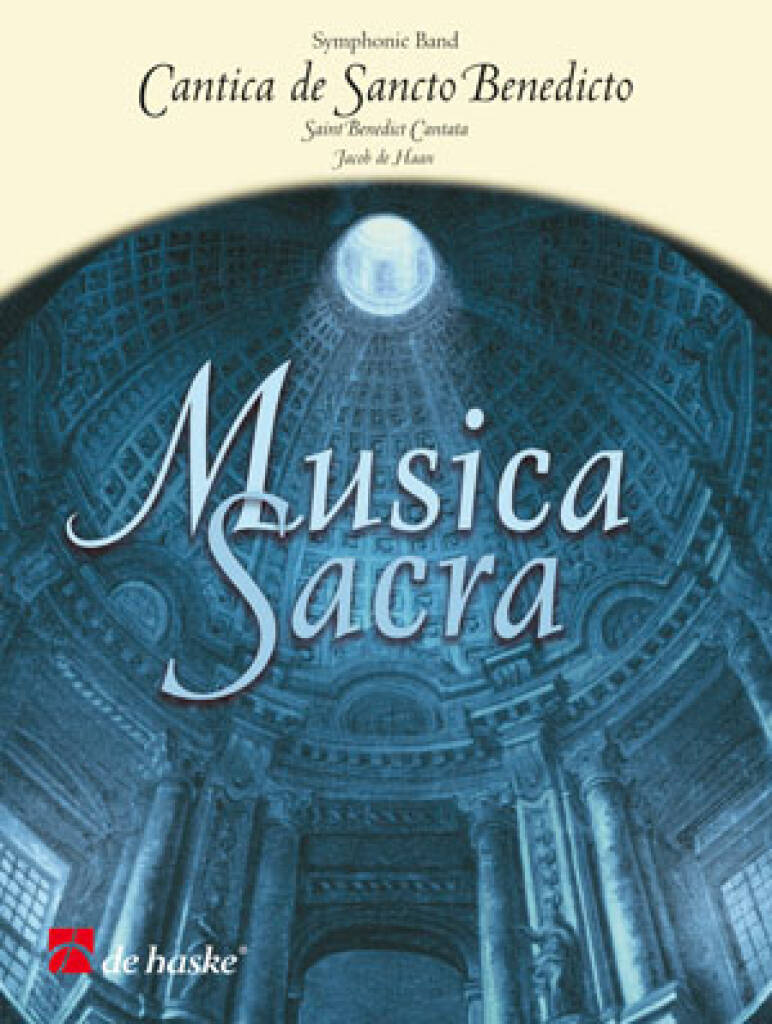
Cantica de Sancto Benedicto - Jacob de Haan
Cantica de Sancto Benedicto is a three-movement work for mixed choir, soprano solo, concert band and organ ad libitum - on Latin lyrics that relate to the life of Saint Benedict. It was commissioned by the city of Norcia in Italy, whereBenedict was born. The holy Benedict (480-547) is considered the founder of monastic life within the Roman Catholic Church. His enormous influence is especially owing to his monastic rule, the Regula Benedicti.Jacob de Haan has named the movements ofCantica de Sancto Benedicto after the Holy Trinity: the Father (Gloria Patri), the Son (Gloria Filio) and the Holy Spirit (Gloria Spiritui Sancto). The lyrics of thehymn Gemma Caelestis, (which, like the othertexts, were originally used in Gregorian chant) are voiced by the choir. To this purpose, Jacob de Haan composed new, choral-like, homophone music. The sequence Laeta Quies is rendered by the soprano; the verses (divided over the threemovements) are alternated with those of Gemma Caelestis. The work closes with an impressive grand finale, in which texts are used from the proprium of the mass in honor of the saint's day of the holy Benedict (11 July). Notes to the conductor:For this cantata, there are various possibilities for the performance. The first involves a performance in which the choir and soprano parts are only accompanied by organ. Such a performance has several advantages: since the band never soundstogether with the choir and the soprano, no balance problems occur, and even a performance with a large concert band and a small cantata choir is conceivable. A special layout is also possible - with which you can set up a three-dimensionalperformance in a church. For example, the choir can sing in the chancel, accompanied by the choir organ; the soprano can stand on the gallery, accompanied by the main organ; and the band can be seated in another part of the church. The choir couldalso sing from a gallery. With layouts like this, working with two conductors is advisable. Choral parts available separately.
Estimated dispatch 7-14 working days
-
 £137.99
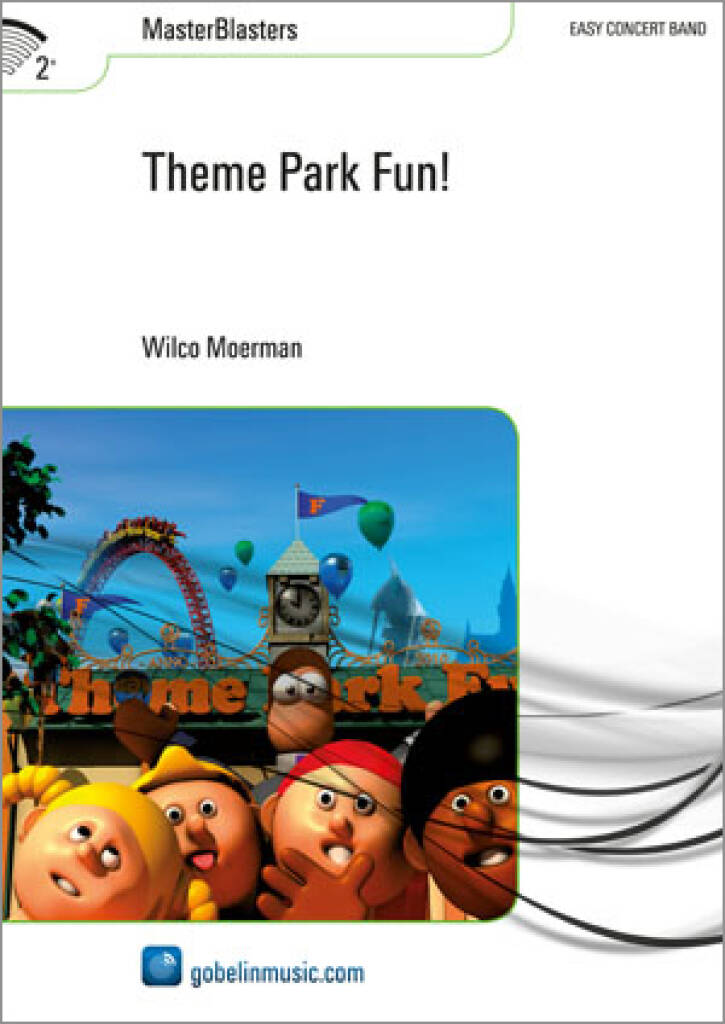
Theme Park Fun! - Wilco Moerman
In Theme Park Fun! your orchestra pays a visit to an amusement park. During your visit, you will experience some spectacular rides and attractions this theme park offers. The uniqueness of Theme Park Fun! is the interplay between music and(moving) images. Animations and illustrations support the visual composition.Part 1: The Entrance & Parade [with animation]The opening of the park is a fact. A day full of fun and pleasure awaits! You and the other visitors willbe confronted with all the rides, attractions and adventures the theme park has to offer. Which ride shall we do first?! There is so much to do and experience on this day in the park! A parade of colorful floats and park figures is passing by.Letthe fun begin!Part 2: The Haunted House [with animation]The only ride in the park that is not related to fun, is the Haunted House. Here visitors will be challenged to visit a house full of ghosts, creepy figures and otherominous things. The clock strikes twelve, there is no turning back. Ghosts are whispering, yelling, screaming... Fortunately it is almost one oclock, so we can leave this creepy place quickly.Part 3: The Swinging Galleon [withillustrations]What a huge pirate ship! Each time you swing back and forth, you will feel that weird feeling in your stomach. When you are thrown completely into the top you will have a fantastic view over the park, but you can not enjoy itfor long. Before you know the ship swings back the other way.Part 4: The Fairy Tale Ride [with illustrations]After all those exciting and spectacular rides and attractions, it is time for a peaceful tour in The Fairy Tale Ride.Surrounded by a fairytale setting, you will discover fable figures, talking animals and colorful designs. Such a beauty and tranquility. Having had this experience, we are ready again for the big rides in the park!Part 5: The Bumper Cars[with illustrations]Now its time to crawl behind the wheel of the Bumper Cars! Shall we all chase the conductor?! Before you know you are hit by another visitor or you will bump against someone else. In this tough ride you can prove yourselfas a real driver, or perhaps as a really bad one.Part 6: The Roller Coaster [with illustrations]The largest, fastest and scariest ride in the park ... we should definitely do the Roller Coaster! All together in the train, theover-the-shoulder restraints are lowering... be ready to ride. The train leaves the station and is heading for the big lift hill. It will be very scary when the train reaches the top and the train will be plunged down the first drop! Loops,corkscrews and other spectacular coaster elements will follow... Before you know it, the ride of your life is over. Shall we ride it again?!Part 7: Leaving the Park [with animation]Unfortunately everything comes to an end. Thisday in the theme park is over, but we have a lot new experiences to talk about! The memories of all the funny and spectacular rides will come up when we walk through the park to the exit. Just one look over the shoulder, the amusement park figuresare waving at us. Hopefully we will come back again soon!
Estimated dispatch 7-14 working days
-
 £159.60
Sculptures Of An Exhibition - Kees Vlak
This composition was commissioned by the village of Midden-Beemster to commemorate the 375th anniversary of the polder of the same name. It was premiered in august 1987 by the Beemster Fanfare Band. On this occasion some twenty sculptors were invited to create a work of art. Those sculptures were set up at the most picturesque areas of the polder. On a 40 km long bicycle route one can admire the curious statues wile enjoying the beautiful scenery as well. The compostition is based on two themes: a main theme and the promenade theme.1.Introduction: After the grandiose presentation of the main theme, on the dominant, we leave the village to the sound of some pretty music.2.Promenade and Watchman: After some time, we discover a dark statue hidden in the bushes; it is shaped like a square standing on one of its corners. It is called "Watchman". We hear the promenade theme as a solo and all next themes will be variations.3.A Building of Willow-trees: Far away on a dike, we discover the huge skeleton of a kind of house. It is a construction of skilfully interwoven willow-branches. The musical themes are also interwoven. The sculpture is called "Construction of wood used by the farmers".4."Die Flsse, ah die Flsse"and Promenade: We continue our trip and see now a horn of plenty, made of brown ceramics and set up on the green slope of an old fortress. The sun shines on the sheep being at pasture under the willow-trees. No doubt, this scene will have something to do with abundance.5.Cardplayers in front of the Nightingale: A statue in cast iron, representing two carplayers, has been erected in front of the windmill called "The Nightingale". This sculpture suggests a rather animate atmosphere. The opponents with the trumpets and the trombones suggest the cardgame. The trumpets are constantly changing from players. At a certain moment the trumpet gets hold of the decisive trick and starts a victorious blow. The trombone, however, repeats this shout of joy with quite some perverse delight and in a completely wrong pitch. The game continues and after a climax all cards are finally thrown on the table.6.Autumn and Promenade: The trip now brings us a white sculpture in ceramics, decorated with some autumn leaves. Is this a seated man or a chair? Anyway, it looks very nostalgic. This is the time for a moment of reflection with the oboe or the saxophone. It is called "Autumn".7. The Powerlifter: Somewhat hidden in a ditch, we discover a small statue in cast iron, representing a powerlifter who is going to give way under the weight. The music uses the main theme with powerlifting euphoniums, saxophones and clarinets.8.The Bull: Here we have another cast iron sculpture, but this time it is a really powerful figure. This "Bull" statue uses the same theme as that of the powerlifter, but it gets a stronger foundation from the bass insturments.9.Mirror and Promenade: While strolling alongside the channel we suddenly see four mirrors. They not only reflect themselves, but also mirror in the water of the channel. These reflections are suggested by the use of tuned percussion. The promenade theme is also used in mirror image.10.Reflictions or...?: On top of the dike we have a nice view on a farmyard with its orchard. A very big net, coverd with sparkling tin plates, has been stretched between the trees. This sculpture is called "Reflections of ...?. Of what? Yes, of course, reflections of the times when the polder was a lake and the sun was reflecting in the wild waves.11.Willpower: Finally we discover a big statue in cast iron. It is not clear whether it is a man or a woman. Anyway the enormous bundles of muscles in the legs and the thighs are striking. This sculpture is called "Willpower". The idea of determination is musically suggested by a very long preamble to the promenade theme in one great stringendo, leading to the conclusion of the trip.12.The beautiful country: Here we have the most beautiful picture. The magnificent Beemster Polder in bloom. We see a nice windmill with decorated wings. We hear the main theme, now on the tonic.
Estimated dispatch 7-14 working days
-
 £214.80
Skies - Oliver Waespi
Program notes by Oliver Waespi on his composition Skies:Skies is the plural of Sky. We may wonder are there several skies? Is the sky we all long for not the same for everybody? While travelling on foot and "in the open air" I have observed the firmament often in quite different shapes, so that I can say I have indeed experienced the sky in different ways. Years ago I already wanted to portray "my sky" in music; I finally have been able to realise this long-cherished dream.This composition deals with the sky, more precisely with my sensual and emotional experience of the sky in all its aspects. Two point of views are combined in this composition: one showing the sky as it presents itself to me, the other showing the sky as I observe it. The music was bom simultaneously by intemal and extemal inspiration: it describes nature but also the emotional and spiritual experience of nature. To me, the experience of nature is not abstract, but it is connected with concrete ages, places or people from my neighbourhood. This is why I have combined several parts of this composition with certain landscapes.The sky presents itself in different landscapes in the most varied ways: for the sensual experience, there is no sky as such. The indications of places spread all over the score, are primarily clues for myself; they represent certain atmospheres, which I have experienced especially in England and Scotland. They can however also be useful to the musicians and the audience, providing they know those landscapes and the celestial atmospheres linked to them.The music is independent from the atmospheres described in the subtitles, as those are rather connected to a tragic nature, and so the music is not based on any program. Musically spoken, the composition has a symphonic structure, which means that the complete musical material is derived from three contrasting main themes. In the first part, the description of a noctumal sky ("Night") two themes are developed in an organic way; the first, rather "dusky", is to be found with the horns, the second, "in bright daylight", with the oboe and flute, the third, "more quiet" , with the brass instruments. In the next part, we have clouds and rain over the Isle of Skye (one of the Hebrides islands in Scotland) and here several elements of the first theme are still more developed. Then we get an increasingly dark mood, which is released, in heavy chords. Then suddenly, the sun breaks through and the music gets a majestic character. We have a new shape of the initial theme, first with the French horns and then with the trombones. The music gets a quicker tempo and flows into a quick movement describing the winds and waves at sea ("Wind and Waves"). Three themes are gathering and some variations are developed. The music gets more and more energetic and, after a climax, calms down again. Then we have a kind of "summer pastoral" which suggests summer at the South coast of Cornwall ("South Coast of Penwith Peninsuia in Summer"). This is certainly not the hotte st summer in Europe, but still it is beautiful in this country that is blessed with so much rain. In the "pastoral" , the sea is already sketched in broad outlines in the French horn solo. The magnificence of an aftemoon at the seaside is developed at the end of the composition ("Noon at Treen Cliff', a rock protruding in the sea next to Porthcumo at the South Coast of Cornwall); here the music gets stronger and stronger and after a majestic climax it vanishes completely.
Estimated dispatch 7-14 working days
-
 £159.60
Sci-Fi Suite of Dances - Bernhard Bogisch
1. Harvest Dance - Phoeboia II Like many of the inhabited planets Phoebia II was first colonized by the survivors of a spaceship crash. There is no certainty as to where these survivors originated from. In the late 21st century many spaceship were launched manned by people who were looking for a new future, away from an over-populated Earth. Some succeeded, some managed to return, some were never heard of again. In 2311 a survey ship had to make an emergency landing on Phoebia II and they found a triving colony there. Although the early history of the colony is shrouded in antiquity, certain aspects of the language, as well as physical features, seem to point to a south-east European origin. The harvest dance, in the aspects of rhythm, melody and harmony has many things in common with the music of what once were the countries of Macedonia, Greece and Turkey, little of which has unfortunately, been left due to primitive recording methods of the period.2. Ritual Seduction Dance - Rugel VWhen first discovered Rugel V was already a very civilized planet populated by a humanoid race and governed by a class of superior females. The first settlers from Earth were held as slaves but gained freedom over the years. It is assumed that this happened because the Earth people were all male and considered very attractive by the native females in comparison with the aboriginal males. The Earth males were evidently very attractive to the native women, who on their part used all their womanly wiles to entice them. We all know that Rugel V is now a very advanced and totally integrated society. The people have not forgotten their roots, and these Ritual Seduction Dances are performed on a regular basis in commemoration of the original Grand Seduction. Musically speaking Romanian origin influenced by native characteristics is virtually certain.3. Attack Dance - Planet Khi't'onThis is the only dance in this suite that is purely native. The natives people know as Khi't'och are now very civilized, but initial contact was difficult due to the difference in physical make-up between the two peoples. Suffice it to say that in the early stages Earth people referred to the Khi't'och as 'mosquito people'. We still don't know very much about them, other then that they have a history of violence but are now quite peaceful although they love to relive their past in a stylised way, not unlike the Maories of the former New Zealand, whose fearsome tattoos were later only painted on. This Attack Dance is, at best, an imitation due to the lack native instruments, and it was a very happy occasion for this composer when, at a concert at the House of Culture on Khi't'on, the Khi't'och showed their appreciation by clicking their feeding tubes and emitting loud shouts.4. Wedding Dance and Prayer - Planet B'lGarThere is little doubt that the people of this planet originate in the former country of Bulgaria. Several examples of similar pieces featuring the quaint 11/8 time signature have been found in old archives and recordings. Russian influence is also noticeable in the prayer the style of which is reminiscent of that of the now extinct sect of Raskolniky.
Estimated dispatch 7-14 working days
 View Music