Results
-
 £84.00
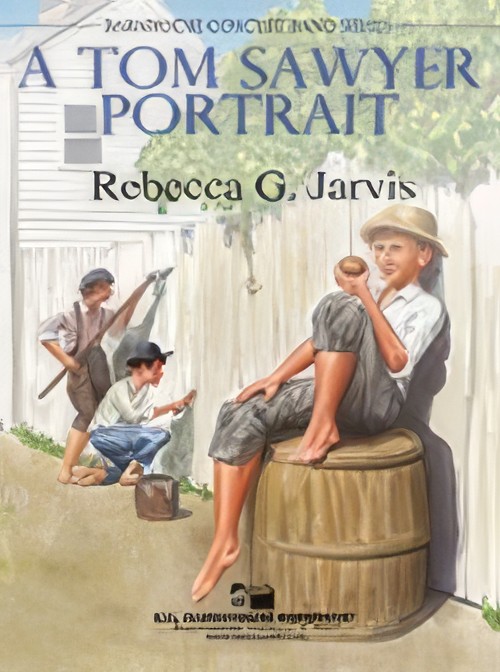
A Tom Sawyer Portrait (Concert Band - Score and Parts) - Jarvis, Rebecca G.
Mark Twain's colorful characters come to musical life in "A Tom Sawyer Portrait!" The journey begins in St. Petersburg, Missouri, with a jaunty musical portrayal of Tom and Huck and a ragtime sequence which depicts the sleepy river town. An Americana-style ballad follows that is tender, lyrical and poignant. This segues into a "no holds barred" blues section representing the mighty Mississippi. The Portrait concludes with our heroes' return, featuring a recap of the opening theme augmented in the brass and accompanied by woodwind runs and exciting percussion. This is a great selection for the concert band that demands solid musicianship but will reward students for their efforts! Duration: 8.15
Estimated dispatch 7-14 working days
-
 £52.00
A Hero's Return (Concert Band - Score and Parts) - Richard, Douglas A.
A Hero's Return was written for the West Point Middle School Band, located at the United States Military Academy, West Point, NY. The opening section conveys the celebratory atmosphere of when a hero comes home to friends and family. The middle section represents the quiet tribute we pay to the fond memories of heroes no longer in our midst. The return to the initial theme welcomes not only the hero returning today, but symbolises the hopes for the safe return of all our heroes who so bravely serve their nation.Duration: 4.00
Estimated dispatch 7-14 working days
-
£74.95
Sonata for Clarinet No.2 in Eb - Score and Parts - Johannes Brahms
This clarinet sonata was composed in 1894 for clarinetist Richard Mu?hlfeld. This was an interesting time in Brahms' life as he vowed he would retire from composing in 1890 but after he heard a performance of the Weber clarinet concerto No.1 and the Mozart clarinet quintet he so admired the soloist that he felt he should come out of retirement and compose 2 clarinet sonatas for him. These were completed in 1894 and first performed in a private concert in September of that year. These 2 sonatas were the last chamber pieces he composed before his death.
Estimated dispatch 7-14 working days
-
£14.95
Sonata for Clarinet No.2 in Eb - Score only - Johannes Brahms
This clarinet sonata was composed in 1894 for clarinetist Richard Mu?hlfeld. This was an interesting time in Brahms' life as he vowed he would retire from composing in 1890 but after he heard a performance of the Weber clarinet concerto No.1 and the Mozart clarinet quintet he so admired the soloist that he felt he should come out of retirement and compose 2 clarinet sonatas for him. These were completed in 1894 and first performed in a private concert in September of that year. These 2 sonatas were the last chamber pieces he composed before his death.
Estimated dispatch 7-14 working days
-
£75.00
A Festive Overture - Kenneth Hesketh
A Festive Overture is bravura in nature, with important solos for upper winds and trumpets. The outer sections are busy and colourful and frame a more expansive, but no less urgent, middle section which develops a large arching oboe and clarinet theme. The work ends as it began, with excitement and exuberance.
In stock: Estimated delivery 1-3 days
-
 £134.99
Slavonic Dances No. 7 & 8 Wind Band Set (Score & Parts)
In 1878, on a commission from his publisher, Anton?n Dvor?k wrote a series of eight Slavonic dances. Modelled on Johannes Brahms' famous Hungarian Dances, although in contrast to Brahms' work, Dvor?k used no original melodies. Wil van der Beek has arranged No. 7, a brisk 2/4 dance, as well as No. 8, a passionate, exuberant furiant in 3/4. 0:08:15
Estimated dispatch 7-14 working days
-
 £407.00
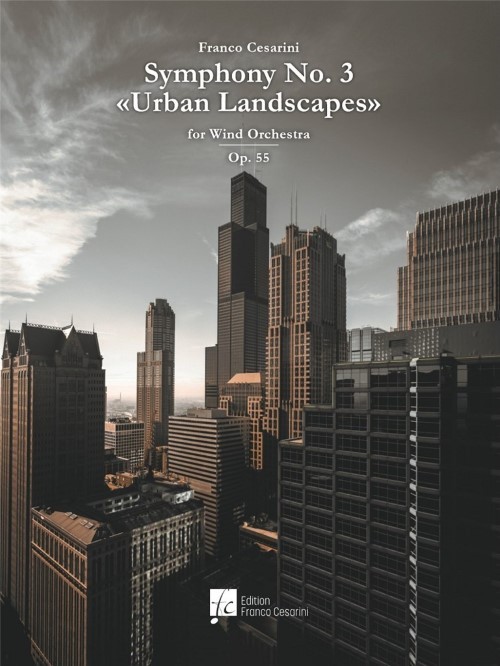
Symphony No.3 (Urban Landscapes) (Concert Band - Score and Parts) - Cesarini, Franco
Fascinated by the beauty of Chicago, Franco Cesarini has translated his emotions into music: this is how Symphony No. 3 "Urban Landscapes" Op. 55, was born, a musical portrait of this metropolis overlooking Lake Michigan. The composition is divided into three movements: The Wrigley Building from Dawn to Noon, Blue Silhouette and Cloud Gates, which by sharing the same thematic material arranged in cyclical form, strengthen the overall cohesion of the piece. The first movement, preceded by a short slow introduction in which the main theme is presented in an almost dreamlike form, metaphorically represents the city at dawn. The sudden change of time symbolizes the start of activities with all its noises and sounds: you can hear the bell that announces the closing of the subway doors, the sound of cars speeding by, the siren of a patrol car. If the first movement represents the day, the second introduces a nocturnal environment: a melancholic melody played by the English horn anticipates a more animated tempo depicting melodies coming from jazz clubs. Powerful fanfares that take up the second theme of the first movement introduce the third movement. In this finale, the role of the two themes is reversed compared to the first movement and one takes the place of the other in a kind of games of mirrors. Symphony No. 3 "Urban Landscapes" Op. 55: a sumptuous musical portrait of the "Windy City". Duration: 27.00
Estimated dispatch 7-14 working days
-
 £60.50
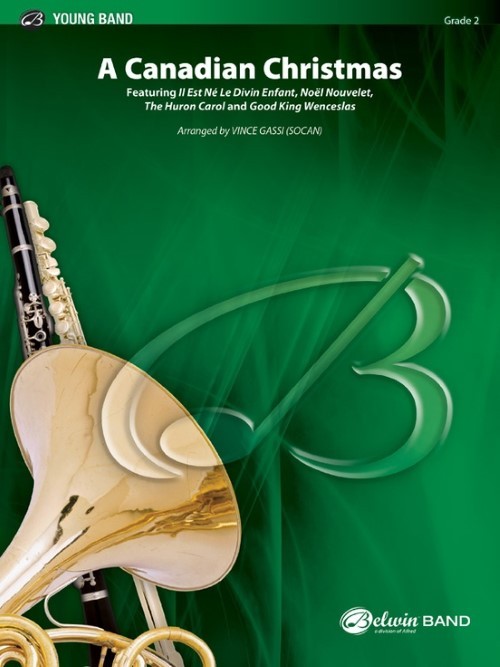
A Canadian Christmas (Concert Band - Score and Parts) - Gassi, Vince
Get ready for an abundance of merriment! This work features carols that have been traditionally sung in Canada for many years and will help to create a spirit of mirth in no time. It opens with the joyous strains of "Il Est N? Le Divin Enfant (He is Born, The Divine Child)" and continues with the plaintive and modal "No?l Nouvelet (Sing We Now of Christmas)." "The Huron Carol ('Twas In the Moon of Wintertime)" is then presented with remnants of "No?l Nouvelet" cleverly woven in. The dramatic conclusion develops brief dialogue between "Good King Wenceslas" and "Il Est N? Le Divin Enfant" that brings the work to an exuberant and powerful close. Juxtaposing the lyrical and expressive with the joyous and cheerful in this masterful arrangement will add a little touch of Canada to your next holiday concert. Duration: 4.00
Estimated dispatch 7-14 working days
-
 £94.00
Dance No. 2 (from Jazz Suite No.2) (Concert Band - Score and Parts) - Shostakovich, Dmitri - De Meij, Johan
In 1938 Shostakovich composed his Second Jazz Suite at the request of the recently founded State Orchestra for Jazz conducted by Victor Knushevitsky. This suite was originally scored for a complete symphony orchestra to which four saxophones, an accordion and a guitar had been added. The Jazz Suite no. 1 in three movements, composed in 1934, had been written for a smaller ensemble. The title 'Jazz Suite' is rather misleading, as the composer definitely uses the style of light music. Back in 1928, the twenty-two-year-old Shostakovich had already composed some light music. A bet among friends to make an orchestration of the popular song 'Tea for Two' in less then one hour time, caused him to compose 'Tahiti Trot'. Shostakovich easily won the bet as he completed the original and witty arrangement within only forty minutes!Duration: 3.45
Estimated dispatch 7-14 working days
-
 £98.00
Dance No.1 (from Jazz Suite No.2) (Concert Band - Score and Parts) - Shostakovich, Dmitri - De Meij, Johan
In 1938 Shostakovich composed his Second Jazz Suite at the request of the recently founded State Orchestra for Jazz conducted by Victor Knushevitsky. This suite was originally scored for a complete symphony orchestra to which four saxophones, an accordion and a guitar had been added. The Jazz Suite no. 1 in three movements, composed in 1934, had been written for a smaller ensemble. The title 'Jazz Suite' is rather misleading, as the composer definitely uses the style of light music. Back in 1928, the twenty-two-year-old Shostakovich had already composed some light music. A bet among friends to make an orchestration of the popular song 'Tea for Two' in less then one hour time, caused him to compose 'Tahiti Trot'. Shostakovich easily won the bet as he completed the original and witty arrangement within only forty minutes!Duration: 3.00
Estimated dispatch 7-14 working days
 View Music