
Results
-
 £2.85
Discovery Band Book No.2 (Flute) - Edmondson & McGinty
Contents:Concert Warm-Ups and Chorales No.2Acapulco HolidayAnchors AweighAtlantisThe Coventry CarolThe Duke of BedfordDr. DixielandIf I Were a Rich ManMickey Mouse MarchPep Rally RockSax-O-MaticSomewhere Out ThereThe Sound of MusicThree Carols for ChristmasTreasury of Carols
Estimated dispatch 7-14 working days
-
£15.99
Discovery Band Book No.2 (Conductor) - Edmondson & McGinty
Contents:Concert Warm-Ups and Chorales No.2Acapulco HolidayAnchors AweighAtlantisThe Coventry CarolThe Duke of BedfordDr. DixielandIf I Were a Rich ManMickey Mouse MarchPep Rally RockSax-O-MaticSomewhere Out ThereThe Sound of MusicThree Carols for ChristmasTreasury of Carols
Estimated dispatch 7-14 working days
-
 £12.95
SALAMANCA (Peninsula March No.1) (Programme Concert Band Extra Score) - Ellerby, Martin
Extra Score. The Peninsula marches were written for the Coldstream Guards Band in celebration of two great battles the regiment was involved in and fought in Spain in the early 19th Century. The battle of Salamanca, fought in 1812, was one of the duke of Wellington's most dramatic victories and this minor key march caputres the turmoil of such a momentous event. Also available Vitoria (Peninsular March No.1) Duration: 3:05 Grade 3
Estimated dispatch 7-14 working days
-
 £39.60
Symphony No.1 Theme (Concert Band - Score and Parts)
The Johannes Brahms Symphony No. 1 Theme is designed to give your best players an opportunity to play a solo with band accompaniment. This solo is the same one that appears on page 36, book 1 of The Yamaha Advantage for oboe, bassoon, alto clarinet, tenor saxophone and horn. This arrangement also includes solo parts for Flute, Clarinet and Alto Saxophone. This piece can also be performed by band alone.
Estimated dispatch 7-14 working days
-
 £99.95
Sinfonietta No.2 - A Sign of the Times (Concert Band - Score and Parts) - Wiffin, Rob
It was an interesting challenge to return to the form of a sinfonietta some twenty years after the last one. This work is not hugely problematic to play but was written without regard for technical demands, following a series of compositions that needed to take difficulty level into consideration. The work has five percussion parts but the tuned percussion, although desirable, can be omitted. As for the band parts, Oboe 2 is largely covered elsewhere but the colour of the cor anglais would be a definite enhancement to the overall sound. The work was written in 2025 when it seemed as if the world was a particularly volatile place.The first movement 'Foment' seeks to capture that menacing mood of unrest and the potential for violence that seemed to erupt without warning and without efforts to contain it from warmongers posing as peacemakers. The music is severe and focussed with just a short scherzo-like episode of levity to balance the quasi-military mood.'A Dream of Peace' takes a few moments to contemplate a different, more peaceful world and several ideas are considered before settling on the slow waltz-like melody. This uses a very tonal language but is given a particular hue by its use of sevenths and ninths and there are moments of stress which disrupt the tranquillity.In 'Call to Arms' the warlike mood returns with a sense of restless energy that drives the music to its conclusion.- Rob WiffinDuration: 14.00
Estimated dispatch 7-14 working days
-
 £191.30
Nepotism (Movement II from Symphony No.1, The Borgias) (Concert Band - Score and Parts) - Schwarz, Otto M.
A sinister legend hangs over the Borgia family, a legend of corruption, abuse of power, orgies, sex and murder. These rumours proliferated especially during the papacy of Alexander VI, a descendant of the family, who was even called the Antichrist. On his death, contemporary witnesses reported that the devil himself prowled around the death chamber and a black dog run along the corridors of the Vatican as his emissary. One might say that this Borgia pope, who ruled together with his family with the greatest brutality, became demonised. Unscrupulousness, poison-toting, incest and other malice are to this day the hallmarks of this pontiffNepotism: Rodrigo Borgia was elected Pope on 11 August 1492. From the very start, the new pope was prepared to use any means to eliminate his opponents, either through the infamous Borgia poison or by excommunication and execution. His son Cesare, who wanted little to do with the church, was appointed cardinal against his will. Alessandro Farnese, broth of Giulia Farnese, the Pope's mistress, also became a cardinal. Numerous Spaniards were brought into the country and were appointed to ecclesiastical posts. This infuriated the opponents of Alexander VI. The Dominican Girolamo Savonarola from Florence demanded the removal of the Pope. He was tortured and banned. Giuliano della Rovere wanted to convene councils to depose the Pope, which Alexander managed to prevent through artful political manoeuvrings. Through great brutality, brilliant political skill and power games, this pope was able to achieve his goal of leaving for his children a great legacy. Alexander VI constantly changed his allies and always acted unscrupulously to improve his financial situation and expand his sphere of influence. At the centre of the second movement of this work is the medieval hymn Dies Irae (Day of Wrath), which acts as a warning in the background condemning the Pope's actions.Duration: 9.15
Estimated dispatch 7-14 working days
-
 £191.30
Alexander VI (Movement I from Symphony No.1, The Borgias) (Concert Band - Score and Parts) - Schwarz, Otto M.
The Borgia family is the subject of a so-called black legend, a pejorative term that has been used since the Middle Ages to refer to Spain and Spaniards. The Borgias' black legend is one of corruption, abuse of power, orgies, sex and murder. These rumours spread especially during the reign of Pope Alexander VI, a member of the family. Alexander was even referred to as the Antichrist. According to eyewitnesses, when he died Satan prowled the death chamber and a black dog, an envoy of the Devil, ran up and down the aisles of the Vatican. The brutal rule of Pope Alexander and his family led to a kind of demonization of the Borgia family. But it is precisely the lack of scruples, the brewing of poisons, the incest and various cruelties that continue to hold a certain fascination for us.Alexander VI: Rodrigo Borgia was born in 1431 near Valencia. He studied law in Bologna and, through his uncle Pope Calixtus III, he rose through the church hierarchy. As vice-chancellor of the Holy Roman Catholic church, he became one of the richest men in Europe. As a cardinal he fathered four children who he later legitimised when he became pope. His election to the papacy was funded by the sale of offices, extortion and bribes of all kinds. Through an alliance with Ascanio Sforza he was elected pope on August 11 1492 and named himself from then on Alexander VI, an allusion to Alexander the Great.Duration: 9.30
Estimated dispatch 7-14 working days
-
 £77.00
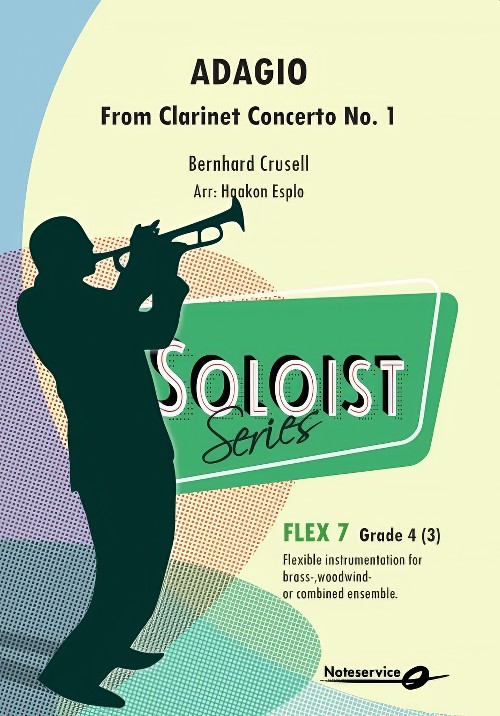
Adagio (from Clarinet Concerto No.1) (Clarinet Solo with Flexible Ensemble - Score and Parts) - Crusell, Bernhard - Esplo, Haakon
The Finnish-Swedish clarinetist and composer Bernhard Crusell (1775-1838) was born in Nystad in a poor family of bookbinders. He started studying clarinet in Stockholm at a young age and established himself as a clarinet soloist and was appointed director of the regimental band as a 16-year-old. The following year he became a solo clarinetist in the Royal Court Orchestra, which was conducted by his composition teacher Abb? Vogler. Crusell was offered positions as a musician in other orchestras in Europe, but King Gustav IV Adolf wanted to keep him in the Royal Orchestra and gave the job as chief conductor of the bodyguard regiment's band. Bernhard Crusell composed a lot of music for both orchestra, ensembles and singers. This beautiful adagio is from his first of a total of three clarinet concerts. Duration: 3.45
Estimated dispatch 7-14 working days
-
 £209.99
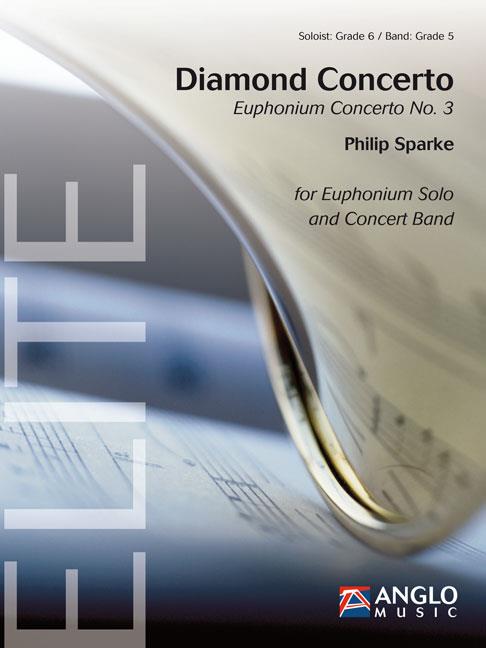
Diamond Concerto (Euphonium Concerto No.3) (Euphonium Solo with Concert Band - Score and Parts) - Sparke, Philip
Diamond Concerto was commissioned by Musikverein Morschied from Germany - Dr. Eric Grandjean, conductor - for a special concert featuring Steven Mead as guest soloist. Together they gave the world premiere on 28th April 2012 in the town theatre of Idar-Oberstein. The commission is a highlight in the 30-year friendship between composer and soloist, which has included many mutual CD projects and concerts and, now, a concerto. Sparke had Steven Mead's special euphonium sound in his head throughout the composition process and made free use of the variety of styles which the world-renowned virtuoso has made his own during his highly successful solo career.The village of Morschied lies to the west of Frankfurt am Main in the area known as the German Road of Precious Stones, which is famous for its thriving gem industry. Because of this it was decided to give the commission a local connection by choosing the title, Diamond Concerto. Each of the three movements is named after a famous diamond:Earth Star is rather stern in mood, opening with a free fantasy for the soloist over a static chord from the band. This leads to an Allegro Moderato in minor mode where small motives are gradually repeated and developed by both band and soloist.Ocean Dream uses a varied quote from the composer's Music for Battle Creek, including a melting slow melody that was originally written with Steven Mead in mind.Blue Heart was written, at Steven Mead's suggestion, in bebop style and takes the form of a jazz waltz. The quasi-improvisatory central section features a call-and-response passage for the soloist and upper woodwinds.Duration: 15:45
Estimated dispatch 7-14 working days
-
 £41.50
American Song Settings, No.2 (Skip to My Lou) (Concert Band - Score and Parts) - Kreines, Joseph
It opens with a short introduction utilising the opening notes of the melody, proceeding to its first full statement in the upper woodwinds. The second presentation features the trumpets and xylophone followed by a statement in the bass instruments while the melody "Long, Long Ago" appears in the upper voices. A contrasting legato section follows, succeeded by a more rhythmic statement in woodwinds and trumpets. The melody then appears in the alto saxophones with a contrasting idea in upper woodwinds. A marcato statement of the melody appears as a three-bar phrase with a staccato accompaniment. The final section utilises the style of the opening measures and is expanded to bring the work to a final climactic conclusion.Duration: 2.30
Estimated dispatch 7-14 working days
 View Music