
Results
-
 £154.99
Deux Mouvements (Alto Saxophone Solo with Concert Band - Score and Parts) - Waignein, Andre
Early in 1989 Jean Baily, director of the Royal Conservatoire in Bruxelles, asked his very close friend Andre Waignein to compose a piece which could be performed by the conservatoire's saxophone class. Andre Waignein was readily agreeable. Not only was his father a saxophone player, but himself felt strongly attracted to the instrument and he was further encouraged into accepting the commission by his friend Alain Crepin, saxophone teacher at the Bruxelles Conservatoire.The piece he composed consists of two movements, hence the title. An elegy is expressed by means of a melody which is full with pronounced magnanimity, full of spectacular musical freedom enabling the soloist to express himself to the full. In this movement the melodic element is of the utmost importance.The capriccio, the second movement is musically disconcerting. The band's accompaniment is particularly important. Due to the high notes, the soloist brings this capriccio to a close with enthusiastic virtuosity.Duration: 9:15
Estimated dispatch 7-14 working days
-
 £68.99
Requiem Aeternam - Giacomo Puccini
Giacomo Puccini was commissioned to write a second opera after the resounding success of his first, Le Villi. However, the original four-act, grand opera Edgar, to a libretto by Ferdinando Fontana, received a rather lukewarm reception at its premire in La Scala in Milan in 1889 - initially, the work was only performed three times. Of all the planned performances in the subsequent two years, only one took place, in Lucca, Puccini's birthplace. There, the work was well received. Nevertheless, the composer decided to make drastic changes to Edgar the most radical being the reduction of the opera to three acts, as well as altering a few arias, charactersand instrumental parts. In its revised form, the work was even less popular than before. The discarded fourth act later provided material for Tosca (the duet Amoro sol' per te), but Puccini never felt the need to defend Edgar - as he did other less fortunate operas, such as La Rondine and Suor Angelica. On a piano excerpt for his female friend Sybil Seligman he even corrupted the title to 'E Dio ti GuARda da quest' opera' (may God preserve you from this opera). This did not prevent Arturo Toscanini performing the Requiem from the third act at Puccini's funeral in Milan Cathedral on 3 December 1924. The Requiem in the third act is being played when the long funeral procession carries the alleged body of Edgar - the confusedyoung man hesitating between the love of the virtuous Fidelia and the exotic Tigrana. The mass hails Edgar as a hero, but a monk claims that he has betrayed his country for a few gold pieces. When the soldiers try to desecrate the body, they discover that the armor contains none. The monk reveals himself as Edgar. He wants to leave with his faithful Fidelia, but the vengeful Tigrana stabs him and kills Fidelia. Edgar grieves over the lifeless body of his beloved, while Tigrana is arrested and the people submerge into prayer.
Estimated dispatch 7-14 working days
-
 £164.95
Elgar Variations (Concert Band - Score and Parts) - Ellerby, Martin
The year 2007 marked the 150th anniversary of the birth of the British composer Sir Edward Elgar (1857-1934) and as such I thought it an appropriate moment to write something in tribute to this event. There are quite a few enigmas about this piece and they are all intentional! First and foremost is that the variations are not constructed on any of Elgar's actual themes. Rather I have written a sequence of contrasting sections (all played without a break) on the essence and character of his musical style. I have also written this work with bands, the soloists within, conductors and, not least, their audience firmly in mind. The language is essentially tonal and the test musical rather than overtly technical. There are no tempo indications other than suggested metronome marks. I have deliberately kept things to a minimum as the true test here is to find the style and interpret that aspect over the whole structure. Whereas the faster sections are more or less self explanatory the slower parts require deliberate rubato and much feeling. This is for the conductors to discover and I encourage them to do so. Adjudicators should be fully aware that I sanction this aspect but it requires an insight and understanding to successfully execute so 'any old thing' will not suffice! The 'variation' commencing at rehearsal letter P is the emotional core of the piece and requires a passionate but not saccharine approach to pacing and sensuality. The cadenza type material is built into the process rather than being a separate sequence of entities. There are many allusions to the music of Elgar here without recourse to blatant pastiche - if it is thought of as a series of songs and dances this may help. The final comment is the dedication, after one of Elgar's own but subtly adjusted: to my friend pictured within - never to be revealed - now there's an enigma!- Martin EllerbyDuration: 14.00Recorded on Polyphonic QPRM155D Scenes from Childhood (Great British Music for Wind Band Vol.15), Royal Northern College of Music Wind Orchestra
Estimated dispatch 7-14 working days
-
 £32.95
Elgar Variations (Concert Band - Score only) - Ellerby, Martin
The year 2007 marked the 150th anniversary of the birth of the British composer Sir Edward Elgar (1857-1934) and as such I thought it an appropriate moment to write something in tribute to this event. There are quite a few enigmas about this piece and they are all intentional! First and foremost is that the variations are not constructed on any of Elgar's actual themes. Rather I have written a sequence of contrasting sections (all played without a break) on the essence and character of his musical style. I have also written this work with bands, the soloists within, conductors and, not least, their audience firmly in mind. The language is essentially tonal and the test musical rather than overtly technical. There are no tempo indications other than suggested metronome marks. I have deliberately kept things to a minimum as the true test here is to find the style and interpret that aspect over the whole structure. Whereas the faster sections are more or less self explanatory the slower parts require deliberate rubato and much feeling. This is for the conductors to discover and I encourage them to do so. Adjudicators should be fully aware that I sanction this aspect but it requires an insight and understanding to successfully execute so 'any old thing' will not suffice! The 'variation' commencing at rehearsal letter P is the emotional core of the piece and requires a passionate but not saccharine approach to pacing and sensuality. The cadenza type material is built into the process rather than being a separate sequence of entities. There are many allusions to the music of Elgar here without recourse to blatant pastiche - if it is thought of as a series of songs and dances this may help. The final comment is the dedication, after one of Elgar's own but subtly adjusted: to my friend pictured within - never to be revealed - now there's an enigma!- Martin EllerbyDuration: 14.00Recorded on Polyphonic QPRM155D Scenes from Childhood (Great British Music for Wind Band Vol.15), Royal Northern College of Music Wind Orchestra
Estimated dispatch 7-14 working days
-
 £68.00
Requiem Aeternam (from Edgar) (Concert Band - Score and Parts) - Puccini, Giacomo - De Meij, Johan
Giacomo Puccini was commissioned to write a second opera after the resounding success of his first, Le Villi. However, the original four-act, grand opera Edgar, to a libretto by Ferdinando Fontana, received a rather lukewarm reception at its premiere in La Scala in Milan in 1889. Initially, the work was only performed three times. Of all the planned performances in the subsequent two years, only one took place, in Lucca, Puccini's birthplace. There, the work was well received. Nevertheless, the composer decided to make drastic changes to Edgar the most radical being the reduction of the opera to three acts, as well as altering a few arias, characters and instrumental parts. In its revised form, the work was even less popular than before. The discarded fourth act later provided material for Tosca (the duet Amoro sol' per te), but Puccini never felt the need to defend Edgar as he did other less fortunate operas, such as La Rondine and Suor Angelica. On a piano excerpt for his female friend Sybil Seligman he even corrupted the title to 'E Dio ti Guarda da quest' opera' (may God preserve you from this opera). This did not prevent Arturo Toscanini performing the Requiem from the third act at Puccini's funeral in Milan Cathedral on 3 December 1924. The Requiem in the third act is being played when the long funeral procession carries the alleged body of Edgar, the confused young man hesitating between the love of the virtuous Fidelia and the exotic Tigrana. The mass hails Edgar as a hero, but a monk claims that he has betrayed his country for a few gold pieces. When the soldiers try to desecrate the body, they discover that the armor contains none. The monk reveals himself as Edgar. He wants to leave with his faithful Fidelia, but the vengeful Tigrana stabs him and kills Fidelia. Edgar grieves over the lifeless body of his beloved, while Tigrana is arrested and the people submerge into prayer. Duration: 3.30
Estimated dispatch 7-14 working days
-
 £84.99
Axis - Naoya Wada
I composed Axis as a dedication to my friend Shinya Nakamitsu. He is a wonderful graphic designer who loves wind band music. Some years ago, I made a demo CD to hand out to a number of people. He oversaw the jacket design for that project and I composed this traditional march to thank him. Shinya Nakamitsu runs a design company called AXIS: hence the name of the composition.
Estimated dispatch 7-14 working days
-
 £144.99
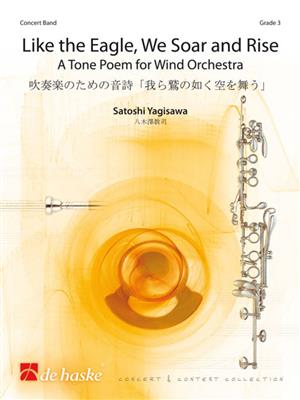
Like the Eagle, We Soar and Rise - Satoshi Yagisawa
Like the Eagle, We Soar and Rise was commissioned by Yuying Secondary School Concert Band and Yuying Alumni Association for the 2010 centenary of the school's foundation. The piece was named by a friend of the composer named Steven Phua, who originally suggested commissioning a new piece to Satoshi Yagisawa. The piece furthermore takes its name from the text of the Yuying Secondary School song.This composition is based on three different concepts: the first one demonstrates 'The founders' passion for education'; the second concept illustrates 'Hardship in war time'; the third one 'To the future' describes the inner strength people find to overcome struggles. Thispiece concludes with a fanfare, which is the sound of hope that leads to a brighter future in a positive direction.The world premiere of this piece was conducted by Faizal Bin Othman, who is one of the leading educators in Singapore, and was performed by the Yuying Secondary School Concert Band.
Estimated dispatch 7-14 working days
-
 £85.00
Castlebrooke Overture (Flexible Ensemble - Score and Parts) - Smith, Claude T. - Earp, Joseph Benjamin
Dedicated to William (Bill) Maupin, a friend and fellow music educator of Claude T. Smith, Castlebrooke Overture is a perfect piece to introduce younger ensembles to meter changes and a couple measures in 3/8 time. This flexible arrangement allows ensembles to perform the work with as few as ten musicians providing accessibility and flexibility for numerous instrumentation needs, while still allowing a full ensemble sound.*The posted recording is based on the full band scoring but aligns with the suggested preferences for either woodwinds/strings or brass suggested in the score.
Estimated dispatch 7-14 working days
-
 £144.99
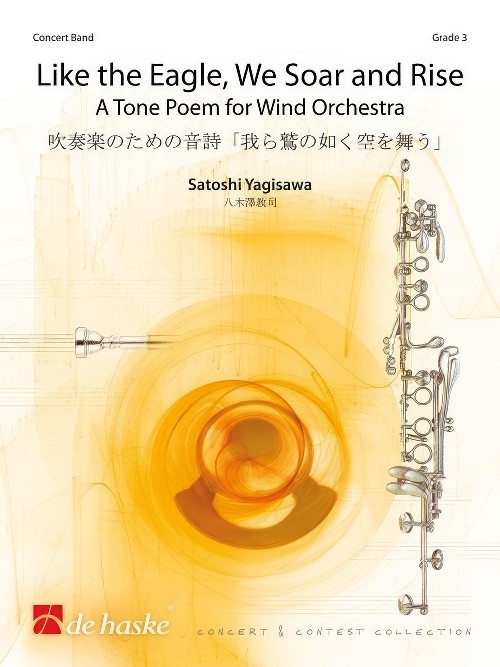
Like the Eagle, We Soar and Rise (Concert Band - Score and Parts) - Yagisawa, Satoshi
Like the Eagle, We Soar and Rise was commissioned by Yuying Secondary School Concert Band and Yuying Alumni Association for the 2010 centenary of the school's foundation. The piece was named by a friend of the composer named Steven Phua, who originally suggested commissioning a new piece to Satoshi Yagisawa. The piece furthermore takes its name from the text of the Yuying Secondary School song.This composition is based on three different concepts: the first one demonstrates 'The founders' passion for education'; the second concept illustrates 'Hardship in war time'; the third one 'To the future' describes the inner strength people find to overcome struggles. This piece concludes with a fanfare, which is the sound of hope that leads to a brighter future in a positive direction.The world premiere of this piece was conducted by Faizal Bin Othman, who is one of the leading educators in Singapore, and was performed by the Yuying Secondary School Concert Band.Duration: 8.00
Estimated dispatch 7-14 working days
-
 £76.99
Whispers from Beyond - Rossano Galante
Composed as a tender tribute to a lost friend, this is meant not to be a mournful piece, but rather a joyous remembrance of a life ended too soon. The work features two primary themes that ebb and flow as the music progresses. Soaring melodic lines and rich orchestration help bring character and distinction to this effective and emotional piece. Dur: 4:00
Estimated dispatch 7-14 working days
 View Music