
Results
-
 £23.99
Pasodobles Para Banda - Pascual Marquina Narro
Four pasodobles for band by the popular Spanish composer, the titles of which are 'Solera Fina', 'Viva La Jota', 'Alegrias' and 'Joselito Bienvenida'. Includes piano conducting score and full set of parts.
Estimated dispatch 7-14 working days
-
 £76.99
Kinderweihnacht
Kinderweihnacht is a medley for four-part instrumentation, featuring four famous German childrens Christmas carolss. Creative interpretation requires the use of kitchen utensils (bottles, spoons, lids) by the percussion section! Something alittle different for Christmas.
Estimated dispatch 7-14 working days
-
 £122.50
Brilliant Beatles - Peter Kleine Schaars
There have been many arrangements of Beatles' songs for various kinds of ensembles, so rather than just producing a further medley of Beatles' hits, Peter Kleine Schaars has added a new twist to them with this excellent new work. All You Need Is Love and With a Little Help from my Friends pass by in a swing march, Michelle sounds like a newly composed ballad and When I'm Sixty Four is played in Dixie swing style. A Hard Day's Night is transformed into a funk theme with a samba interlude, Let It Be into a slow march, and Ob-La-Di, Ob-La-Da in a rock beat. Experience The Beatles as you have never heard them before.
Estimated dispatch 7-14 working days
-
 £184.99
Colors - Bert Appermont
This work was written especially for the Belgian trombonist Ben Haemhouts and was created on Dec. 29, 1998 in Ravels. Colors for Trombone is a virtuous composition based on four colors, 'Yellow', 'Red', 'Blue' and 'Green'. Each Color characterizes a typical musical quality. This masterpiece of Bert Appermont is undoubtedly a superb addition to the Trombone repertoire!
Estimated dispatch 7-14 working days
-
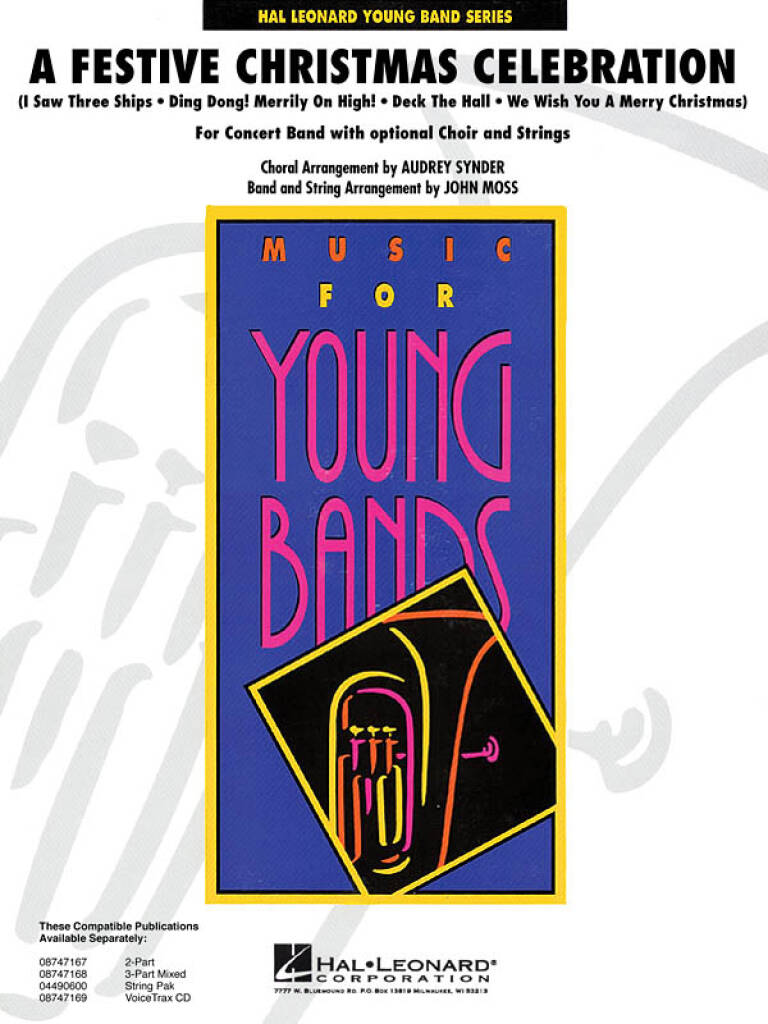 £72.99
A Festive Christmas Celebration
Four Christmas favorites combine to create a sparkling showcase for holiday programs. Perform with band alone or with chorus and strings for a fabulous concert finale! Includes: Deck the Hall, Ding Dong! Merrily on High, I SawThree Ships and We Wish You a Merry Christmas.
Estimated dispatch 7-14 working days
-
 £57.50
Symphonic Chorales - John Moss
Chorale playing is an important element in teaching an ensemble to play with good balance, tone and intonation. This marvelous set of four chorales ranges in musical mood from solemn and reverent to sonorous and vibrant. Beautifully scored, but in a more contemporary style, these chorales will be a wonderful addition to your band's warm-up routine and a welcome alternative to playing the traditional chorales.
Estimated dispatch 7-14 working days
-
 £60.99
Dreams and Fancies - Timothy Broege
These four contrasting vignettes written in contemporary style greatly enhance your programming options. The colorful movements are: I. First Dream, II. First Fancy, III. Second Dream, and IV. Second Fancy.
Estimated dispatch 7-14 working days
-
 £36.89
Adoration (Trumpet Solo with Wind Band) Florence Price trs. John Hanchett
Florence Price was an American classical composer, pianist, organist and music teacher. She is noted as the first African-American woman to be recognised as a symphonic composer, and the first to have a composition played by a major orchestra. Price composed over 300 works: four symphonies, four concertos, as well as choral works, art songs, chamber music and music for solo instruments. In 2009, a substantial collection of her works and papers that had been previously considered lost was found in her abandoned summer home. Amongst these was this delightful work, Adoration, which had been composed in the 1950s for organ. According to IMSLP.org, the piece "failed to meet notice or renewal requirements to secure statutory copyright with no 'restoration' under the GATT amendments" and therefore is in the public domain. A version for violin and piano by Elaine Fine has become popular. This setting for trumpet soloist with wind band has been arranged by John Hanchett. Also available as: Bb Solo with Piano Cornet Solo with Brass Band To view a video of Andrew Roe performing the work (brass band version), please visit: www.youtube.com/watch?v=_7UYlz8Fzxo Difficulty Level: Medium Easy (Grade 3) Length: 3.15 minutes Sheet music available from: UK - www.wind-band-music.co.uk USA - https://satradecentral.org
In stock: Estimated dispatch 1-3 days
-
 £22.13
All Tuned Up - 120 Famous Tunes for All Occasions (Full Score A4 Size) PDFs
This unique new resource from BrookWright Music will be an essential part of every band's library! All Tuned Up is designed to cater for ensembles for occasions throughout the year. Tunes are drawn from genres including Classical, Hymns, Folk and Patriotic amongst many others to form a comprehensive book that will cover a wide variety of events such as Weddings, Funerals, Graduation Ceremonies, Parties, Proms, Remembrance, Street Playing and Thanksgiving. Playable by as few as five players but also designed to work for full brass band or wind band, it features flexible parts in a wide variety of transpositions. These excellent arrangements have been expertly created by Andrew Wainwright, David E. Jones, Dean H. Jones and Steven Ponsford. The general harmonic format of All Tuned Up is in five parts, although additional notes have been included to thicken the harmony where more players are available. Therefore, the book will work equally well with larger groups, including full brass bands and wind bands. To view a promotional video please visit www.youtube.com/watch?v=nmodRrXQRRs At the end of the Part 1 Bb book are four a capela tunes for Remembrance/Memorial occasions. This PDF download is International Size - A4 (297mm x 210mm) Physical copies of the books available from: UK - Individual Books Full Set Brass Band Set USA - www.solidbrassmusic.com/product/all-tuned-up-ensemble-books
In stock: Estimated dispatch 1-3 days
-
 £81.18
All Tuned Up - 120 Famous Tunes for All Occasions (Brass Band Set - A5) PDFs
This unique new resource from BrookWright Music will be an essential part of every band's library! All Tuned Up is designed to cater for ensembles for occasions throughout the year. Tunes are drawn from genres including Classical, Hymns, Folk and Patriotic amongst many others to form a comprehensive book that will cover a wide variety of events such as Weddings, Funerals, Graduation Ceremonies, Parties, Proms, Remembrance, Street Playing and Thanksgiving. Playable by as few as five players but also designed to work for full brass band or wind band, it features flexible parts in a wide variety of transpositions. These excellent arrangements have been expertly created by Andrew Wainwright, David E. Jones, Dean H. Jones and Steven Ponsford. The general harmonic format of All Tuned Up is in five parts, although additional notes have been included to thicken the harmony where more players are available. Therefore, the book will work equally well with larger groups, including full brass bands and wind bands. To view a promotional video please visit www.youtube.com/watch?v=nmodRrXQRRs At the end of the Part 1 Bb book are four a capela tunes for Remembrance/Memorial occasions. This PDF download is for International sizes: Full Score - A4 Size - 297mm x 210mm Band Parts - A5 Size - 210mm x 148mm Physical copies of the books available from: UK - Individual Books Full Set Brass Band Set USA - www.solidbrassmusic.com/product/all-tuned-up-ensemble-books The Brass Band set includes: Full Score Part 1 Eb (optional) - Soprano Cornet Eb Part 1 Bb - Cornet Bb, Flugel Part 2 Bb - Cornet Bb, Flugel Part 2 Eb - Tenor Horn Part 3 Bb - Baritone, Trombone, Euphonium Part 3 Eb - Tenor Horn Part 4 Bb - Euphonium, Baritone Part 5 C (Bass Clef) - Bass Trombone Part 5 Eb - Bass Eb Part 5 Bb - Bass Bb Percussion (optional) - Various
In stock: Estimated dispatch 1-3 days
 View Music