
Results
-
 £112.95
FANTASIA AND FUGUE IN C MINOR (Concert Band) - Hunsberger, Donald
This work, originally written for organ, was the initial offering in the DHWL. The organ and the contemporary wind band share numerous timbre and sound projection properties as well as sharing philosophy and technique in organ registrations and in wind orchestration. Hunsberger, whose instrumentation closely follows concepts of organ registration, has created unique timbres and tonal couplings in the wind and brass sections throughout.
Estimated dispatch 7-14 working days
-
 £123.20
3 Letzte Motetten (Concert Band - Score and Parts) - Bruckner, Anton - Doss, Thomas
Anton Bruckner (b. 4.9.1824, Ansfelden, d. 11.10.1896, Vienna) didn't have it easy. Throughout his life, the Austrian composer was plagued by self-doubt. Anton Bruckner came from a simple, rural background. After the death of his father, he was accepted as a choirboy at the monastery of Sankt Florian in 1837. After several years as a school assistant and his own organ and piano studies, he first worked as organist in St. Florian, then from 1855 as cathedral organist in Linz. Introduced to music theory and instrumentation by Simon Sechter and Otto Kitzler, he discovered Richard Wagner as an artistic role model, whom he admired throughout his life and also visited several times in Bayreuth. In 1868 Anton Bruckner became professor of basso continuo, counterpoint and organ at the Vienna Conservatory; ten years later court organist; and in 1891 finally honorary doctor of the University of Vienna. He was considered an important organ virtuoso of his era, but had to wait a long time for recognition as a composer. It was not until Symphony No.7 in E major, composed between 1881 and 1883, with the famous Adagio written under the effects of Wagner's death, that he achieved the recognition he had hoped for, even if he was reluctant to accept it given his inclination towards scepticism and self-criticism. Anton Bruckner was a loner who did not want to follow a particular school or doctrine. He composed numerous sacred vocal works, such as his three masses, the Missa Solemnis in B flat minor (1854), the Te Deum (1881-84) and numerous motets. As a symphonic composer, he wrote a total of nine symphonies and many symphonic studies from 1863 onwards, tending to revise completed versions several times over. Bruckner's orchestral works were long considered unplayable, but in fact were merely exceptionally bold for the tonal language of their time, uniting traditions from Beethoven through Wagner to folk music, on the threshold between late Romanticism and Modernism. Anton Bruckner composed about 40 motets during his lifetime, the earliest a setting of Pange lingua around 1835, and the last, Vexilla regis, in 1892. Thomas Doss has compiled some of these motets in this volume for symphonic wind orchestra. These motets show many characteristics of personal expression, especially Bruckner's colourful harmony in the earlier works, which is in places aligned with Franz Schubert (changes between major and minor; and movements in thirds). Later works are characterised by many components which, in addition to the expanded stature of the movements, include above all a sense of the instrumentation as an outward phenomenon and the harmony as a compositional feature that works more internally. Some aspects of Bruckner's work are the result of his long period of study, which familiarised him not only with the tradition of his craft, but also gave him insights into the "modernity" of his time in such composers as Wagner, Liszt and Berlioz. From this developed his personal standpoint, which always pursues the connection between the old and the new.Duration: 14.00
Estimated dispatch 7-14 working days
-
 £256.00
14 Motetten (Concert Band - Score and Parts) - Bruckner, Anton - Doss, Thomas
Anton Bruckner (b. 4.9.1824, Ansfelden, d. 11.10.1896, Vienna) didn't have it easy. Throughout his life, the Austrian composer was plagued by self-doubt. Anton Bruckner came from a simple, rural background. After the death of his father, he was accepted as a choirboy at the monastery of Sankt Florian in 1837. After several years as a school assistant and his own organ and piano studies, he first worked as organist in St. Florian, then from 1855 as cathedral organist in Linz. Introduced to music theory and instrumentation by Simon Sechter and Otto Kitzler, he discovered Richard Wagner as an artistic role model, whom he admired throughout his life and also visited several times in Bayreuth. In 1868 Anton Bruckner became professor of basso continuo, counterpoint and organ at the Vienna Conservatory; ten years later court organist; and in 1891 finally honorary doctor of the University of Vienna. He was considered an important organ virtuoso of his era, but had to wait a long time for recognition as a composer. It was not until Symphony No.7 in E major, composed between 1881 and 1883, with the famous Adagio written under the effects of Wagner's death, that he achieved the recognition he had hoped for, even if he was reluctant to accept it given his inclination towards scepticism and self-criticism. Anton Bruckner was a loner who did not want to follow a particular school or doctrine. He composed numerous sacred vocal works, such as his three masses, the Missa Solemnis in B flat minor (1854), the Te Deum (1881-84) and numerous motets. As a symphonic composer, he wrote a total of nine symphonies and many symphonic studies from 1863 onwards, tending to revise completed versions several times over. Bruckner's orchestral works were long considered unplayable, but in fact were merely exceptionally bold for the tonal language of their time, uniting traditions from Beethoven through Wagner to folk music, on the threshold between late Romanticism and Modernism. Anton Bruckner composed about 40 motets during his lifetime, the earliest a setting of Pange lingua around 1835, and the last, Vexilla regis, in 1892. Thomas Doss has compiled some of these motets in this volume for symphonic wind orchestra. These motets show many characteristics of personal expression, especially Bruckner's colourful harmony in the earlier works, which is in places aligned with Franz Schubert (changes between major and minor; and movements in thirds). Later works are characterised by many components which, in addition to the expanded stature of the movements, include above all a sense of the instrumentation as an outward phenomenon and the harmony as a compositional feature that works more internally. Some aspects of Bruckner's work are the result of his long period of study, which familiarised him not only with the tradition of his craft, but also gave him insights into the modernity of his time in such composers as Wagner, Liszt and Berlioz. From this developed his personal standpoint, which always pursues the connection between the old and the new.Duration: 39.00
Estimated dispatch 7-14 working days
-
 £75.00
A Child is Born in Bethlehem (Concert Band with Optional Choir - Score and Parts) - Scheidt, Samuel - Noble & Willcocks
Samuel Scheidt (1587 - 1654) was a German composer, organist and teacher of the early Baroque era, and was one of Germany's most distinguished composers at that time, especially in the field of keyboard music. His three volumes of Tabulatura nova (1624) are a monumental compendium of song and dance arrangements, sets of variations, fantasias, toccatas, fugues and liturgical pieces (often plainsong-based) for the Lutheran Mass and Office. Likewise his four books of Geistliche Konzerte illustrate the ways of elaborating a chorale, fusing declamatory ideas with contrapuntal writing. Scheidt was the first internationally significant German composer for the organ, and represents the flowering of the new north German style, which occurred largely as a result of the Protestant Reformation. Scheidt's music is in two principal categories: instrumental music, including a large amount of keyboard music, mostly for organ; and sacred vocal music, some of which is a cappella and some of which uses a basso continuo or other instrumental accompaniment. Edited for double chorus by David Willcocks, this arrangement represents one in the Series of Band Arrangements compatible with David Willcocks' Carols for Choirs.
Estimated dispatch 7-14 working days
-
 £75.00
Once in Royal David's City (Concert Band with Optional Choir - Score and Parts) - Noble & Willcocks
Once in Royal David's City is a Christmas carol originally written as a poem by Cecil Frances Alexander. The carol was first published in 1848 in her hymnbook Hymns for Little Children. A year later, the English organist Henry John Gauntlett discovered the poem and set it to music. According to The New Oxford Book of Carols, the text was conceived by Cecil Alexander after overhearing a group of her god children complaining about the dreariness of the catechism. Cecil masterfully took doctrines from the Apostle's Creed and simplified them for her hymns. Cecil wrote about 400 hymns in her lifetime, among which are All things bright and beautiful and There Is a Green Hill Far Away. She used the money for charitable purposes, and was a tireless advocate (and visitor) of the poor and sick. Henry John Gauntlett had spent the first half of his career as a lawyer before abandoning his practice to pursue music. He served as the organist at a number of leading London churches. Gauntlett was a prolific writer and is said to have composed over 1000 hymn tunes. He made tremendous contributions to the world of music, even inventing mechanical improvements to the organ. As a result, he was praised by the famous Felix Mendelssohn and was awarded an honorary doctorate in music from the Archbishop of Canterbury. In 1919, Arthur Henry Mann, organist at King's College (1876-1929), introduced an arrangement of Once in Royal David's City as the processional hymn for the service. In his version, the first stanza is sung unaccompanied by a boy chorister. The choir and then the congregation join in with the organ on succeeding stanzas. This has been the tradition ever since. It is a great honor to be the boy chosen to sing the opening solo--a voice heard literally around the world. In this arrangement for band accompaniment, the first five verses may be performed as directed by the conductor, with different groupings of instruments for each verse, i.e., Vs.1, A cappella; Vs. 2, Fl., Oboe, E.H., Bsns; Vs. 3 Cl., Saxes; Vs. 4, Brass; Vs. 5, All, and Vs. 6 as written with featured descant. This arrangement is one of the Series of Band Arrangements compatible with the David Willcocks Carols for Choir, Book 2 (#31).
Estimated dispatch 7-14 working days
-
 £75.00
Nun Danket Alle Gott (Concert Band - Score and Parts) - Noble, Paul
Sigfrid Karg-Elert, (1877 - 1933), was one of the principal German composers for organ of his generation. He studied at the Leipzig Conservatory, and in 1919 he became a member of the staff there. Music for organ has been a worthy source of arrangements for the Wind Band, and this piece is among his most famous works for the instrument.
Estimated dispatch 7-14 working days
-
 £104.99
Canterbury Chorale (Concert Band - Score and Parts) - Van der Roost, Jan
This quiet piece with its broad tones was originally written for brass band on request of Robert Leveugle, chairman of the composers own band: Brass Band Midden Brabant (Belgium). The direct cause was a visit to the beautiful cathedral of the English city Canterbury, in which so many fine compositions sounded throughout the centuries. Later on, Jan Van der Roost rescored this piece for symphonic wind band, exploring the full richness of colours of this formation. Besides solo phrases for several instruments, there are some massive tutti passages making the wind orchestra sound like a majestic organ. By the way: an "ad libitum" organ part adds an extra richness, colour and power to this piece, making it sound even more broad and grand.Duration: 6:30
Estimated dispatch 7-14 working days
-
 £104.99
Jubilant Prelude Wind Band Set (Score & Parts)
Jubilant Prelude' is an orchestration of the 'Preludium over Psalm 150' originally composed for organ by Toon Hagen. Since 1998 Toon Hagen has been organ-player of the 'Grote or Sint Micha?lskerk' in Zwolle (the Netherlands). He has written several 'contemporary' compositions for organ.'Jubilant Prelude' has a capricious character by the use of irregular measures and its many measure changes. The structure of the Prelude is that of a fugue and is based on motives from the psalm.After the first climax, which is both dynamic and harmonic, the theme in the Andante Jubiloso is clearly audible and it is alternated with erratic motifs. Tension increases until at last the psalm itself is heard in all its glory. The melody of the psalm sounds as a cantus firmus in tenor register, with motifs in ornamentation for saxophones, bugles and trumpets. The finale, like the prelude is capricious and vehement.The instrumentation for concert band was made by Wim Rouw. It is particularly colourful and has a surprising role for the percussion section. 04:30
Estimated dispatch 7-14 working days
-
 £104.99
Arioso Cantabile (Concert Band - Score and Parts) - Van der Roost, Jan
This composition exudes serenity and tranquillity, but also intensity and expressiveness - giving it similar qualities to earlier works by Van der Roost, like Canterbury Chorale and Adagio for Winds. Long melodic lines characterize the main themes that arise in different registers and develop through varying keys. The band rather sounds like an organ: the varying timbres and broad musical phrases fully justify the comparison with this majestic instrument. There is no bombast, and the work contains no exaggerated technical or rhythmic tours de force. On the contrary, from a lush richness it moves towards a softening final passage that culminates in a slowly fading final chord: following the many warm harmonies and grand melodies, this work concludes in a contemplative mood.Duration: 7.45
Estimated dispatch 7-14 working days
-
 £171.00
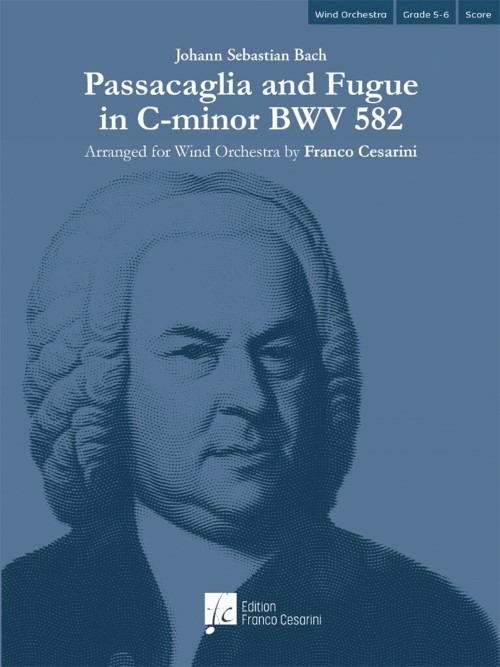
Passacaglia and Fugue in C minor BWV 852 (Concert Band - Score and Parts) - Bach, Johann Sebastian - Cesarini, Franco
The Passacaglia is a set of instrumental variations based on an ostinato bass. Bach's Passacaglia and Fugue in C-minor for organ represents the pinnacle of what had been achieved in this compositional form at that time. In Franco Cesarini's arrangement for large wind orchestra, the particularly careful interpretation of the original piece enables him to exploit all the sound colors at his disposal, and in this sumptuous guise Bach's work also takes on a grandiose dimension, albeit tinged with late-Romanticism. The exposition of the beautiful theme begins in the bass part, immediately creating a solemn and serious atmosphere which is accentuated by the intensely pathetic character of the first variations. Up to the tenth variation it remains confined to the bass, but in subsequent ones it also passes to the soprano and alto register. The integrity of the theme is also embellished with elegant arpeggios, in whose lower and higher extensions the theme can be distinguished. Towards the end it returns to the bass in an impressive thickening of the polyphonic texture that swiftly re-establishes the key of C-minor. The "Thema fugatum" which follows immediately does not constitute a Fugue in its own right, rather it is nothing but the twenty-first and most extensive variation of the Passacaglia. This time Bach uses only the first half of the theme, superimposing a rhythmic countersubject that considerably enlivens the entire development of the composition. The polyphonic discourse becomes increasingly dense, until the building tension peaks in a powerful "Neapolitan sixth" chord, followed by a sudden pause. This culminating moment then leads to the coda and final cadence on a bright C-major chord. Duration: 12.45
Estimated dispatch 7-14 working days
 View Music