
Results
-
 £205.70
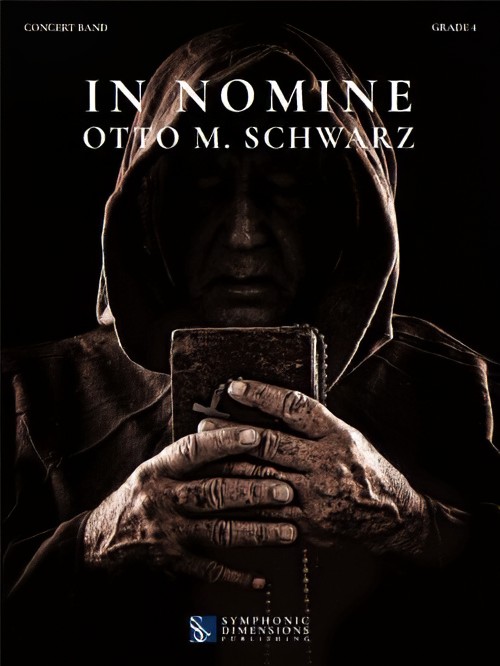
In Nomine (Concert Band - Score and Parts) - Schwarz, Otto M.
How often has something been justified by, declared to be, or blessed as 'in the name of' some cause or other? How can it be that opposing armies and the use of weapons are ever 'in the name of...'? This is a common thread in the history of different faiths. Good was created but evil was committed and all 'in the name of...' This thread is also found in the history of the Premonstratensian Abbey at Wadgassen. The abbey was built in the 12th century on unfertile, desolate moorland, which later evolved into the most powerful religious community in the Saarland. The history of the abbey records quite astounding achievements under the motto desertum florebit quasi lilium ('the desert will bloom like a lily'); but also the harsh treatment of delinquents. The order had its own school, in which children were taught the seven liberal arts (which included music as well as geography and astronomy), but the poor were left to starve outside the abbey walls and were only allowed to eat from the members' leftovers on feast days. The medieval witch trials demanded their pound of flesh, and one group that fell victim were ecstatic dancers who moved wildly to music, which was interpreted as the devil's work. The result: a show trial that sentenced the dancers to death by fire. All in the name of... The year is 1789: Abbot Bordier is in the tenth year of his command. He does not yet know that he is to be the last abbot of an almost 700-year tradition. Not far from the abbey is the French border, which has long been making itself felt with the sound of gunfire, and the brothers continue to keep a nervous eye on it. The first portents of the French Revolution loom, but no one wants to believe it, that is, until the French pound the door down, storm the abbey and come right into the brothers' chambers. In a blind fury, all the pipes of the abbey organ are torn out, icons beheaded with swords and brothers beaten death while numerous buildings are set on fire. The abbey church is in flames. A frantic and desperate escape begins. Abbot Bordier and a handful of brothers make their getaway via the River Saar, adjacent to the abbey, to the neighbouring village of Bous. They survive, but their life, the Premonstratensian abbey, is destroyed. While they flee towards Prague and the sanctuary of the Strahov Monastery, the abbey at Wadgassen is razed to the ground and becomes a stone quarry. The desert blooms once more, however. A few short decades later, a glasswork arises from the foundations of the abbey. As peace returns to the region, it brings jobs and a new vision for its people.Duration: 11.15
Estimated dispatch 7-14 working days
-
 £110.00
Nade (Concert Band - Score and Parts) - Rydland, Frode
This is the finale from the original soundtrack of the opening ceremony of the XVII Olympic Winter Games in Lillehammer, Norway, 1994. The piece was composed by Knut Reiersrud, Iver Kleive and Marilyn Mazur. It features them all as musicians; Marilyn Mazur (percussion), Knut Reiersrud (guitar) and Iver Kleive (organ) together with Linda ?vreb? (vocals), Odd Lund (piccolo trumpet), Kjell Erik Arnesen (french horn) and The Boys Choir of Oslo Cathedral.
Estimated dispatch 7-14 working days
-
 £150.00
Cockaigne Overture (In London Town) (Concert Band - Score and Parts) - Elgar, Edward - Noble, Paul
Cockaigne Overture was composed when Edward Elgar received a commission from the Royal Philharmonic Society, and he reported that the new piece was "cheerful and Londony, 'stout and steaky'...honest, healthy, humorous and strong, but not vulgar." The first performance was in the Queen's Hall, London, on 20 June 1901, conducted by the composer. He dedicated the work to his "many friends, the members of British orchestras." The music was an immediate success and became one of Elgar's most popular works. In its 15 minutes or so, the overture gives a lively and colourful musical portrait of Edwardian London. 'Cockaigne' was a term used by moralists at that time as a metaphor for gluttony and drunkenness, while Britain adopted the name humorously for London, and from it we get the Cockney. Cockaigne or Cockayne /ka' kein/, the word origin tracing back to the 13th century, is a land of plenty in medieval myth, an imaginary place of extreme luxury and ease where physical comforts and pleasures are always immediately at hand and where the harshness of medieval peasant life does not exist. The work presents various aspects of turn-of-the-century London and Londoners. It begins with a quiet but bustling theme which leads into an unbroken sequence of snapshots: the cockneys, the church bells, the romantic couples, a slightly ragged brass band (perhaps the Salvation Army) and a contrastingly grand and imperious military band. The broad theme representing Londoners has been stated as the first occurrence of Elgar's trademark direction, 'nobilmente.' The work ends in a characteristically Elgarian blaze of sound, including an optional full organ.
Estimated dispatch 7-14 working days
-
 £75.00
Resonemus Laudibus (Concert Band with Optional Choir - Score and Parts) - Noble & Willcocks
Resonemus Laudibus is a 14th-century carol which was widely known in medieval Europe, and is still performed today. David Willcocks' arrangement brings a modern excitement to the piece, which would not have been out of place all those centuries ago. The Latin text is translated: 1. Resonemus laudibus cum jocunditatibus ecclesiam fidelibus. Let us make the church resound with the joyful praises of the faithful. Apparuit quem genuit Maria He whom Mary bore has appeared. 2. Deus fecit hominem ad suam imaginem et similitudinem. God made man in his own image and likeness. 3. Deus fecit omnia caelum, terram, maria cunctaque nascentia. God made all things, heaven, earth, the seas and all creation. 4. Ergo nostra concio in chordis et organo benedicat Domino. Therefore let our congregation praise God with strings and organ. 5. Et Deo qui venias donat et laetitias nos eidem gratias. And to God, who gives favours and happiness, we give thanks. This arrangement represents one in the Series of Band Arrangements compatible with David Willcocks' Carols for Choirs.
Estimated dispatch 7-14 working days
-
 £110.00
Sine Nomine (For All the Saints) (Concert Band with Optional Choir - Score and Parts) - Williams, Vaughan - Noble, Paul
For All the Saints was written as a processional hymn by the Anglican Bishop of Wakefield, William Walsham How. The setting by Vaughan Williams was included in The English Hymnal which was published in 1906 for the Church of England by Oxford University Press. The music editor was composer and music historian Ralph Vaughan Williams. This hymnal used his new setting which he called Sine Nomine (literally, without name) in reference to its use on the Feast of All Saints, 1 November (or the first Sunday in November, All Saints Sunday). It has been described as one of the finest hymn tunes of the 20th century. This arrangement adheres in form to the original RVW orchestration, including all eight verses and an optional organ part, which is the standard format in many hymnals. It may be performed as accompaniment to a congregational hymn, with choir, or as a band piece alone.
Estimated dispatch 7-14 working days
-
 £225.00
Lord, Thou Hast Been Our Refuge (Concert Band with Optional Choir - Score and Parts) - Rutter, John - Noble, Paul
Lord, thou hast been our refuge (2008) was written for the annual City United Guilds service in St Paul's Cathedral for SATB choir, solo trumpet, and organ. This impressive and stately setting of verses from Psalm 90 culminates in a jubilant, maestoso final section. The arrangement is written to accompany the chorus, or may be performed by band alone. The trumpet solo is haunting, and will be a showcase for that performer. The work would suit any festive service or concert.
Estimated dispatch 7-14 working days
-
 £110.00
Now Thank We All Our God (Concert Band with Optional Choir - Score and Parts) - Rutter, John - Noble, Paul
This powerful setting by John Rutter of one of the world's most beloved hymns is a perfect vehicle for the Concert/Wind Band with Chorus and audience participation, and may be performed by band alone. The extended Festival Fanfare may be omitted, or may be shortened as desired. The organ and harp parts are optional.
Estimated dispatch 7-14 working days
-
 £64.95
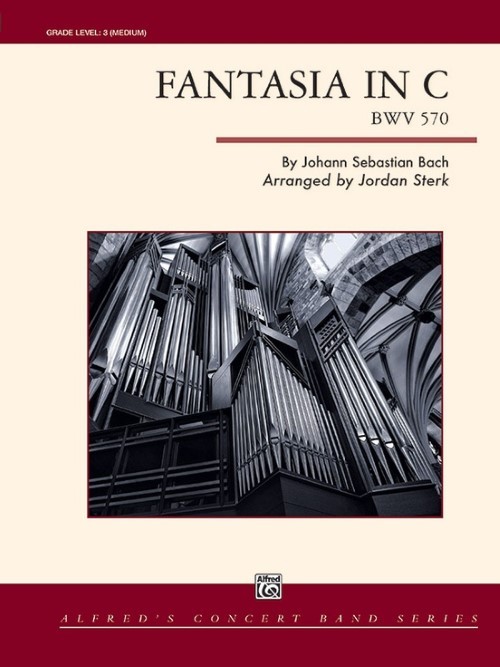
Fantasia in C BWV 570 (Concert Band - Score and Parts) - Bach, Johann Sebastian - Sterk, Jordan
This arrangement of the baroque organ work by Johann Sebastian Bach preserves all of the rhythms and style of the original, but transposes to the key of B-flat for more accessibility. Duration: 2:30
Estimated dispatch 7-14 working days
-
 £89.99
The Pageant of London (Concert Band - Score and Parts) - Bridge, Frank
Frank Bridge was one of the finest English composers of the first half of the 20th century. The Pageant of London is his only work for wind band, comprising of two marches, one scored from Bridge's best known organ piece and including the chimes of Big Ben, plus three short renaissance pastiche items, one arranged from Playford (later used by Peter Warlock in Capriol Suite). The music is tuneful, approachable and makes a fine alternative to Holst's two suites, which were composed around the same time. Duration: 15.00
Estimated dispatch 7-14 working days
-
 £75.00
Rondo in E flat (Concert Band - Score and Parts) - Bull, John - Noble, Paul
This arrangement for Concert Band is based on the organ adaptation (Rondo in D) of the string orchestration (Rondo in G). Regardless of the key, it is a delightful piece representing music of the late Renaissance that recalls the English folk dances of an earlier century. An excellent teaching piece for 6/8 meter and rondo form, this presentation in E-flat falls comfortably under the fingers of band instrumentalists. The music is attributed to John Bull, but may have been written much later by noted organist, Richard Ellsasser.
Estimated dispatch 7-14 working days
 View Music