
Results
-
£137.99
Three Onegin Dances - Pyotr Ilyich Tchaikovsky
Tchaikovsky is best known for his purely instrumental compositions. However, we must not underestimate him as a composer of operas. Many of his operas such as Pique Dame and Eugene Onegin are still performed regularly throughout the world. Eugene Onegin (also called Jevgeny Onegin), composed in 1877-1878, was not called an opera by Tchaikovsky himself, but "lyric scenes". The work is entirely dominated by lyricism. However, there are two moments that contrast sharply with this lyricism: two ball scenes, for which Tchaikovsky wrote a waltz and a polonaise.After opening with a less well-known allegro dansant, this arrangement features the aforementioned waltz, which can beconsidered a beautiful Russian equivalent of the Faust Waltz by Charles Gounod. In the opera, this waltz is actually played by a military band. The arrangement concludes with the pompous polonaise (also mentioned above) which opens the last act: the ideal music to characterize high aristocracy in the salon of a palace in St. Petersburg.
Estimated dispatch 7-14 working days
-
 £53.50
Four Pictures - Árpád Balázs
The teachers under whom rpd Balzs (b.1937) studied composition - Ferenc Farkas, Aram Khachaturian and Goffredo Petrassi - each independently formed the opinion that with his lyrical gift rpd Balzs's true creative field would be that of choral music and wind ensembles. Their early predictions are borne out by the roughly two hundred and fifty works for choir and almost twenty for wind orchestra that the composer has since produced. It is interesting that in the suite entitled Ngy kp (Four pictures) the stylistic features of these two related musical fields are united. In it the wind instruments sing! It was not by chance that the expansive second movement was given the title Cantilena, while the slightly livelier but just as lyrical third movement was entitled Arietta. The opening movement of the work is a stridently jolly, energetic Indul (March), but not one of the rigidly military kind: the 6/8 rhythm contributes to its light-hearted character. This music is avowedly akin to the ballet music of Prokofiev. This choice series of four character pieces is crowned by Jtk (Play) in which conveying the effect of the mixture of lines moving in parallel and then colliding with each other may be more technically demanding, but is well worth the effort! (Hungaroton HCD 31353)
Estimated dispatch 7-14 working days
-
£66.95
Each Time You Tell Their Story - Samuel R. Hazo
Sam Hazo, composer of In Heaven's Air, offers this new beautiful work based on a poem written by his father, poet laureate of Pennsylvania. After a sensitive introduction, the poem is read under a haunting military cadence in the percussion. The material in the introduction is then developed and presented in a lush and beautiful setting. Chimes, wind chimes, and bells conclude the work which fades to silence. Very compelling.
Estimated dispatch 7-14 working days
-
£68.99
Celtic Fantasy - Keiichi Kurokawa
"Celtic" is a widely used term. Its history and culture expands to modern day Spain, Portugal, and North America.However, in this piece, I have based my music on the typical "Celtic" areas of Ireland and Scotland.The Bagpipe drone at the beginning reappears several times.After the introduction, the music transitions to an Irish Reel, The Wind That Shakes The Barley. Reel is a fast tempo dance, often in 4/4 or 2/2 time.Next is the Scottish folksong Auld Lang Syne, known as "Hotaru no Hikari" in Japan.The third movement is called Scotland the Brave. It is often performed by military bagpipe ensembles. Once air is blown into the bag, there is a constant reservoir of sound for Great Highland Bagpipes.A Part (advanced) is a grade 2.5-3 in American grading system. B Part (beginner) is 1-1.5.B Part is accessible for elementary school and junior high school beginning band students in Japan. However, the drone-sounding sections require a certain technique to hold the sound steady.It is my sincere desire that beginning musicians understand the importance of fundamentals through performing good music.Keiichi Kurokawa
Estimated dispatch 7-14 working days
-
 £93.50
National Defense March - John M. Pasternak
National Defense (Military March) is adapted for grade 3 concert band by John M. Pasternak. A stunning march, this piece is now more accessible than ever.
Estimated dispatch 7-14 working days
-
 £204.99
Storia Eroica - André Waignein
Andr Waignein received order of this composition of the "Municipal Brass Band of Luxembourg-Bonnevoie". It is in the presence of the Grand-Duke Heir Henri that took place first interpretation on January 24, 1998 with this orchestra, and with the composer as director.This work is a musical evocation describing this magnificent Luxembourgian region and her inhabitants.The overture evokes the serenity met in this region. An orchestrale development, as rhythmic as sound, propels the orchestra in a "military" atmosphere putting in evidence all the registers of the orchestra. This tension is maintained until the general explosion of the whole. One cantilena appears in all theinnocence. Gradually, the orchestration suppresses, until the exhaustion. The passage which follows represents the tempestuous events which took place through ages. A spectacular cadence, by the clarinet or by the soprano saxophone, terminates this desorder.An ample and lyric theme reflects the generosity which always played an important role. Then, having found some of initial themes, work ends in an atmosphere of enjoyment, developed in rich and eclectic one variety which proves the sphere of influence of the sound colour at Andr Waignein.
Estimated dispatch 7-14 working days
-
 £84.99
The Brigadier - Franco Cesarini
Brigadier is a senior military rank who typically commands a Brigade consisting of three battalions, approximately 3000 soldiers. The appointment to a high-ranking officer in the Army provides a lot of Swiss communities with the opportunity to celebrate. When Heinrich Tanner was promoted to Brigadier, the 'Knabenmusik der Stadt St. Gallen' wanted to pay tribute by dedicating a march to him. The result was this rousing march by Franco Cesarini.
Estimated dispatch 7-14 working days
-
 £159.99
Bonaparte - Otto M. Schwarz
This brilliant composition by Otto M. Schwarz reflects the adventurous life of the historical figure Napoleon Bonaparte. Probably the best-known Frenchman of all time, he developed exceptional military talent and eventually becameemperor of France. Relive the golden French age with this fantastic work for concert band. Dur: 14:45 (Grade 5)
Estimated dispatch 7-14 working days
-
£118.99
Jig - Gustav Holst
Together with his good friend Ralph Vaughan Williams, Gustav Holst had a strong liking for the abundant folk music of the British Isles. This influence is heard in many of his works and is perhaps strongest in his Second Suite for Military Band and in the Saint Paul Suite for string orchestra. This work was composed in 1913 for the school orchestra of St. Paul's Girls School in London, where Holst was the Director of Music. The suite opens with this exuberant Jig, a dance originating from Scottish and Irish folk music in alternating duple and triple time (6/8 and 9/8), which has been expertly arranged for concert band.
Estimated dispatch 7-14 working days
-
 £134.99
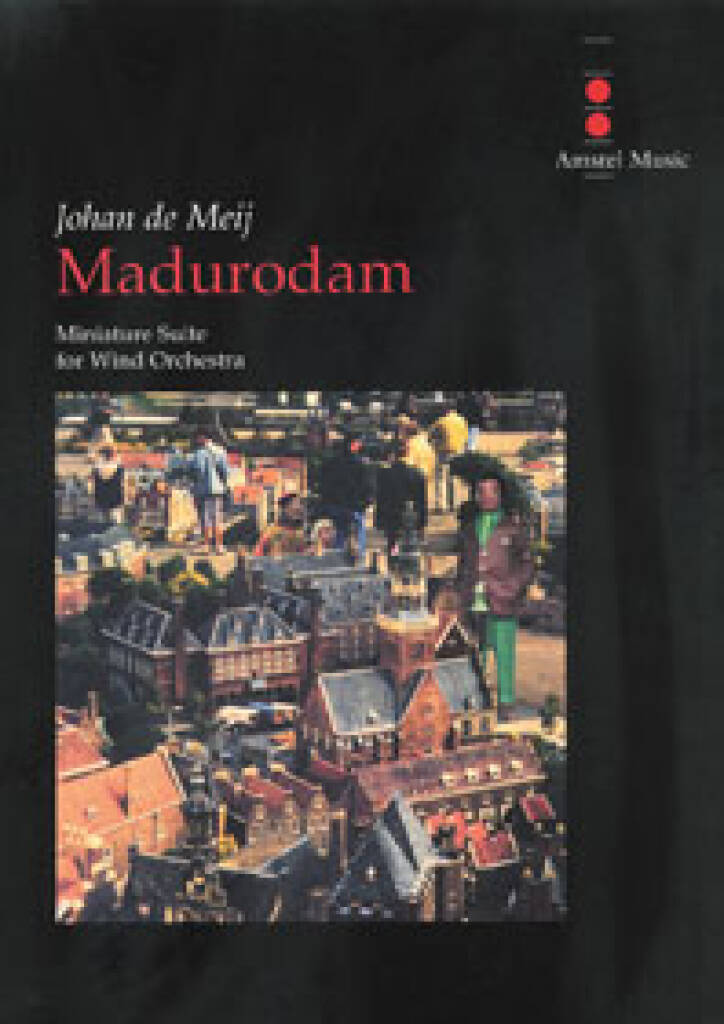
Madurodam - Johan de Meij
Madurodam is a small scale miniature town at Scheveningen (near The Hague) and is since many years one of the most important tourist attractions of the conurbation of Western Holland (called "Randstad"). On a scale 1:25 a charming picture of The Netherlands is given in bird's eye view: several important buildings, churches and townscapes are reconstructed up to the smallest details. There is also a fine transport system: a network of railroads, harbours and motorways covers the park and Madurodam Airport enables air traffic with all continents. The miniature suite Madurodam consists of eight short parts presenting a musical impression of the smallest town in The Netherlands. IReveille the piccolo flute and the side drum announce a new day; II Toy Soldiers there is a military parade in front of the George Maduro Barracks; III Binnenhof/Buitenhof a solemn melody is the main theme of the suite and depicts the state buildings and the nearby lake "Hofvijver" at The Hague; IV Small Windmills everything that moves or whirls at Madurodam is described in this barrel organ waltz; V Intermezzo/Nocturne Madurodam by night is described by a solemn passage played in unison by the lower instruments; VI The Westerkerk Church also the capital Amsterdam is represented with the chimes of the famous Westerkerk church; VII The Muiderslot Castle an elegant pavane recalls medieval atmospheres; VIII "Grande" Finale the windmill theme comes back and then the suite comes to an end with the "Binnenhof" theme, decorated by the first strains of the national hymn "Wilhelmus".
Estimated dispatch 7-14 working days
 View Music