
Results
-
 £274.99
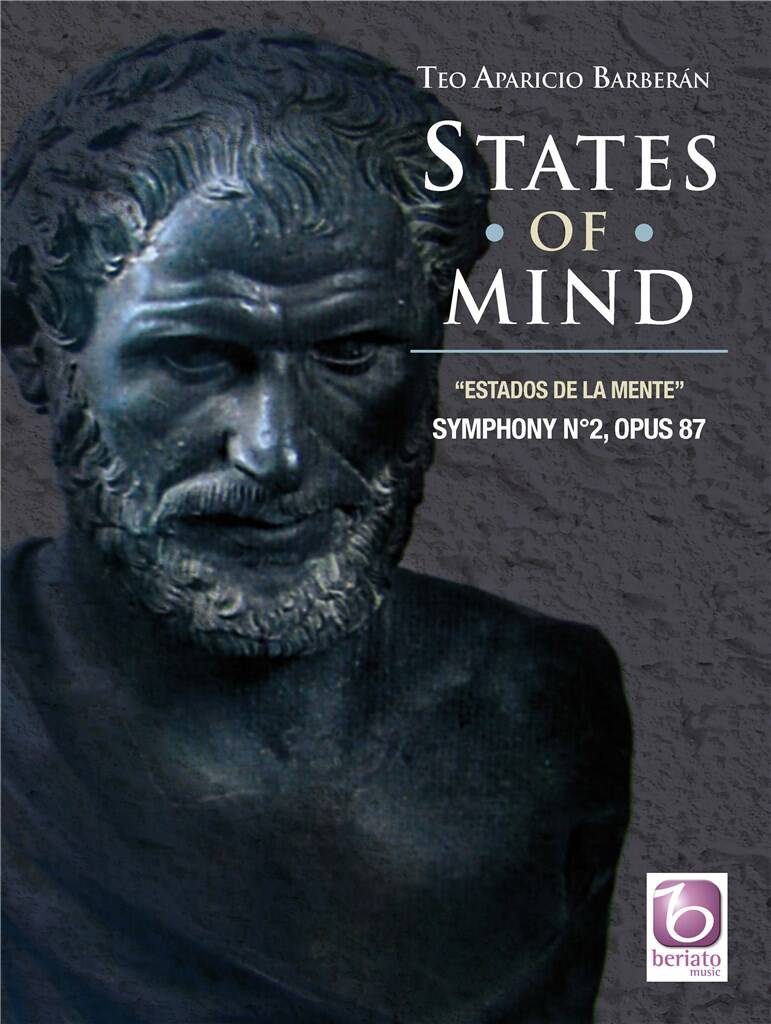
Symphony No. 2: States Of Mind, Opus 87 - Teo Aparicio-Barberán
I- Logos (reason)II- Pathos (emotion)III- Ethos (credibility)The ancient Greeks believed that music shaped the character of man. In Egyptian temples, music was an essential part of the magical rites to alter the course of nature or to treat illness.And today we know that sound can actually alter matter. The secret of music lies in harmony and mathematics, as many great musicians and experts have always known.One of the most important qualities of music is that it enables the listener to focushis attention inwards instead of on what is around him. It is indisputable that music can inspire emotion. Music leads us into a universe of emotions that are difficult to put into words. In short, music reaches into corners of our soul and thoughtsthat words cannot reach and makes it possible to more clearly describe these different States of mind.The composer of this symphony also believes that each "musical argument" must be constructed so that it will induce the desired reaction in thelistener.Music: more than wordsIn recent times, most orchestral symphonies have been based on a story, a text or something similar so that their composition must be structured accordingly.The intention of this work by Teo Aparicio-Barbern is quitedifferent. The composer describes the three elements of the argument as the only formal structure of the work. Since certain philosophers in world history were able to subdivide grammatical argument, why shouldnt that also be possible for the musicalargument?Since ancient times the power of the spoken word has captivated mankind. How can an argument move people and mobilise the masses? Where does the power of words come from today? The answer lays not so much in what people say but in how theysay it.Rhetoric is one of the oldest humanist disciplines in Western civilisation. Aristotle, in the 4th century BC, called it the art of persuasion. Indeed, the terms rhetoric and persuasion are mutually interchangeable.More than 2000 years agoAristotle structured his rhetoric according to the following three elements: the logos, the pathos and the ethos.Logos (words, reason) is the reasoning that gives freedom to the structure of the text by expressing what one wishes to say usingspecialist terms. With logos we create arguments to receive public approval and to defend our ideas.Pathos, the second element, refers to the effective use of public psychology. Pathos can be considered as the capacity to induce the desired emotionalresponse in the public, by creating an emotional connection with the public so that they accept our message.The third element, ethos (credibility), refers to the character of the speaker and is perhaps the most important of the three elements.Aristotle based his concept of ethos upon his belief that truth and justice will always have the upper hand over anger. He believed that what was true and good was easier to prove and was more persuasive.This second orchestral symphony from thecomposer from Enguera follows these three parameters of the argument according to Aristotle. Each movement tries to summon a different state of mind in the listener so that the message itself can be better understood and appreciated. Apart from thesethree general concepts the music is only structured, as Claude Debussy would say, in a "formative way".The first movement, logos, is based on a scherzo melody that undergoes various changes in rhythm and harmony. The arguments are presented by meansof conventional techniques of composition. The second movement, pathos, is characterised by suggestions of sound. It is subdivided into two large parts. The first part is based on a five seven sequence with five sounds that are repeated in differentenvironments, structures and dynamics. The second part, which is largely tonal, brings out more directly the emotional overtones that each argument must have. The third movement, ethos, is a faithful rendition of the composers personality. In thislast part, clear rhythmic sequences stand out, there are large dynamic contrasts and lots of tone variation. In addition, and this is quite in keeping with the composers earlier work, the harmony in States of Mind is handled in a manner that is bothoriginal and efficient, as a result of which Aparicio-Barberns message is well understood by the listener.This second symphony by Teo Aparicio-Barbern is devoted to "my dear Henrie Adams, a guiding light in this eternally dark musical world. Thankyou for everything."
Estimated dispatch 7-14 working days
-
 £47.50
The Good King Rocks - Timothy Johnson
Young band directors are always on the lookout for something new and a little different for the winter concert. Timothy Johnson's new Christmas arrangement for Beginning Bands fits the bill perfectly. It remains technically accessible to the young band while exploring this old familiar tune in new and different ways. You even have the option of including a "set" drummer by using the Optional Percussion 1 Advanced part. Lots of unison rhythms in the Winds ensure that you can prepare The Good King Rocks in time for that winter concert, and there are enjoyable parts for every instrument, which keeps the whole group focused and involved during rehearsal. Fun!
Estimated dispatch 7-14 working days
-
 £94.99
Conzensus - Jan Van der Roost
This stately concert opener was originally written by Jan Van der Roost for a special event in which six respected wind orchestras (two Belgian and four Dutch) of different composition (two symphonic bands, two fanfare bands and two brass bands) were featured during six concerts. Each evening brought forth a performance by a symphonic band, a fanfare, and brass band, so that the audience could experience all three types of ensembles. This was indeed an original concept.The name, ConZEnSus, comes from a combination of the words, 'Concert Cyclus' (concert series) and 'zes' (Dutch for 'six'). This leads to a new word, which refers to 'consensus'. The general tenor of the cycle isthus immediately indicated. The richness of color of the various ensembles is revealed through an open and friendly atmosphere. During all six concerts (over a span of three years), ConZEnSus functioned as a permanent opening number for each orchestra. Thus the same musical story was portrayed in three different packages.
Estimated dispatch 7-14 working days
-
£149.99
An Olympic Celebration - Robert Buckley
An Olympic Celebration is a tribute to the pursuit of excellence and the triumph of the human spirit. This piece was commissioned by The West Vancouver Youth Band for the build up to the 2010 Winter Olympics. The initial "festive fanfare", based on open fifths moving in contrary motion, brings the athletes out into the arena. This leads to the "parade of the athletes" theme. Then comes the establishment of the "heroic theme" in the woodwinds and horns - moving through different sections - until the transition, with an alto saxophone solo and an oboe solo, leading into the "flashback" section. Here we go into the minds of the athletes and the internal and physical struggles thathave brought them to this place. The melody is epic; rich in feeling and full of heart. This moves through various moods until the introduction of the "challenge" theme; a theme stated by the horns and trombones, which passes through the different sections of the band. A restatement of the "flashback" theme, this time triumphant, takes us to a final fanfare of celebration and jubilation.
Estimated dispatch 7-14 working days
-
 £286.40
Poeme du Feu - Ida Gotkovsky
Major Albert Fasce, head of the musical department of the French Army, wrote about Pome du Feu:The Pome du Feu by Madame Ida Gotkovski is probably one of the original compostitions for symphonic band which has been most successful in recent years. I have had to conduct this work at concerts with different orchestras, and in particular at Budapest, and each performance was greeted by enthusiastic ovations. Moreover, it is quite rare in contemporary music to achieve, at the same time, the satisfaction of the musicians and success with the public. This is significant. This magnificent work is written remakably for wind instruments. There is no major technical difficulty, but the character of this work calls for meticulous placing and a certain orchestral glow. There is a "key" to be found in the first movement, which is in some way the rhythmic genesis of the work. The metronome marking of the first movement should be absolutely respected, and proper interpretation of the accents and the articulations are imperative. The fortissimi and rallentandi should not be exaggerated. As far as the little "trick" is concerned, this lies in the execution of the double crochets which should be considered in two ways: the first, a rhythmical one for those which arise from the rhythmic genesis, and the second more melodic for those arising in passages.Finally, to unseal the rhythmic origin of the double crochets, it is necessary to proceed by recurrence, starting from the four double crochets of the finale.These four double crochets must be executed very rhythmically in the different times. For the first, they arise:1: from the second bar of the first movement2: from the bar three bars before A for the second3: from the bar from G to the fourth time for the third.These double crochets must be played rhythmcally, while diminishing, however, those three bars before A.All this is of great importance, otherwise the whole execution will be in contradition with the spirit and the rhythmic inspiration of the work. Moreover, this beautiful work could very well support a ballet.As Head of Broadcast Music I must express all our gratitude to Madame Gotkovski for her contribution to constituting a real repertoire for wind ensemble. This articular and sometimes unappreceated band possesses unsuspected riches. This magnificent work is now in the repertoire of Musique de l'Air de France.
Estimated dispatch 7-14 working days
-
 £90.30
Concerto for Trumpet - part 1 - Alfred Reed
The five movements of this concerto, each, by design, in a different musical style, and requiring the soloist to perform on the three main soprano bass instruments: Trumpet, Cornet and Fluegelhorn, were written to demonstrate the modern trumpeter's ability to negotiate and produce a convincing interpretation in five different musical styles. The first movement, 'Sonata' is cast in a typical neo classical mode, calling the soloist to perform on the Trumpet; the second, 'Slow Blues' calls for Fluegelhorn; the third, 'Jazz Waltz', calls for Cornet; the fourth; 'Song', a modern setting of an old Taiwanese folksong, calls for Trumpet again; and the fifth, 'Samba', concludes the work with a brilliant outburst of Latin American rhythms and colors.
Estimated dispatch 7-14 working days
-
 £116.40
Three Pictures for Band - Oliver Waespi
This composition consists of three sound pictures. When writing this work Oliver Waespi did not have any concrete image such as a scenery or a specific form in mind, but rather some typical visual movements. Hence the successive titles of the different parts: Procession, Dialogue and Waves. Numerous associations mutually link those parts as far as motifs and harmony are concerned. The motif of the ascending and descending fourth plays an important role in many a theme. There are many fourth chords by means of which Waespi tries to put a harmonic and unifying stamp on the compostition as a whole. Moreover there are similar or identical, though varied, motifs in the successive parts.The first part, Cortge (Procession), describes the dignified majestic procession by means of simple precise rhythms. At first the music is scarcely audible, as if coming from a distance; it gradually comes nearer until it reaches its climax in large chords, before fading away again. At each quarter note one could imagine a step. The second part, Dialogue, consists of broad outlines of dialogues between the different orchestral groups. Some instruments are asking questions, others are giving answers. After a rather sad passage, the music turns into a climax followed by a second passage that brings comfort and leads to a quiet ending. In the third part, there is a sudden movement coming up in the shape of waves. The principle of the wave, successively swelling and decreasing, dominates the entire musical structure of this part, even in the separate motifs.As far as the instrumentation is concerned there are the following notes: in the brass band version Oliver Waespi has a definite (orchestral) brass band strength in mind. If some parts (e.g. euphonium and flugelhorn) are played by several musicians, the conductor should feel free either to double or to thin those parts, providing the musical contents are not damaged. The same goes for the fanfare band in which the conductor can feel even more free as to the band's orchestral strenght. Anyway, a convincing overall sound is determining and that is to be realised by any kind of wind band.
Estimated dispatch 7-14 working days
-
 £101.20
Valse de Fleurs - Pyotr Ilyich Tchaikovsky
The 'Flower Waltz' (1892) is a piece of orchestral music from the second act of The Nutcracker, a ballet composed by Tchaikovsky. The waltz is also the last number in his Nutcracker Suite. The 'Flower Waltz' is very popular. It has been frequently arranged for different instrumentations and for different combinations of instruments. Walt Disney Studios animated the waltz for the movie Fantasia. This arrangement for wind orchestra has been arranged very professionally by Geert Schrijversthe harp part is optional
Estimated dispatch 7-14 working days
-
 £163.70
Joyful Joyful - Ludwig van Beethoven
Beethoven's everlasting melody keeps popping up in different arrangements. This one is inspired by the version made to the movie "Sister Act". Gospel at its best!You may use this piece both in church concerts and entertainmentsshows.This is a fine number to practice sixteenths syncopations. Often, most players have similar rhythm and phrasing, but with different pitches. Extended harmonies and ensemble balance are also elements to work on. Two groups havespecial roles: * If you perform the arrangement instrumental, 1st Altosax and Tenorsax are both important. The solos may be played as written or improvised. There is also an optional womens choir arrangement (SSAA) includedin the set.* The bass line is also challenging and very important. Make it groove!
Estimated dispatch 7-14 working days
-
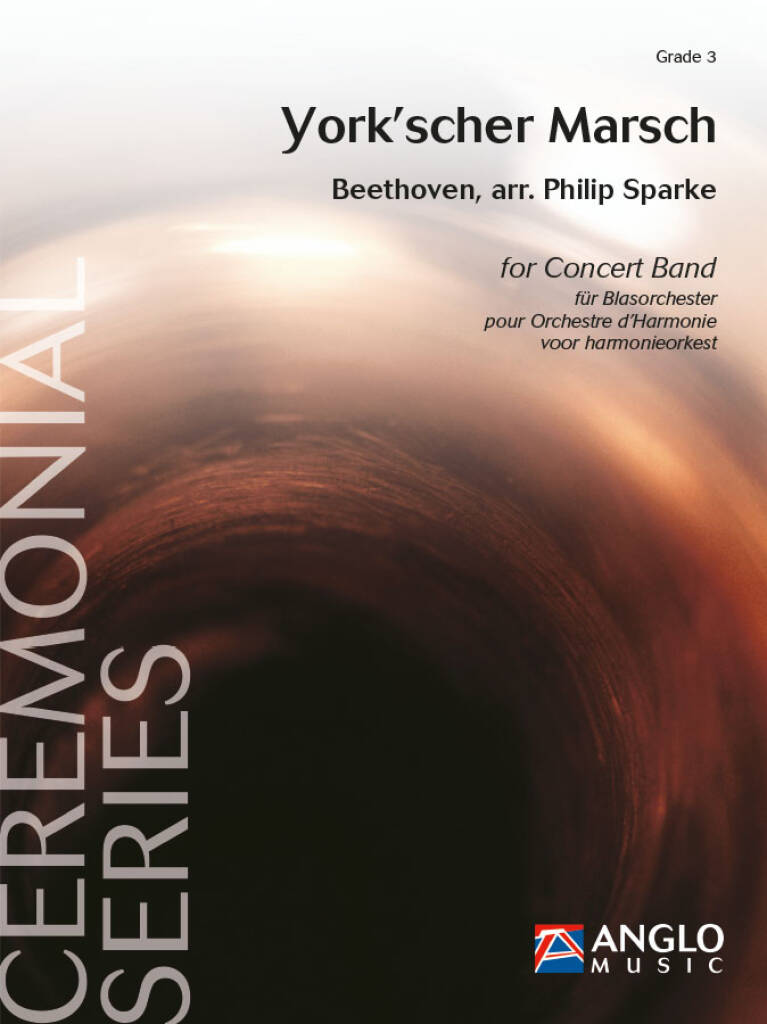 £87.99
York'scher Marsch - Ludwig van Beethoven
Beethoven's York'scher Marsch is one of a collection of three tattoos (WoO 18-20) and has had a chequered history, to say the least. There are several autograph copies for different instrumentations, dedicated to different archdukes who were commanders of various regiments of the army including the Prussian regiment called Marsch des Yorkschen Corps, which is how its current title arose. Philip Sparke's arrangement enables a march by this major classical composer to be enjoyed by concert bands.
Estimated dispatch 7-14 working days
 View Music