
Results
-
 £84.60
SABRE DANCE (Intermediate Concert Band) - Khachaturian, Aram - Woodfield, Ray
Grade: medium/difficult.
Estimated dispatch 7-14 working days
-
 £69.95
SYMPHONIC DANCE NO: IV (Music for Concert Band) - Grieg, Edvard - Martinsen, Kjell
American Grade 4.5. Duration: 11:55
Estimated dispatch 7-14 working days
-
 £39.95
The Floral Dance (Military Band Set) - Moss, Katie - Broadbent, Derek
Single Page Conductor part
Estimated dispatch 7-14 working days
-
£94.30
ZORBA'S DANCE (Intermediate Concert Band) - Theodorakis, Mikis - Woodfield, Ray
From Zorba the Greek. Grade: Medium.
Estimated dispatch 7-14 working days
-
 £36.95
Chorale and Dance (Concert Band - Score and Parts) - Feldstein & O'Reilly
Duration: 2.30
Estimated dispatch 7-14 working days
-
 £67.99
Dances Fantastique - David Shaffer
This exciting work for concert band is a set of three delightful dances. Opening with a bold fanfare statement, the first dance reveals the melodic material that is the basis for all three movements. The title of this movement, Double Dance, is derived from the second statement of the melody, appearing in doubled rhythmic values. The second movement, Round Dance, the melody is written as a three part round. You could not have a Round Dance without a Square Dance, which is the title of final movement. Lots of fun percussion instruments add interesting timbres throughout. This interesting and clever composition is perfect for contest and festival.
Estimated dispatch 7-14 working days
-
 £119.99
The African Connection - Carl Wittrock
Carl Wittrock's wide interest in global folk-music resulted in this concert-piece based on original African rhythms. Obviously, the percussion section has a conspicious role to play, but the band too may indulge itself in moments of thoroughly delightful excitement. The introduction depicts the awakening of nature, and develops into a dance. The (main) motif of this dance is from a dance entitled Apollo and comes from Gambia. Its accompaniment consists of an ostinato pattern by balaphon-master Maudo Susa. The quiet middle movement is based on the rhythm of the 'gigbo' : a traditional dance from Ghana. In the final movement -which also bears a slight resemblanceto a theme from 'The Lion King'- the so-called 'Kono' rhythm is used. The work is played most advantageously using djembes. Challenge and please your percussion section with 'The African Connection'. Carl Wittrock's brede interesse voor de wereldmuziek resulteerde in dit op originele Afrikaanse ritmes gebaseerde concertwerk. Het slagwerk speelt uiteraard een opvallende rol, maar ook het orkest kan zich op een heerlijke manier uitleven. De inleiding schildert het ontwaken van de natuur, welke overgaat in een dans. Het motief van deze dans (Apollo) is afkomstig uit Gambia. De begeleiding bestaat uit een ostinaatpatroon van de balafon-meester Maudo Susa. De basis van het rustige middendeel is gelegen in het ritme van de Gigbo, een traditionele dans uit Ghana. Het laatste deel (met enige gelijkenis met The Lion King) maakt gebruik van het zogenaamde Kono ritme. Het werk komt het best tot zijn recht als er gebruik wordt gemaakt van djembes.Daag uw percussie sectie uit en doe ze een groot plezier met: The African Connection!
Estimated dispatch 7-14 working days
-
£184.99
Rubicon - Bert Appermont
The Rubicon is a river in Northern Italy which Julius Caesar crossed with his army in 49 BC in defiance of the leaders of Rome, who feared his power. A civil war against rival Pompey ensued, which culminated in Caesar seizing power as the absoluteruler of Rome. The phrase "crossing the Rubicon" therefore refers to any person committing himself irrevocably to a risky, decisive and irrevocable of course of action.The work consists of three parts that deal with this important moment in history.Part 1 (Meditation) symbolises Caesars request to the Gods to assist him in his difficult choice. In a slow introduction we hear the melancholy and beseeching sounds of the duduk (alternatively, this part can be played by a soprano saxophone)and of the soprano solo singer over the bourdon accompaniment. The soprano solo singer then sings "dona tibi pacem" (give him rest) in a melodious and probing theme.In Part 2 (Battle of Pharsalus) trumpets and trombones resound alternately ina stately Roman fanfare, producing a stereophonic effect. This develops into a martial theme in which Caesars impressive army goes to battle against the army of rival Pompey. While the theme of Caesars army fades away, Pompeys theme emerges as anaive dance in six-eight time. His army is definitely in the majority and it believes it can easily defeat the enemy. Suddenly trumpets and trombones clash on two sides of the orchestra: Caesars army advances and attacks. A fierce battle ensues inwhich the two themes are played alternately as well as simultaneously. Thanks to his shrewd battle tactics, Caesar manages to win this legendary battle after all: his theme resounds ever louder in trumpets and horns until everything dies out andchanges into a kind of reconciliation between the soldiers of the two armies. The melancholy "dona tibi pacem" from part 1 now serves as a reconciliation theme.Caesar is now the sole ruler of the New Roman Empire, which would be destined to leave itsmark on our Western civilisation to this day. The third part is a sparkling succession of dance music (Dance) with many Greek and Roman elements in which Caesars victory is praised and celebrated. It is common knowledge that the culture(arts, gods, etc.) of the Romans drew heavily on Greek culture. I have therefore used an authentic Greek theme (the Seikolos song) several times in this part (bar 17 in the euphonium, bar 60 in the base section, bar 68 in the sopranosaxophone) to suggest the music of that era and to evoke the right atmosphere. After a gradual increase in tempo in the entire orchestra, the opening melody gloriously resounds once more, surrounded by virtuoso dance music. The work ends withbombastic brass fanfares in which Caesars theme triumphs once more.NOTE FOR THE CONDUCTOR:The Armenian duduk and the monochord that are used in the introduction give a special tone to the music, but could be substituted (soprano saxophone instead ofthe duduk) or left out (monochord). The soprano solo is also doubled within the orchestra and could therefore also be left out if necessary, although it does provide the work with an extra dimension. The male voices in the introduction and the finalecould possibly be replaced with a synthesizer with choral setting.As a visual and acoustic element in part 2, the trumpets, the e-flat cornet, the small drum and trombones can be stood up and placed at two sides of the orchestra (bar 80).Seen fromthe point of view of the conductor, put the trumpets, the e-flat cornet and the small drum in the left section and the trombones in the right section of the orchestra. This also helps to create a visual contrast between the two themes of the secondpart. The players can be seated again at bar 97 or bar 121. The soprano soloist can be placed in or in front of the orchestra, depending on what gives the best result. For the conclusion of the work the soprano solo can be sung from afar (from thewings) to create additional atmosphere.This work was composed especially for the "St Joseph" brass band from Pey/Echt (Belgium) with conductor Mark Prils.
Estimated dispatch 7-14 working days
-
 £131.30
Hymns And Dances II - J. Slothouwer
In 1990 Jochem Slothouwer composed Hymns and Cances II. This work for symphonic band and harp (ad libitum) is based on Hymns and Dances I for piano, mixed choir and percussion. The compostition is based on the contrast between hymnlike melodies and dance music episodes. The work, in five connected parts, seems to look for a reconciliation of both melodic and rythmical elements. The initial theme with the horns and the answer of the band form the base of the first part.The second part, charcterized by a vitorous dance rhythm, is dominated by the percussionn and syncopated motifs with the brass. A melody with the euphoniums almost imperceptibly slips into the ensemble and gradually gets to the foreground. The dance and the hymn reach a real climax interrupted by a short and dark intermezzo (part three). The clear sonority of part four, a fiery tarantella with many small byt virtuoso solos, is a new contras. The final adagio reuses the previously developed ideas of part one and ends in sheer ecstasy.
Estimated dispatch 7-14 working days
-
 £85.00
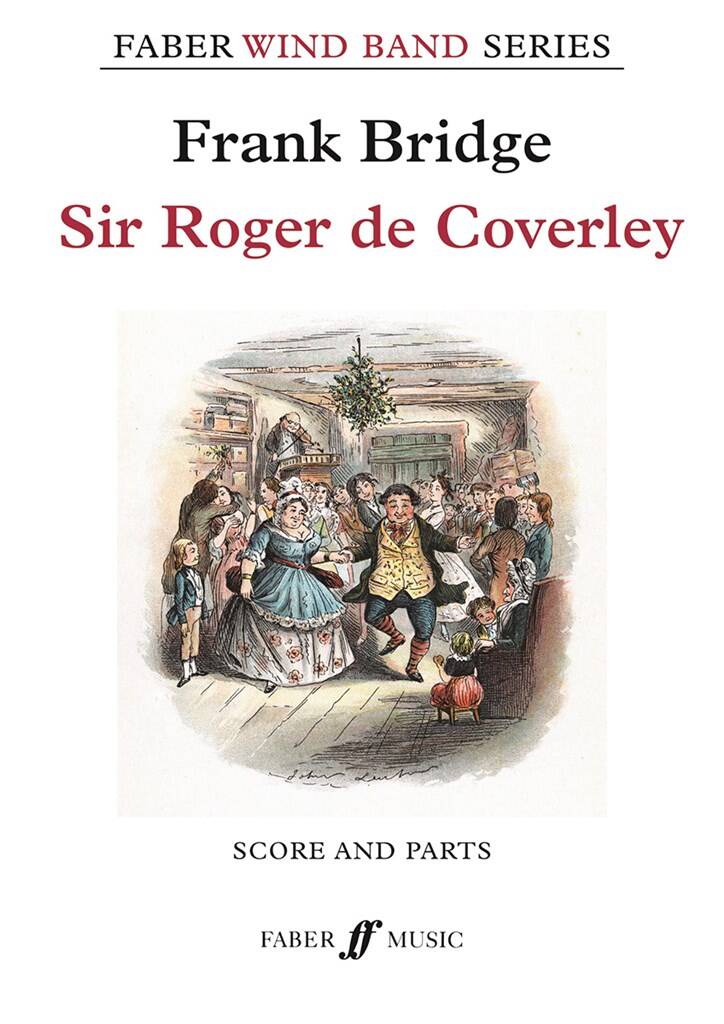
Sir Roger de Coverley - Frank Bridge
Frank Bridge (1879 - 1941) was one of the leading English composers of his time. In October 1922 he adapted his popular string quartet Sir Roger de Coverley for full symphony orchestra and Sir Henry Wood agreed, at the last minute, to include it in the last night of the Queen's Hall Promenade Concerts at the end of that month.This elaborate and colourful orchestral version has never been widely performed, but has now been brilliantly transcribed by Alastair Wheeler to provide a miniature dance poem for grade 5 level concert band.Bridge's lively treatment of one of England's most famous traditional dance melodies willmake a fitting end to any concert, with the strains of Auld Lang Syne introduced by Bridge as a nod towards Sir Roger de Coverley's traditional function as the final dance of a Christmas Ball, as it was in Old Mr. Fezziwig's party in Dickens' A Christmas Carol.
Estimated dispatch 7-14 working days
 View Music