
Results
-
 £435.40
Goldberg 2012 - Svein H. Giske
The first time I heard Bach's Goldberg Variations was in the movie Silence of the lambs, in the early 1990s. I noticed the beautiful background music in one of the scenes, but at that time I didn't know what it was. A few years later, when I was studiying at the Grieg Academy, I got to know the entire piece. For me, this is a piece of music which I can listen to countless times. I think it sounds as fresh today as it did more than 15 years ago and it never ceases to inspire me. Both Bach's composition and Glenn Gould's famous 1955 recording (which was the first one I heard) still makes a great impression on me. Before Gould recorded it at age 22, it wasn't a highly ranked piece amongst pianists and Bach was by many viewed as a bit old-fashioned. The young Canadian turned all this around. He managed to portray Bach in a reformed way, producing fine nuances in phrasing and making the many layers in Bach's music more transparent than anyone before him. Thus he plunged both himself and Bach (back) onto the international music scene. When The Norwegian Band Federation (NMF) asked me to write the test piece for NM in 2012, it was only natural for me to use the Goldberg Variations as a starting point and inspiration for my work. Since I was a teenager at NMF's summer courses in the mid eighties I've always listened to many different styles of music. Growing up in Sunnmre with the Brazz Brothers as teachers and mentors, jazz-, pop/rock- and folk music were early on a natural part of my musical background. I also have my classical education from the Grieg Academy on trumpet. As the title of my piece implies, I've wanted to bring Bach to the present and put his music into various modern musical landscapes. I think you can bring about a special kind of energy when music from different genres are mixed and I've tried to do this by mixing Bach with artists and musical styles from the present. In Goldberg 2012, the music is often constructed by several layers, which in a way are living parallel musical lives. They are seemingly moving or floating freely, almost unaware of each other, but bound together by the same basic pulse. The rythms, however, are often notated on a different rythmic subdivision level than the usual 8th- or 16th note levels. By doing this, I hope to achieve transparent sounds that rythmically are perceived as more free and detached from each other. In large sections of the piece, pop/jazz is fusioned with elements from Bach. I guess you could have this little scene as a synopsis for the piece: picture a group of musicians meeting: some are classical performers, some are jazz. They start to improvise together, each in their own voice or musical dialect and I'm sort of in the middle, trying to write down what they are playing. This is what I feel much of Goldberg 2012 is about. The foundation of the piece, in addition to Bach and references from pop/jazz music, lies also in my own material. This material, basically two chords, is heard in it's purest form in the 1st movement. I use these chords to create scales, new chords and different motifs which contribute to blend together the different moods of the piece. It has not been my intention to copy Bach's form (theme and 30 variations), but rather to use the bits and pieces that I like the most as an inspiration for my own variations. The 1st movement, Aria 2, is for my 3rd son, Olav, who was born on the 21st of April 2011, and the 5th movement, From long ago, is dedicated to the memory of my father, Svein J. Giske, who passed away on the 6th of June 2011. -Svein H. Giske, January 2012-
Estimated dispatch 7-14 working days
-
 £214.80
Skies - Oliver Waespi
Program notes by Oliver Waespi on his composition Skies:Skies is the plural of Sky. We may wonder are there several skies? Is the sky we all long for not the same for everybody? While travelling on foot and "in the open air" I have observed the firmament often in quite different shapes, so that I can say I have indeed experienced the sky in different ways. Years ago I already wanted to portray "my sky" in music; I finally have been able to realise this long-cherished dream.This composition deals with the sky, more precisely with my sensual and emotional experience of the sky in all its aspects. Two point of views are combined in this composition: one showing the sky as it presents itself to me, the other showing the sky as I observe it. The music was bom simultaneously by intemal and extemal inspiration: it describes nature but also the emotional and spiritual experience of nature. To me, the experience of nature is not abstract, but it is connected with concrete ages, places or people from my neighbourhood. This is why I have combined several parts of this composition with certain landscapes.The sky presents itself in different landscapes in the most varied ways: for the sensual experience, there is no sky as such. The indications of places spread all over the score, are primarily clues for myself; they represent certain atmospheres, which I have experienced especially in England and Scotland. They can however also be useful to the musicians and the audience, providing they know those landscapes and the celestial atmospheres linked to them.The music is independent from the atmospheres described in the subtitles, as those are rather connected to a tragic nature, and so the music is not based on any program. Musically spoken, the composition has a symphonic structure, which means that the complete musical material is derived from three contrasting main themes. In the first part, the description of a noctumal sky ("Night") two themes are developed in an organic way; the first, rather "dusky", is to be found with the horns, the second, "in bright daylight", with the oboe and flute, the third, "more quiet" , with the brass instruments. In the next part, we have clouds and rain over the Isle of Skye (one of the Hebrides islands in Scotland) and here several elements of the first theme are still more developed. Then we get an increasingly dark mood, which is released, in heavy chords. Then suddenly, the sun breaks through and the music gets a majestic character. We have a new shape of the initial theme, first with the French horns and then with the trombones. The music gets a quicker tempo and flows into a quick movement describing the winds and waves at sea ("Wind and Waves"). Three themes are gathering and some variations are developed. The music gets more and more energetic and, after a climax, calms down again. Then we have a kind of "summer pastoral" which suggests summer at the South coast of Cornwall ("South Coast of Penwith Peninsuia in Summer"). This is certainly not the hotte st summer in Europe, but still it is beautiful in this country that is blessed with so much rain. In the "pastoral" , the sea is already sketched in broad outlines in the French horn solo. The magnificence of an aftemoon at the seaside is developed at the end of the composition ("Noon at Treen Cliff', a rock protruding in the sea next to Porthcumo at the South Coast of Cornwall); here the music gets stronger and stronger and after a majestic climax it vanishes completely.
Estimated dispatch 7-14 working days
-
 £108.40
Three Brass Cats - Chris Hazell
This is what Chris Hazell, the composer, had to say about 'Three Brass Cats': 'Some years ago I had four cats in the house - all were strays and decided that I was a soft touch when it came to free board and lodgings, so instead of moving on, they all decided to stay. Sadly they have all now gone to the great cattery in the sky. However, at the time they were around I was asked to write some pieces for a brass group (The Philip Jones Brass Ensemble). What should I write about? Well, I've always liked writing about the people and places around me (they appear in a lot of my music) so I thought.. I know, my cats. These days I don't have any cats as I travel around a lot with my work, but it's nice to think that they're still with me in the music.'
Estimated dispatch 7-14 working days
-
 £84.99
Matreshka - Johan Nijs
For more than a hundred years, the matreshka dolls have been a traditional trademark of Russia. The story behind these dolls is that many years ago, a little Russian girl, Olga, got lost in a forest. When her older sister finally found her, she said, ?Let me hold you.? Next, their mother also arrived, and said, ?Let me hold you both.? Subsequently, the grandmother joined them, and said, ?Let me hold you all.? As a result of this story, these popular ?nesting dolls? came into being. The work Matreshka consists of originally-composed themes. The first theme, reminiscent of a Russian hymn, is followed by another theme in a typically Russian style. A slow passage forms thetransition to the final, energetic movement ? this Russian troika in two-four time starts slowly and ends very exuberantly. A great piece of Russian exuberance that will delight any audience.
Estimated dispatch 7-14 working days
-
£159.99
Fantasia Per La Vita E La Morte - Bert Appermont
The mystique surrounding life and death formed the starting point of this composition. I wanted to write a work without a story, mixed up in a kind of musical quest for a new world of sound, original rhythm sequences, melodies filled with suspenseand distinct orchestral tones.The indirect cause was the birth of my first child which took place during this time, followed by the death of a close family member. At such a moment you experience just how close life and death are to each other, anddespite one being the antithesis of the other, they are incredibly similar. Both radical events are passages into new worlds and have great emotional impact. Moreover, the work was commissioned by "New Life", an orchestra that lost one of itsmusician in a plane crash, which also led me to believe that this approach would be appropriate.I would prefer not to comment on which passages in the composition concern life (birth) and which refer to death. It seems to me that it is moreinteresting to question traditional conceptions and leave it open for the listener. If you think that a passage is about birth, and this idea then shifts, it is this that raises fascinating questions, on both a musical and metaphysical level.Music isin an indirect but incredibly persuasive way in which to express the endless striving and seeking of mankind. Music can even touch eternity, as it were, and give us the feeling that we can transcend death. This endless search (and also longing) canbe heard throughout the work; as much in the sound fields and accent shifts in the first part as in the enormous tension curves and compelling themes of the second part. The semi-tone functions in this way as a guide or something to hold on to,running through the whole work and upon which much of the musical material is based. Traces of profound love resound with quiet simplicity in the slow section's melodious solos, after which the work contemplates life and death one last time, musesupon joy and sadness, on the possibilities and limitations of people and on the why of all things.I would like to dedicate this work to my dearest daughter Paulientje, to Meterke and to Johan de Jong of the "New Life" orchestra. May it fare themwell, here or in another dimension...
Estimated dispatch 7-14 working days
-
£202.99
Spirited Away - Joe Hisaishi
This is an arrangement of Ghibli's Anime film, "Spirited Away". It consists of six themes including No-Face, One Summer Day, The Bottomless Pit, Yubaba's Panic, Always with Me, and Reprise. I also added an alternate introduction using The Dragon Boy. The No-Face opener is somewhat avant-garde with technical difficulties so select the opening that is best suited to your ensemble. The arrangement concept was created by Mr. Tomoki Ubata of Ina Gakuen Sr. High School. His wonderfully crafted ideas always impress me. Especially, in the arrangement, mallet percussion and piano are effectively used to sound like a music box and the lyrical melody of Reprise is superimposed. This scene is the best part of the entire arrangement and is very emotional. All these fine melodies from the film transport both audience and performers to the fantastic world of anime. (Kazuhiro Morita)
Estimated dispatch 7-14 working days
-
 £90.30
Giubilare Flautissimo - Harald Suilen
It was for the 80 anniversary as musician of Mr. Denessen that the wind band Harmonie St. Cecilia' at Tegelen, The Netherlands asked me to write this march. As his slogan is 'Playing music keeps me fit' the 94 year old Wiel Denessen still plays the flute in the band and is an example for many a musician. This march is a homage to a special music amateur, an exemplary band member, but above all a man of great qualities.The march 'Giubilare Flautissimo' was premiered at the anniversary concert on 17 November 1996.Harald Suilen
Estimated dispatch 7-14 working days
-
 £52.70
Irish Air
The complete title of this Irish tune is : 'Believe me if all those endearing young charms'. The character of this song is rather nostalgic, but yet it is popular all over the world as it has been sung and performed by all kinds of ensembles and singers. This piece can be used at several occasions and the well-known tune will be a huge success.
Estimated dispatch 7-14 working days
-
 £155.90
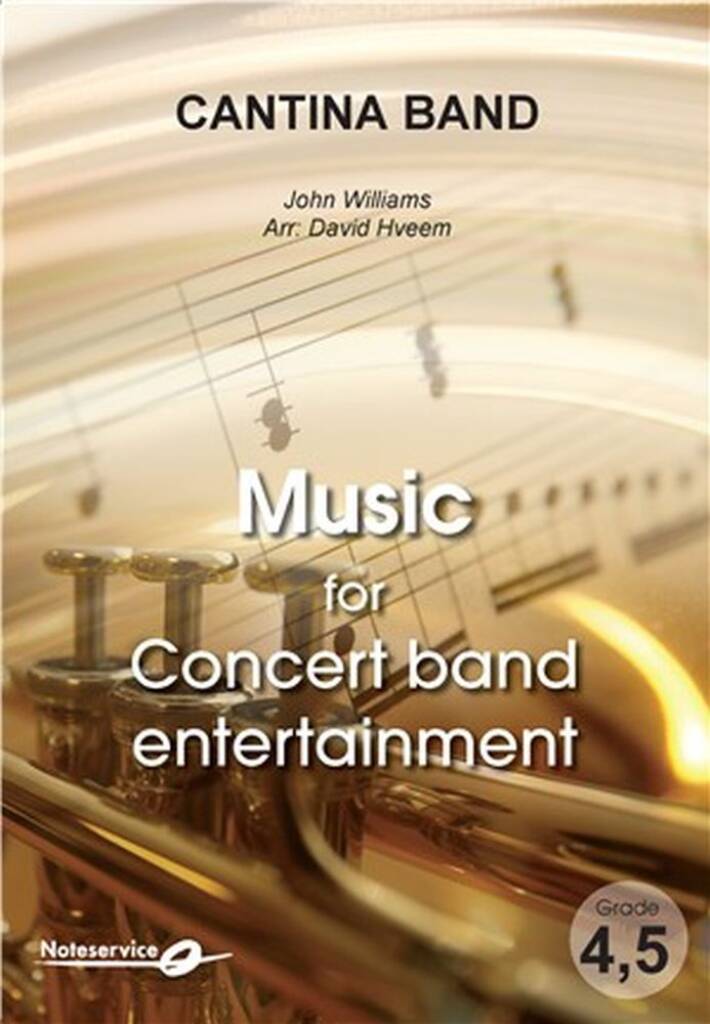
Cantina Band - John Williams
Cantina Band (or Mad About Me) was written by John Williams in 1977 for the film Star Wars (later Star Wars IV: A New Hope). Even with quite a bit of the Star Wars music being quite well known, Cantina Band is literally in a style of its own. In the Star Wars-universe this style is called jizz, Williams' take on the more well-known genre jazz. Williams was tasked by Star Wars-creator George Lucas to make music that sounded like several creatures in a future century finding some 1930's Benny Goodman swing band music ... and how they might attempt to interpret it and ended up with Cantina Band #1 and #2. Both numbers are played in the legendary scene taking place in Chalmun's Spaceport Cantina where Luke Skywalker and Obi-Wan Kenobi gets in a fight causing even the band to stop playing.The band, which goes by the name Figrin D'an and the Modal Nodes, comes from the planet Clak'dor VII and specializes in jizz and the nearby, slightly older style of jatz. Performers of this music often go by the name "jizz-wailers", and the Bith people from Clak'dor VII are especially well suited for jizz-wailing since they can hold every note as long as they want thanks to a unique respiratory system - something many perhaps would like to be able to do in the performance of this arrangement as well.The arrangement is relatively faithful to Williams' original version, but with a somewhat different ending. Although the woodwind section undoubtedly has the biggest technical challenges, an understanding of the musical style is the very key to making the arrangement sound good - and here all groups must work together. Playing lightly but quite articulated, and very precise, will be an absolute necessity to get the music drifting off all the way to Tatooine.In measure 113 there is a small improvised solo in either trombone or trumpet, but if you want the real authentic Cantina Band-sound this is of course done on a steel drum.
Estimated dispatch 7-14 working days
-
 £134.99
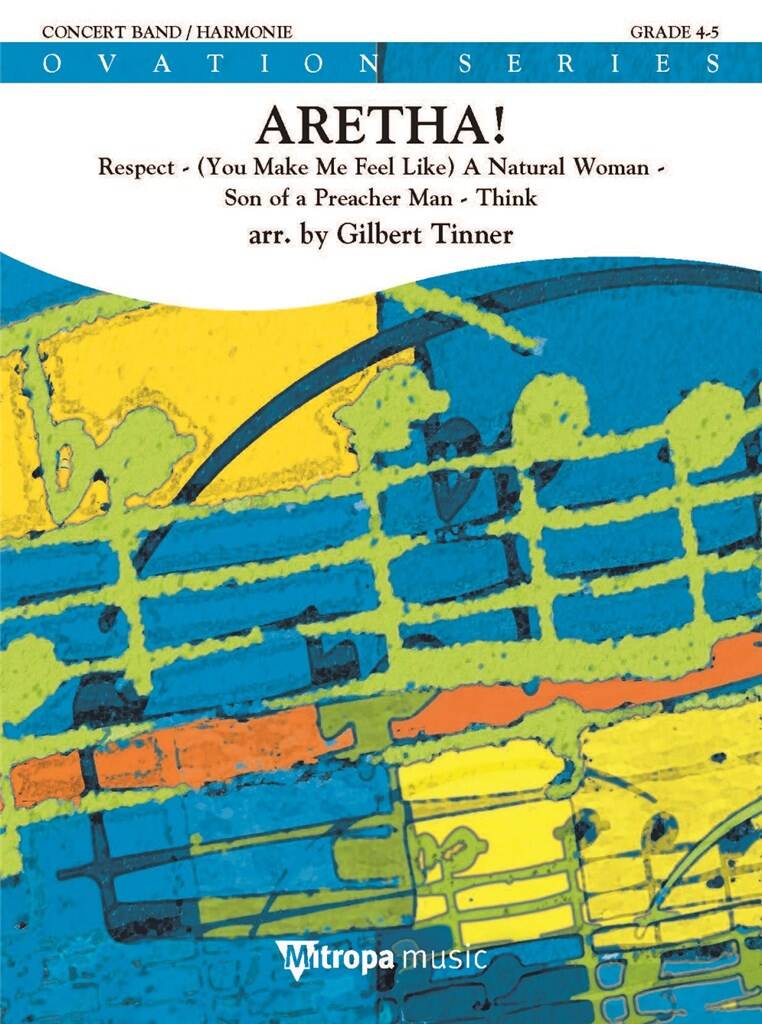
Aretha!
Aretha Franklin - the 'Queen of Soul' - was an icon and inspiration for women all around the world, and the first female artist to enter the 'Rock and Roll Hall of Fame' in 1987. This medley by Gilbert Tinner contains Aretha Franklin's most famous hits: 'Respect', '(You Make Me Feel Like) A Natural Woman', 'Son of a Preacher Man' and of course 'Think', one of the greatest up-tempo tracks of all time.
Estimated dispatch 7-14 working days
 View Music