
Results
-
 £137.99
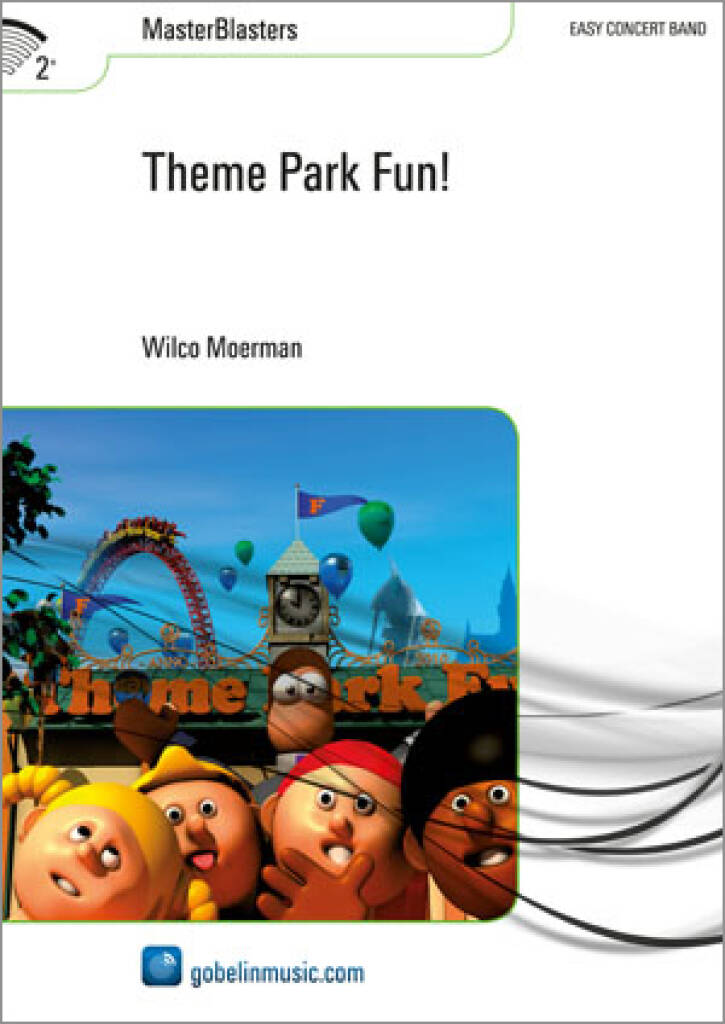
Theme Park Fun! - Wilco Moerman
In Theme Park Fun! your orchestra pays a visit to an amusement park. During your visit, you will experience some spectacular rides and attractions this theme park offers. The uniqueness of Theme Park Fun! is the interplay between music and(moving) images. Animations and illustrations support the visual composition.Part 1: The Entrance & Parade [with animation]The opening of the park is a fact. A day full of fun and pleasure awaits! You and the other visitors willbe confronted with all the rides, attractions and adventures the theme park has to offer. Which ride shall we do first?! There is so much to do and experience on this day in the park! A parade of colorful floats and park figures is passing by.Letthe fun begin!Part 2: The Haunted House [with animation]The only ride in the park that is not related to fun, is the Haunted House. Here visitors will be challenged to visit a house full of ghosts, creepy figures and otherominous things. The clock strikes twelve, there is no turning back. Ghosts are whispering, yelling, screaming... Fortunately it is almost one oclock, so we can leave this creepy place quickly.Part 3: The Swinging Galleon [withillustrations]What a huge pirate ship! Each time you swing back and forth, you will feel that weird feeling in your stomach. When you are thrown completely into the top you will have a fantastic view over the park, but you can not enjoy itfor long. Before you know the ship swings back the other way.Part 4: The Fairy Tale Ride [with illustrations]After all those exciting and spectacular rides and attractions, it is time for a peaceful tour in The Fairy Tale Ride.Surrounded by a fairytale setting, you will discover fable figures, talking animals and colorful designs. Such a beauty and tranquility. Having had this experience, we are ready again for the big rides in the park!Part 5: The Bumper Cars[with illustrations]Now its time to crawl behind the wheel of the Bumper Cars! Shall we all chase the conductor?! Before you know you are hit by another visitor or you will bump against someone else. In this tough ride you can prove yourselfas a real driver, or perhaps as a really bad one.Part 6: The Roller Coaster [with illustrations]The largest, fastest and scariest ride in the park ... we should definitely do the Roller Coaster! All together in the train, theover-the-shoulder restraints are lowering... be ready to ride. The train leaves the station and is heading for the big lift hill. It will be very scary when the train reaches the top and the train will be plunged down the first drop! Loops,corkscrews and other spectacular coaster elements will follow... Before you know it, the ride of your life is over. Shall we ride it again?!Part 7: Leaving the Park [with animation]Unfortunately everything comes to an end. Thisday in the theme park is over, but we have a lot new experiences to talk about! The memories of all the funny and spectacular rides will come up when we walk through the park to the exit. Just one look over the shoulder, the amusement park figuresare waving at us. Hopefully we will come back again soon!
Estimated dispatch 7-14 working days
-
 £140.80
Belvedere Suite - Wilhelm Koenen
Part One: 'Danse mditerranenne'This part is composed of stylized folkmusic elements from several regions of Mediterra-nean countries. If this music recalls memories of your holidays on the sunny beaches, the composer will have reached his goal.Part Two: 'Impression'This part is meant as a contrast with the first and the third parts. The conductor should not stick to the metronome tempo, but he can express his own interpretation by means of 'rubato playing'. This 'impression' was inspired by the Provence landscape.Part Three: 'Marche grotesque'We deliberately used non-typical characteristics of the traditional march. The underlying idea is: A band starts playing a march at the ordinary marching tempo. There is already a mistake at measure 4 when some musicians play the wrong bar which causes the fifers to start too early with the drum and fife signals. A grumpy 'Stop' brings and end to the false start by means of a pathetic quaver (eighth note). The drummers however continue to play their drum beats, so the fifers start again and play very quickly in order to catch up with the drummers. They even manage to do so, thanks to that late quaver (eighth note). The band now also starts to play again and reacts to this chaos by laughter. The march that comes next does not match the metric characteristics of the usual march. The woodwinds, dreaming of holidays, get caught in a Tarantella. A compelling signal by the trumpets and the horns, soon joined by all band registers, leads the band back to reality. We deliberately chose well-known 'secondary parts' in order to make the audience accept the 'out-of-tune playing'. Original themes would not have had the same effect. The whole composition is just one great musical joke. If the audiance chuckles the composer will have achieved his aim. The third part is extremely well suited to end a concert or to be used as encore.
Estimated dispatch 7-14 working days
-
 £149.99
Jericho - Bert Appermont
Jericho is the musical translation of the well-known story from the book of Joshua about the capture of the city of Jericho by the Israelites.Part 1 depicts the cruel journey through the desert to Canaan, the promised land. An emotional lamentation for the yearning for a home, for the end of a roaming existence.The capture of Jericho is the theme of part 2. The city cannot be captured immediately and Jehovah orders an impressive army to march around the city for six days. On the seventh day, they marched around the city seven times and the priests blew their trumpets and the people cried so loud that the walls of Jericho came tumbling down. The Jews stormed the city and drove theinhabitants away. The music clearly reveals the marching army and you can hear the walls falling down with a tremendous noise. However, there is quite some artistic freedom in the actual story.A majestic and grand melody subsequently evokes the triumphant emotions that emerged as the fortified city fell (part 3).Following a personal and romantic interpretation, the scene ultimately ends in a typical Jewish feast (part 4) whereby the virtuosity of melodies played by the woodwinds and the passionate rhythms refer to traditional Jewish music. All themes are repeated in this last part in various forms, often simultaneous and in duelling counterpoint. The piece ends with fragments from the main theme of part 1 in major: peace and quiet return at last.
Estimated dispatch 7-14 working days
-
 £186.20
Une Vida Un Dia - Pablo C. Escande
The title a life, a day or life as one day is the basis of the musical contents of this composition. It consists of five parts and is written in a neo baroque style, combining a number of baroque music elements, such as imitative counterpoint, abundant ornamentation and tutti solo effects, with more contemporary elements such as composed rhythms, modal harmonics and dodecaphony.Part 1: Alba - Dawn. Just before the sun rises, the world is full of tensed expectation of a new beginning. At daybreak a new life is received with cries of jubilation.Part 2: La Maana - Morning. The early life has begun. Hardly conscious of its environment, the child is resting in its mother's loving embrace.Part 3: Mediodia - Midday. Now is the time! Time to work, to love and to dance in the midday sun, but also to start the fight, before strength is flowing away. Let's not waste time!Part 4: Tarde - Twilight. The day is not over yet, but time passes by. Dusk is falling, the end approaches inevitably...Part 5: La Noche - Night. The comforting dark relieves the strong anxiety of the soul. Finally the soul is released of all worldly bonds.
Estimated dispatch 7-14 working days
-
 £149.99
Moretus - Bart Picqueur
Jan Moretus (1543-1610) was a book printer and publisher in his native city of Antwerp. He worked as assistant to his father-in-law, the renowned master printer and publisher Christoffel Plantijn. After Plantijn's death in 1589 Moretus took over the business.The composition Moretus consists of four parts that draw on the remarkable personality of Jan Moretus aswell as the printing business. In both the titles of the movements and the thematic structure we can see a certain symmetry: a playful allusion to the process of printing.Part 1, A Celebrated Gentleman, describes the illustrious figure of Moretus in a festive chorale. In the second part, ExpressiveImpressions, the printing press itself is brought to life in repeated motifs - despite the industrial, mechanical nature of the process, the product always has an artistic and cultural dimension. In the third part, Impressive Expression, the wind band is invited (or challenged), to intone the slow theme with a poignant expressiveness. Part 4, A Gentle Celebration, is a celebratory finale with a fresh theme.
Estimated dispatch 7-14 working days
-
 £110.40
Urban Beat - Tohru Kanayama
Urban Beat was commissioned by Tokyo Wind Harmony Orchestra. This work contains two parts.The first part is a fast tempo reminiscent of the urban highway, includes trumpet and alto saxophone solos (written but it's good for improvisation). The second part is a pop ballad that start with tenor saxophone's solo, and it gets excited gradually. After this, the first part appears again and head to the end. The introduction of this work is written in 5/4.
Estimated dispatch 7-14 working days
-
 £140.80
Mannin Veen - H. Wood
This piece is based on 4 songs from the island Man. The first, The Good Old Way, is an old and typical Air, mostly written in Dorian mode. The biggest part of the song is probably added aroun 1882, after the introduction of the primitive Methodism on the island.The second song, on which the faster part of the piece is composed, is a real Folk tune: The Manx Fiddler. Chaloner, a seventeenth century writer, found out that the island of Man's population felt very much attracted to the violin and that in almost every family someone played the instrument.The third song, Sweet Water in the Common, is about dike boards and the last part is a beautiful old hymn, The Harvest of the Sea, sung by fishermen after their safe return.
Estimated dispatch 7-14 working days
-
 £53.50
Evergreen Overture - Hayato Hirose
Composed in 2017 by recommendation from Brain Music (Bravo Music)."Evergreen" means "perennially fresh" or "never fading". It depicts what I believe we all felt when we first truly enjoyed playing our instruments.This "Dual Grade" piece allows players of different experience levels to perform the same ensemble. A Part is for more advanced players and B Part is for beginning-level players.There are also optional parts to make it accessible for any size of band. The least you can have is nine voices. (Cl,Cl,A.Sax,Trp,Hr,Trb,Euph,Tub,Perc).Perc. 1 and 2 can be combined and performed on the drum set.Recommended assigned parts for percussion are as follows:1 percussionist: Perc.1/2 (Drums)2 percussionists: Timp. and Perc.1/2 (Drums)3 percussionists: Timp., Perc.1/2 (Drums), and Perc.3Over 4 percussionists: one per part
Estimated dispatch 7-14 working days
-
 £104.99
Divertimento - Roger Boutry
Divertimento is an outstanding composition by Roger Boutry for Alto Saxophone and Wind Orchestra. This great work is really nice to play and will enlighten the audience. The Orchestracomposition required is: 2 Flutes, 2 Oboes, 2 Bassoons, 2 small Clarinets, Clarinet I, Clarinet II, 1 Bass Clarinet, 2 Alto Saxophones, 2 Tenor Saxophones, 1 Baritone Saxophone, 4 Horns, 4 Bb or C Trumpets, 4 Trombone or 3Trombone and an Euphonium, 1 Bb or C Bass, 1 Double Bass, 1 Harp, Timpani, Drum and a Celesta. It is divided into three parts: I. "Allegro ma non troppo", is strongly rhythmic and syncopated.Itincludes a Cadenza by the Solo Saxophone and is written as a tribute to Jazz music. II. "Andante", also includes a Cadenza by the Solo Saxophone but at the end of the section. It is reminiscent of slowerblues ballads. III. This part features few sections by the Solo Saxophone but is specially highlighted its ending, in a bright and fast finale. This volume features the score and parts for all theinstruments. Born in France in 1932, Roger Boutry received numerous prizes, including those for Piano, Composition and Conducting. He received the Grand Prix de Rome in 1954. His career was quite successful,alternating between Harmony professor, composer and conductor. He also received numerous prizes for his incredible compositions.
Estimated dispatch 7-14 working days
-
 £39.95
Music for Junior Wind Band - Vol. 6 - Adrian Taylor
The arrangements and compositions in these books were written by Adrian Taylor for various beginner or school bands that he has conducted over the years. Children joined these bands on the 2nd parts, usually having only been playing for a year and they then progressed to the 1st parts the following year.This volume of music was orchestrated a little differently to the other volumes but the easiest parts for each instrument continue to be written without key signatures in treble clef, in B flat major for bass clef trombone and euphonium and in E flat major for bass clef tuba. More advanced parts are written with the appropriate key signatures for each piece, reflecting the greater understanding and skills of the players on these parts. Most of the pieces can be played with only a few parts being covered, the addition of the other parts usually enhancing the arrangement rather than simply doubling existing musical lines. The essential parts are the Trumpet (and Clarinet or Cornet) parts, the two Trombone/Euphonium parts and in No. 4, the 1st Horn part. A piano part helps to fill out the harmonies where other parts are missing. The brass parts in the wind band versions are identical to those in the brass versions. This volume was created so that beginner players can play Calypso and When The Saints, which feature in Just Play... Book 1, accompanied by their school band.
Estimated dispatch 7-14 working days
 View Music